Canadian Dollar Dilemma: Oil Prices Relatively Good, Interest Rate Spreads Narrowing; But No Direction
2026-02-13 21:20:12
On Friday, February 13th, the USD/CAD pair traded around 1.3620 during the North American session, near the lower end of its year-to-date trading range. While it appeared to be close to a support level, the market lacked significant buying interest. Instead, the exchange rate exhibited typical sideways movement, failing to break out of the stalemate since February. This stalemate was not due to a lack of driving factors, but rather a rare hedging pattern between bullish and bearish forces.
On the one hand, the overall weakness of the US dollar has limited the upside potential of the USD/CAD exchange rate; on the other hand, uncertainty surrounding US-Canada trade relations continues to escalate, especially with the 2026 deadline for the agreement's review approaching, keeping traders wary of the Canadian dollar. Even a rebound in oil prices has failed to effectively boost the Canadian dollar—indicating that the traditional commodity currency logic is temporarily failing. The result is that the US dollar is unable to rise, and the Canadian dollar is unable to strengthen, with the exchange rate trapped within a range, fluctuating repeatedly.
Analysts point out that this pattern is unlikely to break in the short term. In the coming months, the key variable driving exchange rate breakthroughs will not be single economic data, but rather the interplay between policy interest rate differentials and geopolitical sentiment. Currently, the US-Canada two-year government bond yield spread is again showing synchronization with exchange rate movements; a narrowing spread means a decrease in the relative attractiveness of the US dollar, which should theoretically suppress the rise of the USD/CAD exchange rate. However, at the same time, if trade frictions escalate, risk premiums could rise rapidly, putting additional pressure on the Canadian dollar. Therefore, the market is more likely to see—not a trending market, but rather volatile range-bound trading.
Although the recent daily price movement of USD/CAD has narrowed, giving the illusion of a "dormant period," underlying market volatility risks are actually accumulating. While implied volatility has fallen from its previous high, this is more like a temporary cooling of sentiment than a genuine dissipation of risk. With the July 1st review window for the trade agreement approaching, any slight disturbance could trigger a sharp reaction.
From a technical perspective, the exchange rate fell from the previous high of 1.3927, hitting a low of 1.3481 before rebounding, indicating some support below. However, it was repeatedly resisted around 1.3700, indicating heavy selling pressure above. Currently, the RSI indicator is at 44.7410, in the neutral to weak zone, lacking both extreme oversold signals and strong buying momentum; the MACD is running close to the zero line, with ambiguous trend signals, further confirming the unclear direction.
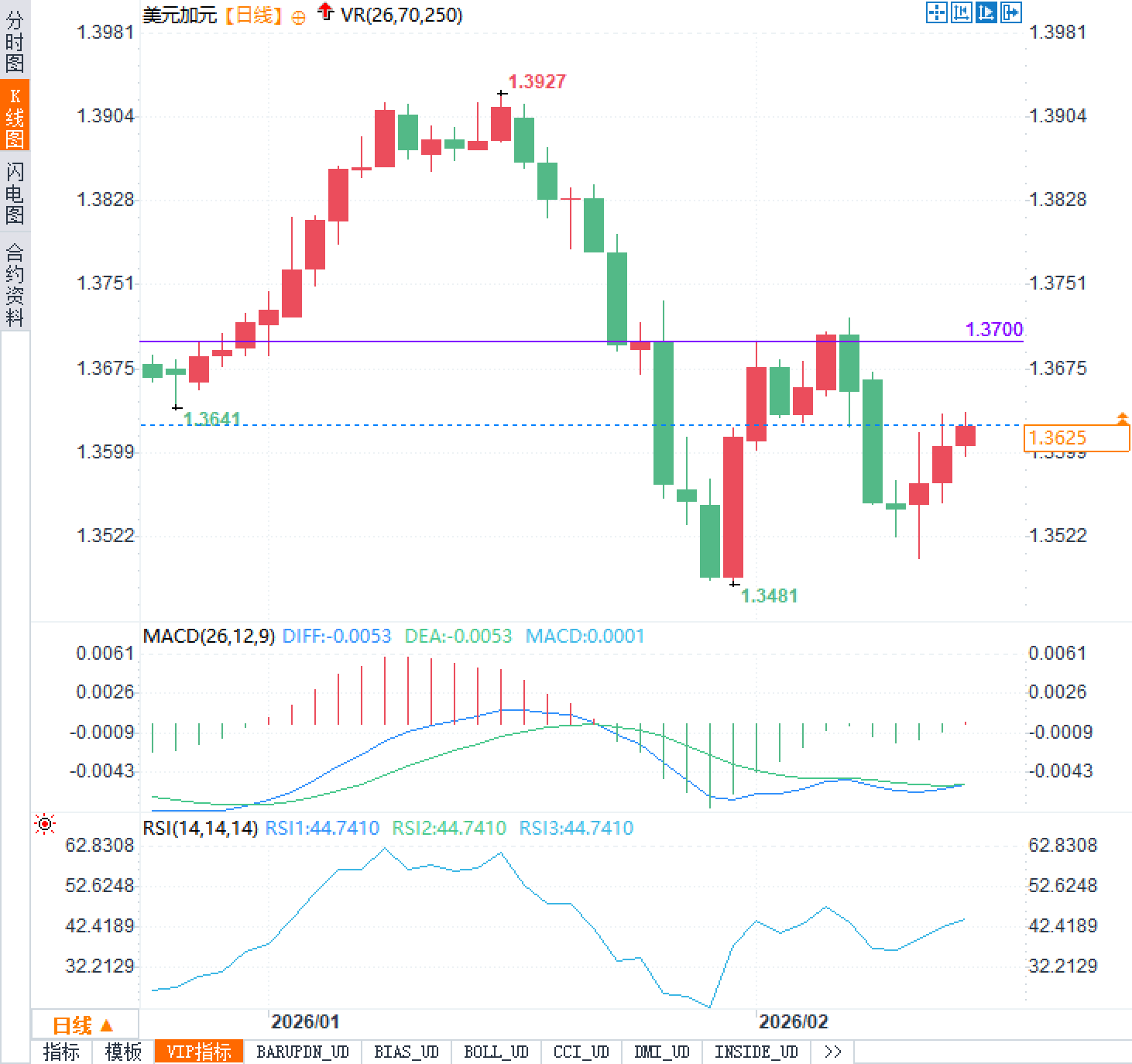
If the market breaks below the 1.3600 level in the short term and confirms its strength, it may further test the 1.35 area. Conversely, if it can hold above 1.3700 and maintain that level, it may challenge 1.40. However, these breakthroughs require strong catalysts, such as a sudden change in policy expectations from the Federal Reserve or the Bank of Canada, or a shocking trade news event. Otherwise, it's more likely to be a false breakout followed by a consolidation trap.
In the past, many people were accustomed to using the simple formula "rising oil prices = stronger Canadian dollar" to predict the USD/CAD exchange rate. However, in the current environment, this logic is no longer reliable. What truly deserves close attention is the dynamic balance between changes in interest rate differentials and risk premiums. Currently, the market generally expects the monetary policies of the US and Canada to converge, meaning the US may cut interest rates faster than Canada, thus narrowing the interest rate advantage. Theoretically, this process benefits the Canadian dollar and suppresses the strengthening of the USD/CAD exchange rate. However, as soon as trade tensions rise, the so-called "tariff premium" will again suppress the Canadian dollar's performance, offsetting the benefits of the interest rate differential.
Therefore, future trading frameworks should not be based on trend betting, but rather on range-bound thinking. A reasonable perspective is to consider 1.35 to 1.40 as the boundary of a large range, and observe the core oscillation zone between 1.37 and 1.39 within it. When trade news is stable and interest rate differentials dominate, the exchange rate is more likely to fluctuate within this core zone; however, once a major policy or diplomatic shock occurs, the range is likely to expand outward.
In conclusion, the current position of USD/CAD does not signify the start of a trend reversal or the initiation of a new round of declines, but rather appears to be a routine test of the lower end of the trading range. With mixed fundamentals, insufficient technical momentum, and a key timeframe approaching, the market is likely to experience a period of sideways movement with fluctuations. The true direction may not become clear until around July. Before then, the market is more likely to undergo a series of tests involving emotional ups and downs, news disruptions, and liquidity fluctuations.
On the one hand, the overall weakness of the US dollar has limited the upside potential of the USD/CAD exchange rate; on the other hand, uncertainty surrounding US-Canada trade relations continues to escalate, especially with the 2026 deadline for the agreement's review approaching, keeping traders wary of the Canadian dollar. Even a rebound in oil prices has failed to effectively boost the Canadian dollar—indicating that the traditional commodity currency logic is temporarily failing. The result is that the US dollar is unable to rise, and the Canadian dollar is unable to strengthen, with the exchange rate trapped within a range, fluctuating repeatedly.
Analysts point out that this pattern is unlikely to break in the short term. In the coming months, the key variable driving exchange rate breakthroughs will not be single economic data, but rather the interplay between policy interest rate differentials and geopolitical sentiment. Currently, the US-Canada two-year government bond yield spread is again showing synchronization with exchange rate movements; a narrowing spread means a decrease in the relative attractiveness of the US dollar, which should theoretically suppress the rise of the USD/CAD exchange rate. However, at the same time, if trade frictions escalate, risk premiums could rise rapidly, putting additional pressure on the Canadian dollar. Therefore, the market is more likely to see—not a trending market, but rather volatile range-bound trading.
Turbulence is brewing: Seemingly calm, but with undercurrents surging beneath.
Although the recent daily price movement of USD/CAD has narrowed, giving the illusion of a "dormant period," underlying market volatility risks are actually accumulating. While implied volatility has fallen from its previous high, this is more like a temporary cooling of sentiment than a genuine dissipation of risk. With the July 1st review window for the trade agreement approaching, any slight disturbance could trigger a sharp reaction.
From a technical perspective, the exchange rate fell from the previous high of 1.3927, hitting a low of 1.3481 before rebounding, indicating some support below. However, it was repeatedly resisted around 1.3700, indicating heavy selling pressure above. Currently, the RSI indicator is at 44.7410, in the neutral to weak zone, lacking both extreme oversold signals and strong buying momentum; the MACD is running close to the zero line, with ambiguous trend signals, further confirming the unclear direction.
If the market breaks below the 1.3600 level in the short term and confirms its strength, it may further test the 1.35 area. Conversely, if it can hold above 1.3700 and maintain that level, it may challenge 1.40. However, these breakthroughs require strong catalysts, such as a sudden change in policy expectations from the Federal Reserve or the Bank of Canada, or a shocking trade news event. Otherwise, it's more likely to be a false breakout followed by a consolidation trap.
Reshaping Trading Logic: Stop Believing in Single Factors, Focus on "Dual-Core Drivers"
In the past, many people were accustomed to using the simple formula "rising oil prices = stronger Canadian dollar" to predict the USD/CAD exchange rate. However, in the current environment, this logic is no longer reliable. What truly deserves close attention is the dynamic balance between changes in interest rate differentials and risk premiums. Currently, the market generally expects the monetary policies of the US and Canada to converge, meaning the US may cut interest rates faster than Canada, thus narrowing the interest rate advantage. Theoretically, this process benefits the Canadian dollar and suppresses the strengthening of the USD/CAD exchange rate. However, as soon as trade tensions rise, the so-called "tariff premium" will again suppress the Canadian dollar's performance, offsetting the benefits of the interest rate differential.
Therefore, future trading frameworks should not be based on trend betting, but rather on range-bound thinking. A reasonable perspective is to consider 1.35 to 1.40 as the boundary of a large range, and observe the core oscillation zone between 1.37 and 1.39 within it. When trade news is stable and interest rate differentials dominate, the exchange rate is more likely to fluctuate within this core zone; however, once a major policy or diplomatic shock occurs, the range is likely to expand outward.
In conclusion, the current position of USD/CAD does not signify the start of a trend reversal or the initiation of a new round of declines, but rather appears to be a routine test of the lower end of the trading range. With mixed fundamentals, insufficient technical momentum, and a key timeframe approaching, the market is likely to experience a period of sideways movement with fluctuations. The true direction may not become clear until around July. Before then, the market is more likely to undergo a series of tests involving emotional ups and downs, news disruptions, and liquidity fluctuations.
- Risk Warning and Disclaimer
- The market involves risk, and trading may not be suitable for all investors. This article is for reference only and does not constitute personal investment advice, nor does it take into account certain users’ specific investment objectives, financial situation, or other needs. Any investment decisions made based on this information are at your own risk.