Investors weighed OPEC+ supply against US inflation data, keeping international oil prices stable.
2026-02-14 02:20:43
On Friday (February 13), during the European trading session, the international crude oil market initially declined before rebounding, ultimately stabilizing. This trend reflects investors' comprehensive assessment of multiple factors, including supply and demand dynamics and geopolitical considerations, resulting in a temporary balance between bullish and bearish forces. WTI crude oil was trading at $63.15 per barrel, up 0.49%.
Despite oil prices stabilizing on Friday, WTI crude oil is likely to record a weekly decline, dragged down by a nearly 3% drop on Thursday, marking the second consecutive week of slight declines, reflecting that market concerns about oversupply have not been completely eliminated.
Supply and demand
The interplay between supply and demand has become the core factor influencing oil prices. On the supply side, OPEC+ members tend to gradually resume crude oil production from April onwards to cope with the upcoming peak summer fuel demand. This move will directly offset the momentum of demand recovery and put downward pressure on oil prices. Affected by this expectation, Brent crude oil fell to $66.89 per barrel in early trading on Friday.
Meanwhile, the United States eased sanctions on Venezuela’s energy sector on Friday, issuing two general licenses that allow global energy companies to conduct oil and gas projects and negotiate investments in the country. The U.S. Energy Secretary revealed that Venezuelan oil sales under his control have exceeded $1 billion and will generate another $5 billion in revenue in the coming months. The gradual recovery of Venezuelan crude oil supply will further enrich the global supply.
On the demand side, the US January Consumer Price Index (CPI) data was positive, with overall inflation growth lower than expected and core inflation declining moderately, mainly due to lower gasoline prices and slower rental inflation. This has led the market to expect the Federal Reserve to potentially cut interest rates slightly further in the future.
Dennis Kisler, senior vice president and head of trading at BOK Financial, said that stabilizing inflation provides room for interest rate adjustments, and lower interest rates will boost risk appetite, indirectly supporting oil demand and becoming an important support for stabilizing oil prices.
Geopolitical level
Subtle shifts in the geopolitical situation continue to influence risk premiums in the crude oil market, becoming a significant variable in oil price fluctuations. In the Middle East, escalating tensions between the US and Iran earlier this week raised concerns about disruptions to oil shipping routes through the Strait of Hormuz, briefly pushing oil prices higher. However, US President Trump's statement that Washington might reach an agreement with Iran within the next month eased market concerns about escalating tensions in the Middle East, becoming a major reason for Thursday's sharp drop in oil prices.
In Europe, Russia announced on Friday that the next round of peace talks in Ukraine is scheduled for next week. Kisler pointed out that progress in US-Iran and Ukraine-Russia negotiations will dominate near-term market trends, and current crude oil prices already include a geopolitical premium of $5 to $7 per barrel.
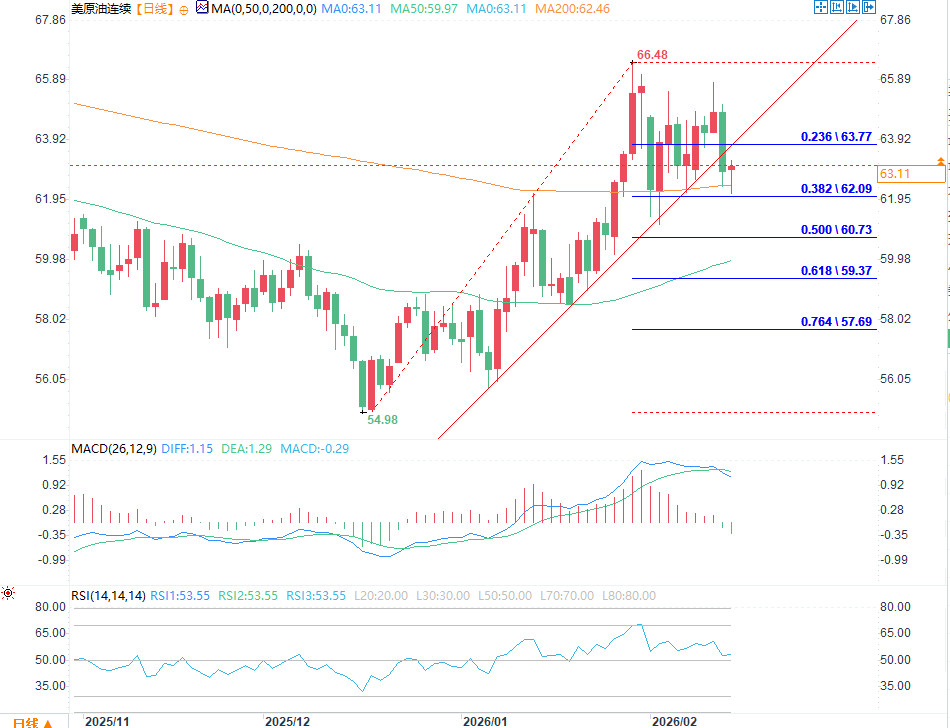
(WTI crude oil daily chart source: FX678)
Summary and Outlook
In summary, the current international crude oil market is in a state of equilibrium amidst a mix of bullish and bearish factors. On the supply and demand side, OPEC+ production increases and the easing of sanctions on Venezuela are putting pressure on supply, while expectations of a US interest rate cut are supporting demand recovery. On the geopolitical side, uncertainties remain regarding the progress of negotiations between the US and Iran, and between Ukraine and Russia, affecting market risk premiums. The future trend of oil prices will mainly depend on the specific implementation of the OPEC+ production increase plan, the pace of US interest rate adjustments, and the development of the geopolitical situation, which investors will continue to monitor closely.
Despite oil prices stabilizing on Friday, WTI crude oil is likely to record a weekly decline, dragged down by a nearly 3% drop on Thursday, marking the second consecutive week of slight declines, reflecting that market concerns about oversupply have not been completely eliminated.
Supply and demand
The interplay between supply and demand has become the core factor influencing oil prices. On the supply side, OPEC+ members tend to gradually resume crude oil production from April onwards to cope with the upcoming peak summer fuel demand. This move will directly offset the momentum of demand recovery and put downward pressure on oil prices. Affected by this expectation, Brent crude oil fell to $66.89 per barrel in early trading on Friday.
Meanwhile, the United States eased sanctions on Venezuela’s energy sector on Friday, issuing two general licenses that allow global energy companies to conduct oil and gas projects and negotiate investments in the country. The U.S. Energy Secretary revealed that Venezuelan oil sales under his control have exceeded $1 billion and will generate another $5 billion in revenue in the coming months. The gradual recovery of Venezuelan crude oil supply will further enrich the global supply.
On the demand side, the US January Consumer Price Index (CPI) data was positive, with overall inflation growth lower than expected and core inflation declining moderately, mainly due to lower gasoline prices and slower rental inflation. This has led the market to expect the Federal Reserve to potentially cut interest rates slightly further in the future.
Dennis Kisler, senior vice president and head of trading at BOK Financial, said that stabilizing inflation provides room for interest rate adjustments, and lower interest rates will boost risk appetite, indirectly supporting oil demand and becoming an important support for stabilizing oil prices.
Geopolitical level
Subtle shifts in the geopolitical situation continue to influence risk premiums in the crude oil market, becoming a significant variable in oil price fluctuations. In the Middle East, escalating tensions between the US and Iran earlier this week raised concerns about disruptions to oil shipping routes through the Strait of Hormuz, briefly pushing oil prices higher. However, US President Trump's statement that Washington might reach an agreement with Iran within the next month eased market concerns about escalating tensions in the Middle East, becoming a major reason for Thursday's sharp drop in oil prices.
In Europe, Russia announced on Friday that the next round of peace talks in Ukraine is scheduled for next week. Kisler pointed out that progress in US-Iran and Ukraine-Russia negotiations will dominate near-term market trends, and current crude oil prices already include a geopolitical premium of $5 to $7 per barrel.
(WTI crude oil daily chart source: FX678)
Summary and Outlook
In summary, the current international crude oil market is in a state of equilibrium amidst a mix of bullish and bearish factors. On the supply and demand side, OPEC+ production increases and the easing of sanctions on Venezuela are putting pressure on supply, while expectations of a US interest rate cut are supporting demand recovery. On the geopolitical side, uncertainties remain regarding the progress of negotiations between the US and Iran, and between Ukraine and Russia, affecting market risk premiums. The future trend of oil prices will mainly depend on the specific implementation of the OPEC+ production increase plan, the pace of US interest rate adjustments, and the development of the geopolitical situation, which investors will continue to monitor closely.
- Risk Warning and Disclaimer
- The market involves risk, and trading may not be suitable for all investors. This article is for reference only and does not constitute personal investment advice, nor does it take into account certain users’ specific investment objectives, financial situation, or other needs. Any investment decisions made based on this information are at your own risk.