GBP/USD Forecast: Economic data strengthens expectations of a March rate cut, limiting upside potential for the pound.
2026-02-17 19:46:50
On Tuesday (February 17), the pound weakened after the release of UK wage and employment data during the European session, with market expectations for a Bank of England rate cut in March rising sharply (unless there are surprises in tomorrow's inflation report). If the data does not show a significant reversal, the Bank of England is expected to cut rates again in June; if inflation risks ease further, there may be more rate cuts this summer, which will limit the pound's upside potential.
How should we interpret today's UK economic data?
The pound fell across the board after the release of the latest UK labor market data, reflecting rising market expectations for a Bank of England interest rate cut – as the weakening job market continues to ease pressure on wage growth.
In December, the average monthly wage growth in the UK slowed to 4.2% year-on-year, down from 4.6% in November and far below 5.9% in the same period last year. Private sector wages followed a similar trend, with wage growth excluding bonuses falling from 3.6% to 3.4%, a significant drop from 6.2% growth last year.
A closer look at the data reveals that the weakness was primarily concentrated in the consumer services sector, particularly the hotel, retail, and leisure sectors. This may be a lingering effect of last year's national insurance rate increase and rising minimum wage costs. Other sectors, however, remained relatively stable: private sector employment saw only a slight decline, layoffs were under control, and the number of job vacancies stabilized.
In short, wage pressures, a core concern of the Bank of England's Monetary Policy Committee, are easing significantly, giving the Bank of England a stronger reason to cut interest rates as early as March, rather than waiting until April. Traders are currently pricing in a 76% probability of a March rate cut, and the expectation of two rate cuts before November has been fully priced in (previously expected to be around 48 basis points). I believe the second rate cut could happen as early as June, which will continue to put downward pressure on the pound.
What is the trend in the foreign exchange market?
The foreign exchange market started the week uneventfully, with the dollar weakening slightly last week. Despite better-than-expected US non-farm payroll data, weaker-than-expected inflation data on Friday reinforced expectations of an impending Federal Reserve rate cut, causing the dollar to fail to hold onto its gains. The weaker dollar provided some support for the pound, even with weak UK economic data.
The UK economy is projected to weaken by the end of 2025, with the construction sector and business investment under pressure. The Bank of England's previous decision to hold rates steady, while signaling a dovish stance, has already weakened the pound against most major currencies. Today's weak wage data further pressured pound cross rates, with GBP/JPY experiencing a particularly significant drop.
Market Outlook: More key data releases are expected this week.
The market is closely watching tomorrow's UK Consumer Price Index (CPI) release to determine the timing and magnitude of a Bank of England interest rate cut. The UK's January CPI year-on-year growth rate is expected to slow to 3.0% from 3.4% in December.
This Friday, the UK will release retail sales data, while the US will release GDP data and the core personal consumption expenditures (PCE) price index (the Fed's preferred inflation indicator). In short, interest rate expectations will remain central to the market, and the GBP/USD exchange rate is expected to remain neutral.
GBP/USD Forecast: Key Levels
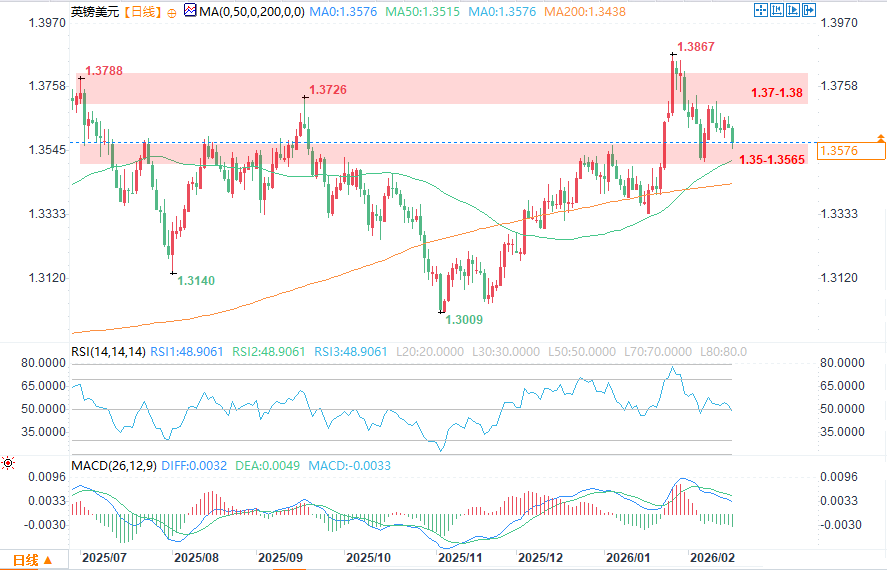
(GBP/USD daily chart source: FX678)
The relative strength of GBP/USD against a backdrop of overall pound weakness is more attributable to the weakening dollar than to the strength of the pound itself. If we disregard the dollar factor and only consider weak UK data, the pair should have fallen significantly.
From a technical perspective, the 1.3500–1.3565 range is a key support level. A break below this level would open up space towards the 200-day moving average around 1.3400. Resistance levels are around 1.3700 and 1.3800.
Looking ahead, UK inflation data will determine the Bank of England's next policy move, while US GDP data will dominate the overall trend of the US dollar. Unless US data significantly exceeds expectations, given the recent weakness of the US dollar, the GBP/USD exchange rate is expected to remain neutral.
At 19:36 Beijing time, the pound/dollar exchange rate was 1.3579/80, down 0.35%.
How should we interpret today's UK economic data?
The pound fell across the board after the release of the latest UK labor market data, reflecting rising market expectations for a Bank of England interest rate cut – as the weakening job market continues to ease pressure on wage growth.
In December, the average monthly wage growth in the UK slowed to 4.2% year-on-year, down from 4.6% in November and far below 5.9% in the same period last year. Private sector wages followed a similar trend, with wage growth excluding bonuses falling from 3.6% to 3.4%, a significant drop from 6.2% growth last year.
A closer look at the data reveals that the weakness was primarily concentrated in the consumer services sector, particularly the hotel, retail, and leisure sectors. This may be a lingering effect of last year's national insurance rate increase and rising minimum wage costs. Other sectors, however, remained relatively stable: private sector employment saw only a slight decline, layoffs were under control, and the number of job vacancies stabilized.
In short, wage pressures, a core concern of the Bank of England's Monetary Policy Committee, are easing significantly, giving the Bank of England a stronger reason to cut interest rates as early as March, rather than waiting until April. Traders are currently pricing in a 76% probability of a March rate cut, and the expectation of two rate cuts before November has been fully priced in (previously expected to be around 48 basis points). I believe the second rate cut could happen as early as June, which will continue to put downward pressure on the pound.
What is the trend in the foreign exchange market?
The foreign exchange market started the week uneventfully, with the dollar weakening slightly last week. Despite better-than-expected US non-farm payroll data, weaker-than-expected inflation data on Friday reinforced expectations of an impending Federal Reserve rate cut, causing the dollar to fail to hold onto its gains. The weaker dollar provided some support for the pound, even with weak UK economic data.
The UK economy is projected to weaken by the end of 2025, with the construction sector and business investment under pressure. The Bank of England's previous decision to hold rates steady, while signaling a dovish stance, has already weakened the pound against most major currencies. Today's weak wage data further pressured pound cross rates, with GBP/JPY experiencing a particularly significant drop.
Market Outlook: More key data releases are expected this week.
The market is closely watching tomorrow's UK Consumer Price Index (CPI) release to determine the timing and magnitude of a Bank of England interest rate cut. The UK's January CPI year-on-year growth rate is expected to slow to 3.0% from 3.4% in December.
This Friday, the UK will release retail sales data, while the US will release GDP data and the core personal consumption expenditures (PCE) price index (the Fed's preferred inflation indicator). In short, interest rate expectations will remain central to the market, and the GBP/USD exchange rate is expected to remain neutral.
GBP/USD Forecast: Key Levels
(GBP/USD daily chart source: FX678)
The relative strength of GBP/USD against a backdrop of overall pound weakness is more attributable to the weakening dollar than to the strength of the pound itself. If we disregard the dollar factor and only consider weak UK data, the pair should have fallen significantly.
From a technical perspective, the 1.3500–1.3565 range is a key support level. A break below this level would open up space towards the 200-day moving average around 1.3400. Resistance levels are around 1.3700 and 1.3800.
Looking ahead, UK inflation data will determine the Bank of England's next policy move, while US GDP data will dominate the overall trend of the US dollar. Unless US data significantly exceeds expectations, given the recent weakness of the US dollar, the GBP/USD exchange rate is expected to remain neutral.
At 19:36 Beijing time, the pound/dollar exchange rate was 1.3579/80, down 0.35%.
- Risk Warning and Disclaimer
- The market involves risk, and trading may not be suitable for all investors. This article is for reference only and does not constitute personal investment advice, nor does it take into account certain users’ specific investment objectives, financial situation, or other needs. Any investment decisions made based on this information are at your own risk.