Is the old logic behind gold dead? Where is the next tipping point?
2026-02-18 14:58:24
On Wednesday, February 18th, spot gold traded around $4930 in early European trading, with the market at a delicate crossroads. Looking at the daily chart, after a significant pullback from the previous high of $5596.33, the price is currently seeking a directional choice within the $4650.00 to $5100.00 range.

The MACD indicator shows the DIFF at 76.99, DEA at 107.41, and MACD value at -60.84. The moving average system is in a death cross pattern, indicating weak short-term momentum. The RSI is around 52, and the market is not significantly oversold, suggesting the battle between bulls and bears continues. However, the market's core focus has gradually shifted from short-term price fluctuations to a deeper structural issue: is the traditional pricing relationship between US real yields and gold undergoing a subtle but fundamental change?
For a considerable period, the US real yield has served as a reliable framework for analyzing gold price movements. The logic is simple and direct: rising real yields mean an increased opportunity cost of holding zero-interest assets like gold, naturally drawing funds away from gold and towards assets that generate real returns, thus putting downward pressure on gold prices; conversely, falling real yields increase gold's relative attractiveness, leading to higher prices. This mechanism was almost textbook-perfectly validated during the interest rate hike cycle from 2018 to 2022.
However, the current macroeconomic environment is far more complex than this framework can describe. The market is simultaneously digesting multiple overlapping risks: persistently sticky inflation exceeding expectations, continuously expanding fiscal deficits and debt levels in major economies, concentrated issuance pressures of global sovereign debt, and the ongoing reshaping of asset allocation patterns by various geopolitical frictions. Given this confluence of risks, while real yields remain a crucial variable influencing gold, their marginal pricing power has been significantly diluted. The most direct evidence is recent price performance. When US real yields stabilized or even slightly rebounded, gold did not exhibit the significant follow-through decline seen in previous tightening cycles.
If the real yield framework describes the marginal pricing mechanism of gold, then structural demand describes the price floor for gold. From the demand side, the structural forces supporting gold are currently manifested in at least three aspects. First, the increasing holdings by major central banks worldwide continue. In recent years, central banks in many economies have made the proportion of gold reserves an important goal of diversifying their foreign exchange reserves, and this trend has not been substantially reversed in the past two years. A significant characteristic of central bank gold purchases is that their decision-making logic is more subordinate to long-term strategic asset allocation considerations than to immediate reactions to short-term interest rate or price fluctuations.
Secondly, the continued fragmentation of the geopolitical landscape is driving a restructuring of global asset allocation. With geopolitical risk premiums remaining high for an extended period, gold, as an independent store of value beyond sovereign credit, continues to enhance its strategic appeal. Thirdly, institutional demand for portfolio diversification is generating incremental capital inflows. Against the backdrop of increasing correlations in traditional asset portfolios, gold, as a low-correlation alternative asset, is seeing increased allocation in institutional portfolios. When these allocation-driven funds become the marginal force driving gold pricing, the traditional interest rate transmission mechanism will be suppressed.
While gold has shown considerable resilience, this does not mean that its price is completely immune to macroeconomic shocks. For traders, the most threatening downside risk scenario is a sustained, disorderly, and rapid rise in real yields, accompanied by a simultaneous tightening of financial conditions and a significant strengthening of the US dollar. Under this combined pressure, even if structural demand persists, it will be difficult to fully offset the heavy pressure from interest rates.
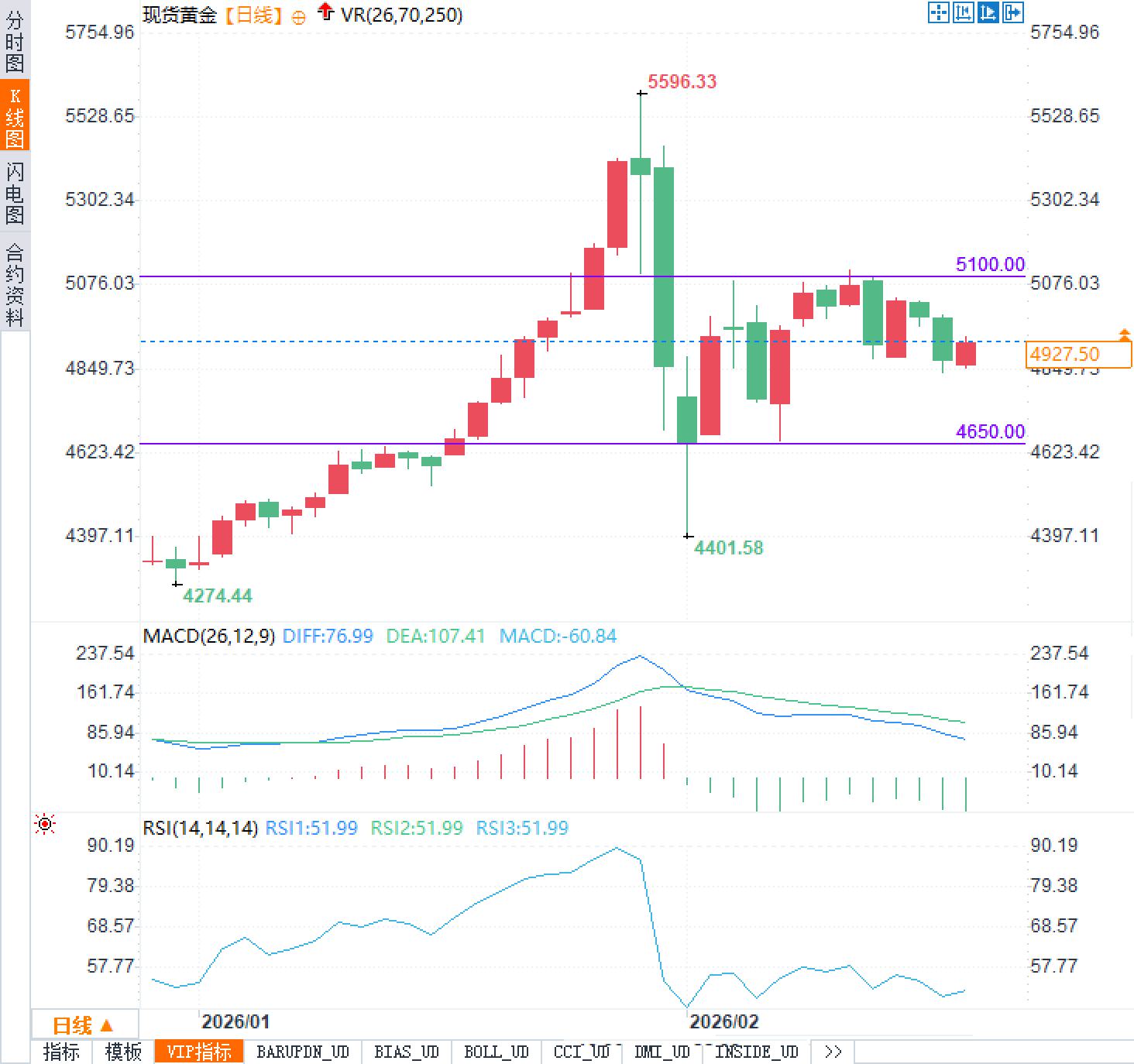
From a technical perspective, if gold prices break below the support level of $4650.00, it could trigger larger-scale stop-loss orders, accelerating the downward trend. On the upside risk side, if macroeconomic pressures intensify again, real yields turn downwards once more, or new systemic risk events emerge globally, gold's safe-haven appeal will be strengthened. Previously accumulated bullish forces are expected to converge, pushing gold prices towards a breakout above $5100.00. In summary, the current pricing logic for spot gold has entered a more complex institutional framework, and the moment of directional choice may not be far off.
The MACD indicator shows the DIFF at 76.99, DEA at 107.41, and MACD value at -60.84. The moving average system is in a death cross pattern, indicating weak short-term momentum. The RSI is around 52, and the market is not significantly oversold, suggesting the battle between bulls and bears continues. However, the market's core focus has gradually shifted from short-term price fluctuations to a deeper structural issue: is the traditional pricing relationship between US real yields and gold undergoing a subtle but fundamental change?
The collapse of old beliefs: Why does the real rate of return fail?
For a considerable period, the US real yield has served as a reliable framework for analyzing gold price movements. The logic is simple and direct: rising real yields mean an increased opportunity cost of holding zero-interest assets like gold, naturally drawing funds away from gold and towards assets that generate real returns, thus putting downward pressure on gold prices; conversely, falling real yields increase gold's relative attractiveness, leading to higher prices. This mechanism was almost textbook-perfectly validated during the interest rate hike cycle from 2018 to 2022.
However, the current macroeconomic environment is far more complex than this framework can describe. The market is simultaneously digesting multiple overlapping risks: persistently sticky inflation exceeding expectations, continuously expanding fiscal deficits and debt levels in major economies, concentrated issuance pressures of global sovereign debt, and the ongoing reshaping of asset allocation patterns by various geopolitical frictions. Given this confluence of risks, while real yields remain a crucial variable influencing gold, their marginal pricing power has been significantly diluted. The most direct evidence is recent price performance. When US real yields stabilized or even slightly rebounded, gold did not exhibit the significant follow-through decline seen in previous tightening cycles.
Who's bailing out the market? The unseen hand and structural demand.
If the real yield framework describes the marginal pricing mechanism of gold, then structural demand describes the price floor for gold. From the demand side, the structural forces supporting gold are currently manifested in at least three aspects. First, the increasing holdings by major central banks worldwide continue. In recent years, central banks in many economies have made the proportion of gold reserves an important goal of diversifying their foreign exchange reserves, and this trend has not been substantially reversed in the past two years. A significant characteristic of central bank gold purchases is that their decision-making logic is more subordinate to long-term strategic asset allocation considerations than to immediate reactions to short-term interest rate or price fluctuations.
Secondly, the continued fragmentation of the geopolitical landscape is driving a restructuring of global asset allocation. With geopolitical risk premiums remaining high for an extended period, gold, as an independent store of value beyond sovereign credit, continues to enhance its strategic appeal. Thirdly, institutional demand for portfolio diversification is generating incremental capital inflows. Against the backdrop of increasing correlations in traditional asset portfolios, gold, as a low-correlation alternative asset, is seeing increased allocation in institutional portfolios. When these allocation-driven funds become the marginal force driving gold pricing, the traditional interest rate transmission mechanism will be suppressed.
Decisive Battle Zone: Game Strategies Under Two-Way Risk
While gold has shown considerable resilience, this does not mean that its price is completely immune to macroeconomic shocks. For traders, the most threatening downside risk scenario is a sustained, disorderly, and rapid rise in real yields, accompanied by a simultaneous tightening of financial conditions and a significant strengthening of the US dollar. Under this combined pressure, even if structural demand persists, it will be difficult to fully offset the heavy pressure from interest rates.
From a technical perspective, if gold prices break below the support level of $4650.00, it could trigger larger-scale stop-loss orders, accelerating the downward trend. On the upside risk side, if macroeconomic pressures intensify again, real yields turn downwards once more, or new systemic risk events emerge globally, gold's safe-haven appeal will be strengthened. Previously accumulated bullish forces are expected to converge, pushing gold prices towards a breakout above $5100.00. In summary, the current pricing logic for spot gold has entered a more complex institutional framework, and the moment of directional choice may not be far off.
- Risk Warning and Disclaimer
- The market involves risk, and trading may not be suitable for all investors. This article is for reference only and does not constitute personal investment advice, nor does it take into account certain users’ specific investment objectives, financial situation, or other needs. Any investment decisions made based on this information are at your own risk.