Geopolitical tensions escalate, oil prices surge 2%! US-Iran negotiations, undercurrents of Trump's new policies.
2026-02-18 20:15:57
On Wednesday (February 18), during the European session, US crude oil futures strengthened significantly, rising more than 2% to trade at $63.75. Driven by multiple geopolitical risks and supply disturbances, market risk aversion and supply concerns together formed the core support for the rise in oil prices.
The bombing of the CPC pumping station in Russia, coupled with simultaneous production cuts/shutdowns in the Black Sea, North America, and Canada, created a triple supply shock. This was compounded by the escalating military risks between the US and Iran, increased uncertainty in the Russia-Ukraine negotiations, and a rapid recovery in geopolitical risk premiums. Furthermore, the combination of technical oversold rebounds, short covering, and the return of liquidity led to a multi-factor rally.
Iran stated early Wednesday morning that the Iran-US nuclear negotiations had reached a consensus on basic principles, but a final agreement was still far off.
Market doubts about substantial progress in negotiations, coupled with the unresolved risk of a US military strike against Iran, have kept the geopolitical risk premium in the oil market high.
Meanwhile, peace talks between Russia and Ukraine are progressing in tandem, with representatives from both sides completing the first day of negotiations mediated by the United States in Geneva. Trump urged Ukraine to cease hostilities as soon as possible.
The US and Russia are also holding talks in Riyadh. Although the expectation of a ceasefire is rising, there has been no substantial progress on the agreement. Concerns about Ukraine being excluded from the negotiations continue to fester, and sudden changes in the geopolitical landscape could disrupt oil prices at any time.
Frequent unexpected events on the global crude oil supply side have provided strong momentum for rising oil prices: a Ukrainian drone attack on a key Russian pumping station caused a decline in Caspian Pipeline Union crude oil transportation, and the recovery will take 1.5-2 months;
A storm in the Black Sea has suspended oil loading operations at the port of Novorossiysk; extreme cold weather in North Dakota, USA, has reduced local crude oil production by 120,000-150,000 barrels per day; ExxonMobil in Canada has lowered production forecasts for two major oil fields due to a shortage of tankers and severe weather.
In addition, production at Kazakhstan's Tengiz oil field is gradually recovering and is scheduled to return to full production by February 23; the G7 plans to tighten the cap on Russian oil prices, and Brazil has officially joined OPEC+, leading to a slight adjustment in the long-term supply pattern; the Oxford Institute for Energy Studies maintains its 2025 Brent crude oil price forecast at $77 per barrel, and slightly lowers its 2026 forecast to $74 per barrel.
Demand was weak, with JODI member countries experiencing a double decline in oil demand in December, both month-on-month and year-on-year. Warmer-than-usual weather in the US over the next 6-14 days is expected to weaken demand for heating oil, and refining crack spreads have fallen, erasing previous gains.
Market focus shifted to the API crude oil inventory data later in the evening and the EIA data on Thursday. The market expects U.S. crude oil inventories to increase by 2.3 million barrels last week, while gasoline and distillate inventories decreased by 200,000 barrels and 1.6 million barrels, respectively.
The Trump administration has taken a clear negative stance toward new energy sources and wind power. Its policy revolves around "revitalizing traditional energy and suppressing clean energy." It has repeatedly claimed that we have the world's richest oil and gas reserves, yet we are foolishly pursuing expensive and unstable wind power, which is a betrayal of America's energy independence.
On the one hand, citing "national security risks" and "legal deficiencies," all large-scale offshore wind power projects under construction, as well as the Lava Ridge wind power project approved during the Biden administration, were halted, with the argument that wind power facilities would interfere with radar detection and harm rural communities. On the other hand, the "Magnificent Act" completely eliminated federal tax credits for electric vehicles, gradually terminated investment and production tax credits for wind and solar energy, opened federal land and waters to oil and gas drilling, reduced extraction royalties, and strongly supported traditional energy industries with policy inclinations. Furthermore, it expanded its control over the world's existing resources through means such as sending troops to Venezuela.
Oil prices are currently poised for a technical rebound, with short-term geopolitical risks being the key variable.
In the medium term, expectations of easing US-Iran sanctions, the resilience of the US economy, the direction of Federal Reserve policy, and the global trade environment will jointly dominate the future trend of crude oil prices.
In the long run, Trump's actions—including military intervention in Venezuela, talks with domestic oil companies, and policy and geopolitical maneuvers to drive up oil prices—are aimed at revitalizing the oil and shale gas industries. His ultimate goal is to acquire more energy resources through plunder, thereby securing greater fiscal revenue and ensuring domestic energy supply. Until a strategic oil industry agreement is reached, oil prices are expected to remain resilient.
From a technical perspective, consistent with what I wrote in yesterday's article, the pullback in US crude oil presents a good opportunity. After touching the middle line of the channel, it rebounded quickly. The resistance and support levels are 64.60 and 62.37, respectively.
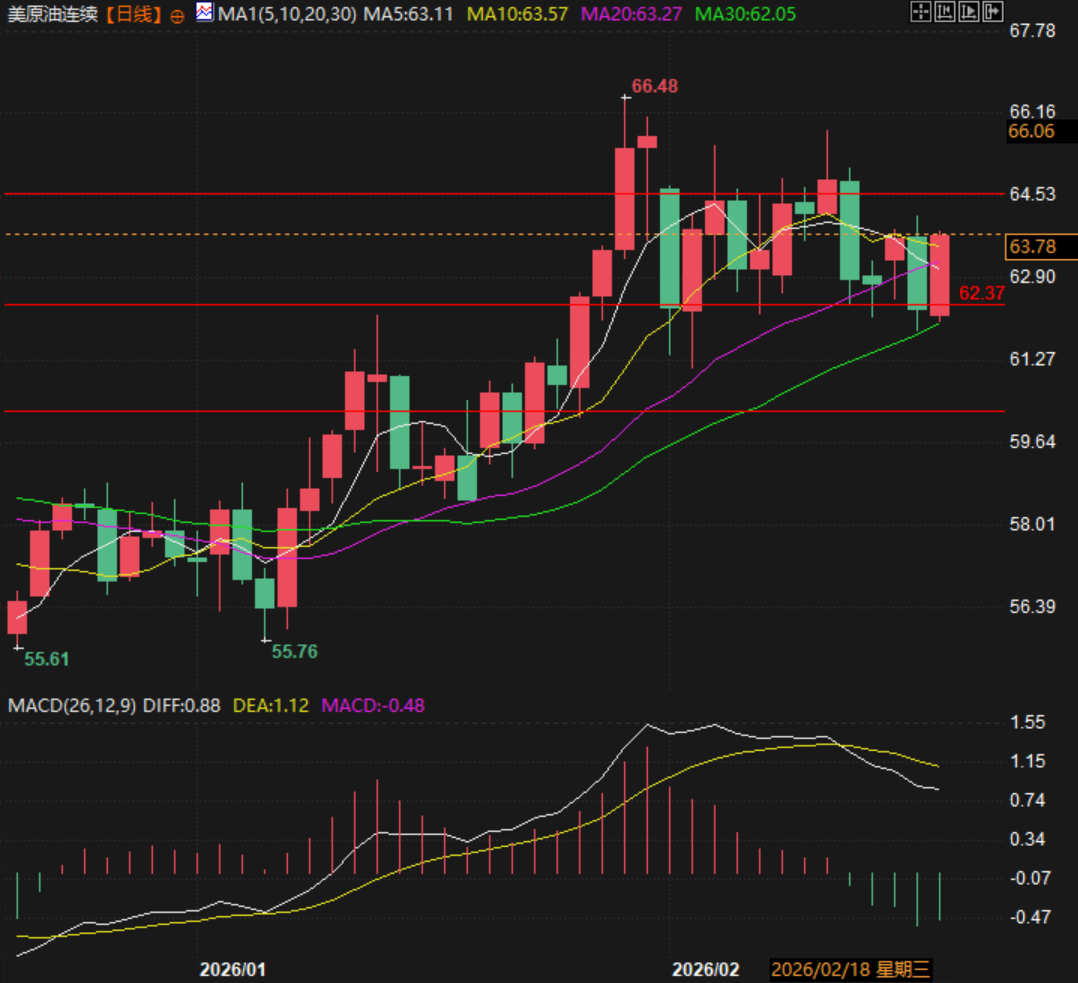
(US crude oil futures daily chart, source: FX678)
At 20:14 Beijing time, US crude oil futures were trading at 63.78/79.
The bombing of the CPC pumping station in Russia, coupled with simultaneous production cuts/shutdowns in the Black Sea, North America, and Canada, created a triple supply shock. This was compounded by the escalating military risks between the US and Iran, increased uncertainty in the Russia-Ukraine negotiations, and a rapid recovery in geopolitical risk premiums. Furthermore, the combination of technical oversold rebounds, short covering, and the return of liquidity led to a multi-factor rally.
Core driver: Repeated tug-of-war over geopolitical risks
Iran stated early Wednesday morning that the Iran-US nuclear negotiations had reached a consensus on basic principles, but a final agreement was still far off.
Market doubts about substantial progress in negotiations, coupled with the unresolved risk of a US military strike against Iran, have kept the geopolitical risk premium in the oil market high.
Meanwhile, peace talks between Russia and Ukraine are progressing in tandem, with representatives from both sides completing the first day of negotiations mediated by the United States in Geneva. Trump urged Ukraine to cease hostilities as soon as possible.
The US and Russia are also holding talks in Riyadh. Although the expectation of a ceasefire is rising, there has been no substantial progress on the agreement. Concerns about Ukraine being excluded from the negotiations continue to fester, and sudden changes in the geopolitical landscape could disrupt oil prices at any time.
Supply side: Global disturbances support oil prices
Frequent unexpected events on the global crude oil supply side have provided strong momentum for rising oil prices: a Ukrainian drone attack on a key Russian pumping station caused a decline in Caspian Pipeline Union crude oil transportation, and the recovery will take 1.5-2 months;
A storm in the Black Sea has suspended oil loading operations at the port of Novorossiysk; extreme cold weather in North Dakota, USA, has reduced local crude oil production by 120,000-150,000 barrels per day; ExxonMobil in Canada has lowered production forecasts for two major oil fields due to a shortage of tankers and severe weather.
In addition, production at Kazakhstan's Tengiz oil field is gradually recovering and is scheduled to return to full production by February 23; the G7 plans to tighten the cap on Russian oil prices, and Brazil has officially joined OPEC+, leading to a slight adjustment in the long-term supply pattern; the Oxford Institute for Energy Studies maintains its 2025 Brent crude oil price forecast at $77 per barrel, and slightly lowers its 2026 forecast to $74 per barrel.
Demand and Data: Focusing on Evening API Inventory
Demand was weak, with JODI member countries experiencing a double decline in oil demand in December, both month-on-month and year-on-year. Warmer-than-usual weather in the US over the next 6-14 days is expected to weaken demand for heating oil, and refining crack spreads have fallen, erasing previous gains.
Market focus shifted to the API crude oil inventory data later in the evening and the EIA data on Thursday. The market expects U.S. crude oil inventories to increase by 2.3 million barrels last week, while gasoline and distillate inventories decreased by 200,000 barrels and 1.6 million barrels, respectively.
US energy policy leans towards: denying new energy sources and reviving oil hegemony.
The Trump administration has taken a clear negative stance toward new energy sources and wind power. Its policy revolves around "revitalizing traditional energy and suppressing clean energy." It has repeatedly claimed that we have the world's richest oil and gas reserves, yet we are foolishly pursuing expensive and unstable wind power, which is a betrayal of America's energy independence.
On the one hand, citing "national security risks" and "legal deficiencies," all large-scale offshore wind power projects under construction, as well as the Lava Ridge wind power project approved during the Biden administration, were halted, with the argument that wind power facilities would interfere with radar detection and harm rural communities. On the other hand, the "Magnificent Act" completely eliminated federal tax credits for electric vehicles, gradually terminated investment and production tax credits for wind and solar energy, opened federal land and waters to oil and gas drilling, reduced extraction royalties, and strongly supported traditional energy industries with policy inclinations. Furthermore, it expanded its control over the world's existing resources through means such as sending troops to Venezuela.
Market Outlook: Multiple Variables Dominate Market Trends
Oil prices are currently poised for a technical rebound, with short-term geopolitical risks being the key variable.
In the medium term, expectations of easing US-Iran sanctions, the resilience of the US economy, the direction of Federal Reserve policy, and the global trade environment will jointly dominate the future trend of crude oil prices.
In the long run, Trump's actions—including military intervention in Venezuela, talks with domestic oil companies, and policy and geopolitical maneuvers to drive up oil prices—are aimed at revitalizing the oil and shale gas industries. His ultimate goal is to acquire more energy resources through plunder, thereby securing greater fiscal revenue and ensuring domestic energy supply. Until a strategic oil industry agreement is reached, oil prices are expected to remain resilient.
From a technical perspective, consistent with what I wrote in yesterday's article, the pullback in US crude oil presents a good opportunity. After touching the middle line of the channel, it rebounded quickly. The resistance and support levels are 64.60 and 62.37, respectively.
(US crude oil futures daily chart, source: FX678)
At 20:14 Beijing time, US crude oil futures were trading at 63.78/79.
- Risk Warning and Disclaimer
- The market involves risk, and trading may not be suitable for all investors. This article is for reference only and does not constitute personal investment advice, nor does it take into account certain users’ specific investment objectives, financial situation, or other needs. Any investment decisions made based on this information are at your own risk.