Gold Trading Alert: A looming US-Iran conflict and a deeply divided Federal Reserve push gold prices near $5,000.
2026-02-19 08:06:17
On Wednesday (February 18), spot gold rallied strongly from a one-week low of around $4,842 per ounce, ultimately closing at $4,976 per ounce, a gain of approximately 2%. April US gold futures also rose 2%, with the settlement price approaching the $5,010 mark. This scene thrilled the entire market – amidst escalating geopolitical risks and significant internal disagreements within the Federal Reserve regarding interest rate paths, gold once again proved its status as the ultimate safe-haven asset. On Thursday (February 19) in early Asian trading, spot gold traded in a narrow range, currently hovering around $4,970 per ounce.
Wednesday's rally was most directly catalyzed by the simultaneous emergence of two major powder kegs in the Middle East and Eastern Europe.
Talks between the US and Iran in Geneva have yielded only "limited progress," with significant differences remaining between the two sides. The White House has made it clear that Iran will provide more details in the coming weeks, while Israeli media has released bombshell news: the "timetable" for a US military strike against Iran is being shortened, and Trump is highly likely to approve the attack plan soon. Senior Israeli officials have confirmed that if the US takes action, the Israeli military will fully participate. The Israeli rear command has even issued a "prepare for war" order, and the security cabinet meeting has been urgently postponed to the 22nd. The entire Middle East has entered a state of high alert.
Meanwhile, Iran is also preparing for the worst-case scenario. While Tehran is offering concessions on the nuclear agreement at the negotiating table, it is simultaneously accelerating the deployment of troops, decentralizing decision-making authority, fortifying nuclear facilities, and reviving the "mosaic defense" strategy—granting greater autonomy to commanders at all levels to prevent the command system from being "decapitated." Ali Larijani, head of Iran's National Security Council, publicly stated, "If war is imposed on us, we will retaliate." Swiss international relations expert Farzan Sabette bluntly stated that this is the most serious military threat Iran has faced since the end of the Iran-Iraq War in 1988.
The situation on the Eastern European front remained unchanged. Two days of peace talks between Ukraine and Russia in Geneva ended without result, with neither side reaching even the most basic consensus. The Russian Ministry of Defense announced that day that it had taken control of Kharkivka in the Sumy region and Krinichnoye in the Zaporizhzhia region, and had carried out precision strikes against multiple Ukrainian strategic targets; Ukraine, in turn, claimed to have inflicted heavy losses on Russian forces in the Konstantinovka direction.
Marex analyst Edward Meir noted, "The current geopolitical tensions between the US and Iran have put the market extremely nervous." Against this backdrop of "the shadow of war potentially turning into reality at any moment," gold, as the purest safe-haven asset, naturally becomes the preferred choice for global funds.
If geopolitics is "adding fuel to the fire," then the Fed's January meeting minutes are "adding insult to injury."
The minutes show that almost all of the 17 officials supported keeping interest rates unchanged at 3.50%-3.75% in January, but they were completely divided into two camps on "what to do next":
Some officials explicitly warned that if inflation persists above the 2% target (which is currently about 1 percentage point above), the Federal Reserve may need to raise interest rates again; others believed that as long as inflation falls as expected, interest rate cuts should continue, and even discussed "when" would be more appropriate to cut rates. A few members even voted against the cuts, expressing concern that the job market was quietly weakening.
More notably, the minutes directly mentioned for the first time a "two-way description" of the interest rate path: future policy decisions must consider both upward and downward risks to inflation. This means that the market can no longer simply regard the Federal Reserve as a "fixed rate-cutting machine."
Federal Reserve Vice Chair for Supervision Bowman publicly stated that she remains "concerned" about the labor market, calling the latest jobs report "strange"—most other indicators do not suggest such a strong labor market. This hawkish tone contrasts sharply with the previously widely anticipated easing path.
Investors are now focused on Friday's release of the December PCE price index—the Federal Reserve's preferred inflation gauge. If the data exceeds expectations, hawkish voices will likely amplify; if the data meets expectations, doves may still have a chance to regain ground.
Data released on Wednesday also showed that U.S. economic data exceeded expectations across the board:
Non-defense capital goods orders excluding aircraft rose 0.6% month-on-month in January (expected 0.4%), while manufacturing output rose 0.6% month-on-month (expected 0.4%), reaching an 11-month high. Strong business equipment spending indicates a healthy economic growth momentum.
These data directly pushed up US Treasury yields: the 10-year Treasury yield rose to 4.081%, and the 2-year yield rose to 3.46%; the US dollar index surged 0.6% to 97.71, while the euro fell 0.6% due to rumors that European Central Bank President Christine Lagarde might step down early.
Logically, strong economic data, high yields, and a strong dollar should be the bane of gold. However, this time, gold completely ignored these negative factors and rebounded strongly by 2%. This can only mean one thing: the weight of geopolitical risks has far exceeded that of macroeconomic data and monetary policy expectations.
The weak demand at the 20-year US Treasury auction (with a bid-to-cover ratio of only 2.36, the lowest since at least April 2023) further confirmed market concerns about rising long-term interest rates, but gold remained firm, indicating that safe-haven demand has taken over.
Other precious metals were equally competitive:
Spot silver surged 5% to $77.03 per ounce on Wednesday; spot platinum rose 3.2% to around $2075 per ounce; and palladium climbed nearly 2% to $1709 per ounce. The entire precious metals sector presented a scene of "safe-haven frenzy."
As a commodity with both industrial and precious metal attributes, silver's recent price increase even surpassed that of gold, indicating that the market is not only pricing in the risks of war but also in the risks of potential supply chain disruptions.
In summary, the current rise in gold prices is a typical example of a scenario driven by geopolitical risks and fueled by monetary policy uncertainty. Former Federal Reserve Governor Warsh is set to succeed Powell as chairman in May, and the Trump administration's clear preference for low interest rates leaves room for speculation regarding medium- to long-term rate cuts.
However, in the short term, whether the US-Iran conflict escalates, whether the PCE data "explodes," and whether the Fed's March meeting releases a more hawkish signal will all be the dominant factors influencing gold price fluctuations.
What is certain is that in 2026, with global uncertainty rising sharply, gold's attributes as the "ultimate currency" and "ultimate insurance" are being repriced.
As the shadow of war looms over the Middle East, as infighting within the Federal Reserve drowns out the data, and as global funds seek the safest haven, gold continues to attract an influx of safe-haven capital.
Gold prices rallied sharply in a V-shape after Tuesday's plunge, reaching new highs and demonstrating strong buying support. However, as analysts have noted, trading has been range-bound for most of February, making a clear direction difficult to determine. The market may need a new catalyst to break this pattern—perhaps a genuine outbreak of conflict in the Middle East, or a pleasant surprise in inflation data.
The key focus for this trading day will be on changes in U.S. initial jobless claims, as well as continued attention to speeches by Federal Reserve officials.
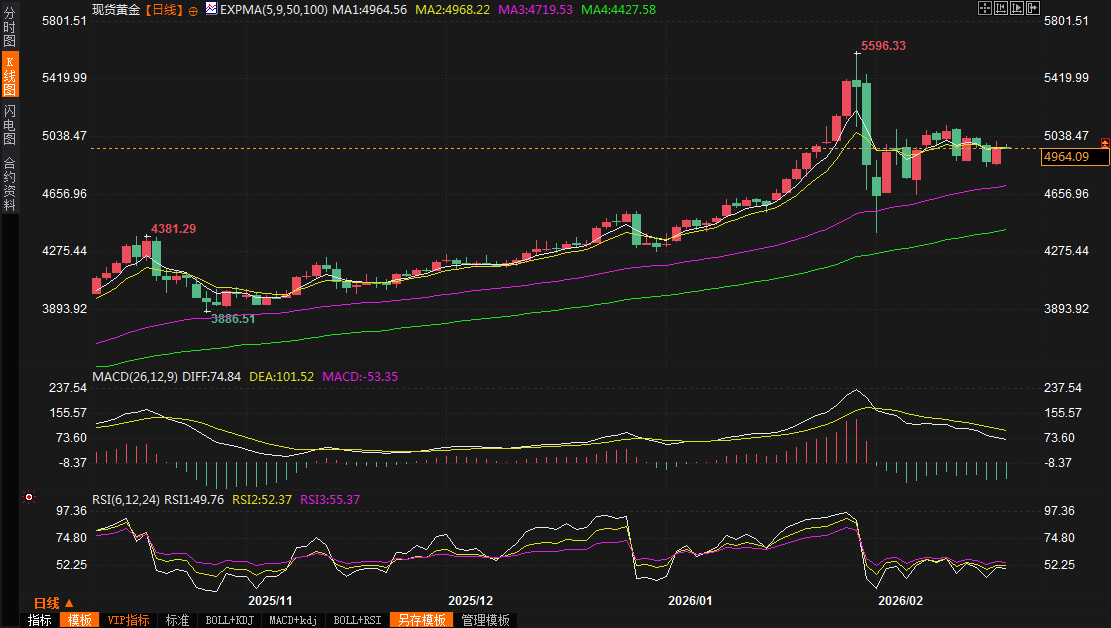
(Spot gold daily chart, source: FX678)
At 08:05 Beijing time, spot gold is currently trading at $4962.82 per ounce.
Geopolitical storms sweep through markets, gold becomes the only "safe haven".
Wednesday's rally was most directly catalyzed by the simultaneous emergence of two major powder kegs in the Middle East and Eastern Europe.
Talks between the US and Iran in Geneva have yielded only "limited progress," with significant differences remaining between the two sides. The White House has made it clear that Iran will provide more details in the coming weeks, while Israeli media has released bombshell news: the "timetable" for a US military strike against Iran is being shortened, and Trump is highly likely to approve the attack plan soon. Senior Israeli officials have confirmed that if the US takes action, the Israeli military will fully participate. The Israeli rear command has even issued a "prepare for war" order, and the security cabinet meeting has been urgently postponed to the 22nd. The entire Middle East has entered a state of high alert.
Meanwhile, Iran is also preparing for the worst-case scenario. While Tehran is offering concessions on the nuclear agreement at the negotiating table, it is simultaneously accelerating the deployment of troops, decentralizing decision-making authority, fortifying nuclear facilities, and reviving the "mosaic defense" strategy—granting greater autonomy to commanders at all levels to prevent the command system from being "decapitated." Ali Larijani, head of Iran's National Security Council, publicly stated, "If war is imposed on us, we will retaliate." Swiss international relations expert Farzan Sabette bluntly stated that this is the most serious military threat Iran has faced since the end of the Iran-Iraq War in 1988.
The situation on the Eastern European front remained unchanged. Two days of peace talks between Ukraine and Russia in Geneva ended without result, with neither side reaching even the most basic consensus. The Russian Ministry of Defense announced that day that it had taken control of Kharkivka in the Sumy region and Krinichnoye in the Zaporizhzhia region, and had carried out precision strikes against multiple Ukrainian strategic targets; Ukraine, in turn, claimed to have inflicted heavy losses on Russian forces in the Konstantinovka direction.
Marex analyst Edward Meir noted, "The current geopolitical tensions between the US and Iran have put the market extremely nervous." Against this backdrop of "the shadow of war potentially turning into reality at any moment," gold, as the purest safe-haven asset, naturally becomes the preferred choice for global funds.
The Fed meeting minutes thoroughly exposed internal divisions, making the interest rate path the biggest question mark.
If geopolitics is "adding fuel to the fire," then the Fed's January meeting minutes are "adding insult to injury."
The minutes show that almost all of the 17 officials supported keeping interest rates unchanged at 3.50%-3.75% in January, but they were completely divided into two camps on "what to do next":
Some officials explicitly warned that if inflation persists above the 2% target (which is currently about 1 percentage point above), the Federal Reserve may need to raise interest rates again; others believed that as long as inflation falls as expected, interest rate cuts should continue, and even discussed "when" would be more appropriate to cut rates. A few members even voted against the cuts, expressing concern that the job market was quietly weakening.
More notably, the minutes directly mentioned for the first time a "two-way description" of the interest rate path: future policy decisions must consider both upward and downward risks to inflation. This means that the market can no longer simply regard the Federal Reserve as a "fixed rate-cutting machine."
Federal Reserve Vice Chair for Supervision Bowman publicly stated that she remains "concerned" about the labor market, calling the latest jobs report "strange"—most other indicators do not suggest such a strong labor market. This hawkish tone contrasts sharply with the previously widely anticipated easing path.
Investors are now focused on Friday's release of the December PCE price index—the Federal Reserve's preferred inflation gauge. If the data exceeds expectations, hawkish voices will likely amplify; if the data meets expectations, doves may still have a chance to regain ground.
Strong economic data pushed up the dollar and US Treasury yields, but gold bucked the trend and surged.
Data released on Wednesday also showed that U.S. economic data exceeded expectations across the board:
Non-defense capital goods orders excluding aircraft rose 0.6% month-on-month in January (expected 0.4%), while manufacturing output rose 0.6% month-on-month (expected 0.4%), reaching an 11-month high. Strong business equipment spending indicates a healthy economic growth momentum.
These data directly pushed up US Treasury yields: the 10-year Treasury yield rose to 4.081%, and the 2-year yield rose to 3.46%; the US dollar index surged 0.6% to 97.71, while the euro fell 0.6% due to rumors that European Central Bank President Christine Lagarde might step down early.
Logically, strong economic data, high yields, and a strong dollar should be the bane of gold. However, this time, gold completely ignored these negative factors and rebounded strongly by 2%. This can only mean one thing: the weight of geopolitical risks has far exceeded that of macroeconomic data and monetary policy expectations.
The weak demand at the 20-year US Treasury auction (with a bid-to-cover ratio of only 2.36, the lowest since at least April 2023) further confirmed market concerns about rising long-term interest rates, but gold remained firm, indicating that safe-haven demand has taken over.
Silver and other precious metals surged across the board as risk aversion spread.
Other precious metals were equally competitive:
Spot silver surged 5% to $77.03 per ounce on Wednesday; spot platinum rose 3.2% to around $2075 per ounce; and palladium climbed nearly 2% to $1709 per ounce. The entire precious metals sector presented a scene of "safe-haven frenzy."
As a commodity with both industrial and precious metal attributes, silver's recent price increase even surpassed that of gold, indicating that the market is not only pricing in the risks of war but also in the risks of potential supply chain disruptions.
Is the gold bull market still in its mid-stage, and $5,000 just the beginning?
In summary, the current rise in gold prices is a typical example of a scenario driven by geopolitical risks and fueled by monetary policy uncertainty. Former Federal Reserve Governor Warsh is set to succeed Powell as chairman in May, and the Trump administration's clear preference for low interest rates leaves room for speculation regarding medium- to long-term rate cuts.
However, in the short term, whether the US-Iran conflict escalates, whether the PCE data "explodes," and whether the Fed's March meeting releases a more hawkish signal will all be the dominant factors influencing gold price fluctuations.
What is certain is that in 2026, with global uncertainty rising sharply, gold's attributes as the "ultimate currency" and "ultimate insurance" are being repriced.
As the shadow of war looms over the Middle East, as infighting within the Federal Reserve drowns out the data, and as global funds seek the safest haven, gold continues to attract an influx of safe-haven capital.
Gold prices rallied sharply in a V-shape after Tuesday's plunge, reaching new highs and demonstrating strong buying support. However, as analysts have noted, trading has been range-bound for most of February, making a clear direction difficult to determine. The market may need a new catalyst to break this pattern—perhaps a genuine outbreak of conflict in the Middle East, or a pleasant surprise in inflation data.
The key focus for this trading day will be on changes in U.S. initial jobless claims, as well as continued attention to speeches by Federal Reserve officials.
(Spot gold daily chart, source: FX678)
At 08:05 Beijing time, spot gold is currently trading at $4962.82 per ounce.
- Risk Warning and Disclaimer
- The market involves risk, and trading may not be suitable for all investors. This article is for reference only and does not constitute personal investment advice, nor does it take into account certain users’ specific investment objectives, financial situation, or other needs. Any investment decisions made based on this information are at your own risk.