The situation in the Middle East is on the verge of exploding: Can gold withstand the $5,000 price tag?
2026-02-19 14:59:31
On Thursday, February 19th, geopolitical tensions once again became a major factor influencing capital flows, particularly the escalating tensions between the US and Iran, forcing traders to prepare for potential breakouts over the weekend. While the market didn't experience a widespread panic sell-off, risk appetite clearly cooled, and funds became exceptionally cautious. In this atmosphere of impending crisis, gold, with its safe-haven and inflation-hedging properties, naturally became a safe haven for capital.
Analysts believe this tension is not unfounded, but stems from a sense of awe towards unknown risks. When uncertainty looms over the market, traders often prioritize stability over profit. Current market trends indicate that funds are withdrawing from high-risk areas and flowing into assets more resilient to storms. This is not merely a simple position adjustment, but a collective action on how to preserve capital in volatile situations.
Crude oil leads the charge: Will the specter of inflation reappear?
Yesterday, West Texas Intermediate (WTI) crude oil surged more than 4% in a single day, quickly rebounding to around $65. Technically, oil prices not only recovered lost ground but also firmly held the key support level of the 200-day moving average, highly consistent with the price action since the beginning of the month. This rapid rise in oil prices reflects, on the one hand, market concerns about supply disruption risks, incorporating a "risk premium" into prices; on the other hand, it may reignite market fears of rising short-term inflation, thereby influencing expectations regarding interest rate paths and the strength of the US dollar.
However, analysts believe that the rise in oil prices is more driven by anticipated trading based on geopolitical risks than by a trend confirmation of supply and demand fundamentals. Typically, when geopolitical conflicts trigger a surge in oil prices, the market increases its allocation to safe-haven assets in the short term. But once the news settles or the situation doesn't worsen further, profit-taking pressure will follow. This means that the current rise in oil prices is more like a game based on sentiment, fast-paced and highly volatile. If there are no substantial signs of escalation, oil prices are very likely to retrace and consolidate, and this volatility will directly transmit to other related assets, triggering a chain reaction.
Gold's Battle for $5000: The Ultimate Test of Bullish and Bearish Sentiment. As the epitome of safe-haven demand, spot gold is currently trading above $5000, clearly reflecting the return of safe-haven buying. In contrast, while silver has also risen to around $78, its short-term resistance is concentrated around $78.85. If it cannot break through effectively, it will likely maintain a consolidation phase. Gold's advantage lies in its more stable hedging properties during risk event windows. Especially against the backdrop of increased risk from weekend news, some funds will increase their gold positions to reduce the tail risk of their portfolios, making the $5000 area a crucial battleground for both bulls and bears.
Looking back at recent candlestick patterns, gold experienced a rapid pullback after surging to 5596.33, reaching a low of 4401.58, before entering a consolidation phase within a range. Currently, the market is in a rebalancing process within this range. The key resistance level is around 5100, while the crucial support level is around 4840. If the price fluctuates around 5000, it indicates that both bulls and bears are waiting for a new catalyst to break the deadlock. Analysts believe that if geopolitical risks continue to escalate and energy prices remain strong, gold is more likely to test the 5100 level; conversely, if there are no unexpected developments over the weekend, the retracement of risk premiums may lead to a short-term pullback in gold prices, at which point the area around 4840 will become the first hurdle to test the resilience of the bulls. If this area is effectively broken, the market may reassess the risk premium priced into the previous rise, and the trading range will passively widen.
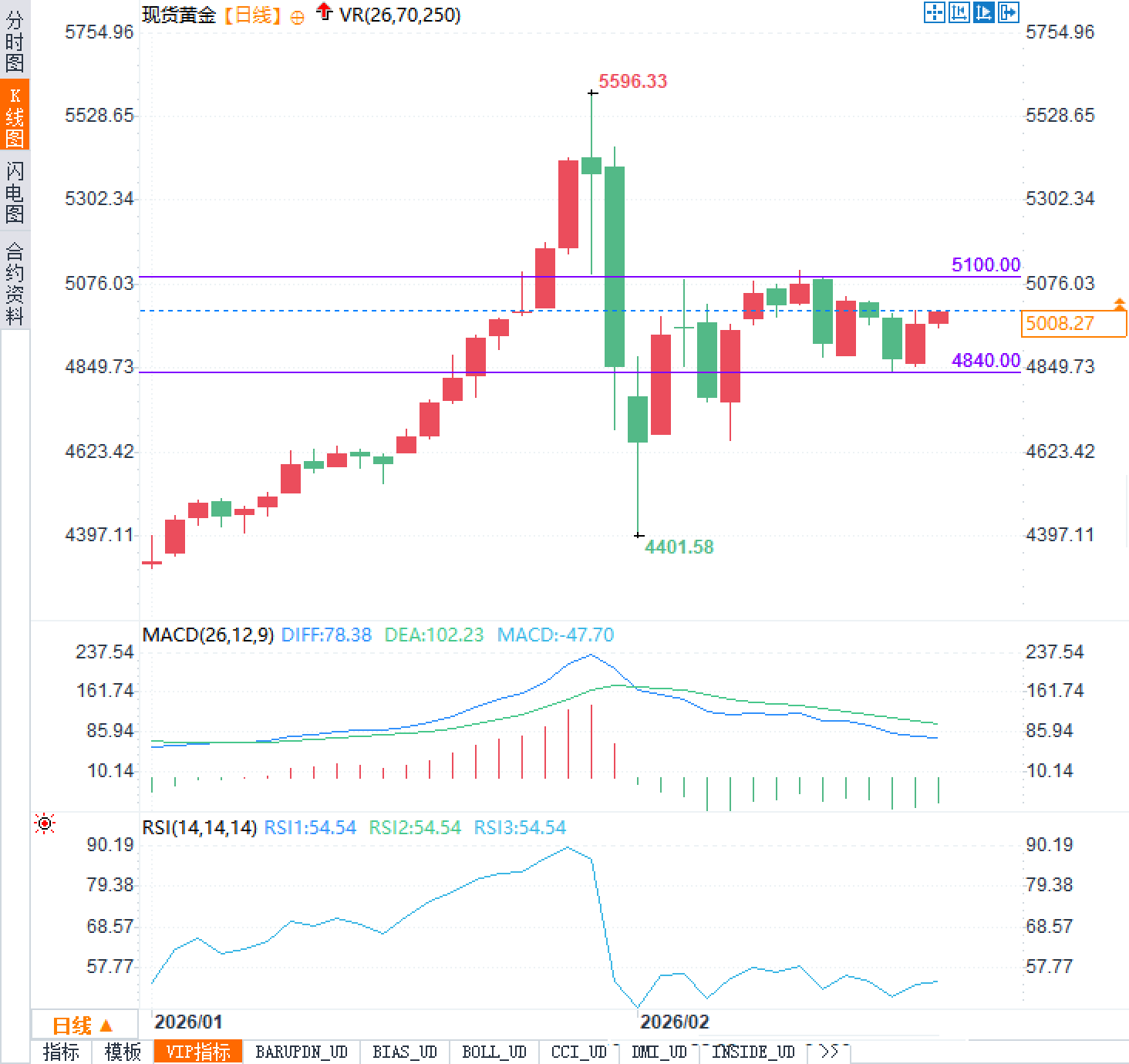
On the news front, Trump has not yet decided whether or when to take military action against Iran. Although relevant departments have made personnel adjustments in the Middle East as a precautionary measure, the overall situation remains in a wait-and-see and assessment phase. This uncertainty in policy path is itself the biggest challenge for trading. Trading related to war and geopolitical conflicts often follows a "first speculate on expectations, then realize profits" pattern. Therefore, a more prudent approach is to treat gold as a risk hedging tool rather than a single-direction bet. Around $5,000, the key is to observe whether the price tests of $5,100 and $4,840 are accompanied by increased trading volume and volatility. If it breaks through $5,100 and holds, the short-term trend may strengthen again; if it fails to break through multiple times and falls back to the lower edge of the range, it is more in line with the logic of range trading, and the strategy should focus more on controlling the risk of pullback. At present, the market is at the intersection of geopolitical uncertainty and cross-asset repricing. The position of spot gold at $5,008.27 is both a watershed for sentiment and positions and a collective vote by bulls and bears on the risks of the weekend events.
Analysts believe this tension is not unfounded, but stems from a sense of awe towards unknown risks. When uncertainty looms over the market, traders often prioritize stability over profit. Current market trends indicate that funds are withdrawing from high-risk areas and flowing into assets more resilient to storms. This is not merely a simple position adjustment, but a collective action on how to preserve capital in volatile situations.
Crude oil leads the charge: Will the specter of inflation reappear?
Yesterday, West Texas Intermediate (WTI) crude oil surged more than 4% in a single day, quickly rebounding to around $65. Technically, oil prices not only recovered lost ground but also firmly held the key support level of the 200-day moving average, highly consistent with the price action since the beginning of the month. This rapid rise in oil prices reflects, on the one hand, market concerns about supply disruption risks, incorporating a "risk premium" into prices; on the other hand, it may reignite market fears of rising short-term inflation, thereby influencing expectations regarding interest rate paths and the strength of the US dollar.
However, analysts believe that the rise in oil prices is more driven by anticipated trading based on geopolitical risks than by a trend confirmation of supply and demand fundamentals. Typically, when geopolitical conflicts trigger a surge in oil prices, the market increases its allocation to safe-haven assets in the short term. But once the news settles or the situation doesn't worsen further, profit-taking pressure will follow. This means that the current rise in oil prices is more like a game based on sentiment, fast-paced and highly volatile. If there are no substantial signs of escalation, oil prices are very likely to retrace and consolidate, and this volatility will directly transmit to other related assets, triggering a chain reaction.
Gold's Battle for $5000: The Ultimate Test of Bullish and Bearish Sentiment. As the epitome of safe-haven demand, spot gold is currently trading above $5000, clearly reflecting the return of safe-haven buying. In contrast, while silver has also risen to around $78, its short-term resistance is concentrated around $78.85. If it cannot break through effectively, it will likely maintain a consolidation phase. Gold's advantage lies in its more stable hedging properties during risk event windows. Especially against the backdrop of increased risk from weekend news, some funds will increase their gold positions to reduce the tail risk of their portfolios, making the $5000 area a crucial battleground for both bulls and bears.
Looking back at recent candlestick patterns, gold experienced a rapid pullback after surging to 5596.33, reaching a low of 4401.58, before entering a consolidation phase within a range. Currently, the market is in a rebalancing process within this range. The key resistance level is around 5100, while the crucial support level is around 4840. If the price fluctuates around 5000, it indicates that both bulls and bears are waiting for a new catalyst to break the deadlock. Analysts believe that if geopolitical risks continue to escalate and energy prices remain strong, gold is more likely to test the 5100 level; conversely, if there are no unexpected developments over the weekend, the retracement of risk premiums may lead to a short-term pullback in gold prices, at which point the area around 4840 will become the first hurdle to test the resilience of the bulls. If this area is effectively broken, the market may reassess the risk premium priced into the previous rise, and the trading range will passively widen.
On the news front, Trump has not yet decided whether or when to take military action against Iran. Although relevant departments have made personnel adjustments in the Middle East as a precautionary measure, the overall situation remains in a wait-and-see and assessment phase. This uncertainty in policy path is itself the biggest challenge for trading. Trading related to war and geopolitical conflicts often follows a "first speculate on expectations, then realize profits" pattern. Therefore, a more prudent approach is to treat gold as a risk hedging tool rather than a single-direction bet. Around $5,000, the key is to observe whether the price tests of $5,100 and $4,840 are accompanied by increased trading volume and volatility. If it breaks through $5,100 and holds, the short-term trend may strengthen again; if it fails to break through multiple times and falls back to the lower edge of the range, it is more in line with the logic of range trading, and the strategy should focus more on controlling the risk of pullback. At present, the market is at the intersection of geopolitical uncertainty and cross-asset repricing. The position of spot gold at $5,008.27 is both a watershed for sentiment and positions and a collective vote by bulls and bears on the risks of the weekend events.
- Risk Warning and Disclaimer
- The market involves risk, and trading may not be suitable for all investors. This article is for reference only and does not constitute personal investment advice, nor does it take into account certain users’ specific investment objectives, financial situation, or other needs. Any investment decisions made based on this information are at your own risk.