Why is the dollar failing to rise despite the Federal Reserve saying it's "in no hurry to cut interest rates"?
2026-02-19 17:00:19
On Thursday (February 19), the US dollar index traded in a narrow range around 97.50. The overnight release of the Federal Reserve meeting minutes revealed internal policy disagreements. While awaiting PMI data from Europe and the US, the market was also assessing the impact of Middle East geopolitical tensions on safe-haven flows. Technically, after a sharp V-shaped reversal at the end of January, the dollar is currently trading within a clear upward channel, but faces resistance from a key resistance zone. The narrowing of short-term volatility suggests a directional move is imminent.

The minutes of the Federal Reserve's January meeting, released early Thursday morning Beijing time, set the tone for market trading this week. The minutes showed that policymakers were not in a hurry to cut interest rates; on the contrary, "several" members were even open to restarting rate hikes, given the possibility of sticky inflation. This coexistence of hawkish and dovish stances effectively weakened market bets on short-term easing. Analysis from well-known institutions pointed out that the minutes suggest there is not a strong urgency to push for rate cuts before the current chairman's term ends in May. At the same time, the minutes mentioned that "most" participants believed the decline in inflation might be slow and uneven, while "several" members emphasized the suppressive effect of productivity gains on prices. This internal disagreement means the next chairman will face a complex situation when pursuing the interest rate path.
Data also provided some support for the US dollar. Data released on Wednesday showed that US factory output in January saw its largest increase in 11 months, with capital goods and housing starts also performing well. This laid a positive foundation for Friday's upcoming global PMI and US GDP data. If the data continues to be strong, it will reinforce the logic of the Federal Reserve maintaining its patience.
In contrast, while political rumors in the Eurozone initially caused volatility in the euro, they did not develop into a sustained trend. Earlier reports that ECB President Christine Lagarde might step down early caused a sharp drop in the euro. However, the market quickly and rationally assessed this. Macro strategists pointed out that the transfer of power at the Federal Reserve has a more crucial impact on the direction of global monetary policy than potential personnel changes at the ECB. Given that the potential successors at the ECB are still undecided between doves and hawks, and that its decision-making mechanism is subject to checks and balances from multiple countries, the impact of a single personnel rumor is limited. The euro's stabilization at the 1.18 level indicates that the market has largely digested this noise.
In other currencies, the Japanese yen weakened this week, with the USD/JPY pair briefly touching 154.96. This was driven by Japan's announcement of initial investment projects in the US, prompting deeper market reflection on capital flows. Research institutions point out that Japanese direct investment in the US is a key variable in this year's foreign exchange market, but its impact is complex: will it directly translate into demand for US dollars, or will it use foreign exchange reserves to guarantee dollar loans and thus prevent yen depreciation? Tokyo clearly leans towards the latter, adding uncertainty to the yen's trajectory. Commodity currencies showed significant divergence. The Australian dollar held steady at 0.7050, supported by employment data (unemployment rate remained low at 4.1%), while the New Zealand dollar rebounded slightly after recording its largest single-day drop in nearly a year following the central bank's cautious stance on future interest rate hikes.
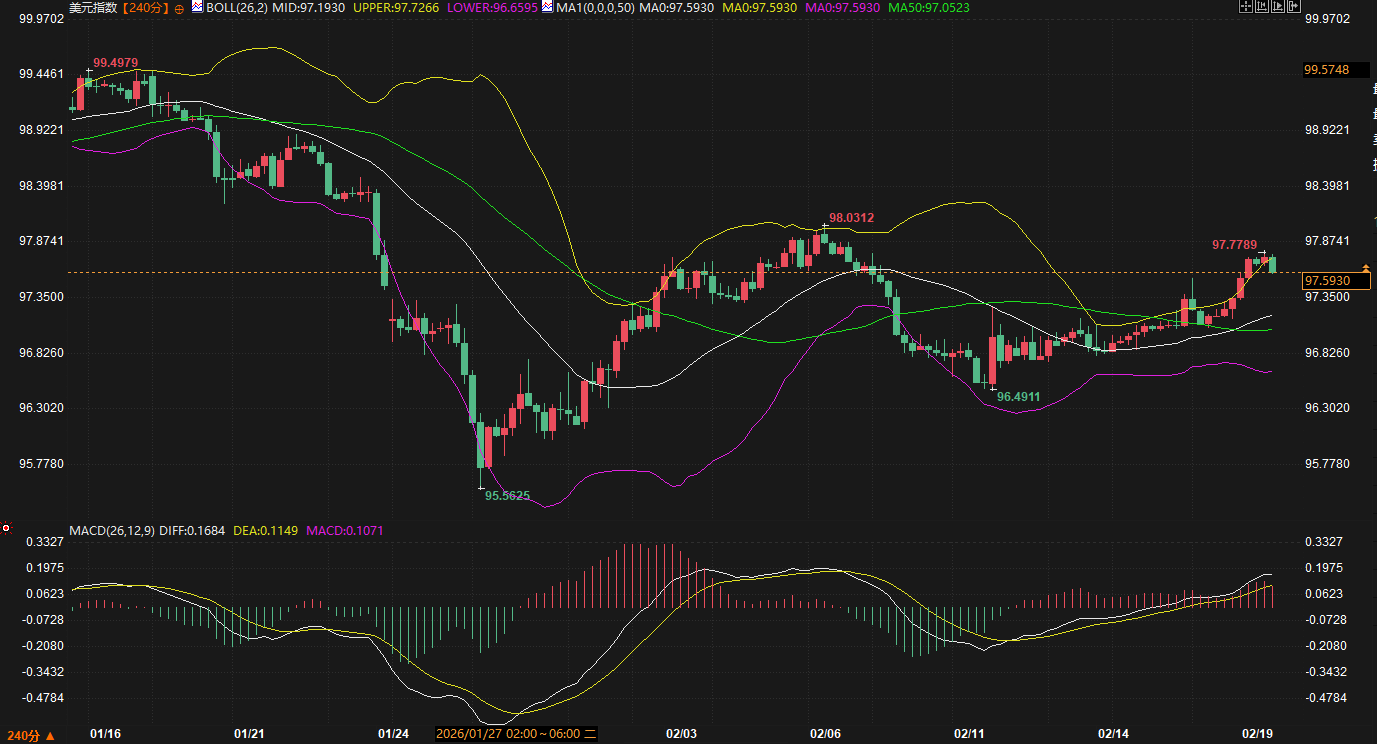
Observing the 240-minute chart, the US dollar index is at a critical juncture in its technical pattern. The chart clearly shows that after reaching a high of 99.4979 in mid-January, the exchange rate experienced a rapid and deep "inverted V-shaped" correction, finding support at 95.5625 at the end of January. Subsequently, the market entered an orderly rebound phase, with lower lows gradually rising (95.5625→96.4911→97.3500) and higher highs moving in tandem (97.7789→98.0312), forming a standard upward channel. As of the Asian and European sessions on February 19th, the price was trading around 97.5930, precisely within this channel.
Key support and resistance zones:
Reference Contract: US Dollar Index (Spot)
Support range: 97.3500 - 96.4911. The first line of defense is the lower edge of the recently tested medium-term consolidation range at 97.3500. If this level is breached, it means that the short-term upward structure has been broken, and the support level of the previous pullback low at 96.4911 will be tested. This level is also the area where the lower Bollinger Band is located.
Resistance zone: 98.0312 - 99.2210. The primary short-term target is the early February rebound high of 98.0312, which is an extension of the upper channel line. A decisive break above this level would allow the bulls to challenge the next resistance level at 99.2210.
Key focus during trading: The interaction between the price and the 10-day moving average (MA10) (97.5930). Currently, the MA10 is roughly in line with the current price. If the price can consistently hold above it during the trading session, the foundation for a rebound will be solid. Conversely, if the price breaks below the MA10, it may trigger a correction towards 97.3500 to seek support.
The indicator system also confirms this "ready to strike" state. In the moving average system, the MA10, MA30, and MA60 are converging within a narrow range of 97.59-97.65, indicating that the market's medium-term holding costs are converging, which is often a precursor to a trend reversal. The Bollinger Bands (26, 2) are currently narrowing, with the middle band providing support at 97.1930 and the upper band providing resistance at 97.2660. Although the price is trading above the middle band, the narrow range between the upper and lower bands (approximately 60 basis points) clearly reflects that current volatility has dropped to an extremely low level. Historical experience shows that extreme narrowing of the Bollinger Bands is often accompanied by the start of a new round of expansion. Meanwhile, the MACD (26, 12, 9) indicator below is releasing a relatively positive signal. The DIFF and DEA lines have formed a golden cross above the zero axis and are continuing to diverge upwards, with the red momentum bars continuing to expand moderately, indicating that in the short-term consolidation pattern, bullish momentum is still slowly accumulating.
In summary, the current foreign exchange market is at the end of a convergence between macroeconomic narratives and technical patterns. On the fundamental front, the Federal Reserve's policy path depends on data, while the disturbances from Eurozone political rumors have temporarily subsided. Market attention will focus on the upcoming release of European and American PMI data and US GDP data, seeking new clues about the resilience of economic growth and inflationary pressures. Technically, the dollar index's upward channel remains intact, and indicators suggest short-term momentum is biased towards the upside. However, the extremely narrow Bollinger Bands and converging moving averages indicate that the consolidation phase is nearing its end.
Looking ahead, the market is likely to continue its upward-biased testing in the short term, relying on the channel support at 97.35 and testing the resistance level at 98.03. However, the effectiveness of a breakout will heavily depend on whether new macroeconomic catalysts (such as better-than-expected economic data or geopolitical developments) emerge to stimulate volatility and provide momentum for prices to break through the Bollinger Bands. If the upward momentum falters, the risk of a price pullback to the lower channel line or even the lower Bollinger Band should be noted.
Fundamentals: The Fed minutes set the tone of "no rush to cut rates," and political noise in the Eurozone had limited impact.
The minutes of the Federal Reserve's January meeting, released early Thursday morning Beijing time, set the tone for market trading this week. The minutes showed that policymakers were not in a hurry to cut interest rates; on the contrary, "several" members were even open to restarting rate hikes, given the possibility of sticky inflation. This coexistence of hawkish and dovish stances effectively weakened market bets on short-term easing. Analysis from well-known institutions pointed out that the minutes suggest there is not a strong urgency to push for rate cuts before the current chairman's term ends in May. At the same time, the minutes mentioned that "most" participants believed the decline in inflation might be slow and uneven, while "several" members emphasized the suppressive effect of productivity gains on prices. This internal disagreement means the next chairman will face a complex situation when pursuing the interest rate path.
Data also provided some support for the US dollar. Data released on Wednesday showed that US factory output in January saw its largest increase in 11 months, with capital goods and housing starts also performing well. This laid a positive foundation for Friday's upcoming global PMI and US GDP data. If the data continues to be strong, it will reinforce the logic of the Federal Reserve maintaining its patience.
In contrast, while political rumors in the Eurozone initially caused volatility in the euro, they did not develop into a sustained trend. Earlier reports that ECB President Christine Lagarde might step down early caused a sharp drop in the euro. However, the market quickly and rationally assessed this. Macro strategists pointed out that the transfer of power at the Federal Reserve has a more crucial impact on the direction of global monetary policy than potential personnel changes at the ECB. Given that the potential successors at the ECB are still undecided between doves and hawks, and that its decision-making mechanism is subject to checks and balances from multiple countries, the impact of a single personnel rumor is limited. The euro's stabilization at the 1.18 level indicates that the market has largely digested this noise.
In other currencies, the Japanese yen weakened this week, with the USD/JPY pair briefly touching 154.96. This was driven by Japan's announcement of initial investment projects in the US, prompting deeper market reflection on capital flows. Research institutions point out that Japanese direct investment in the US is a key variable in this year's foreign exchange market, but its impact is complex: will it directly translate into demand for US dollars, or will it use foreign exchange reserves to guarantee dollar loans and thus prevent yen depreciation? Tokyo clearly leans towards the latter, adding uncertainty to the yen's trajectory. Commodity currencies showed significant divergence. The Australian dollar held steady at 0.7050, supported by employment data (unemployment rate remained low at 4.1%), while the New Zealand dollar rebounded slightly after recording its largest single-day drop in nearly a year following the central bank's cautious stance on future interest rate hikes.
Technical Analysis: The US dollar index has entered a key trading range; a breakout requires significant volume support.
Observing the 240-minute chart, the US dollar index is at a critical juncture in its technical pattern. The chart clearly shows that after reaching a high of 99.4979 in mid-January, the exchange rate experienced a rapid and deep "inverted V-shaped" correction, finding support at 95.5625 at the end of January. Subsequently, the market entered an orderly rebound phase, with lower lows gradually rising (95.5625→96.4911→97.3500) and higher highs moving in tandem (97.7789→98.0312), forming a standard upward channel. As of the Asian and European sessions on February 19th, the price was trading around 97.5930, precisely within this channel.
Key support and resistance zones:
Reference Contract: US Dollar Index (Spot)
Support range: 97.3500 - 96.4911. The first line of defense is the lower edge of the recently tested medium-term consolidation range at 97.3500. If this level is breached, it means that the short-term upward structure has been broken, and the support level of the previous pullback low at 96.4911 will be tested. This level is also the area where the lower Bollinger Band is located.
Resistance zone: 98.0312 - 99.2210. The primary short-term target is the early February rebound high of 98.0312, which is an extension of the upper channel line. A decisive break above this level would allow the bulls to challenge the next resistance level at 99.2210.
Key focus during trading: The interaction between the price and the 10-day moving average (MA10) (97.5930). Currently, the MA10 is roughly in line with the current price. If the price can consistently hold above it during the trading session, the foundation for a rebound will be solid. Conversely, if the price breaks below the MA10, it may trigger a correction towards 97.3500 to seek support.
The indicator system also confirms this "ready to strike" state. In the moving average system, the MA10, MA30, and MA60 are converging within a narrow range of 97.59-97.65, indicating that the market's medium-term holding costs are converging, which is often a precursor to a trend reversal. The Bollinger Bands (26, 2) are currently narrowing, with the middle band providing support at 97.1930 and the upper band providing resistance at 97.2660. Although the price is trading above the middle band, the narrow range between the upper and lower bands (approximately 60 basis points) clearly reflects that current volatility has dropped to an extremely low level. Historical experience shows that extreme narrowing of the Bollinger Bands is often accompanied by the start of a new round of expansion. Meanwhile, the MACD (26, 12, 9) indicator below is releasing a relatively positive signal. The DIFF and DEA lines have formed a golden cross above the zero axis and are continuing to diverge upwards, with the red momentum bars continuing to expand moderately, indicating that in the short-term consolidation pattern, bullish momentum is still slowly accumulating.
Trend Outlook: Awaiting Catalyst, Directional Decision Approaching
In summary, the current foreign exchange market is at the end of a convergence between macroeconomic narratives and technical patterns. On the fundamental front, the Federal Reserve's policy path depends on data, while the disturbances from Eurozone political rumors have temporarily subsided. Market attention will focus on the upcoming release of European and American PMI data and US GDP data, seeking new clues about the resilience of economic growth and inflationary pressures. Technically, the dollar index's upward channel remains intact, and indicators suggest short-term momentum is biased towards the upside. However, the extremely narrow Bollinger Bands and converging moving averages indicate that the consolidation phase is nearing its end.
Looking ahead, the market is likely to continue its upward-biased testing in the short term, relying on the channel support at 97.35 and testing the resistance level at 98.03. However, the effectiveness of a breakout will heavily depend on whether new macroeconomic catalysts (such as better-than-expected economic data or geopolitical developments) emerge to stimulate volatility and provide momentum for prices to break through the Bollinger Bands. If the upward momentum falters, the risk of a price pullback to the lower channel line or even the lower Bollinger Band should be noted.
- Risk Warning and Disclaimer
- The market involves risk, and trading may not be suitable for all investors. This article is for reference only and does not constitute personal investment advice, nor does it take into account certain users’ specific investment objectives, financial situation, or other needs. Any investment decisions made based on this information are at your own risk.