An $88.4 billion exodus? As US Treasury buyers become more "calculating," how long can the dollar remain stable?
2026-02-19 16:42:00
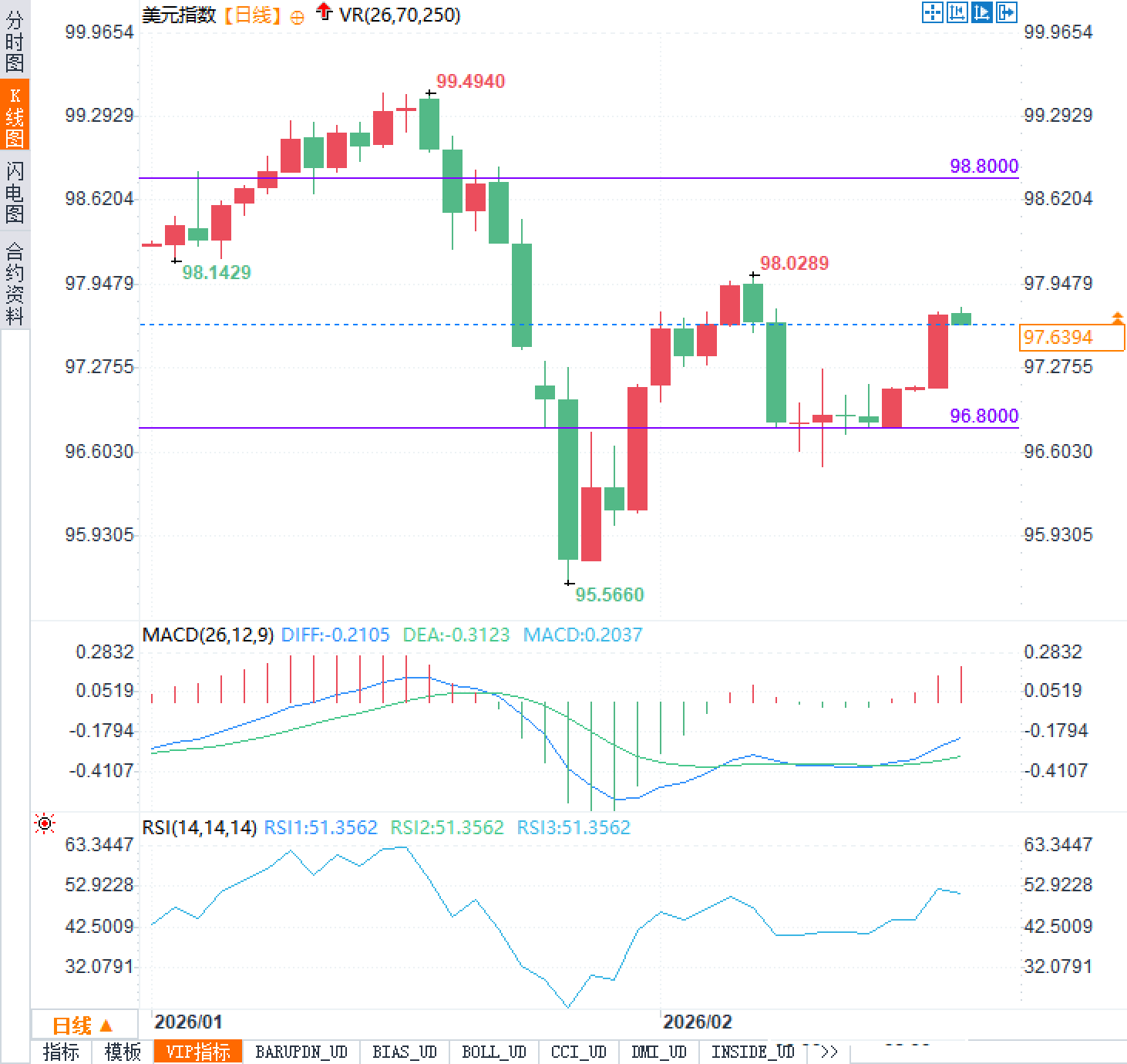
The US dollar index recently experienced a downward trend followed by stabilization at lower levels. Looking back at the daily chart, the price previously surged to a high of 99.4940 before encountering resistance and falling back to around 95.5660, where it formed a bottom and began to rebound. On Thursday, February 19th, the price returned above 97, making this a new battleground between bulls and bears.

From a technical perspective, the 96.8000 level forms a crucial short-term support/resistance level. Analysts believe that as long as this level holds, the current rebound is likely to continue; conversely, a break below this level could open up further downside potential. The 98.8000 area above represents both a previous area of high trading volume and the starting point of the previous pullback, forming a significant resistance zone. If the index repeatedly fails to break through this level, the market will likely revert to a range-bound trading pattern.
Technical indicators are also silently reflecting market hesitation. The MACD histogram has clearly converged and turned upward, indicating that the downward momentum is weakening; at the same time, the RSI indicator is hovering around 51, suggesting that market sentiment is in a delicate neutral state. There is neither strong bullish enthusiasm nor panic selling pressure. This means that a one-sided trend is becoming more difficult, and buying low and selling high between support and resistance levels may be the main strategy at present.
Beyond technical charts, investor attention is rapidly shifting towards interest rates and the supply and demand of Treasury bonds. The latest international capital flow statistics for December 2025 provide a unique window into the market. Data shows that foreign investors' holdings of US Treasury bonds fell slightly to $9.27 trillion that month, a decrease of $88.4 billion from the previous high of $9.36 trillion reached in November. While this single-month decline isn't dramatic, it represents the largest drop since the end of 2022. However, analysts point out that this is more like a normal consolidation after reaching a high point, rather than a fundamental reversal in demand trends. After all, the outstanding amount at the end of 2025 will still be significantly higher than the $8.5 trillion at the end of 2024, meaning that overseas demand for US debt assets will remain high throughout the year.
The key to understanding this data lies in clarifying the limitations of the statistical methodology. This statistic is primarily based on holdings recorded within the US custodian system. Therefore, some funds may be allocated through non-US custodian channels, ultimately appearing in the data as holdings in other financial intermediary locations. In other words, changes in nominal holdings within a single economy do not necessarily equate to changes in actual risk appetite; more often, they reflect shifts in custodian pathways and settlement chains. Some European financial centers often act as "transfer stations" in the data, serving both local institutions and providing flexible custodian arrangements for cross-border funds. Furthermore, the UK market's function as a global clearing and trading hub has been further strengthened post-pandemic, making it easier for fund ownership to be statistically concentrated in these locations. Therefore, behind the apparent fluctuations in the figures may lie a quiet relocation of funds within the global financial network.
More alarming than the monthly fluctuations is the structural shift in buying power. In the past, official institutions and reserve management agencies were seen as stabilizing "ballasts"; however, in recent years, the real growth has come more from market-based funds such as hedge funds, pension funds, and asset management institutions. These buyers' decision-making logic is more direct and ruthless, revolving around yields and term structure. Interest rate spreads, hedging costs, leverage, and risk budgets are their primary considerations. Compared to official institutions, they are extremely sensitive to prices and have very low tolerance for volatility. Once inflation expectations are repriced, the pace of fiscal supply changes, or risk appetite shifts sharply, yields are prone to short-term spikes, which in turn affect the fluctuation range of the US dollar index through complex transmission mechanisms.
This structural shift has a dual impact on the US dollar index. On the one hand, when rising yields bring substantial nominal returns and funding and hedging costs are manageable, astute market-driven funds may increase their holdings of US Treasuries, providing temporary support for the dollar and helping it stabilize at key levels. On the other hand, if a major event triggers a surge in volatility, or if market concerns about supply pressures lead to higher term premiums, these price-sensitive buyers may quickly deleverage or reduce their positions. In this case, a sharp rise in yields could suppress the dollar's stability through risk appetite channels, causing the index to fluctuate repeatedly near resistance levels. Throughout 2025, despite ongoing disagreements, overseas investors' total holdings of US Treasuries increased by $770 billion. However, the nature of demand has changed; it is no longer naturally stable but highly dependent on the attractiveness of yields and the ease of exit.
In conclusion, the current trading strategy should treat the US dollar index as a range-bound instrument influenced by both interest rates and capital flows. Analysts believe that in the short term, as long as the 96.8000 support level holds, the index may attempt to test 98.8000; however, if there is significant resistance above, it will likely fluctuate between 96.8000 and 98.8000. A slight decrease in monthly open interest is insufficient to shake the fact that demand is strong throughout the year, but the trend of buyers shifting from official to market-based mechanisms is significantly improving the transmission efficiency of interest rate fluctuations to the US dollar.
From a technical perspective, the 96.8000 level forms a crucial short-term support/resistance level. Analysts believe that as long as this level holds, the current rebound is likely to continue; conversely, a break below this level could open up further downside potential. The 98.8000 area above represents both a previous area of high trading volume and the starting point of the previous pullback, forming a significant resistance zone. If the index repeatedly fails to break through this level, the market will likely revert to a range-bound trading pattern.
Technical indicators are also silently reflecting market hesitation. The MACD histogram has clearly converged and turned upward, indicating that the downward momentum is weakening; at the same time, the RSI indicator is hovering around 51, suggesting that market sentiment is in a delicate neutral state. There is neither strong bullish enthusiasm nor panic selling pressure. This means that a one-sided trend is becoming more difficult, and buying low and selling high between support and resistance levels may be the main strategy at present.
The "illusion" of capital flows: the truth behind the custody route
Beyond technical charts, investor attention is rapidly shifting towards interest rates and the supply and demand of Treasury bonds. The latest international capital flow statistics for December 2025 provide a unique window into the market. Data shows that foreign investors' holdings of US Treasury bonds fell slightly to $9.27 trillion that month, a decrease of $88.4 billion from the previous high of $9.36 trillion reached in November. While this single-month decline isn't dramatic, it represents the largest drop since the end of 2022. However, analysts point out that this is more like a normal consolidation after reaching a high point, rather than a fundamental reversal in demand trends. After all, the outstanding amount at the end of 2025 will still be significantly higher than the $8.5 trillion at the end of 2024, meaning that overseas demand for US debt assets will remain high throughout the year.
The key to understanding this data lies in clarifying the limitations of the statistical methodology. This statistic is primarily based on holdings recorded within the US custodian system. Therefore, some funds may be allocated through non-US custodian channels, ultimately appearing in the data as holdings in other financial intermediary locations. In other words, changes in nominal holdings within a single economy do not necessarily equate to changes in actual risk appetite; more often, they reflect shifts in custodian pathways and settlement chains. Some European financial centers often act as "transfer stations" in the data, serving both local institutions and providing flexible custodian arrangements for cross-border funds. Furthermore, the UK market's function as a global clearing and trading hub has been further strengthened post-pandemic, making it easier for fund ownership to be statistically concentrated in these locations. Therefore, behind the apparent fluctuations in the figures may lie a quiet relocation of funds within the global financial network.
The "face-changing" buying structure: the sensitive nerves of market-based funds
More alarming than the monthly fluctuations is the structural shift in buying power. In the past, official institutions and reserve management agencies were seen as stabilizing "ballasts"; however, in recent years, the real growth has come more from market-based funds such as hedge funds, pension funds, and asset management institutions. These buyers' decision-making logic is more direct and ruthless, revolving around yields and term structure. Interest rate spreads, hedging costs, leverage, and risk budgets are their primary considerations. Compared to official institutions, they are extremely sensitive to prices and have very low tolerance for volatility. Once inflation expectations are repriced, the pace of fiscal supply changes, or risk appetite shifts sharply, yields are prone to short-term spikes, which in turn affect the fluctuation range of the US dollar index through complex transmission mechanisms.
This structural shift has a dual impact on the US dollar index. On the one hand, when rising yields bring substantial nominal returns and funding and hedging costs are manageable, astute market-driven funds may increase their holdings of US Treasuries, providing temporary support for the dollar and helping it stabilize at key levels. On the other hand, if a major event triggers a surge in volatility, or if market concerns about supply pressures lead to higher term premiums, these price-sensitive buyers may quickly deleverage or reduce their positions. In this case, a sharp rise in yields could suppress the dollar's stability through risk appetite channels, causing the index to fluctuate repeatedly near resistance levels. Throughout 2025, despite ongoing disagreements, overseas investors' total holdings of US Treasuries increased by $770 billion. However, the nature of demand has changed; it is no longer naturally stable but highly dependent on the attractiveness of yields and the ease of exit.
In conclusion, the current trading strategy should treat the US dollar index as a range-bound instrument influenced by both interest rates and capital flows. Analysts believe that in the short term, as long as the 96.8000 support level holds, the index may attempt to test 98.8000; however, if there is significant resistance above, it will likely fluctuate between 96.8000 and 98.8000. A slight decrease in monthly open interest is insufficient to shake the fact that demand is strong throughout the year, but the trend of buyers shifting from official to market-based mechanisms is significantly improving the transmission efficiency of interest rate fluctuations to the US dollar.
- Risk Warning and Disclaimer
- The market involves risk, and trading may not be suitable for all investors. This article is for reference only and does not constitute personal investment advice, nor does it take into account certain users’ specific investment objectives, financial situation, or other needs. Any investment decisions made based on this information are at your own risk.