Gold Trading Alert: Bulls and bears battle at the 5000 mark; Iran's ultimatum versus the US PCE nuclear test – who will ignite the next market move?
2026-02-20 08:09:32
On Thursday (February 19), the gold market saw a back-and-forth struggle between bulls and bears. Spot gold briefly touched a record high of $5022.15 per ounce before finally closing at $4995.83 per ounce, a slight increase of 0.4%. What undercurrents lie behind this near-flat figure? Investors are at a crossroads, facing Trump's "10-day ultimatum" to Iran on one side, and the upcoming US PCE inflation data—an "economic bomb"—on the other. Gold is searching for its direction amidst the smoke of geopolitical conflict and the cold light of economic data. On Friday (February 20) in early Asian trading, spot gold fluctuated slightly lower, currently trading around $4988 per ounce.
Daniel Pavilonis, senior market strategist at RJO Futures, noted, "The market is experiencing significant volatility and is consolidating sideways." This statement accurately captures the essence of the current gold market—a fierce battle between bulls and bears at the psychological level of $5,000, with neither side able to gain a decisive advantage. And this is precisely the most suffocating calm before the storm.
Dark clouds have once again descended upon the Middle East. US President Trump issued a stern warning on Thursday, demanding that Iran reach an agreement on its nuclear program or face "very bad things." Even more alarming, Trump appeared to set a deadline of no more than 10 to 15 days, after which the US might take military action. This statement immediately sent shockwaves through global financial markets.
The footsteps of war are drawing near. It is understood that Trump is considering an initial, limited military strike against Iran, targeting a few military or government sites. Sources familiar with the matter indicate that, if authorized, the first attack could occur within days. More worryingly, this is merely an "appetizer"—if Iran continues to refuse to comply with Trump's directive to end its nuclear enrichment activities, the United States will respond with a broad-based operation targeting the regime's facilities, with the potential goal of overthrowing the Tehran government.
Meanwhile, the US military is massively increasing its troop presence in the Middle East, with warships and fighter jets already deployed. The Kremlin has issued an urgent appeal for restraint from all parties, but tensions continue to escalate. Oil prices have risen in response, as markets worry about a potential new attack on Iran, which could trigger instability throughout the Middle East.
Historically, gold and geopolitical risks have always been inextricably linked. From the 1979 Iranian hostage crisis to the 1990 Gulf War and the 2003 Iraq War, each period of tension in the Middle East has driven gold prices significantly higher. This time, the situation is even more complex—Iran is not only a major oil producer but also controls the Strait of Hormuz, a vital chokepoint for global oil transport. If war breaks out, the consequences would be unimaginable. Against this backdrop, gold, as the ultimate safe-haven asset, is quietly accumulating a safe-haven premium.
However, geopolitics is not the only factor influencing gold prices. Across the Pacific, US economic data is telling a different story. Data released by the US Department of Labor on Thursday showed that initial jobless claims fell to 206,000 in the week ending February 14, far below the expected 225,000. This larger-than-expected drop further confirms the economic resilience signaled by last week's strong monthly jobs report.
The Federal Reserve's minutes from its January 27-28 policy meeting explicitly stated that "the vast majority of policymakers believed that the labor market had shown signs of stabilization." Minneapolis Fed President Neel Kashkari went even further, stating that the labor market remained "quite resilient" and that the Fed was close to achieving its dual goals of full employment and price stability.
However, beneath the surface of apparent prosperity lies a hidden worry. In the week ending February 7, continuing jobless claims rose by 17,000 to a seasonally adjusted 1.869 million. This data sends a significant signal—those who have left their jobs are facing difficulties in finding new employment. Labor market liquidity is declining, a typical characteristic of the late stages of an economic cycle.
It is precisely this situation of "overall stability but emerging structural problems" that has put the Federal Reserve in a dilemma. The meeting minutes show that policymakers are clearly divided on the direction of US interest rates. Several policymakers are open to raising rates if inflation remains high, a hawkish stance that exceeded market expectations. However, at the same time, some members are concerned about downside risks in the labor market. This internal division means that future policy direction will be highly dependent on upcoming economic data.
The U.S. Personal Consumption Expenditures Price Index, to be released on Friday, has become a key variable determining the short-term direction of gold prices. As the Federal Reserve's preferred inflation indicator, this report will provide the market with important clues about the future path of monetary policy.
The current situation is quite delicate. On the one hand, the US economy has shown greater resilience than expected, with initial jobless claims declining and the labor market stabilizing. On the other hand, there are disagreements within the Federal Reserve regarding the inflation outlook, with some members concerned that price pressures may remain high, necessitating further tightening of monetary policy. Adding to the complexity, the trade deficit widened sharply to $70.3 billion in December, far exceeding expectations, casting a shadow over the economic growth outlook.
Against this backdrop, Friday's PCE data will be crucial. Higher-than-expected inflation data will reinforce the Fed's hawkish stance, which typically puts downward pressure on gold prices. However, if the data shows easing inflationary pressures, it will support a dovish policy stance, thereby driving gold prices higher.
Michael Lorizio, Head of U.S. Interest Rates and Mortgage Trading at Manulife Investment Management, offered a insightful observation: "Compared to our views a few weeks ago, the upside potential of the economy and the range of possible overall outcomes are more constrained." This statement reveals a shift in market sentiment—from previous optimism to cautious observation. This sentiment is vividly reflected in the bond market: the 10-year Treasury yield is fluctuating between 4.018% and 4.313%, while the 2-year Treasury yield is hovering between 3.385% and 3.468%, as traders await a clear directional signal.
The dollar's performance has consistently played a crucial role influencing gold prices. On Thursday, the dollar index strengthened for the fourth consecutive trading day, rising 0.19% to 97.88, a near two-week high. This marks the dollar's longest winning streak since early January.
The strength of the US dollar is mainly due to the relative resilience of the US economy. Joseph Trevisani, senior analyst at FXStreet in New York, points out, "This doesn't seem like an economy plagued by high interest rates." This statement accurately summarizes the current market sentiment—despite relatively high interest rates, the US economy continues to demonstrate strong performance.
However, the relationship between the US dollar and gold has never been a simple negative correlation. Given the current escalating geopolitical risks, both could strengthen simultaneously. Historically, during major crises, we have often seen both the US dollar and gold sought after as safe-haven assets. Will history repeat itself this time? The key lies in the nature of the crisis—if the crisis is confined to the Middle East, the US dollar may strengthen due to safe-haven inflows, while gold will also benefit from safe-haven demand. But if the crisis spreads and threatens global economic growth, gold may perform even better.
From a technical perspective, $5,000 per ounce has become the focal point of contention between gold bulls and bears. Gold prices briefly broke through $5,022 on Thursday, but failed to close above the $5,000 mark, indicating that this level represents significant psychological resistance.
It's worth noting that gold's recent price action has exhibited a typical "two steps forward, one step back" pattern. While the overall trend is upward, the fluctuations and pullbacks along the way have been quite pronounced. This type of movement usually indicates that the market is at a critical turning point—either a continuation of the uptrend, accumulating energy for the next round of gains, or a topping area, potentially brewing a significant pullback.
From a weekly chart perspective, the upward trend in gold that began at the end of 2024 has lasted for over a year, with a remarkable cumulative increase. No asset can rise indefinitely; appropriate pullbacks are actually beneficial for the healthy development of a long-term bull market. The key is to determine the nature of the pullback—is it a trend reversal or a normal adjustment within an uptrend?
The price action of silver deserves particular attention. On Thursday, spot silver rose 1.7% to $78.35 per ounce, following a gain of over 5% on Wednesday. This continued strong performance warrants careful consideration.
In the precious metals market, silver is often considered a leading indicator for gold. Because silver possesses the dual attributes of both a precious metal and an industrial metal, its volatility is typically higher than that of gold. When a bull market in precious metals begins, silver often leads the way and outperforms gold; conversely, when the market is nearing its end, silver tends to peak earlier.
The recent sharp rise in silver prices during gold's consolidation period raises the question of whether gold is poised for a new breakout. This is a question worth considering. However, the sideways movement in platinum and the decline in palladium also remind us of the divergence within the precious metals market—platinum is fluctuating around $2070, while palladium fell as much as 3% to $1651 during the session. This divergence suggests that a unified bullish sentiment has not yet formed in the market.
Gold, hovering near the $5,000 mark, is undergoing a process of hedging and balancing multiple forces. The tensions between the US and Iran hang like a Damocles' sword, potentially triggering safe-haven buying at any time; the resilience of the US labor market provides justification for the Federal Reserve to maintain a hawkish stance, putting downward pressure on gold prices; the upcoming PCE data could be a catalyst to break this balance; and the battle for key technical levels reflects the delicate equilibrium between bullish and bearish forces.
For investors, the wisest strategy at present is perhaps to remain cautious, neither chasing highs nor shorting prematurely. In the short term, gold prices may continue to fluctuate within the $4950-$5050 range, awaiting a clear breakout signal. This signal could come from two sources: either a substantial deterioration in the US-Iran situation, pushing gold prices higher; or stronger-than-expected PCE data causing the market to reassess expectations for Fed policy, thereby pushing gold prices down below support.
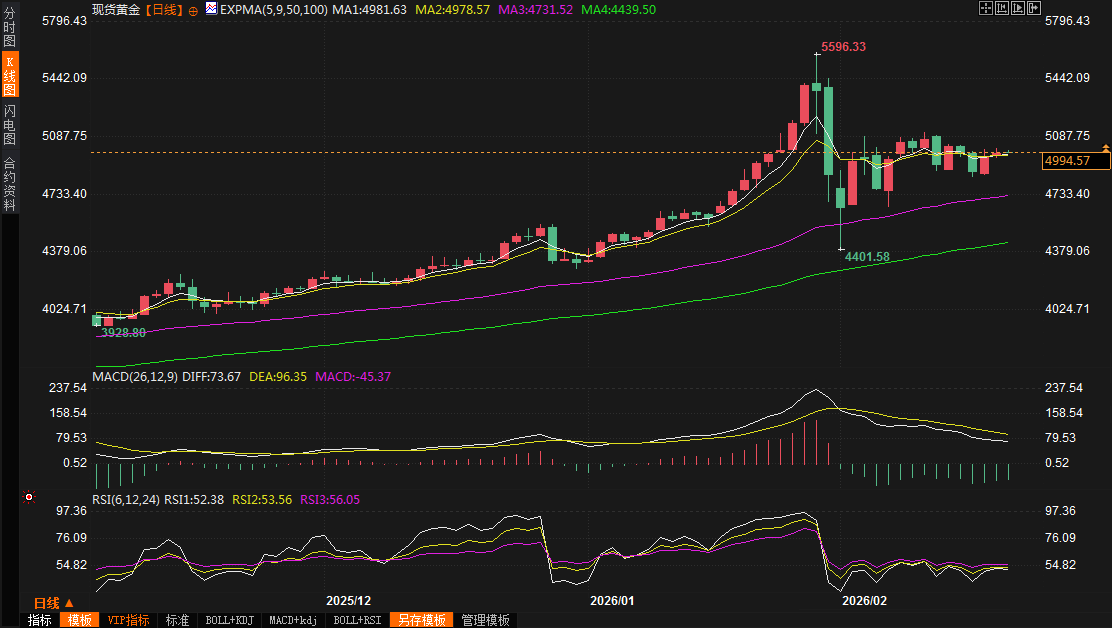
(Spot gold daily chart, source: FX678)
At 08:05 Beijing time, spot gold was trading at $4992.73 per ounce.
Daniel Pavilonis, senior market strategist at RJO Futures, noted, "The market is experiencing significant volatility and is consolidating sideways." This statement accurately captures the essence of the current gold market—a fierce battle between bulls and bears at the psychological level of $5,000, with neither side able to gain a decisive advantage. And this is precisely the most suffocating calm before the storm.
The US-Iran Crisis: Trump's "Ten-Day Deadline" and the Countdown to War
Dark clouds have once again descended upon the Middle East. US President Trump issued a stern warning on Thursday, demanding that Iran reach an agreement on its nuclear program or face "very bad things." Even more alarming, Trump appeared to set a deadline of no more than 10 to 15 days, after which the US might take military action. This statement immediately sent shockwaves through global financial markets.
The footsteps of war are drawing near. It is understood that Trump is considering an initial, limited military strike against Iran, targeting a few military or government sites. Sources familiar with the matter indicate that, if authorized, the first attack could occur within days. More worryingly, this is merely an "appetizer"—if Iran continues to refuse to comply with Trump's directive to end its nuclear enrichment activities, the United States will respond with a broad-based operation targeting the regime's facilities, with the potential goal of overthrowing the Tehran government.
Meanwhile, the US military is massively increasing its troop presence in the Middle East, with warships and fighter jets already deployed. The Kremlin has issued an urgent appeal for restraint from all parties, but tensions continue to escalate. Oil prices have risen in response, as markets worry about a potential new attack on Iran, which could trigger instability throughout the Middle East.
Historically, gold and geopolitical risks have always been inextricably linked. From the 1979 Iranian hostage crisis to the 1990 Gulf War and the 2003 Iraq War, each period of tension in the Middle East has driven gold prices significantly higher. This time, the situation is even more complex—Iran is not only a major oil producer but also controls the Strait of Hormuz, a vital chokepoint for global oil transport. If war breaks out, the consequences would be unimaginable. Against this backdrop, gold, as the ultimate safe-haven asset, is quietly accumulating a safe-haven premium.
US Labor Market: Resilience and Hidden Concerns
However, geopolitics is not the only factor influencing gold prices. Across the Pacific, US economic data is telling a different story. Data released by the US Department of Labor on Thursday showed that initial jobless claims fell to 206,000 in the week ending February 14, far below the expected 225,000. This larger-than-expected drop further confirms the economic resilience signaled by last week's strong monthly jobs report.
The Federal Reserve's minutes from its January 27-28 policy meeting explicitly stated that "the vast majority of policymakers believed that the labor market had shown signs of stabilization." Minneapolis Fed President Neel Kashkari went even further, stating that the labor market remained "quite resilient" and that the Fed was close to achieving its dual goals of full employment and price stability.
However, beneath the surface of apparent prosperity lies a hidden worry. In the week ending February 7, continuing jobless claims rose by 17,000 to a seasonally adjusted 1.869 million. This data sends a significant signal—those who have left their jobs are facing difficulties in finding new employment. Labor market liquidity is declining, a typical characteristic of the late stages of an economic cycle.
It is precisely this situation of "overall stability but emerging structural problems" that has put the Federal Reserve in a dilemma. The meeting minutes show that policymakers are clearly divided on the direction of US interest rates. Several policymakers are open to raising rates if inflation remains high, a hawkish stance that exceeded market expectations. However, at the same time, some members are concerned about downside risks in the labor market. This internal division means that future policy direction will be highly dependent on upcoming economic data.
Inflation data: A crossroads for Fed policy
The U.S. Personal Consumption Expenditures Price Index, to be released on Friday, has become a key variable determining the short-term direction of gold prices. As the Federal Reserve's preferred inflation indicator, this report will provide the market with important clues about the future path of monetary policy.
The current situation is quite delicate. On the one hand, the US economy has shown greater resilience than expected, with initial jobless claims declining and the labor market stabilizing. On the other hand, there are disagreements within the Federal Reserve regarding the inflation outlook, with some members concerned that price pressures may remain high, necessitating further tightening of monetary policy. Adding to the complexity, the trade deficit widened sharply to $70.3 billion in December, far exceeding expectations, casting a shadow over the economic growth outlook.
Against this backdrop, Friday's PCE data will be crucial. Higher-than-expected inflation data will reinforce the Fed's hawkish stance, which typically puts downward pressure on gold prices. However, if the data shows easing inflationary pressures, it will support a dovish policy stance, thereby driving gold prices higher.
Michael Lorizio, Head of U.S. Interest Rates and Mortgage Trading at Manulife Investment Management, offered a insightful observation: "Compared to our views a few weeks ago, the upside potential of the economy and the range of possible overall outcomes are more constrained." This statement reveals a shift in market sentiment—from previous optimism to cautious observation. This sentiment is vividly reflected in the bond market: the 10-year Treasury yield is fluctuating between 4.018% and 4.313%, while the 2-year Treasury yield is hovering between 3.385% and 3.468%, as traders await a clear directional signal.
US Dollar and Gold: A Classic Seesaw Game
The dollar's performance has consistently played a crucial role influencing gold prices. On Thursday, the dollar index strengthened for the fourth consecutive trading day, rising 0.19% to 97.88, a near two-week high. This marks the dollar's longest winning streak since early January.
The strength of the US dollar is mainly due to the relative resilience of the US economy. Joseph Trevisani, senior analyst at FXStreet in New York, points out, "This doesn't seem like an economy plagued by high interest rates." This statement accurately summarizes the current market sentiment—despite relatively high interest rates, the US economy continues to demonstrate strong performance.
However, the relationship between the US dollar and gold has never been a simple negative correlation. Given the current escalating geopolitical risks, both could strengthen simultaneously. Historically, during major crises, we have often seen both the US dollar and gold sought after as safe-haven assets. Will history repeat itself this time? The key lies in the nature of the crisis—if the crisis is confined to the Middle East, the US dollar may strengthen due to safe-haven inflows, while gold will also benefit from safe-haven demand. But if the crisis spreads and threatens global economic growth, gold may perform even better.
Technical Analysis: The Strategic Significance of the $5,000 Level
From a technical perspective, $5,000 per ounce has become the focal point of contention between gold bulls and bears. Gold prices briefly broke through $5,022 on Thursday, but failed to close above the $5,000 mark, indicating that this level represents significant psychological resistance.
It's worth noting that gold's recent price action has exhibited a typical "two steps forward, one step back" pattern. While the overall trend is upward, the fluctuations and pullbacks along the way have been quite pronounced. This type of movement usually indicates that the market is at a critical turning point—either a continuation of the uptrend, accumulating energy for the next round of gains, or a topping area, potentially brewing a significant pullback.
From a weekly chart perspective, the upward trend in gold that began at the end of 2024 has lasted for over a year, with a remarkable cumulative increase. No asset can rise indefinitely; appropriate pullbacks are actually beneficial for the healthy development of a long-term bull market. The key is to determine the nature of the pullback—is it a trend reversal or a normal adjustment within an uptrend?
Silver's unusual movements: a leading indicator for gold?
The price action of silver deserves particular attention. On Thursday, spot silver rose 1.7% to $78.35 per ounce, following a gain of over 5% on Wednesday. This continued strong performance warrants careful consideration.
In the precious metals market, silver is often considered a leading indicator for gold. Because silver possesses the dual attributes of both a precious metal and an industrial metal, its volatility is typically higher than that of gold. When a bull market in precious metals begins, silver often leads the way and outperforms gold; conversely, when the market is nearing its end, silver tends to peak earlier.
The recent sharp rise in silver prices during gold's consolidation period raises the question of whether gold is poised for a new breakout. This is a question worth considering. However, the sideways movement in platinum and the decline in palladium also remind us of the divergence within the precious metals market—platinum is fluctuating around $2070, while palladium fell as much as 3% to $1651 during the session. This divergence suggests that a unified bullish sentiment has not yet formed in the market.
Conclusion: The calm before the storm, or the approaching turning point?
Gold, hovering near the $5,000 mark, is undergoing a process of hedging and balancing multiple forces. The tensions between the US and Iran hang like a Damocles' sword, potentially triggering safe-haven buying at any time; the resilience of the US labor market provides justification for the Federal Reserve to maintain a hawkish stance, putting downward pressure on gold prices; the upcoming PCE data could be a catalyst to break this balance; and the battle for key technical levels reflects the delicate equilibrium between bullish and bearish forces.
For investors, the wisest strategy at present is perhaps to remain cautious, neither chasing highs nor shorting prematurely. In the short term, gold prices may continue to fluctuate within the $4950-$5050 range, awaiting a clear breakout signal. This signal could come from two sources: either a substantial deterioration in the US-Iran situation, pushing gold prices higher; or stronger-than-expected PCE data causing the market to reassess expectations for Fed policy, thereby pushing gold prices down below support.
(Spot gold daily chart, source: FX678)
At 08:05 Beijing time, spot gold was trading at $4992.73 per ounce.
- Risk Warning and Disclaimer
- The market involves risk, and trading may not be suitable for all investors. This article is for reference only and does not constitute personal investment advice, nor does it take into account certain users’ specific investment objectives, financial situation, or other needs. Any investment decisions made based on this information are at your own risk.