The Fed's hawkish stance is suppressing gold's gains, and it is expected to remain in a high-level consolidation phase in the short term.
2026-02-24 14:05:02
On Tuesday, the XAU/USD pair showed a clear pattern of rising and then falling during the Asian session. Gold, after hitting a monthly high of $5230, quickly retreated, ending its previous upward trend.
Market funds have begun to shift from short-term chasing of rising prices to profit-taking, causing a significant slowdown in the upward slope of gold prices. US monetary policy remains the core variable influencing gold's price movement. Recent minutes from the Federal Reserve meeting show that many officials believe that a new round of easing should not be rushed before the downward trend in inflation has fully stabilized.

Federal Reserve Governor Christopher Waller stated that if the U.S. job market demonstrates greater resilience in future data, the Fed may maintain interest rates in the near term. Meanwhile, changes in U.S. trade policy are also impacting market sentiment.
US President Trump's proposed new global tariffs have raised concerns about the global economic growth outlook. While slower economic growth typically increases demand for gold as a safe haven, current market trading is more driven by dollar liquidity and interest rate expectations.
Geopolitically, the situation in the Middle East remains a potential source of conflict, and the market continues to focus on the progress of the US-Iran nuclear negotiations. The risk of potential military conflict typically increases demand for safe-haven assets, providing medium- to long-term support for gold. Overall, gold is currently in a phase of balancing between support from macroeconomic uncertainty and suppression from monetary policy.
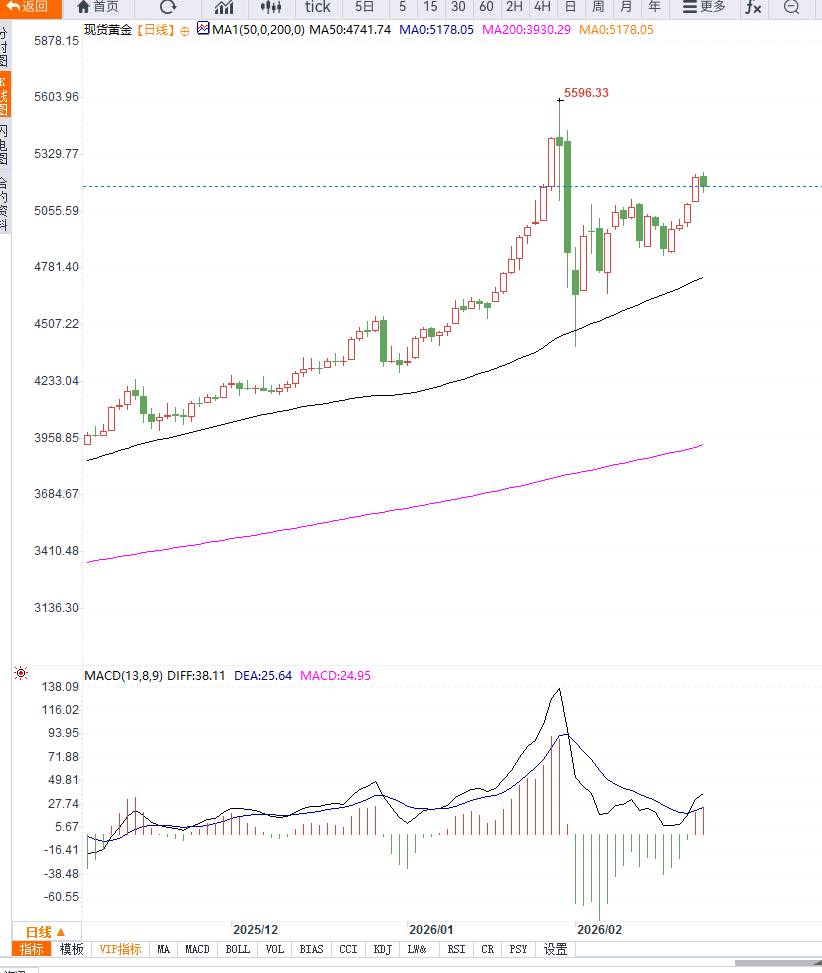
From a daily chart perspective, the overall trend for gold remains bullish, but it has entered a short-term structural correction phase following the recent rise. The price has retreated after forming a temporary high near $5230, indicating that short-term bullish momentum is gradually weakening.
Regarding the moving average system, gold is still trading above its medium- and long-term moving averages, but a significant gap has emerged between the price and these averages. While the short-term moving averages continue their upward trend, the rapid price increase has led to a widening technical divergence, creating a market demand for a return to the mean.
The 50-day exponential moving average will act as a key dynamic support zone. In the medium to long term, the 200-day exponential moving average remains significantly below the price, indicating that the long-term bullish structure has not been broken. As long as the price does not fall below the medium-term trend support, the overall market can still be considered a correction within an uptrend.
The upper resistance is at $5230, the previous high is at $5300, and the lower support is at $5100. The short-term watershed is the psychological level of $5000, a strong support. If the price stabilizes above $5250 again, it may reopen the upside potential; if it falls below $5000, it may enter a deeper correction cycle.
Editor's Note:
The current gold price movement resembles a temporary consolidation within a bull market structure, rather than the formation of a trend top. Federal Reserve policy remains the most important factor influencing short-term gold prices, and the uncertainty surrounding the interest rate path limits the potential for a one-sided upward move in gold prices.
The future direction of gold prices will depend on three main variables: the performance of US employment market data; changes in the pace of interest rate cuts by the Federal Reserve; and the evolution of global geopolitical risks.
Market funds have begun to shift from short-term chasing of rising prices to profit-taking, causing a significant slowdown in the upward slope of gold prices. US monetary policy remains the core variable influencing gold's price movement. Recent minutes from the Federal Reserve meeting show that many officials believe that a new round of easing should not be rushed before the downward trend in inflation has fully stabilized.
Federal Reserve Governor Christopher Waller stated that if the U.S. job market demonstrates greater resilience in future data, the Fed may maintain interest rates in the near term. Meanwhile, changes in U.S. trade policy are also impacting market sentiment.
US President Trump's proposed new global tariffs have raised concerns about the global economic growth outlook. While slower economic growth typically increases demand for gold as a safe haven, current market trading is more driven by dollar liquidity and interest rate expectations.
Geopolitically, the situation in the Middle East remains a potential source of conflict, and the market continues to focus on the progress of the US-Iran nuclear negotiations. The risk of potential military conflict typically increases demand for safe-haven assets, providing medium- to long-term support for gold. Overall, gold is currently in a phase of balancing between support from macroeconomic uncertainty and suppression from monetary policy.
From a daily chart perspective, the overall trend for gold remains bullish, but it has entered a short-term structural correction phase following the recent rise. The price has retreated after forming a temporary high near $5230, indicating that short-term bullish momentum is gradually weakening.
Regarding the moving average system, gold is still trading above its medium- and long-term moving averages, but a significant gap has emerged between the price and these averages. While the short-term moving averages continue their upward trend, the rapid price increase has led to a widening technical divergence, creating a market demand for a return to the mean.
The 50-day exponential moving average will act as a key dynamic support zone. In the medium to long term, the 200-day exponential moving average remains significantly below the price, indicating that the long-term bullish structure has not been broken. As long as the price does not fall below the medium-term trend support, the overall market can still be considered a correction within an uptrend.
The upper resistance is at $5230, the previous high is at $5300, and the lower support is at $5100. The short-term watershed is the psychological level of $5000, a strong support. If the price stabilizes above $5250 again, it may reopen the upside potential; if it falls below $5000, it may enter a deeper correction cycle.
Editor's Note:
The current gold price movement resembles a temporary consolidation within a bull market structure, rather than the formation of a trend top. Federal Reserve policy remains the most important factor influencing short-term gold prices, and the uncertainty surrounding the interest rate path limits the potential for a one-sided upward move in gold prices.
The future direction of gold prices will depend on three main variables: the performance of US employment market data; changes in the pace of interest rate cuts by the Federal Reserve; and the evolution of global geopolitical risks.
- Risk Warning and Disclaimer
- The market involves risk, and trading may not be suitable for all investors. This article is for reference only and does not constitute personal investment advice, nor does it take into account certain users’ specific investment objectives, financial situation, or other needs. Any investment decisions made based on this information are at your own risk.