Japanese bond yields have gone crazy, so why is the yen still falling? If it holds at 156, will it continue to rise?
2026-02-25 19:03:38
On Wednesday (February 25), the USD/JPY exchange rate showed a strong upward trend. It reached a high of 156.775 and a low of 155.343 during the session. Looking at the candlestick chart, the exchange rate has essentially recovered the losses of the previous two trading days, indicating that the market's bullish momentum remains strong.

Today's market focus revolved around the dramatic fluctuations in Japanese government bond (JGB) yields. A well-known institution's analysis pointed out that JGB futures opened with a 31-point jump, reaching 133.01, but subsequently reversed course, resulting in a significantly steeper yield curve. Behind this phenomenon is heightened market concern that the Bank of Japan's (BOJ) policy normalization pace may slow.
On the news front, Japanese Prime Minister Shigeru Ishiba expressed reservations about further interest rate hikes during his meeting with Bank of Japan Governor Kazuo Ueda on February 16. This news, after some time, continues to influence the market today. More crucially, the government's two newly nominated Bank of Japan policy board members—Toshiro Asada and Ayano Sato—have contrasting views. Asada previously supported the concept of "helicopter money," while Sato explicitly opposes interest rate hikes and advocates for the government to issue more debt. This is interpreted by the market as indicating that the government still favors supporting the economy through loose monetary policy, even if it might trigger further weakening of the yen.
Affected by this expectation, ultra-long-term government bonds experienced a sharp sell-off. During the session, the yield on 40-year non-newly issued government bonds surged by 20 basis points at one point, while the 30-year yield touched a high of 3.38%, a daily increase of 10.5 basis points. Although former central bank governor Haruhiko Kuroda made a statement through the media at the end of the trading day, calling for interest rate hikes and fiscal tightening policies, which slightly reduced the yields on ultra-long-term bonds, the steepening of the entire yield curve is difficult to reverse. Short-term government bond yields, such as 2-year and 5-year bonds, actually fell by 2.5 basis points due to safe-haven demand or portfolio adjustments, a stark contrast to the trend at the long end.
From a technical chart perspective, the USD/JPY pair continues its strong upward trend on the 240-minute candlestick chart. The current price is firmly above the Bollinger Band's middle band and continues to approach the upper band (around 156.773). The MACD indicator shows that the DIFF and DEA lines maintain a golden cross above the zero line. Although the histogram is positive, the lengthening is limited, indicating that while bulls still dominate the market, short-term momentum has slowed somewhat from the previous high (around 159.213).
This technical pattern corroborates the fundamentals. On one hand, the divergence in monetary policy expectations between the US and Japan continues to provide solid support for the US dollar; on the other hand, the sharp fluctuations in the Japanese bond market, particularly the surge in ultra-long-term yields, have not effectively boosted the yen. Instead, they have exacerbated the yen's depreciation pressure, as they reflect market concerns about Japanese fiscal discipline. After breaking through the key level of 156.50, the exchange rate shows an intention to test the psychological level of 157.00.
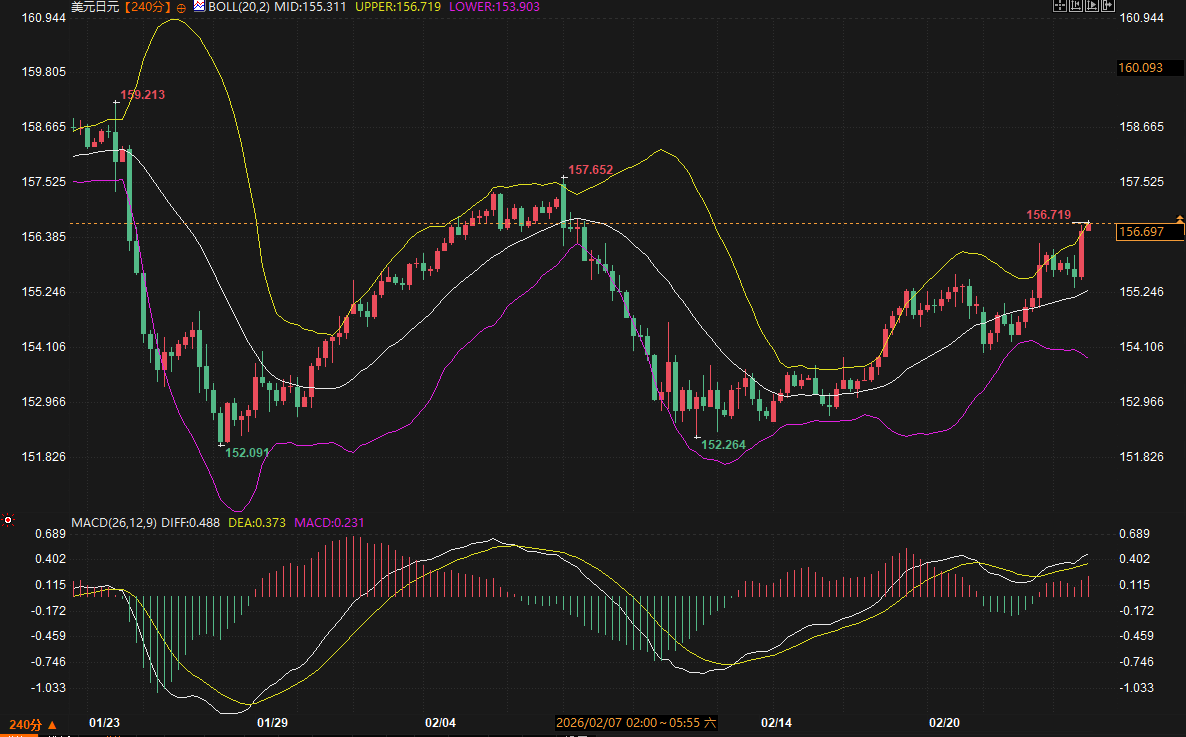
For the current market, the key focus for the USD/JPY exchange rate remains the evolution of Japanese policy signals. The key short-term resistance area to watch is 156.80-157.20, a range that combines previous high-volume trading with a psychologically important psychological level. A successful hold above this level would open up further upside potential. On the downside, the 155.80-156.20 area is crucial, as it represents both the day's opening price and the intersection of the Bollinger Band's middle line and multiple short-term moving averages, and is expected to provide strong support.
During trading, close attention should be paid to the performance of Japanese government bond futures and any reports regarding comments from central bank officials. In particular, changes in ultra-long-term yields have become a crucial indicator of market confidence in Japan's fiscal and monetary policies. As long as the steepening yield curve continues and does not trigger significant concerns from the Japanese authorities, interest rate differentials will likely continue to dominate the exchange rate's upward trend.
Looking ahead, the USD/JPY exchange rate will closely revolve around the "policy expectation gap with Japan." The stance of the new central bank board members and the parliament's attitude towards fiscal expansion will directly influence market pricing of Japanese government bonds. Against this backdrop, the yen's weakness is unlikely to reverse in the short term, but caution is warranted regarding a technical correction triggered by profit-taking or rumors of policy intervention after a rapid surge in the exchange rate. The market will focus on the potential impact of subsequent US economic data this week on expectations of a Fed rate cut, as well as the frequency of verbal interventions by Japanese officials regarding exchange rate and bond market volatility.
The sharp steepening of the Japanese bond yield curve is mainly driven by policy expectations.
Today's market focus revolved around the dramatic fluctuations in Japanese government bond (JGB) yields. A well-known institution's analysis pointed out that JGB futures opened with a 31-point jump, reaching 133.01, but subsequently reversed course, resulting in a significantly steeper yield curve. Behind this phenomenon is heightened market concern that the Bank of Japan's (BOJ) policy normalization pace may slow.
On the news front, Japanese Prime Minister Shigeru Ishiba expressed reservations about further interest rate hikes during his meeting with Bank of Japan Governor Kazuo Ueda on February 16. This news, after some time, continues to influence the market today. More crucially, the government's two newly nominated Bank of Japan policy board members—Toshiro Asada and Ayano Sato—have contrasting views. Asada previously supported the concept of "helicopter money," while Sato explicitly opposes interest rate hikes and advocates for the government to issue more debt. This is interpreted by the market as indicating that the government still favors supporting the economy through loose monetary policy, even if it might trigger further weakening of the yen.
Affected by this expectation, ultra-long-term government bonds experienced a sharp sell-off. During the session, the yield on 40-year non-newly issued government bonds surged by 20 basis points at one point, while the 30-year yield touched a high of 3.38%, a daily increase of 10.5 basis points. Although former central bank governor Haruhiko Kuroda made a statement through the media at the end of the trading day, calling for interest rate hikes and fiscal tightening policies, which slightly reduced the yields on ultra-long-term bonds, the steepening of the entire yield curve is difficult to reverse. Short-term government bond yields, such as 2-year and 5-year bonds, actually fell by 2.5 basis points due to safe-haven demand or portfolio adjustments, a stark contrast to the trend at the long end.
The technical outlook remains bullish, but upward momentum warrants caution.
From a technical chart perspective, the USD/JPY pair continues its strong upward trend on the 240-minute candlestick chart. The current price is firmly above the Bollinger Band's middle band and continues to approach the upper band (around 156.773). The MACD indicator shows that the DIFF and DEA lines maintain a golden cross above the zero line. Although the histogram is positive, the lengthening is limited, indicating that while bulls still dominate the market, short-term momentum has slowed somewhat from the previous high (around 159.213).
This technical pattern corroborates the fundamentals. On one hand, the divergence in monetary policy expectations between the US and Japan continues to provide solid support for the US dollar; on the other hand, the sharp fluctuations in the Japanese bond market, particularly the surge in ultra-long-term yields, have not effectively boosted the yen. Instead, they have exacerbated the yen's depreciation pressure, as they reflect market concerns about Japanese fiscal discipline. After breaking through the key level of 156.50, the exchange rate shows an intention to test the psychological level of 157.00.
Intraday Focus and Range Prediction
For the current market, the key focus for the USD/JPY exchange rate remains the evolution of Japanese policy signals. The key short-term resistance area to watch is 156.80-157.20, a range that combines previous high-volume trading with a psychologically important psychological level. A successful hold above this level would open up further upside potential. On the downside, the 155.80-156.20 area is crucial, as it represents both the day's opening price and the intersection of the Bollinger Band's middle line and multiple short-term moving averages, and is expected to provide strong support.
During trading, close attention should be paid to the performance of Japanese government bond futures and any reports regarding comments from central bank officials. In particular, changes in ultra-long-term yields have become a crucial indicator of market confidence in Japan's fiscal and monetary policies. As long as the steepening yield curve continues and does not trigger significant concerns from the Japanese authorities, interest rate differentials will likely continue to dominate the exchange rate's upward trend.
Looking ahead, the USD/JPY exchange rate will closely revolve around the "policy expectation gap with Japan." The stance of the new central bank board members and the parliament's attitude towards fiscal expansion will directly influence market pricing of Japanese government bonds. Against this backdrop, the yen's weakness is unlikely to reverse in the short term, but caution is warranted regarding a technical correction triggered by profit-taking or rumors of policy intervention after a rapid surge in the exchange rate. The market will focus on the potential impact of subsequent US economic data this week on expectations of a Fed rate cut, as well as the frequency of verbal interventions by Japanese officials regarding exchange rate and bond market volatility.
- Risk Warning and Disclaimer
- The market involves risk, and trading may not be suitable for all investors. This article is for reference only and does not constitute personal investment advice, nor does it take into account certain users’ specific investment objectives, financial situation, or other needs. Any investment decisions made based on this information are at your own risk.