US Dollar Index Analysis: Current Market Sentiment is Highly Sensitive
2026-02-25 20:03:19
On Wednesday (February 25), during the European session, the US dollar index (DXY) rebounded in a V-shape from a slight decline during the Asian session to around 97.98, with a daily increase of about 0.10%. Despite hawkish signals from Federal Reserve officials, the dollar has struggled to break out of its recent consolidation range.
It is worth noting that, over a longer period, the US dollar has appreciated by about 0.87% in the past month, but has fallen by more than 8% in the past 12 months. This divergence reveals a deep disagreement in the market about the medium-term outlook for the US dollar.
Market sentiment is currently highly sensitive. Nvidia will release its quarterly earnings report after the market closes today. Given that the volatility in AI concept stocks has not yet fully subsided, Nvidia may need both its earnings and guidance to exceed expectations in order to effectively boost global risk sentiment.
ING analysts point out that if earnings disappoint the market, high-beta currencies such as the Australian dollar, New Zealand dollar, and Norwegian krone will be the first to be affected; if the US dollar declines in tandem with high-beta currencies, it may indicate that the market is brewing a deeper risk of "US asset repricing," although this scenario is currently rare. It is worth noting that the market's pricing of Nvidia's earnings exhibits a clear asymmetry—the negative impact of lower-than-expected results is likely to outweigh the positive boost from better-than-expected results.
Core driving factor analysis
Tariff Policy: The Biggest Source of Uncertainty
The main pressure on the dollar this week came from the dramatic shift in trade policy. The US recently implemented a 10% temporary global tariff, and the White House is reportedly seeking to raise the rate to 15%, following the Supreme Court's ruling to overturn Trump's reciprocal tariff policy.
In his State of the Union address, Trump made no softening of his stance on tariffs. Instead, he praised his economic achievements, stating that low inflation, border control, and the fentanyl issue were being effectively addressed. At the same time, he reiterated his warning that countries "playing tricks" on trade agreements would face higher tariffs and hinted that tariff revenue might replace income taxes in the future. This rhetoric reinforced market concerns about a continued escalation of the trade war. While major trading partners are currently maintaining compliance with existing agreements, the continued instability of the policy framework is keeping market risk premiums high.
Logically, the impact of tariff policy on the US dollar presents an inherent contradiction: on the one hand, tariff-driven inflation expectations support the Federal Reserve in maintaining high interest rates, which is beneficial to the dollar; on the other hand, the expectation of a global economic slowdown triggered by the trade war, as well as the deterioration of the US's own growth prospects, put downward pressure on the dollar. Currently, the market tends to price in the latter.
Federal Reserve: Hawkish rhetoric fails to support the dollar
The minutes of the January FOMC meeting showed that most officials clearly believed the conditions for a rate cut were not yet ripe and that action should only be taken after inflation was further brought under control. Federal Reserve official Susan Collins stated that maintaining the current interest rate might be appropriate given the continued improvement in the job market and the remaining inflation risks; Thomas Barkin stated that current monetary policy was well-positioned to manage economic risks.
However, these relatively hawkish statements failed to effectively boost the dollar. The market still expects the Fed to cut rates approximately three times this year, each time by 25 basis points. This means there is a significant gap between the Fed's "wait-and-see" stance and market expectations of rate cuts—the market tends to "buy the rumor," betting that a policy shift will eventually occur this year. Against the backdrop of looming stagflation risks, the Fed's policy space is quietly being compressed.
Later today, the market will also be watching public speeches by Federal Reserve officials Jeff Schmid and Alberto Musalem to see if they can inject new support momentum into the dollar.
PPI data: The most critical catalyst in the near term
The US Producer Price Index (PPI) for January, to be released this Friday, will be the most important data catalyst in the short term. Economists expect the data to be slightly cooler, but given the existence of tariff transmission effects, the upside risks cannot be ignored.
If the PPI rises more than expected, it will reinforce the narrative of "maintaining high interest rates for a longer period," pushing the DXY to rebound to around 98.40. If the data is moderate, it will provide more room for expectations of interest rate cuts, further suppressing the dollar. It is worth mentioning that the consumer confidence index for February, released the day before yesterday, rose to 91 points, and the decline after the sharp downward revision last month has also narrowed, which provides some support for the short-term stabilization of the dollar.
Geopolitics: Background noise cannot be ignored
The recent third round of US-Iran nuclear talks in Geneva has also come into investors' view. The progress of the negotiations may affect oil price trends, which in turn will indirectly impact the US dollar and global risk sentiment. However, this factor currently has limited weight in market pricing and plays more of a background noise role.
Technical Analysis
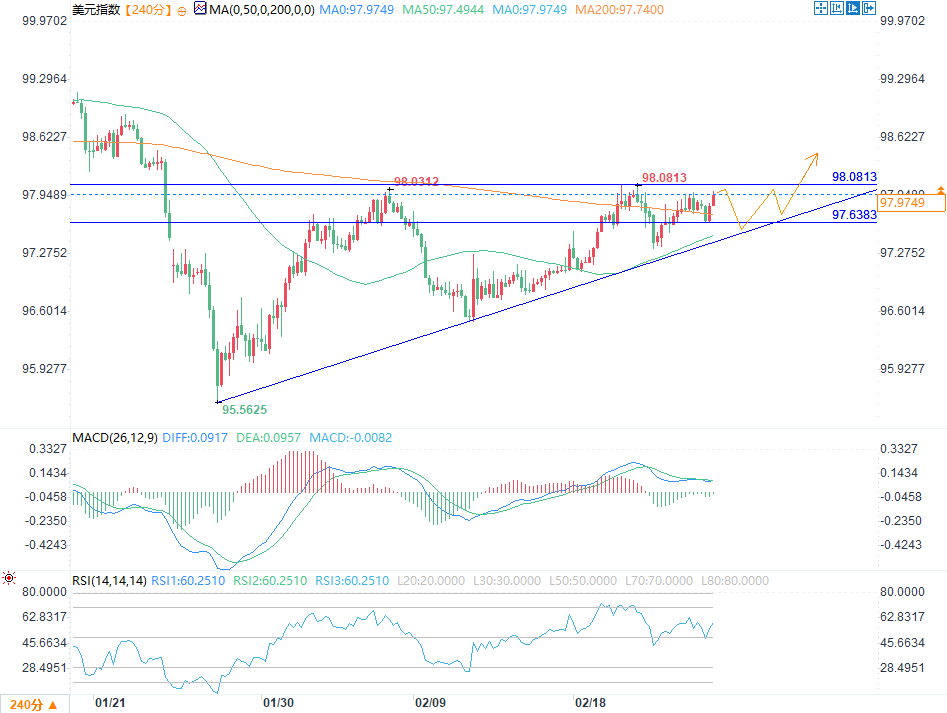
(US Dollar Index 4-hour chart source: FX678)
Currently, the DXY is operating within the core range of 97.64-98.07, forming a short-term consolidation pattern.
On the 4-hour chart, the 50-period moving average is currently around 97.49, providing effective dynamic support for the price; the 200-period moving average is around 97.74, further solidifying the foundation for the recent recovery of the US dollar. The "support zone" formed by the two moving averages is currently intact, and the bulls' defense is relatively solid in the short term.
Since falling to a multi-month low of 96.50 at the end of January, the DXY has formed a clear upward trend line, increasing the probability of a monthly close higher. This would be the first time the price has stopped falling after three consecutive months of decline. However, recent repeated resistance around 98.07 and the narrowing of the candlestick pattern suggest that bullish momentum is weakening, and the resistance above is quite strong.
The current RSI is hovering around 60, which is in the neutral-to-bullish zone. It is neither overbought nor lacks the momentum for further upward movement. This reading supports the judgment of "consolidation and accumulation" rather than a signal of an impending reversal.
Before Nvidia's earnings report is released and the PPI data is finalized, the market may maintain its current range-bound trading, awaiting new directional drivers, with the DXY expected to remain within the 97.64-98.07 range.
The US dollar index is currently facing a tug-of-war between "hawkish fundamentals" and "policy uncertainty premium." Hawkish statements from Federal Reserve officials and resilient economic data should theoretically support the dollar; however, the continued uncertainty surrounding tariff policy, the market's firm pricing in three rate cuts this year, and the cumulative depreciation pressure of over 8% over the past 12 months make any rebound seem weak.
In the short term, Nvidia's earnings report, PPI data, and speeches by Federal Reserve officials will be the three most important catalysts, jointly determining whether the DXY can break out of its current consolidation range. Technically, as long as the 97.49-97.74 support zone holds, the short-term bullish trend can be maintained; however, if the dollar fails to break through 98.10 effectively, the overall trend will still lean towards range-bound trading, and directional opportunities require further confirmation.
It is worth noting that, over a longer period, the US dollar has appreciated by about 0.87% in the past month, but has fallen by more than 8% in the past 12 months. This divergence reveals a deep disagreement in the market about the medium-term outlook for the US dollar.
Market sentiment is currently highly sensitive. Nvidia will release its quarterly earnings report after the market closes today. Given that the volatility in AI concept stocks has not yet fully subsided, Nvidia may need both its earnings and guidance to exceed expectations in order to effectively boost global risk sentiment.
ING analysts point out that if earnings disappoint the market, high-beta currencies such as the Australian dollar, New Zealand dollar, and Norwegian krone will be the first to be affected; if the US dollar declines in tandem with high-beta currencies, it may indicate that the market is brewing a deeper risk of "US asset repricing," although this scenario is currently rare. It is worth noting that the market's pricing of Nvidia's earnings exhibits a clear asymmetry—the negative impact of lower-than-expected results is likely to outweigh the positive boost from better-than-expected results.
Core driving factor analysis
Tariff Policy: The Biggest Source of Uncertainty
The main pressure on the dollar this week came from the dramatic shift in trade policy. The US recently implemented a 10% temporary global tariff, and the White House is reportedly seeking to raise the rate to 15%, following the Supreme Court's ruling to overturn Trump's reciprocal tariff policy.
In his State of the Union address, Trump made no softening of his stance on tariffs. Instead, he praised his economic achievements, stating that low inflation, border control, and the fentanyl issue were being effectively addressed. At the same time, he reiterated his warning that countries "playing tricks" on trade agreements would face higher tariffs and hinted that tariff revenue might replace income taxes in the future. This rhetoric reinforced market concerns about a continued escalation of the trade war. While major trading partners are currently maintaining compliance with existing agreements, the continued instability of the policy framework is keeping market risk premiums high.
Logically, the impact of tariff policy on the US dollar presents an inherent contradiction: on the one hand, tariff-driven inflation expectations support the Federal Reserve in maintaining high interest rates, which is beneficial to the dollar; on the other hand, the expectation of a global economic slowdown triggered by the trade war, as well as the deterioration of the US's own growth prospects, put downward pressure on the dollar. Currently, the market tends to price in the latter.
Federal Reserve: Hawkish rhetoric fails to support the dollar
The minutes of the January FOMC meeting showed that most officials clearly believed the conditions for a rate cut were not yet ripe and that action should only be taken after inflation was further brought under control. Federal Reserve official Susan Collins stated that maintaining the current interest rate might be appropriate given the continued improvement in the job market and the remaining inflation risks; Thomas Barkin stated that current monetary policy was well-positioned to manage economic risks.
However, these relatively hawkish statements failed to effectively boost the dollar. The market still expects the Fed to cut rates approximately three times this year, each time by 25 basis points. This means there is a significant gap between the Fed's "wait-and-see" stance and market expectations of rate cuts—the market tends to "buy the rumor," betting that a policy shift will eventually occur this year. Against the backdrop of looming stagflation risks, the Fed's policy space is quietly being compressed.
Later today, the market will also be watching public speeches by Federal Reserve officials Jeff Schmid and Alberto Musalem to see if they can inject new support momentum into the dollar.
PPI data: The most critical catalyst in the near term
The US Producer Price Index (PPI) for January, to be released this Friday, will be the most important data catalyst in the short term. Economists expect the data to be slightly cooler, but given the existence of tariff transmission effects, the upside risks cannot be ignored.
If the PPI rises more than expected, it will reinforce the narrative of "maintaining high interest rates for a longer period," pushing the DXY to rebound to around 98.40. If the data is moderate, it will provide more room for expectations of interest rate cuts, further suppressing the dollar. It is worth mentioning that the consumer confidence index for February, released the day before yesterday, rose to 91 points, and the decline after the sharp downward revision last month has also narrowed, which provides some support for the short-term stabilization of the dollar.
Geopolitics: Background noise cannot be ignored
The recent third round of US-Iran nuclear talks in Geneva has also come into investors' view. The progress of the negotiations may affect oil price trends, which in turn will indirectly impact the US dollar and global risk sentiment. However, this factor currently has limited weight in market pricing and plays more of a background noise role.
Technical Analysis
(US Dollar Index 4-hour chart source: FX678)
Currently, the DXY is operating within the core range of 97.64-98.07, forming a short-term consolidation pattern.
On the 4-hour chart, the 50-period moving average is currently around 97.49, providing effective dynamic support for the price; the 200-period moving average is around 97.74, further solidifying the foundation for the recent recovery of the US dollar. The "support zone" formed by the two moving averages is currently intact, and the bulls' defense is relatively solid in the short term.
Since falling to a multi-month low of 96.50 at the end of January, the DXY has formed a clear upward trend line, increasing the probability of a monthly close higher. This would be the first time the price has stopped falling after three consecutive months of decline. However, recent repeated resistance around 98.07 and the narrowing of the candlestick pattern suggest that bullish momentum is weakening, and the resistance above is quite strong.
The current RSI is hovering around 60, which is in the neutral-to-bullish zone. It is neither overbought nor lacks the momentum for further upward movement. This reading supports the judgment of "consolidation and accumulation" rather than a signal of an impending reversal.
Before Nvidia's earnings report is released and the PPI data is finalized, the market may maintain its current range-bound trading, awaiting new directional drivers, with the DXY expected to remain within the 97.64-98.07 range.
The US dollar index is currently facing a tug-of-war between "hawkish fundamentals" and "policy uncertainty premium." Hawkish statements from Federal Reserve officials and resilient economic data should theoretically support the dollar; however, the continued uncertainty surrounding tariff policy, the market's firm pricing in three rate cuts this year, and the cumulative depreciation pressure of over 8% over the past 12 months make any rebound seem weak.
In the short term, Nvidia's earnings report, PPI data, and speeches by Federal Reserve officials will be the three most important catalysts, jointly determining whether the DXY can break out of its current consolidation range. Technically, as long as the 97.49-97.74 support zone holds, the short-term bullish trend can be maintained; however, if the dollar fails to break through 98.10 effectively, the overall trend will still lean towards range-bound trading, and directional opportunities require further confirmation.
- Risk Warning and Disclaimer
- The market involves risk, and trading may not be suitable for all investors. This article is for reference only and does not constitute personal investment advice, nor does it take into account certain users’ specific investment objectives, financial situation, or other needs. Any investment decisions made based on this information are at your own risk.