Is the dollar's rebound just a temporary surge? With repeated tests around 98, will the next move be a missed opportunity or a potential disaster?
2026-02-25 20:10:11
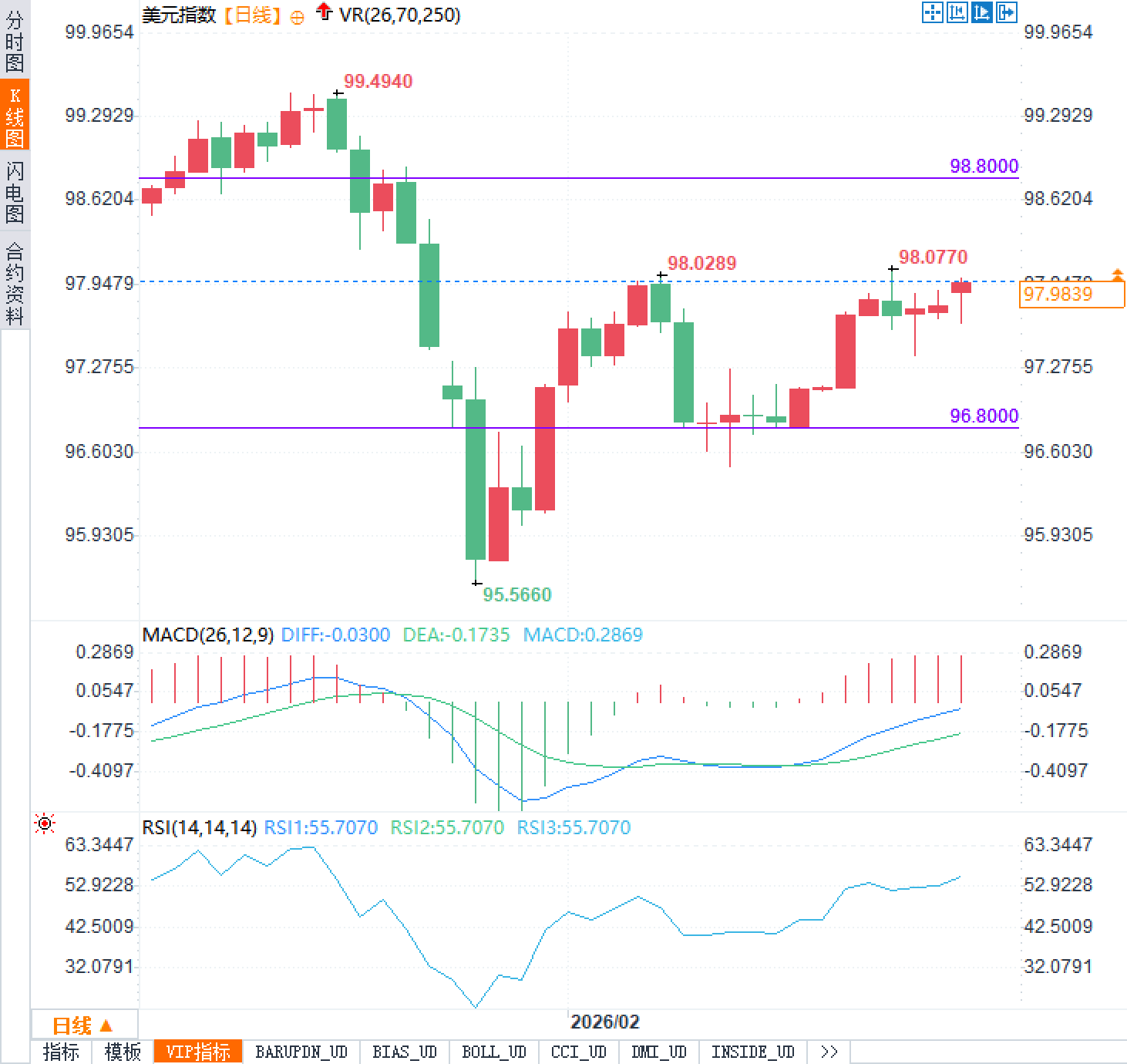
On Wednesday, February 25th, the US dollar index traded around 98 during the European session. This level is quite delicate, as it falls precisely at the upper-middle edge of the previous rebound channel. Looking back at the daily chart, the price experienced a dramatic rollercoaster ride: it initially surged to 99.4940 before encountering resistance and falling back, barely stabilizing at a low of 95.5660, before embarking on a corrective rebound.

The current candlestick pattern is consolidating around 98, seemingly gathering strength for a new upward surge. However, the road ahead is not smooth; resistance levels are clearly visible, with 98.8000 being a key resistance zone determining whether the trend can reverse. If the bulls fail to effectively break through these levels, the market is highly likely to stagnate.
From a technical perspective, market sentiment is in a balanced state of "mildly bullish". The MACD indicator shows DIFF at -0.0300, DEA at -0.1735, and the MACD histogram at 0.2869. The continuation of the red bars indicates that the recovery is still underway, but there are no signs of a one-sided strengthening of momentum; it's more like a slow, steady climb. The RSI reading is 55.7070, in the neutral-to-strong range, suggesting that although the bulls currently have the upper hand, they haven't reached an overheated state. In the short term, there's a high probability of digesting previous gains through oscillating upward movements. Regarding support, 96.8000 is the primary level to watch. If volatility intensifies, the previous low of 95.5660 will become the last line of defense for the medium-term bulls.
On the fundamental front, recent economic data has shown a clear divergence, shifting the driving force behind the US dollar from a single positive factor to a structural game. The consumer confidence index rose to 91.2 in February, higher than the previous value of 89.0, seemingly exceeding the market's previously low expectations. However, a deeper analysis reveals that this "better-than-expected" performance stemmed more from an upward revision of the January data—the January figure was significantly revised from 84.5 to 89.0. In other words, the apparent prosperity is more like a correction of past weak readings than a comprehensive improvement in economic sentiment for the month. Detailed data further reveals underlying concerns: the current conditions index actually fell by 1.8 points in February, a stark contrast to the upward revision of 8.1 points in January, indicating that public pressure regarding the current economic situation has not eased.
Meanwhile, the rebound in expectations was the main driver of this recovery, but the performance of consumption plans in the report was mixed, reflecting that households remain uncertain about their spending and are hesitant to spend. Employment-related signals were also mixed. Consumer assessments of the labor market improved, with the labor force balance rising to 7.4, compared to a revised 6.8 in January, an upward revision of 3.7 points. However, overall job acquisition expectations remain on a downward trend, echoed by other survey data. In summary, the current labor market is characterized by both low layoffs and low hiring. This combination suggests the economy is unlikely to quickly slide into recession, but the elasticity of new demand is also very limited. The strength of the US dollar will depend more on shifts in interest rate expectations and risk aversion than on strong fundamentals.
Regarding the interest rate path, the market generally expects the Federal Reserve to maintain interest rates unchanged at its March and April meetings. The core logic behind this is that inflationary pressures remain above the 2% target and may persist for longer, forcing a cautious policy stance. This expectation provides solid support for the dollar in the short term, as the difficulty in rapidly lowering interest rates would inhibit a large influx of funds into low-yielding currencies. However, if subsequent data continues to reflect a weakening trend and consumer confidence remains uncertain, market bets on future interest rate direction may fluctuate across different timeframes, thus amplifying the range-bound trading characteristic of the dollar index.
Furthermore, geopolitics and commodities are also significant external variables. The progress of the US-Iran negotiations, which are closely watched by the market, will significantly impact oil price expectations. When oil prices are strong, currencies of energy-dependent economies are typically more sensitive, and fluctuations are more easily transmitted to the foreign exchange market. For the US dollar index, rising oil prices may strengthen high-interest-rate expectations by increasing inflation stickiness, thereby indirectly enhancing the relative attractiveness of the dollar; however, if sharp fluctuations in oil prices trigger a decline in risk appetite, funds may temporarily flow back to dollar assets for safety. These two logics alternate in dominance at different stages, making the foreign exchange market's movements more unpredictable.
The current candlestick pattern is consolidating around 98, seemingly gathering strength for a new upward surge. However, the road ahead is not smooth; resistance levels are clearly visible, with 98.8000 being a key resistance zone determining whether the trend can reverse. If the bulls fail to effectively break through these levels, the market is highly likely to stagnate.
From a technical perspective, market sentiment is in a balanced state of "mildly bullish". The MACD indicator shows DIFF at -0.0300, DEA at -0.1735, and the MACD histogram at 0.2869. The continuation of the red bars indicates that the recovery is still underway, but there are no signs of a one-sided strengthening of momentum; it's more like a slow, steady climb. The RSI reading is 55.7070, in the neutral-to-strong range, suggesting that although the bulls currently have the upper hand, they haven't reached an overheated state. In the short term, there's a high probability of digesting previous gains through oscillating upward movements. Regarding support, 96.8000 is the primary level to watch. If volatility intensifies, the previous low of 95.5660 will become the last line of defense for the medium-term bulls.
The illusion of confidence data: a superficial recovery cannot conceal the underlying chill.
On the fundamental front, recent economic data has shown a clear divergence, shifting the driving force behind the US dollar from a single positive factor to a structural game. The consumer confidence index rose to 91.2 in February, higher than the previous value of 89.0, seemingly exceeding the market's previously low expectations. However, a deeper analysis reveals that this "better-than-expected" performance stemmed more from an upward revision of the January data—the January figure was significantly revised from 84.5 to 89.0. In other words, the apparent prosperity is more like a correction of past weak readings than a comprehensive improvement in economic sentiment for the month. Detailed data further reveals underlying concerns: the current conditions index actually fell by 1.8 points in February, a stark contrast to the upward revision of 8.1 points in January, indicating that public pressure regarding the current economic situation has not eased.
Meanwhile, the rebound in expectations was the main driver of this recovery, but the performance of consumption plans in the report was mixed, reflecting that households remain uncertain about their spending and are hesitant to spend. Employment-related signals were also mixed. Consumer assessments of the labor market improved, with the labor force balance rising to 7.4, compared to a revised 6.8 in January, an upward revision of 3.7 points. However, overall job acquisition expectations remain on a downward trend, echoed by other survey data. In summary, the current labor market is characterized by both low layoffs and low hiring. This combination suggests the economy is unlikely to quickly slide into recession, but the elasticity of new demand is also very limited. The strength of the US dollar will depend more on shifts in interest rate expectations and risk aversion than on strong fundamentals.
The interplay of macroeconomic variables: interest rate anchoring and oil price fluctuations
Regarding the interest rate path, the market generally expects the Federal Reserve to maintain interest rates unchanged at its March and April meetings. The core logic behind this is that inflationary pressures remain above the 2% target and may persist for longer, forcing a cautious policy stance. This expectation provides solid support for the dollar in the short term, as the difficulty in rapidly lowering interest rates would inhibit a large influx of funds into low-yielding currencies. However, if subsequent data continues to reflect a weakening trend and consumer confidence remains uncertain, market bets on future interest rate direction may fluctuate across different timeframes, thus amplifying the range-bound trading characteristic of the dollar index.
Furthermore, geopolitics and commodities are also significant external variables. The progress of the US-Iran negotiations, which are closely watched by the market, will significantly impact oil price expectations. When oil prices are strong, currencies of energy-dependent economies are typically more sensitive, and fluctuations are more easily transmitted to the foreign exchange market. For the US dollar index, rising oil prices may strengthen high-interest-rate expectations by increasing inflation stickiness, thereby indirectly enhancing the relative attractiveness of the dollar; however, if sharp fluctuations in oil prices trigger a decline in risk appetite, funds may temporarily flow back to dollar assets for safety. These two logics alternate in dominance at different stages, making the foreign exchange market's movements more unpredictable.
- Risk Warning and Disclaimer
- The market involves risk, and trading may not be suitable for all investors. This article is for reference only and does not constitute personal investment advice, nor does it take into account certain users’ specific investment objectives, financial situation, or other needs. Any investment decisions made based on this information are at your own risk.