The frenzied acceleration from 154 to 156: Who is shorting the yen?
2026-02-25 20:48:04
On Wednesday, February 25th, the US dollar continued its strong upward trend against the Japanese yen in pre-market trading, hovering around 156.70. The yen's weakness against major global currencies seems unstoppable. The core driver of this round of sharp exchange rate fluctuations is not a sudden whim from Wall Street, but rather stems from intense disagreement within Japan regarding the pace of interest rate hikes.

The market astutely picked up on a key signal: During her meeting with Bank of Japan Governor Kazuo Ueda on February 16th, Japanese Prime Minister Sanae Takaichi showed little enthusiasm for further interest rate hikes. She explicitly expressed concern that raising rates too quickly would hinder the already fragile economy and inflation. This subtle shift in high-level attitude instantly ignited market doubts about the normalization process of Japan's monetary policy.
Even more dramatically, this policy game quickly spilled over to the personnel level. The Japanese government nominated two new members, Asada Toichi and Sato Ayano, to join the Bank of Japan's nine-member policy board. This move was widely interpreted by the market as an attempt by the ruling party to inject more dovish sentiment into the decision-making circle, aiming to marginally reduce the probability of a rapid interest rate hike. Even if the policy direction does not ultimately undergo a fundamental reversal, as long as the expectation of a "delayed interest rate hike" takes root in the market, the yen's attractiveness as a funding currency will be greatly diminished. Short-term funds followed suit, frantically chasing dollar assets with significant interest rate advantages, directly driving a rapid rise in the USD/JPY exchange rate.
The US dollar index rebounded to around 98.00 during the session, with this support stemming more from the Federal Reserve's expectation management than from the stimulus of a single data point. The remarks of Fed official Waller were particularly crucial; he emphasized that policy will be highly data-dependent and stated bluntly that if February's employment data replicates the strong momentum of January, he might adjust his previously dovish stance. These comments effectively assign a very high event weight to the upcoming non-farm payroll data. If the data again exceeds expectations, the market's pricing in tighter interest rates will reignite, and the widening US-Japan interest rate differential will continue to fuel the upward movement of the exchange rate.
However, the short-term market is not solely driven by a one-sided upward trend. Analysts believe that two immediate exogenous disturbances—tomorrow's US-Iran nuclear talks and next Friday's US non-farm payroll data—constitute potential risk variables. If geopolitical risks unexpectedly escalate, market sentiment will quickly shift to risk aversion. Conversely, if the risk events unfold smoothly and US data does not show signs of weakness, the yen will lack new bullish drivers, and the exchange rate is more likely to maintain a strong, high-level consolidation pattern.
Whether Japan can reverse its current passive situation hinges on the Tokyo Metropolitan Consumer Price Index (CPI) to be released on Friday. This will be a litmus test: if inflation data shows a significant strengthening, the market will be forced to reassess the Bank of Japan's action window, and the yen may see a rebound; however, if price performance is moderate, coupled with the uncertainty brought about by policy disagreements and personnel changes, market expectations for a delayed interest rate hike will become more solidified, and the yen's weakness may be difficult to reverse in the near term. Institutional views suggest that although the newly nominated scholars have disrupted the bond and foreign exchange markets, as old members retire and new members take office, the market's over-interpretation will eventually return to rationality, and ultimately, the focus will remain on the sustainability of inflation and wage growth.
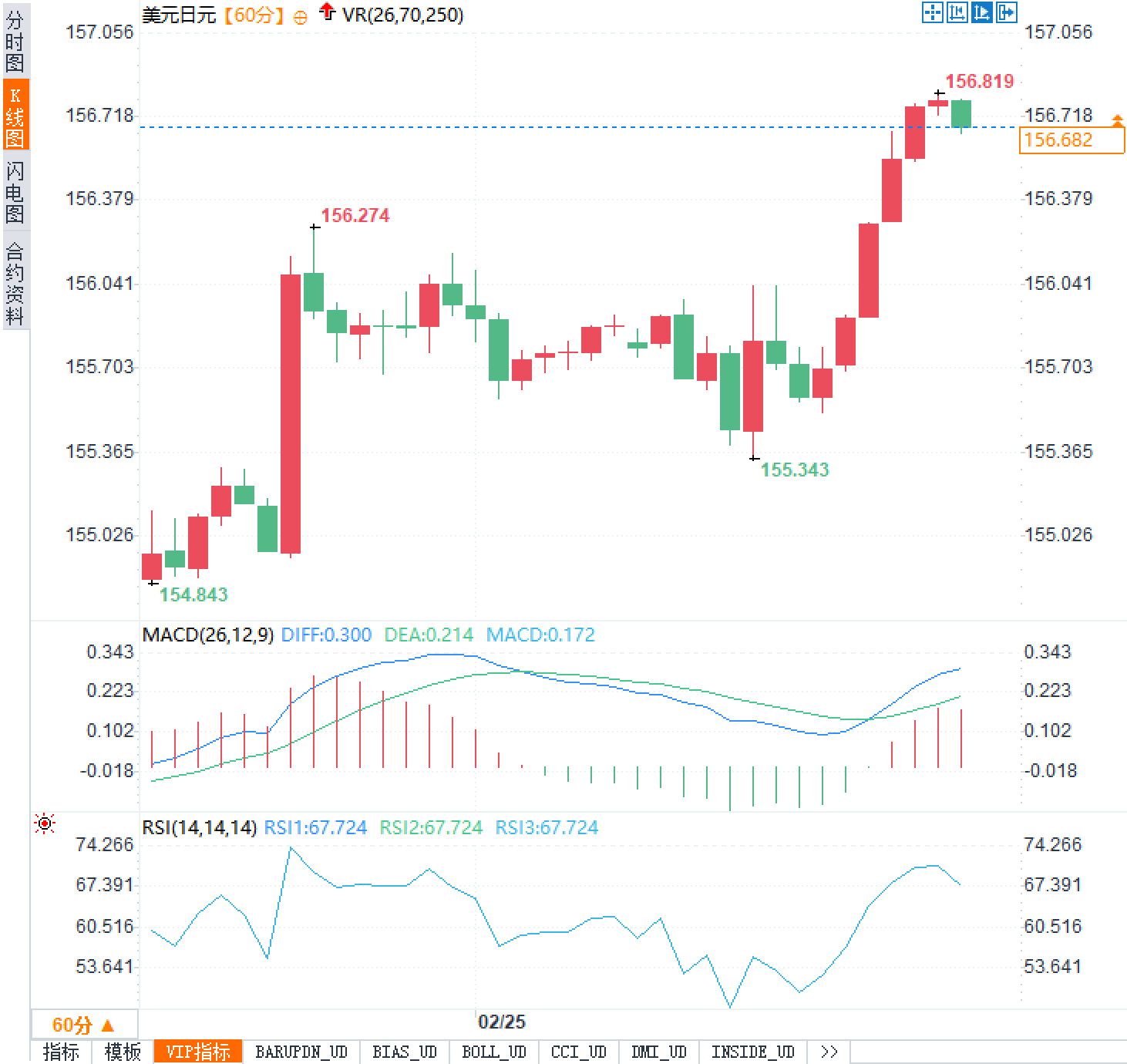
From a technical perspective, the 60-minute chart shows that USD/JPY gradually rose after hitting a low of 154.843, recently accelerating to a high of 156.819. The MACD indicator shows that upward momentum still dominates but has entered a bullish zone, while the RSI indicator is around 67.724, not yet extreme but with a clear bullish advantage. This suggests the exchange rate may continue its upward trend, but also faces pressure to consolidate at higher levels. If a pullback occurs, the 155.343 area is a key support level; on the upside, attention should be paid to whether the resistance around 156.80 can be effectively overcome. Only by firmly establishing itself at higher levels will the certainty of a continued trend increase.
In summary, the rise in USD/JPY is a result of the combined effect of a weakening yen expectation and resilient US interest rates. Ahead of major events such as Tokyo price data, US-Iran nuclear talks, and non-farm payrolls, the probability of increased volatility is extremely high.
The market astutely picked up on a key signal: During her meeting with Bank of Japan Governor Kazuo Ueda on February 16th, Japanese Prime Minister Sanae Takaichi showed little enthusiasm for further interest rate hikes. She explicitly expressed concern that raising rates too quickly would hinder the already fragile economy and inflation. This subtle shift in high-level attitude instantly ignited market doubts about the normalization process of Japan's monetary policy.
Even more dramatically, this policy game quickly spilled over to the personnel level. The Japanese government nominated two new members, Asada Toichi and Sato Ayano, to join the Bank of Japan's nine-member policy board. This move was widely interpreted by the market as an attempt by the ruling party to inject more dovish sentiment into the decision-making circle, aiming to marginally reduce the probability of a rapid interest rate hike. Even if the policy direction does not ultimately undergo a fundamental reversal, as long as the expectation of a "delayed interest rate hike" takes root in the market, the yen's attractiveness as a funding currency will be greatly diminished. Short-term funds followed suit, frantically chasing dollar assets with significant interest rate advantages, directly driving a rapid rise in the USD/JPY exchange rate.
The resilience of the US dollar and the non-farm payrolls test
The US dollar index rebounded to around 98.00 during the session, with this support stemming more from the Federal Reserve's expectation management than from the stimulus of a single data point. The remarks of Fed official Waller were particularly crucial; he emphasized that policy will be highly data-dependent and stated bluntly that if February's employment data replicates the strong momentum of January, he might adjust his previously dovish stance. These comments effectively assign a very high event weight to the upcoming non-farm payroll data. If the data again exceeds expectations, the market's pricing in tighter interest rates will reignite, and the widening US-Japan interest rate differential will continue to fuel the upward movement of the exchange rate.
However, the short-term market is not solely driven by a one-sided upward trend. Analysts believe that two immediate exogenous disturbances—tomorrow's US-Iran nuclear talks and next Friday's US non-farm payroll data—constitute potential risk variables. If geopolitical risks unexpectedly escalate, market sentiment will quickly shift to risk aversion. Conversely, if the risk events unfold smoothly and US data does not show signs of weakness, the yen will lack new bullish drivers, and the exchange rate is more likely to maintain a strong, high-level consolidation pattern.
The tipping point between data-driven battles and technical aspects
Whether Japan can reverse its current passive situation hinges on the Tokyo Metropolitan Consumer Price Index (CPI) to be released on Friday. This will be a litmus test: if inflation data shows a significant strengthening, the market will be forced to reassess the Bank of Japan's action window, and the yen may see a rebound; however, if price performance is moderate, coupled with the uncertainty brought about by policy disagreements and personnel changes, market expectations for a delayed interest rate hike will become more solidified, and the yen's weakness may be difficult to reverse in the near term. Institutional views suggest that although the newly nominated scholars have disrupted the bond and foreign exchange markets, as old members retire and new members take office, the market's over-interpretation will eventually return to rationality, and ultimately, the focus will remain on the sustainability of inflation and wage growth.
From a technical perspective, the 60-minute chart shows that USD/JPY gradually rose after hitting a low of 154.843, recently accelerating to a high of 156.819. The MACD indicator shows that upward momentum still dominates but has entered a bullish zone, while the RSI indicator is around 67.724, not yet extreme but with a clear bullish advantage. This suggests the exchange rate may continue its upward trend, but also faces pressure to consolidate at higher levels. If a pullback occurs, the 155.343 area is a key support level; on the upside, attention should be paid to whether the resistance around 156.80 can be effectively overcome. Only by firmly establishing itself at higher levels will the certainty of a continued trend increase.
In summary, the rise in USD/JPY is a result of the combined effect of a weakening yen expectation and resilient US interest rates. Ahead of major events such as Tokyo price data, US-Iran nuclear talks, and non-farm payrolls, the probability of increased volatility is extremely high.
- Risk Warning and Disclaimer
- The market involves risk, and trading may not be suitable for all investors. This article is for reference only and does not constitute personal investment advice, nor does it take into account certain users’ specific investment objectives, financial situation, or other needs. Any investment decisions made based on this information are at your own risk.