Silver: $96 Heaven or $73 Hell? Non-farm payrolls and Middle East tensions – which will ignite the market?
2026-02-26 19:53:22
On Thursday, February 26th, spot silver traded near the key level of $87 during the European session. This price point appears to be the eye of a storm, surrounded by geopolitical tensions and macroeconomic uncertainty. Previously, silver prices had surged to a trading range around $92.00 before sharply retreating to a low of $63.916; the current price action is consolidating and fluctuating within this significant range.
The market is currently on edge, with all eyes focused on two variables that could trigger significant price movements: first, the US-Iran talks in Geneva today, the success or failure of which directly impacts the sensitive situation in the Middle East; and second, the upcoming non-farm payroll report, which will redefine market expectations for the Federal Reserve's interest rate path. Analysts believe that the current silver market is not in a one-sided trend, but rather is undergoing a fierce balancing act under the pull of two diametrically opposed forces.
From a fundamental perspective, the underlying support for silver prices is not a robust economic recovery, but rather the pervasive "uncertainty." If the situation in the Middle East escalates due to unforeseen negotiations, the geopolitical risk premium will instantly boost demand for safe-haven assets, naturally benefiting silver as a traditional safe haven. However, this support is often heavily influenced by sentiment. Once the risk event fails to escalate further, prices can easily shift from sentiment-driven factors back to a more rational assessment of interest rates and the US dollar. Meanwhile, the shadow of tariffs has once again loomed over the market. Officials have revealed that tariffs in some economies may be raised to 15% or even higher, far exceeding the previously announced general rate of 10%. This statement is like a stone thrown into a calm lake, not only disrupting corporate cost expectations but also making the inflation outlook uncertain.
For silver, tariff clues create a complex hedging effect: on the one hand, escalating trade frictions boost safe-haven demand, benefiting precious metals; on the other hand, potential inflationary pressures may delay the formation of expectations for interest rate cuts, leading to stronger expectations of rising interest rates, thus negatively impacting non-interest-bearing silver. It is this offsetting effect of these two forces that has caused prices to fluctuate repeatedly around key levels, making it difficult to form a breakout trend. Analysts point out that unless a new catalyst breaks this delicate balance, the market will continue to wait anxiously for a directional move.
At the macro level, the US dollar's performance is a significant backdrop to the recent relative strength of silver. The US dollar index is currently showing a slight downward trend around 97.70. The decline in the dollar has lowered the cost of holding dollar-denominated precious metals, making silver more attractive to non-dollar funds and thus marginally increasing demand. However, the direction of the dollar ultimately rests with the Federal Reserve, and the Fed's policy path depends on economic data. Recent comments from Fed official Waller are particularly thought-provoking; he explicitly stated that if February's employment data replicates the strong momentum of January, he might adjust his previously dovish stance. This means that the upcoming non-farm payroll report will be a "judgment day" determining the short-term fate of silver.
If the non-farm payroll data is unexpectedly strong, the market will quickly shift to a more hawkish pricing strategy. The simultaneous rise in the dollar and US Treasury yields will severely impact silver, potentially deepening the pullback and even retesting lower support levels. Conversely, if the employment data shows signs of cooling, expectations of interest rate cuts will resurface, putting downward pressure on the dollar. This would allow silver to regain strength and attempt to attack the key resistance zone above.
Looking through the technical lens of the daily chart, silver's current situation resembles a consolidation rather than a trend-driven breakout. The price is around $87, with immediate resistance at $92.00 and a significant level around $96.00 further away; while a key support level lies around $73.00. Technical indicators also confirm this stalemate: the MACD shows a DIFF of 0.168, a DEA of -0.628, and a MACD histogram of 1.592. Although momentum has recovered somewhat from previous lows, it remains mild; the RSI reading is around 53, in a slightly bullish-neutral zone, reflecting a temporary balance between bulls and bears, with neither side able to easily dominate the market.
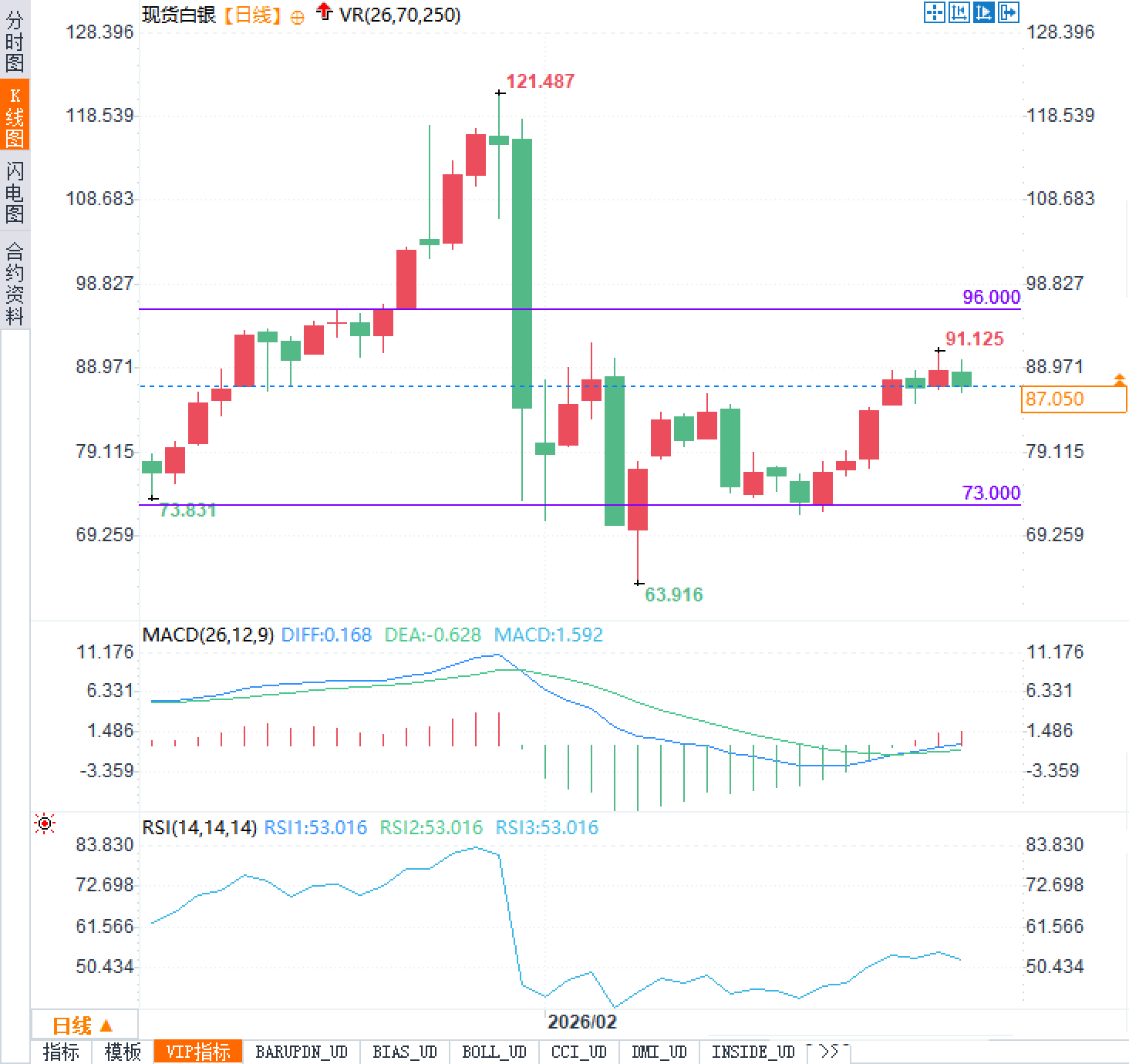
In summary, the core strategy for short-term trading revolves around "range trading and event-driven price movements." Traders should pay attention to the resistance levels around $92.00 and $96.000, while also monitoring the performance of the $87 level as a key support/resistance level. If geopolitical negotiations trigger increased safe-haven demand, silver prices may move towards the $96.000 area; however, if strong non-farm payroll data leads to an upward revision of interest rate expectations, the risk of price resistance and a pullback, testing the $73.000 medium-term support level, should be considered.
The market is currently on edge, with all eyes focused on two variables that could trigger significant price movements: first, the US-Iran talks in Geneva today, the success or failure of which directly impacts the sensitive situation in the Middle East; and second, the upcoming non-farm payroll report, which will redefine market expectations for the Federal Reserve's interest rate path. Analysts believe that the current silver market is not in a one-sided trend, but rather is undergoing a fierce balancing act under the pull of two diametrically opposed forces.
A double whammy of geopolitical uncertainty and tariff shadows
From a fundamental perspective, the underlying support for silver prices is not a robust economic recovery, but rather the pervasive "uncertainty." If the situation in the Middle East escalates due to unforeseen negotiations, the geopolitical risk premium will instantly boost demand for safe-haven assets, naturally benefiting silver as a traditional safe haven. However, this support is often heavily influenced by sentiment. Once the risk event fails to escalate further, prices can easily shift from sentiment-driven factors back to a more rational assessment of interest rates and the US dollar. Meanwhile, the shadow of tariffs has once again loomed over the market. Officials have revealed that tariffs in some economies may be raised to 15% or even higher, far exceeding the previously announced general rate of 10%. This statement is like a stone thrown into a calm lake, not only disrupting corporate cost expectations but also making the inflation outlook uncertain.
For silver, tariff clues create a complex hedging effect: on the one hand, escalating trade frictions boost safe-haven demand, benefiting precious metals; on the other hand, potential inflationary pressures may delay the formation of expectations for interest rate cuts, leading to stronger expectations of rising interest rates, thus negatively impacting non-interest-bearing silver. It is this offsetting effect of these two forces that has caused prices to fluctuate repeatedly around key levels, making it difficult to form a breakout trend. Analysts point out that unless a new catalyst breaks this delicate balance, the market will continue to wait anxiously for a directional move.
The ultimate test of dollar strength and non-farm payroll data.
At the macro level, the US dollar's performance is a significant backdrop to the recent relative strength of silver. The US dollar index is currently showing a slight downward trend around 97.70. The decline in the dollar has lowered the cost of holding dollar-denominated precious metals, making silver more attractive to non-dollar funds and thus marginally increasing demand. However, the direction of the dollar ultimately rests with the Federal Reserve, and the Fed's policy path depends on economic data. Recent comments from Fed official Waller are particularly thought-provoking; he explicitly stated that if February's employment data replicates the strong momentum of January, he might adjust his previously dovish stance. This means that the upcoming non-farm payroll report will be a "judgment day" determining the short-term fate of silver.
If the non-farm payroll data is unexpectedly strong, the market will quickly shift to a more hawkish pricing strategy. The simultaneous rise in the dollar and US Treasury yields will severely impact silver, potentially deepening the pullback and even retesting lower support levels. Conversely, if the employment data shows signs of cooling, expectations of interest rate cuts will resurface, putting downward pressure on the dollar. This would allow silver to regain strength and attempt to attack the key resistance zone above.
Technical aspects
Looking through the technical lens of the daily chart, silver's current situation resembles a consolidation rather than a trend-driven breakout. The price is around $87, with immediate resistance at $92.00 and a significant level around $96.00 further away; while a key support level lies around $73.00. Technical indicators also confirm this stalemate: the MACD shows a DIFF of 0.168, a DEA of -0.628, and a MACD histogram of 1.592. Although momentum has recovered somewhat from previous lows, it remains mild; the RSI reading is around 53, in a slightly bullish-neutral zone, reflecting a temporary balance between bulls and bears, with neither side able to easily dominate the market.
In summary, the core strategy for short-term trading revolves around "range trading and event-driven price movements." Traders should pay attention to the resistance levels around $92.00 and $96.000, while also monitoring the performance of the $87 level as a key support/resistance level. If geopolitical negotiations trigger increased safe-haven demand, silver prices may move towards the $96.000 area; however, if strong non-farm payroll data leads to an upward revision of interest rate expectations, the risk of price resistance and a pullback, testing the $73.000 medium-term support level, should be considered.
- Risk Warning and Disclaimer
- The market involves risk, and trading may not be suitable for all investors. This article is for reference only and does not constitute personal investment advice, nor does it take into account certain users’ specific investment objectives, financial situation, or other needs. Any investment decisions made based on this information are at your own risk.