The US relies on its allies to fill its debt hole, but if those allies turn their backs, the dollar could face catastrophic collapse.
2026-02-27 10:18:20
The United States is increasingly relying on its closest allies to finance its massive debt burden, exposing the potential vulnerabilities of the $30 trillion U.S. Treasury market.

According to an analysis of data from the U.S. Treasury Department, countries closely aligned with Washington will be net buyers of $463.9 billion in U.S. Treasury bonds in 2025, the largest annual net purchase since at least 2016. In stark contrast, countries least aligned with the U.S. sold off $125.24 billion in U.S. debt last year, a six-year high.
From 2016 to 2025, non-allied and neutral countries will cumulatively sell $673 billion in U.S. Treasury bonds, while allied countries will increase their reserves in every year except one. The UK, Canada, and Japan were the largest buyers last year. Even excluding financial centers like the UK and Belgium, U.S. allies as a whole will remain net buyers, with purchases exceeding 2024 levels.
In this analysis, allies are categorized based on whether their voting behavior on key UN resolutions aligns with that of the United States—a common method used in academia. Australia, a long-time military ally, is classified as the closest ally, while neighboring Mexico falls into the neutral category. Voting data is primarily sourced from US State Department records.
This shift in concentration of holdings clearly demonstrates a change in the balance of power, and also means that Trump, while reshaping the global order, must not easily alienate traditional allies. Last month's push to acquire Greenland has already sparked market speculation that Europe may "weaponize" its holdings of US assets.
Kathy Jones, chief fixed income strategist at Charles Schwab, bluntly stated: "As a net debtor, especially one with a high deficit and heavy reliance on foreign capital, it is unwise to anger both friends and enemies. This would drive up financing costs and create market instability. Given the combined effects of sanctions, tariffs, deficit expansion, and the 'America First' policy, it is not surprising that some countries are reducing their dollar exposure."
Trump's public criticism of the Federal Reserve's independence, the escalation of the trade war, and domestic political polarization have further accelerated the reallocation of global investors' holdings of dollar assets. Although Trump has long accused other countries of manipulating exchange rates to make the dollar "overvalued," foreign countries actually hold about one-third of outstanding U.S. Treasury bonds. If more countries join the sell-off, the risk will rapidly amplify.
On Friday (February 27), the yield on the 10-year U.S. Treasury note was around 4%. Kiyoshi Ishigane, Executive Chief Fund Manager at Mitsubishi UFJ Asset Management, stated, "There are no large-scale alternatives in the U.S. market. Even with dissatisfaction with U.S. policies, it's unrealistic to expect a large-scale shift of funds elsewhere."
Strategists believe that as long as US yields remain relatively attractive, funds will continue to flow in. However, Maxence Visseau, research director at Arkevium, warns: "The real risk lies in allies collectively stopping buying or even starting to hedge."
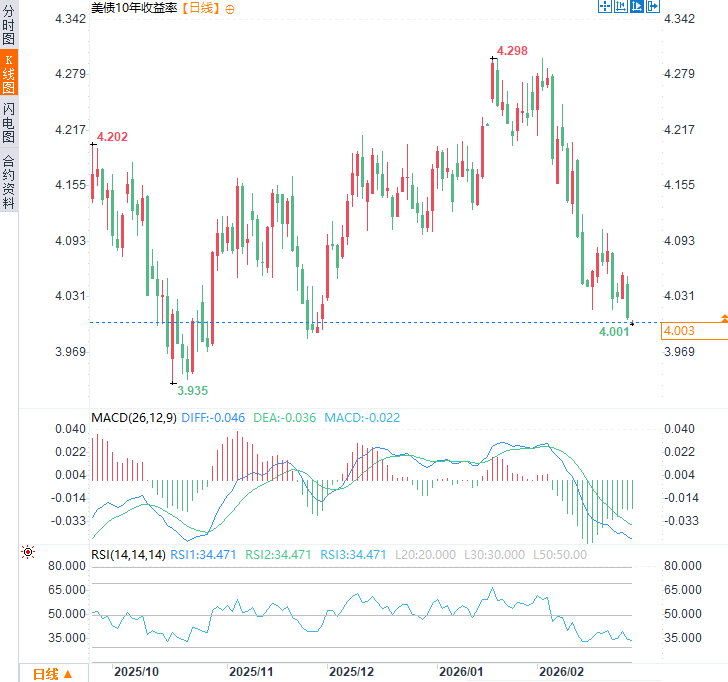
(Daily chart of 10-year US Treasury yield, source: EasyTrade)
Treasury Secretary Scott Bessent has repeatedly refuted the “selling off America” argument, emphasizing that current economic policies are strengthening America’s position: “We are restoring industrial capacity, strengthening technological leadership, expanding economic opportunities and enhancing resilience, fundamentally resetting the framework for American participation in the global economy.”
While foreign official holdings of U.S. Treasury bonds have fallen by about 12% from their 2021 peak to $3.5 trillion, gold reserves have reached a record high. Kristina Hooper, chief market strategist at Man Group, warned that if the trend of allies reducing their holdings continues, it will put significant upward pressure on long-term Treasury yields.
The US is turning its closest allies into "hostages" of its debt. While it has managed to stabilize the situation in the short term, with the dollar index fluctuating narrowly around 97.80 during Friday's Asian trading session, in the long run, this "kidnapping financing" is eroding the dollar's credit foundation. Once allies begin to break free from this bondage, the dollar's twilight will accelerate.
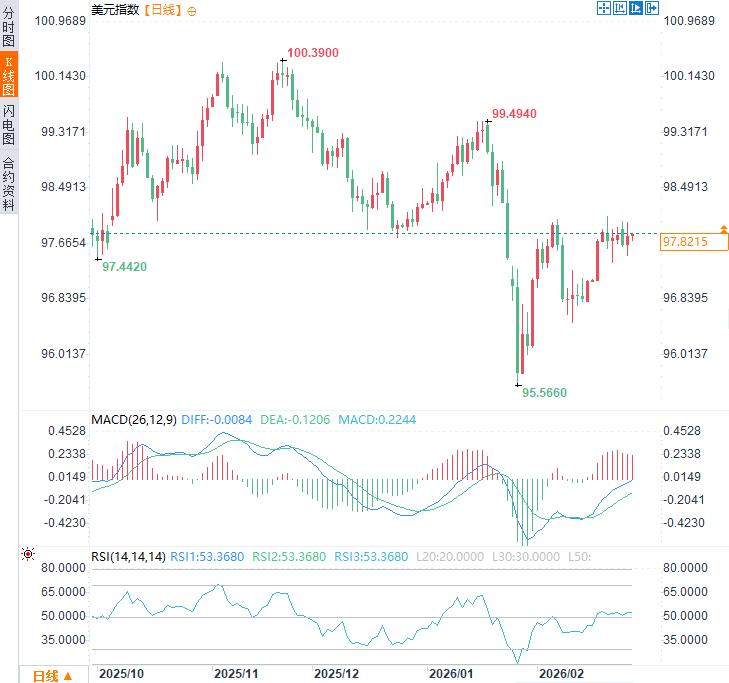
(US Dollar Index Daily Chart, Source: FX678)
At 10:18 Beijing time, the US dollar index is currently at 97.76.
Allies significantly increased their holdings, while non-allies accelerated their selling.
According to an analysis of data from the U.S. Treasury Department, countries closely aligned with Washington will be net buyers of $463.9 billion in U.S. Treasury bonds in 2025, the largest annual net purchase since at least 2016. In stark contrast, countries least aligned with the U.S. sold off $125.24 billion in U.S. debt last year, a six-year high.
From 2016 to 2025, non-allied and neutral countries will cumulatively sell $673 billion in U.S. Treasury bonds, while allied countries will increase their reserves in every year except one. The UK, Canada, and Japan were the largest buyers last year. Even excluding financial centers like the UK and Belgium, U.S. allies as a whole will remain net buyers, with purchases exceeding 2024 levels.
Allies baskets drawn by geopolitical voting
In this analysis, allies are categorized based on whether their voting behavior on key UN resolutions aligns with that of the United States—a common method used in academia. Australia, a long-time military ally, is classified as the closest ally, while neighboring Mexico falls into the neutral category. Voting data is primarily sourced from US State Department records.
This shift in concentration of holdings clearly demonstrates a change in the balance of power, and also means that Trump, while reshaping the global order, must not easily alienate traditional allies. Last month's push to acquire Greenland has already sparked market speculation that Europe may "weaponize" its holdings of US assets.
Angering allies is costly for net debtor nations.
Kathy Jones, chief fixed income strategist at Charles Schwab, bluntly stated: "As a net debtor, especially one with a high deficit and heavy reliance on foreign capital, it is unwise to anger both friends and enemies. This would drive up financing costs and create market instability. Given the combined effects of sanctions, tariffs, deficit expansion, and the 'America First' policy, it is not surprising that some countries are reducing their dollar exposure."
Trump's public criticism of the Federal Reserve's independence, the escalation of the trade war, and domestic political polarization have further accelerated the reallocation of global investors' holdings of dollar assets. Although Trump has long accused other countries of manipulating exchange rates to make the dollar "overvalued," foreign countries actually hold about one-third of outstanding U.S. Treasury bonds. If more countries join the sell-off, the risk will rapidly amplify.
Yields remain attractive, but the greatest risk is that allies will withdraw their purchases.
On Friday (February 27), the yield on the 10-year U.S. Treasury note was around 4%. Kiyoshi Ishigane, Executive Chief Fund Manager at Mitsubishi UFJ Asset Management, stated, "There are no large-scale alternatives in the U.S. market. Even with dissatisfaction with U.S. policies, it's unrealistic to expect a large-scale shift of funds elsewhere."
Strategists believe that as long as US yields remain relatively attractive, funds will continue to flow in. However, Maxence Visseau, research director at Arkevium, warns: "The real risk lies in allies collectively stopping buying or even starting to hedge."
(Daily chart of 10-year US Treasury yield, source: EasyTrade)
Treasury Department Responds to Selling Off US Narrative
Treasury Secretary Scott Bessent has repeatedly refuted the “selling off America” argument, emphasizing that current economic policies are strengthening America’s position: “We are restoring industrial capacity, strengthening technological leadership, expanding economic opportunities and enhancing resilience, fundamentally resetting the framework for American participation in the global economy.”
While foreign official holdings of U.S. Treasury bonds have fallen by about 12% from their 2021 peak to $3.5 trillion, gold reserves have reached a record high. Kristina Hooper, chief market strategist at Man Group, warned that if the trend of allies reducing their holdings continues, it will put significant upward pressure on long-term Treasury yields.
The US is turning its closest allies into "hostages" of its debt. While it has managed to stabilize the situation in the short term, with the dollar index fluctuating narrowly around 97.80 during Friday's Asian trading session, in the long run, this "kidnapping financing" is eroding the dollar's credit foundation. Once allies begin to break free from this bondage, the dollar's twilight will accelerate.
(US Dollar Index Daily Chart, Source: FX678)
At 10:18 Beijing time, the US dollar index is currently at 97.76.
- Risk Warning and Disclaimer
- The market involves risk, and trading may not be suitable for all investors. This article is for reference only and does not constitute personal investment advice, nor does it take into account certain users’ specific investment objectives, financial situation, or other needs. Any investment decisions made based on this information are at your own risk.