Is the Middle East powder keg about to explode? Oil prices keep rising; how long will this frenzy last?
2026-02-27 21:44:52
The oil market has been rapidly escalating due to geopolitical tensions. At the start of the US session on Friday, February 27th, WTI crude oil was priced around $67.50, maintaining its short-term strength. The core logic behind this rally is very clear: the market is no longer simply focusing on the current supply and demand balance sheet, but is instead frantically trading on the expectation of "potential supply disruptions" and the repricing of "risk premiums."
International benchmark crude oil prices surged in tandem, with Brent crude futures rising $2, or 2.8%, to $72.75 a barrel, and WTI crude rising $2.20, or 3.2%, to $67.50 a barrel. For the week, both saw a cumulative weekly increase of 1.4%. This broad-based price increase clearly indicates to the market that the rise in oil prices is not driven by a localized shortage of a single commodity, but rather by systemic geopolitical risk factors that are forcefully pushing up the pricing center of the entire energy market.
The driving force behind this surge in risk sentiment points directly to the stability of Middle Eastern supply chains. While the US-Iran talks failed to reach an agreement, there were signs of progress, with negotiations extended to next week and technical discussions scheduled for Vienna. In the logic of financial markets, prolonged negotiations often indicate that differences are difficult to bridge quickly, and prices tend to factor in the "worst-case scenario" in advance as a probability, resulting in both increased risk premiums and heightened volatility. Meanwhile, unusual signals of regional population movement have further deepened market concerns about the spillover effects of the situation; for example, reports indicate that a large number of US citizens left Iraq via Baghdad International Airport in the past 24 hours. While such information does not directly alter immediate supply and demand, it significantly impacts traders' pricing of tail risks, thus becoming a powerful short-term catalyst for rising oil prices.
The market is largely focused on the safety of passage through the Strait of Hormuz, as approximately 20% of the world's oil supply passes through this vital waterway. The mere possibility of supply disruptions triggers a preemptive price reaction, rather than waiting for a substantial shortage to materialize. Based on this deep-seated concern, the current geopolitical risk premium of $8 to $10 per barrel is considered fully priced into oil prices. Under this premium, oil prices exhibit an "asymmetric" characteristic: they are sensitive to any signs of easing and tend to retrace gains, while amplifying upward movements in response to any signs of tension. This explains why recent rapid price increases have been accompanied by sharp pullbacks.
Faced with potential supply shocks, the supply side is also preparing countermeasures. Reports indicate that Saudi Arabia is increasing oil production and exports; if this pace continues, it could psychologically offset some supply concerns. Especially given that short-term inventories have not yet significantly decreased, the increase is more of a suppressive effect on expectations than an immediate easing of the spot market. Furthermore, policy expectations from the oil-producing alliance are also a key variable. Reports suggest that OPEC+ may consider increasing April's daily oil production by 137,000 barrels at its March 1st meeting, after suspending its first-quarter production increase plan. If this increase materializes, it would be a moderate supply increase, reflecting more of an intention to manage rapidly rising prices than a full-scale shift to easing supply. For the futures market, a small increase in production is more likely to affect sentiment and the strength of the premium in near-month contracts; the medium- to long-term price center still depends on the subsequent price path.
While demand wasn't the trigger for this surge, its resilience in a high oil price environment determines the ceiling for further price increases. If risk premiums remain high, refining margins, refined product crack spreads, and downstream restocking pace will become the litmus test for market resilience. Once end-user demand becomes more sensitive to high prices, prices may shift from a rapid, geopolitically driven surge to high-level consolidation, using time to allow for a rebalancing of supply and demand. Overall, the short-term oil price movement resembles a repricing process driven by risk events.
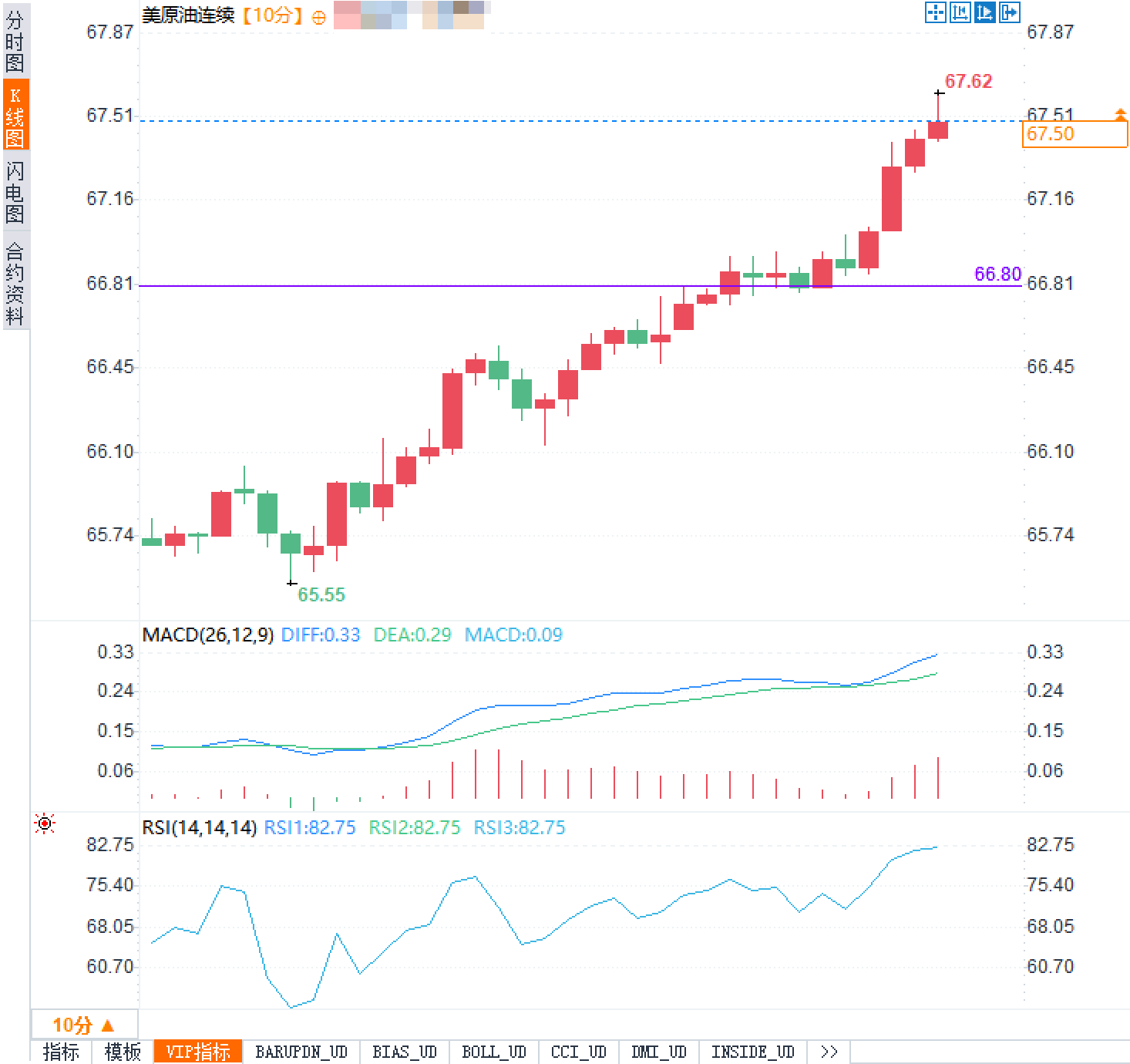
Currently, WTI crude oil is hovering around $67.50, a crucial level where bulls and bears are locked in a battle. If negotiations bring certainty and the risk premium narrows, oil prices are likely to enter a period of consolidation. If uncertainty persists, the risk premium may remain in the $8 to $10 range or even rise again, supporting prices at higher levels.
International benchmark crude oil prices surged in tandem, with Brent crude futures rising $2, or 2.8%, to $72.75 a barrel, and WTI crude rising $2.20, or 3.2%, to $67.50 a barrel. For the week, both saw a cumulative weekly increase of 1.4%. This broad-based price increase clearly indicates to the market that the rise in oil prices is not driven by a localized shortage of a single commodity, but rather by systemic geopolitical risk factors that are forcefully pushing up the pricing center of the entire energy market.
The tug-of-war at the negotiating table and the shadows along the strait.
The driving force behind this surge in risk sentiment points directly to the stability of Middle Eastern supply chains. While the US-Iran talks failed to reach an agreement, there were signs of progress, with negotiations extended to next week and technical discussions scheduled for Vienna. In the logic of financial markets, prolonged negotiations often indicate that differences are difficult to bridge quickly, and prices tend to factor in the "worst-case scenario" in advance as a probability, resulting in both increased risk premiums and heightened volatility. Meanwhile, unusual signals of regional population movement have further deepened market concerns about the spillover effects of the situation; for example, reports indicate that a large number of US citizens left Iraq via Baghdad International Airport in the past 24 hours. While such information does not directly alter immediate supply and demand, it significantly impacts traders' pricing of tail risks, thus becoming a powerful short-term catalyst for rising oil prices.
The market is largely focused on the safety of passage through the Strait of Hormuz, as approximately 20% of the world's oil supply passes through this vital waterway. The mere possibility of supply disruptions triggers a preemptive price reaction, rather than waiting for a substantial shortage to materialize. Based on this deep-seated concern, the current geopolitical risk premium of $8 to $10 per barrel is considered fully priced into oil prices. Under this premium, oil prices exhibit an "asymmetric" characteristic: they are sensitive to any signs of easing and tend to retrace gains, while amplifying upward movements in response to any signs of tension. This explains why recent rapid price increases have been accompanied by sharp pullbacks.
Supply-side competition and demand-side challenges
Faced with potential supply shocks, the supply side is also preparing countermeasures. Reports indicate that Saudi Arabia is increasing oil production and exports; if this pace continues, it could psychologically offset some supply concerns. Especially given that short-term inventories have not yet significantly decreased, the increase is more of a suppressive effect on expectations than an immediate easing of the spot market. Furthermore, policy expectations from the oil-producing alliance are also a key variable. Reports suggest that OPEC+ may consider increasing April's daily oil production by 137,000 barrels at its March 1st meeting, after suspending its first-quarter production increase plan. If this increase materializes, it would be a moderate supply increase, reflecting more of an intention to manage rapidly rising prices than a full-scale shift to easing supply. For the futures market, a small increase in production is more likely to affect sentiment and the strength of the premium in near-month contracts; the medium- to long-term price center still depends on the subsequent price path.
While demand wasn't the trigger for this surge, its resilience in a high oil price environment determines the ceiling for further price increases. If risk premiums remain high, refining margins, refined product crack spreads, and downstream restocking pace will become the litmus test for market resilience. Once end-user demand becomes more sensitive to high prices, prices may shift from a rapid, geopolitically driven surge to high-level consolidation, using time to allow for a rebalancing of supply and demand. Overall, the short-term oil price movement resembles a repricing process driven by risk events.
Currently, WTI crude oil is hovering around $67.50, a crucial level where bulls and bears are locked in a battle. If negotiations bring certainty and the risk premium narrows, oil prices are likely to enter a period of consolidation. If uncertainty persists, the risk premium may remain in the $8 to $10 range or even rise again, supporting prices at higher levels.
- Risk Warning and Disclaimer
- The market involves risk, and trading may not be suitable for all investors. This article is for reference only and does not constitute personal investment advice, nor does it take into account certain users’ specific investment objectives, financial situation, or other needs. Any investment decisions made based on this information are at your own risk.