Iran's Supreme Leader confirmed to have been attacked! A single article to understand where money will flow and where it will rush to when the market opens on Monday.
2026-03-01 10:33:55
On Sunday (March 1), with the situation in Iran deteriorating sharply over the weekend—especially the US-Israel joint military operation that led to the assassination of Iran's Supreme Leader Khamenei, and the subsequent missile retaliation and the de facto paralysis of the Strait of Hormuz—the financial markets will inevitably face an unprecedented "storm" when they open on Monday.
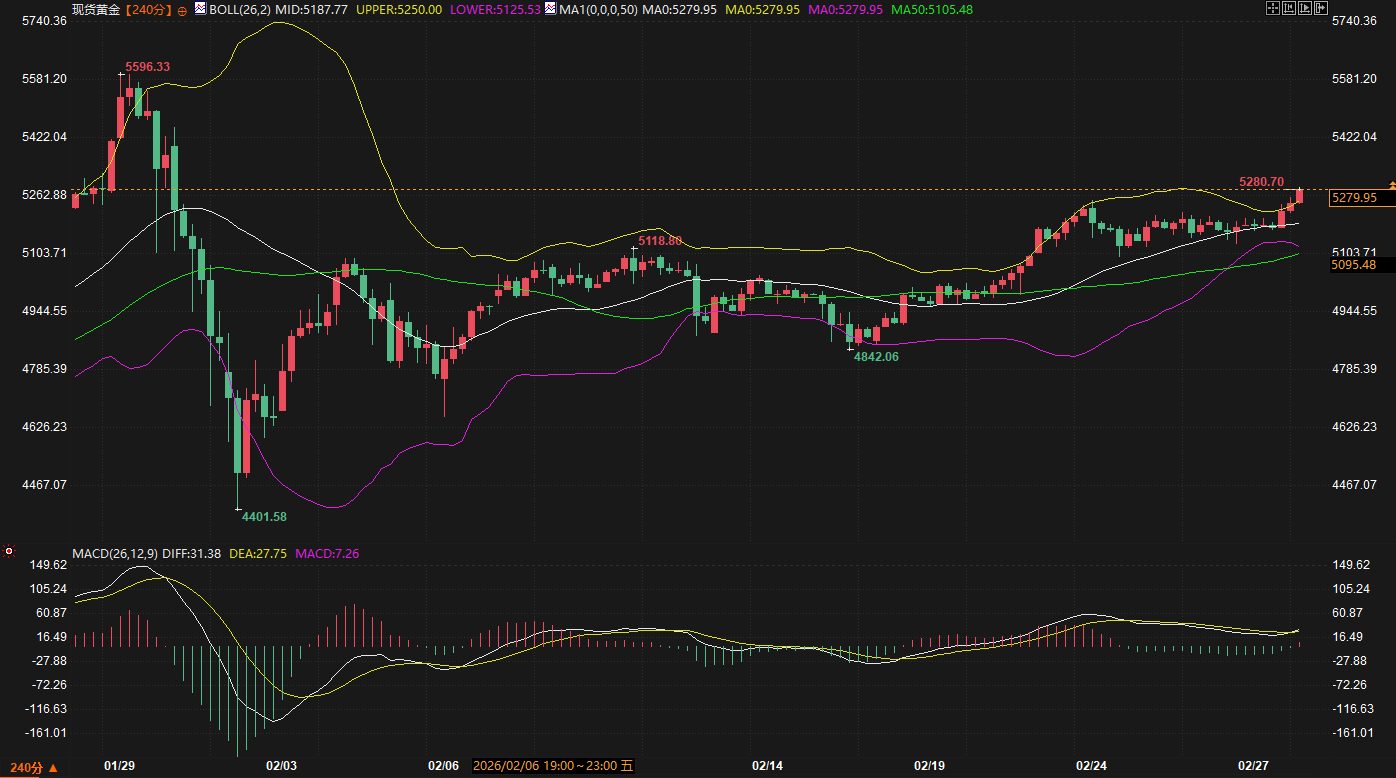
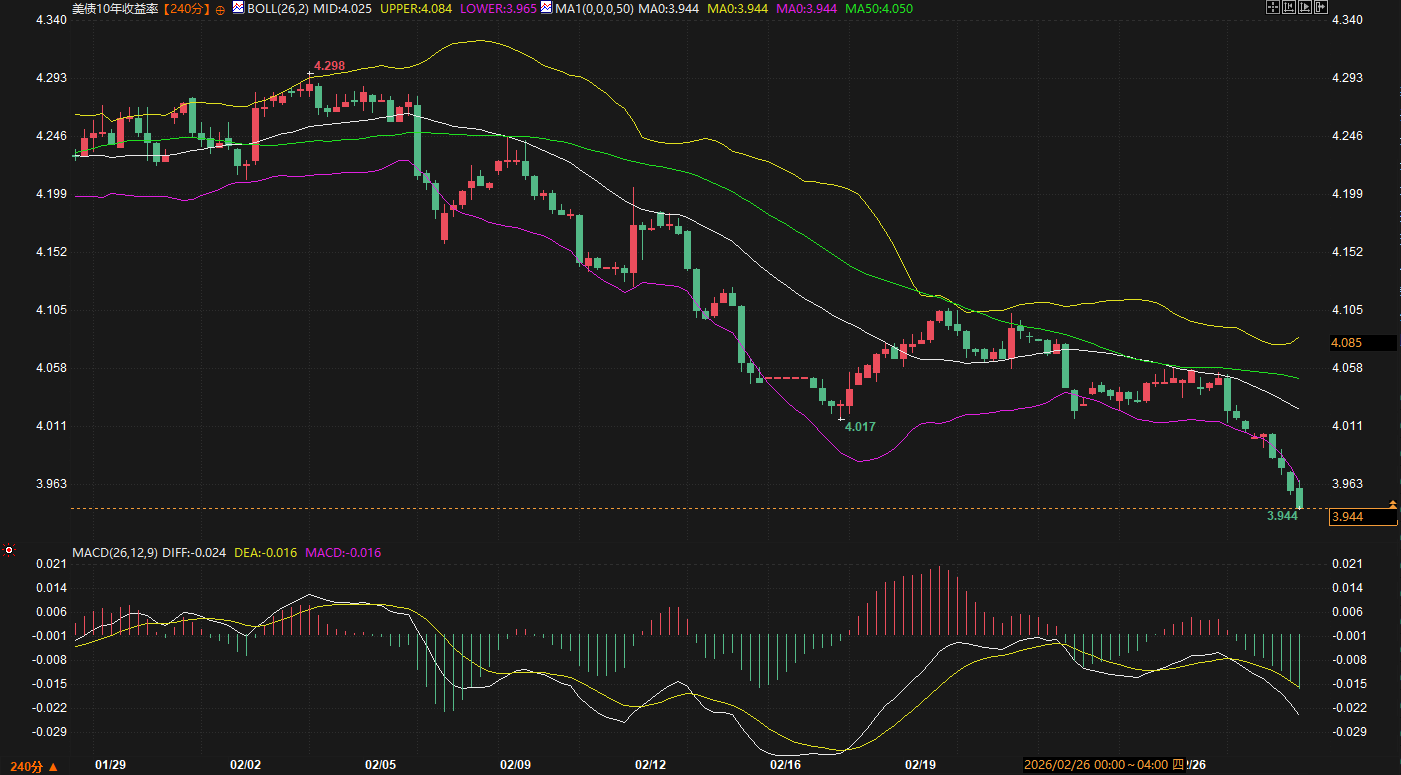
Looking back at the past trading week, the market showed strong unease before the close due to the escalating geopolitical risks. On Friday (February 27), as global financial markets closed, major asset classes were at key technical levels: spot gold surged to around $5280, Brent crude oil held above $73, and the 10-year US Treasury yield accelerated its decline, falling below the 3.95% mark. These figures broadly reflect that, prior to any major unforeseen event, market sentiment had shifted from volatility to a clear risk-averse drive.
This escalation is not a traditional proxy conflict, but a direct attack on the core leadership of a sovereign state. The following is a logical summary of the latest developments as of Sunday morning:
1. The fall of a key figure and the fog of information
According to authoritative media and multiple sources, Iranian Supreme Leader Ayatollah Khamenei was killed in a joint US-Israeli operation. Although Iranian officials attempted to reassure the public with rhetoric of "psychological warfare," the release of photos by the Israel Defense Forces showing the elimination of senior officials and Khamenei's relatives has increasingly replaced the perceived certainty of the information with market expectations.
2. The uncertainty surrounding the successor and the expectation of hardliners taking power
A recent assessment by a prominent institution suggests that even if Khamenei were to die, the Iranian regime would not collapse immediately. Instead, it is likely to be taken over by hardliners within the Islamic Revolutionary Guard Corps (IRGC). The close ties between potential successors like Mojtaba Khamenei and the IRGC foreshadow a more confrontational future foreign policy for Iran.
3. The substantial paralysis of the "energy choke point"
The most alarming signal for the market right now is the state of the Strait of Hormuz. Although the UK Maritime Authority claims the strait remains open, actual data shows that tanker speeds in the area have generally dropped to zero. The large number of tankers halting operations to avoid danger means that approximately 20% of the global oil supply route is effectively paralyzed. This fact, rather than a statement, will be the direct trigger for a gap-up opening in oil prices on Monday.
The market is currently in a state of "extreme risk aversion." We need to combine Friday's candlestick data with the unexpected fundamental developments over the weekend to logically connect the major instruments.
1. Energy Market: The "Wartime Premium" for Brent and WTI Crude Oil
Technical background:
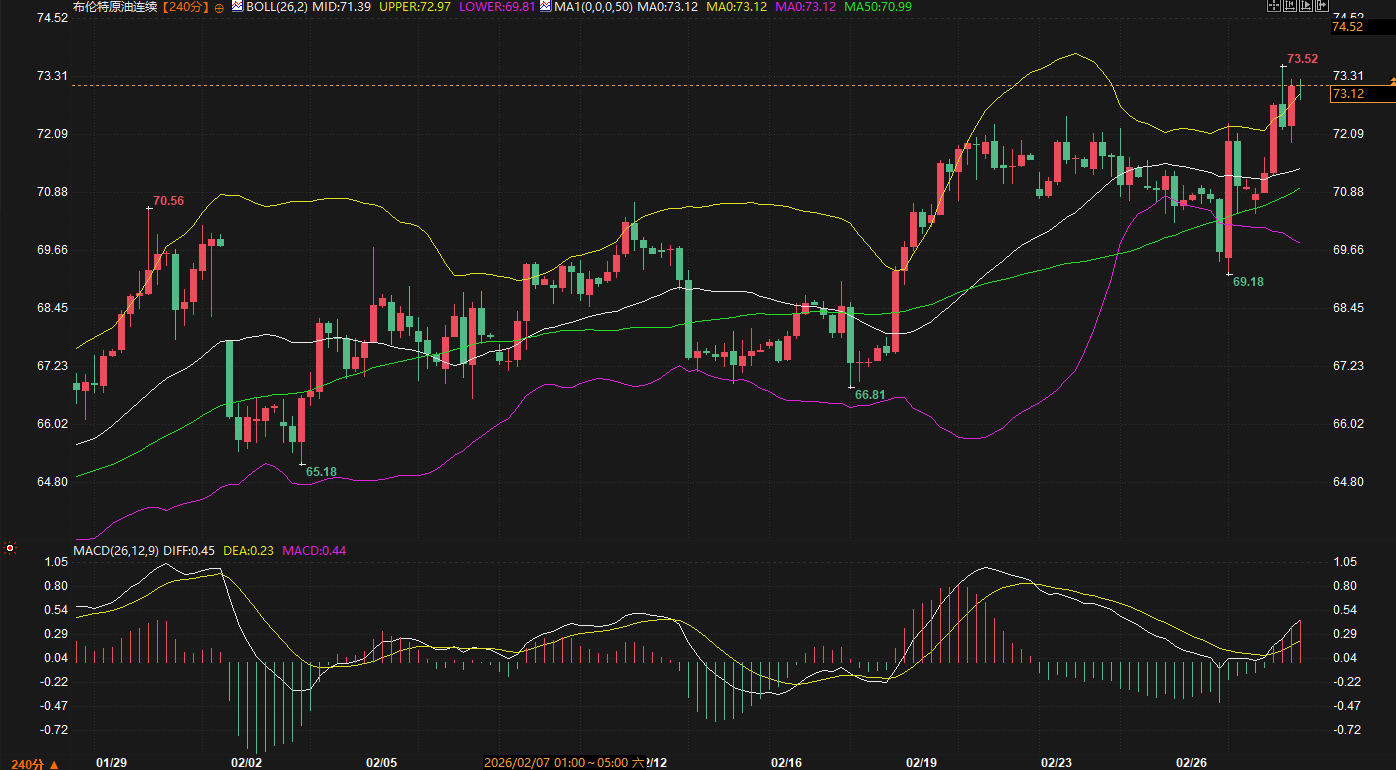
Brent crude oil (reference contract: continuous) : closed at $73.12 on Friday, breaking through the upper Bollinger Band (72.97). The MACD bullish momentum continues, with the MA50 (70.99) providing strong support.
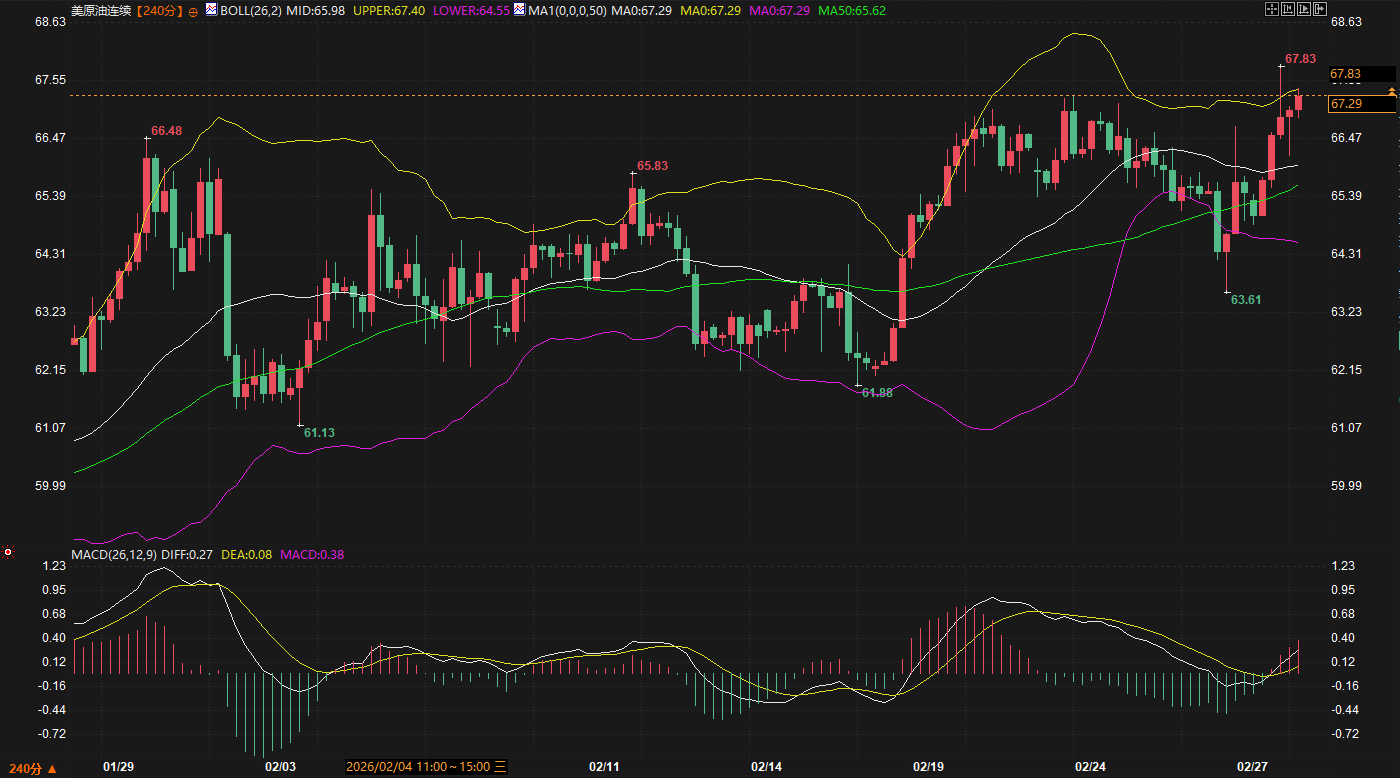
WTI crude oil (reference contract: continuous) : closed at $67.29, MACD golden cross is clear.
Fundamental connection:
If the flow disruption in the Strait of Hormuz exceeds 70%, the market will no longer focus on basic supply and demand, but will instead trade directly in the "supply vacuum." Analysts from well-known institutions point out that if the disruption continues, oil prices could gap up by $5-10 at the opening on Monday, or even directly hit the $80-100 range. Since the US has clearly stated that it will not release strategic petroleum reserves for the time being, upward resistance to oil prices is minimal.
2. Safe-haven assets: Spot gold and safe-haven currencies
Spot gold:
Technical Analysis: On Friday, the price reached a high of $5280.70, far exceeding the upper Bollinger Band ($5250.00). Moving averages are in a bullish alignment, and the MACD histogram continues to expand.
Logical Analysis: Geopolitical uncertainty is the strongest catalyst for gold. Faced with a "historic-altering" event like Khamenei's death, investors will collectively flock to safe havens.
Foreign exchange market (USD, JPY):
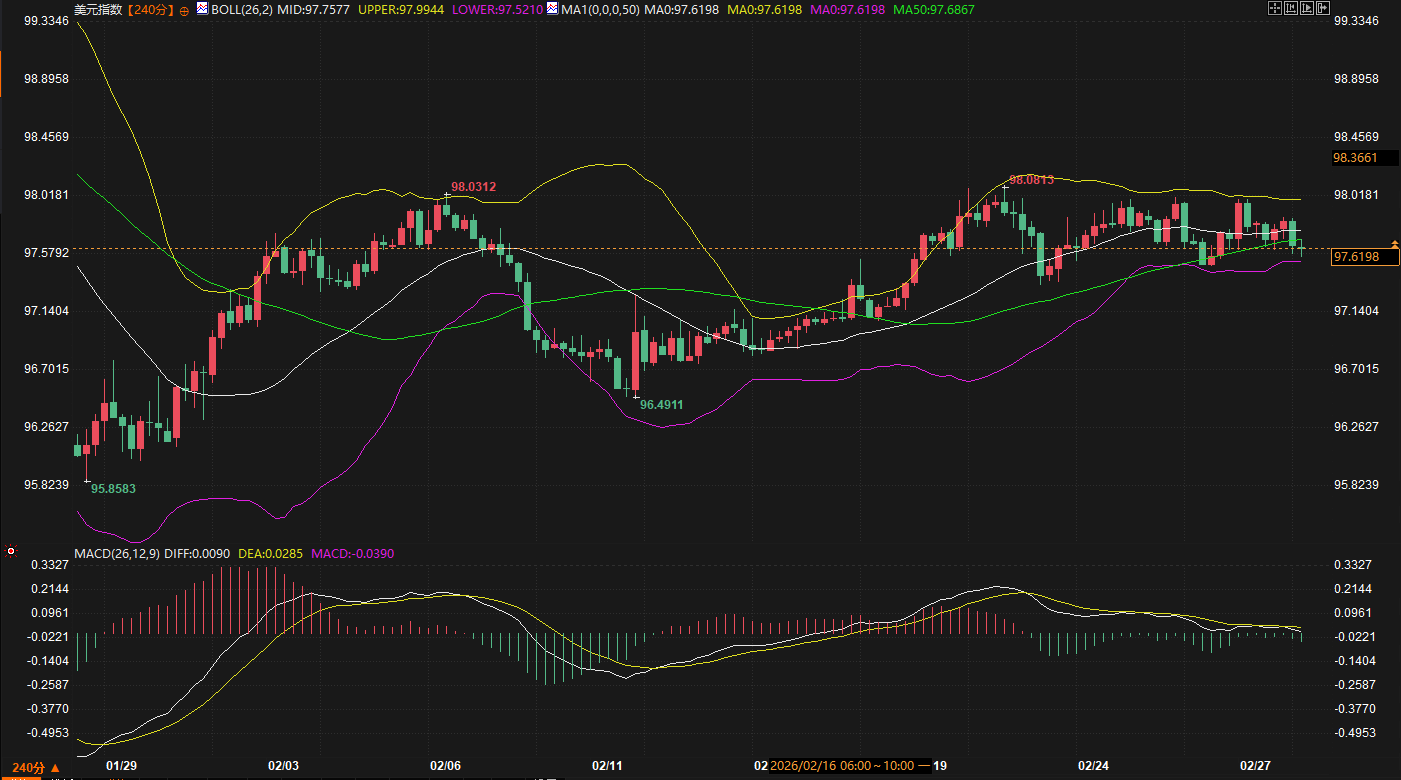
US Dollar Index: Currently fluctuating around 97.62. Although supported by some safe-haven demand triggered by Trump's tariff remarks, short-term momentum is weak.
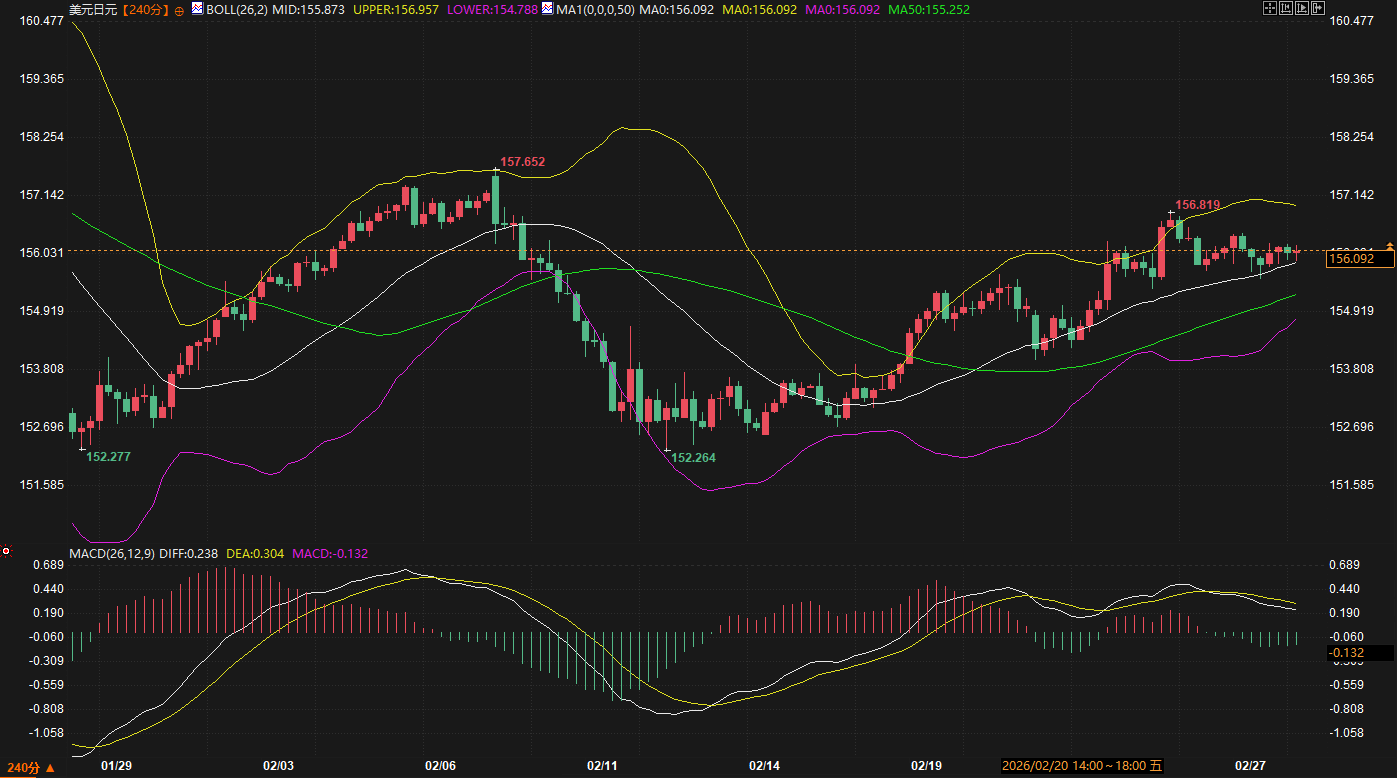
Japanese Yen (USDJPY): Quote 156.092. Although the yen has safe-haven attributes, Japan's heavy reliance on oil imports means that soaring oil prices could trigger concerns about the yen's purchasing power, leading to a significant increase in yen volatility.
3. Bond Market: The accelerated decline in the 10-year US Treasury yield.
Technical background: The latest price is 3.944, which has broken through the lower Bollinger Band (3.965), indicating that the bears are in control.
Logical analysis: Market risk aversion will force funds to flow into US Treasuries. The accelerated decline in yields reflects the extreme thirst for safety. Early next week, yields may further test the 3.900 level.
Based on 240-minute technical patterns and calculations of sudden geopolitical premiums, the key positions and points of interest for each commodity are as follows:
Spot gold is expected to find support between 5180 and 5220, and resistance between 5350 and 5500. During the trading session, attention should be paid to the gap height and sustainability of safe-haven flows.
Brent crude oil has support at $71 to $72.50, while resistance could rise to $80 to $100 if the situation escalates. The actual passage rate of the Strait of Hormuz will be the focus.
WTI crude oil has support in the $64.5 to $66 range, with resistance targets at $75 to $90. Attention should be paid to whether the shutdown announcements from major energy companies will be further expanded.
The US dollar index has support in the 97.2 to 97.5 range, while resistance is seen at 98.1 to 98.5. The market will be watching how safe-haven inflows offset inflation expectations.
The USD/JPY pair is supported by safe-haven demand at 154.5-155.2, while resistance lies at 157.5-158.8. The key focus will be on the Bank of Japan's policy response to the impact of oil prices.
The 10-year US Treasury yield has long-term support in the 3.85 to 3.9% range, while the 3.965 to 4.025% range forms technical resistance. We need to be wary of whether safe-haven buying will trigger a "plummeting" in yields.
The situation is changing rapidly, and the next 24 hours will be crucial in determining the main theme of the market next week and even the first half of the year.
1. Confirmation of the intensity of Iranian retaliation: Attention is focused on whether Tehran will launch a second or third round of missile attacks against broader military or economic targets in the Persian Gulf (such as oil refineries and foreign ports). Explosions have already been reported in Dubai and Doha; this spillover effect is central to market pricing.
2. Filling the political vacuum at Iran's top leadership: Pay attention to the statements from the Iranian Vice President and the Council of Experts. Will a hardliner quickly step into the limelight? If so, the market will price in a "protracted conflict."
3. Militarization of the Strait of Hormuz: Attention should be paid to whether the US and its allies will attempt "escort operations." If direct maritime clashes occur, oil price volatility will reach record levels.
4. The chain reaction among global energy giants: Watch whether more oil companies will announce the suspension of shipments due to "force majeure".
5. The effectiveness of international diplomatic mediation: Pay attention to the mediation efforts or position statements of Gulf Arab countries (such as Saudi Arabia and Qatar).
Logically speaking, this round of conflict has undergone a qualitative change from "sudden attack" to "regional turmoil." The panic accumulated over the weekend will be released in a concentrated manner at the beginning of Monday's trading session, either through gap-up openings (gold and crude oil) or gap-down openings (global stock markets).
Strategists at well-known institutions believe that the impact of the current situation in Iran is far greater than that of Venezuela or the previous Red Sea crisis. Venezuela was merely a matter of production fluctuations, while the Iranian situation involves the potential blockage of a "global energy choke point." If the Strait of Hormuz faces a prolonged blockade, global inflationary pressures will reignite, potentially forcing major central banks to re-evaluate their monetary policy paths.
In such extreme market conditions, technical support and resistance levels are often broken almost immediately after the market opens. Investors should remain cautious and realistically assess the profound impact of geopolitical risks on medium- to long-term inflation and supply chains. Market movements in the coming days will largely depend on the direction of power restructuring in Tehran following Khamenei's death, and whether the Revolutionary Guard will adopt a scorched-earth blockade strategy.
Looking back at the past trading week, the market showed strong unease before the close due to the escalating geopolitical risks. On Friday (February 27), as global financial markets closed, major asset classes were at key technical levels: spot gold surged to around $5280, Brent crude oil held above $73, and the 10-year US Treasury yield accelerated its decline, falling below the 3.95% mark. These figures broadly reflect that, prior to any major unforeseen event, market sentiment had shifted from volatility to a clear risk-averse drive.
I. Event Developments: From Border Friction to Targeted Escalation of "Central Strike"
This escalation is not a traditional proxy conflict, but a direct attack on the core leadership of a sovereign state. The following is a logical summary of the latest developments as of Sunday morning:
1. The fall of a key figure and the fog of information
According to authoritative media and multiple sources, Iranian Supreme Leader Ayatollah Khamenei was killed in a joint US-Israeli operation. Although Iranian officials attempted to reassure the public with rhetoric of "psychological warfare," the release of photos by the Israel Defense Forces showing the elimination of senior officials and Khamenei's relatives has increasingly replaced the perceived certainty of the information with market expectations.
2. The uncertainty surrounding the successor and the expectation of hardliners taking power
A recent assessment by a prominent institution suggests that even if Khamenei were to die, the Iranian regime would not collapse immediately. Instead, it is likely to be taken over by hardliners within the Islamic Revolutionary Guard Corps (IRGC). The close ties between potential successors like Mojtaba Khamenei and the IRGC foreshadow a more confrontational future foreign policy for Iran.
3. The substantial paralysis of the "energy choke point"
The most alarming signal for the market right now is the state of the Strait of Hormuz. Although the UK Maritime Authority claims the strait remains open, actual data shows that tanker speeds in the area have generally dropped to zero. The large number of tankers halting operations to avoid danger means that approximately 20% of the global oil supply route is effectively paralyzed. This fact, rather than a statement, will be the direct trigger for a gap-up opening in oil prices on Monday.
II. Market Analysis: A Deep Resonance Between Technical and Fundamental Factors
The market is currently in a state of "extreme risk aversion." We need to combine Friday's candlestick data with the unexpected fundamental developments over the weekend to logically connect the major instruments.
1. Energy Market: The "Wartime Premium" for Brent and WTI Crude Oil
Technical background:
Brent crude oil (reference contract: continuous) : closed at $73.12 on Friday, breaking through the upper Bollinger Band (72.97). The MACD bullish momentum continues, with the MA50 (70.99) providing strong support.
WTI crude oil (reference contract: continuous) : closed at $67.29, MACD golden cross is clear.
Fundamental connection:
If the flow disruption in the Strait of Hormuz exceeds 70%, the market will no longer focus on basic supply and demand, but will instead trade directly in the "supply vacuum." Analysts from well-known institutions point out that if the disruption continues, oil prices could gap up by $5-10 at the opening on Monday, or even directly hit the $80-100 range. Since the US has clearly stated that it will not release strategic petroleum reserves for the time being, upward resistance to oil prices is minimal.
2. Safe-haven assets: Spot gold and safe-haven currencies
Spot gold:
Technical Analysis: On Friday, the price reached a high of $5280.70, far exceeding the upper Bollinger Band ($5250.00). Moving averages are in a bullish alignment, and the MACD histogram continues to expand.
Logical Analysis: Geopolitical uncertainty is the strongest catalyst for gold. Faced with a "historic-altering" event like Khamenei's death, investors will collectively flock to safe havens.
Foreign exchange market (USD, JPY):
US Dollar Index: Currently fluctuating around 97.62. Although supported by some safe-haven demand triggered by Trump's tariff remarks, short-term momentum is weak.
Japanese Yen (USDJPY): Quote 156.092. Although the yen has safe-haven attributes, Japan's heavy reliance on oil imports means that soaring oil prices could trigger concerns about the yen's purchasing power, leading to a significant increase in yen volatility.
3. Bond Market: The accelerated decline in the 10-year US Treasury yield.
Technical background: The latest price is 3.944, which has broken through the lower Bollinger Band (3.965), indicating that the bears are in control.
Logical analysis: Market risk aversion will force funds to flow into US Treasuries. The accelerated decline in yields reflects the extreme thirst for safety. Early next week, yields may further test the 3.900 level.
III. Support and Resistance Range Forecast (Based on Current Trends and Geopolitical Premiums)
Based on 240-minute technical patterns and calculations of sudden geopolitical premiums, the key positions and points of interest for each commodity are as follows:
Spot gold is expected to find support between 5180 and 5220, and resistance between 5350 and 5500. During the trading session, attention should be paid to the gap height and sustainability of safe-haven flows.
Brent crude oil has support at $71 to $72.50, while resistance could rise to $80 to $100 if the situation escalates. The actual passage rate of the Strait of Hormuz will be the focus.
WTI crude oil has support in the $64.5 to $66 range, with resistance targets at $75 to $90. Attention should be paid to whether the shutdown announcements from major energy companies will be further expanded.
The US dollar index has support in the 97.2 to 97.5 range, while resistance is seen at 98.1 to 98.5. The market will be watching how safe-haven inflows offset inflation expectations.
The USD/JPY pair is supported by safe-haven demand at 154.5-155.2, while resistance lies at 157.5-158.8. The key focus will be on the Bank of Japan's policy response to the impact of oil prices.
The 10-year US Treasury yield has long-term support in the 3.85 to 3.9% range, while the 3.965 to 4.025% range forms technical resistance. We need to be wary of whether safe-haven buying will trigger a "plummeting" in yields.
IV. Events to closely monitor in the next 24 hours (around Monday's market opening)
The situation is changing rapidly, and the next 24 hours will be crucial in determining the main theme of the market next week and even the first half of the year.
1. Confirmation of the intensity of Iranian retaliation: Attention is focused on whether Tehran will launch a second or third round of missile attacks against broader military or economic targets in the Persian Gulf (such as oil refineries and foreign ports). Explosions have already been reported in Dubai and Doha; this spillover effect is central to market pricing.
2. Filling the political vacuum at Iran's top leadership: Pay attention to the statements from the Iranian Vice President and the Council of Experts. Will a hardliner quickly step into the limelight? If so, the market will price in a "protracted conflict."
3. Militarization of the Strait of Hormuz: Attention should be paid to whether the US and its allies will attempt "escort operations." If direct maritime clashes occur, oil price volatility will reach record levels.
4. The chain reaction among global energy giants: Watch whether more oil companies will announce the suspension of shipments due to "force majeure".
5. The effectiveness of international diplomatic mediation: Pay attention to the mediation efforts or position statements of Gulf Arab countries (such as Saudi Arabia and Qatar).
Outlook
Logically speaking, this round of conflict has undergone a qualitative change from "sudden attack" to "regional turmoil." The panic accumulated over the weekend will be released in a concentrated manner at the beginning of Monday's trading session, either through gap-up openings (gold and crude oil) or gap-down openings (global stock markets).
Strategists at well-known institutions believe that the impact of the current situation in Iran is far greater than that of Venezuela or the previous Red Sea crisis. Venezuela was merely a matter of production fluctuations, while the Iranian situation involves the potential blockage of a "global energy choke point." If the Strait of Hormuz faces a prolonged blockade, global inflationary pressures will reignite, potentially forcing major central banks to re-evaluate their monetary policy paths.
In such extreme market conditions, technical support and resistance levels are often broken almost immediately after the market opens. Investors should remain cautious and realistically assess the profound impact of geopolitical risks on medium- to long-term inflation and supply chains. Market movements in the coming days will largely depend on the direction of power restructuring in Tehran following Khamenei's death, and whether the Revolutionary Guard will adopt a scorched-earth blockade strategy.
- Risk Warning and Disclaimer
- The market involves risk, and trading may not be suitable for all investors. This article is for reference only and does not constitute personal investment advice, nor does it take into account certain users’ specific investment objectives, financial situation, or other needs. Any investment decisions made based on this information are at your own risk.