Soaring oil prices and a weaker dollar put pressure on USD/CAD, causing the exchange rate to remain in a narrow range.
2026-03-02 13:18:50
At the start of the week, USD/CAD rose slightly to the 1.3675 area during the Asian session before encountering selling pressure and subsequently falling back to trade near a two-week low. The current exchange rate movement is mainly influenced by two core factors.
First, geopolitical risks continue to dominate the energy market. The US and Israel's military actions against Iran and shipping risks in the Strait of Hormuz caused international crude oil prices to rise by more than 5% in a single day. Rising oil prices typically benefit Canada, an energy-exporting economy, thus supporting the Canadian dollar and putting downward pressure on the USD/CAD exchange rate.

Secondly, the US dollar experienced a temporary pullback. Although the US Producer Price Index (PPI) was higher than market expectations, concerns about stagflation triggered by slowing economic growth led to divergence in market opinions regarding the Federal Reserve's policy path.
A coexistence of high inflation and economic slowdown often limits the dollar's unilateral upward potential, but risk aversion still provides some support, resulting in a relatively moderate decline in USD/CAD. Overall, the market is currently in a phase of balancing between the dollar's safe-haven appeal and the Canadian dollar's commodity currency characteristics, with no clear short-term directional trend.
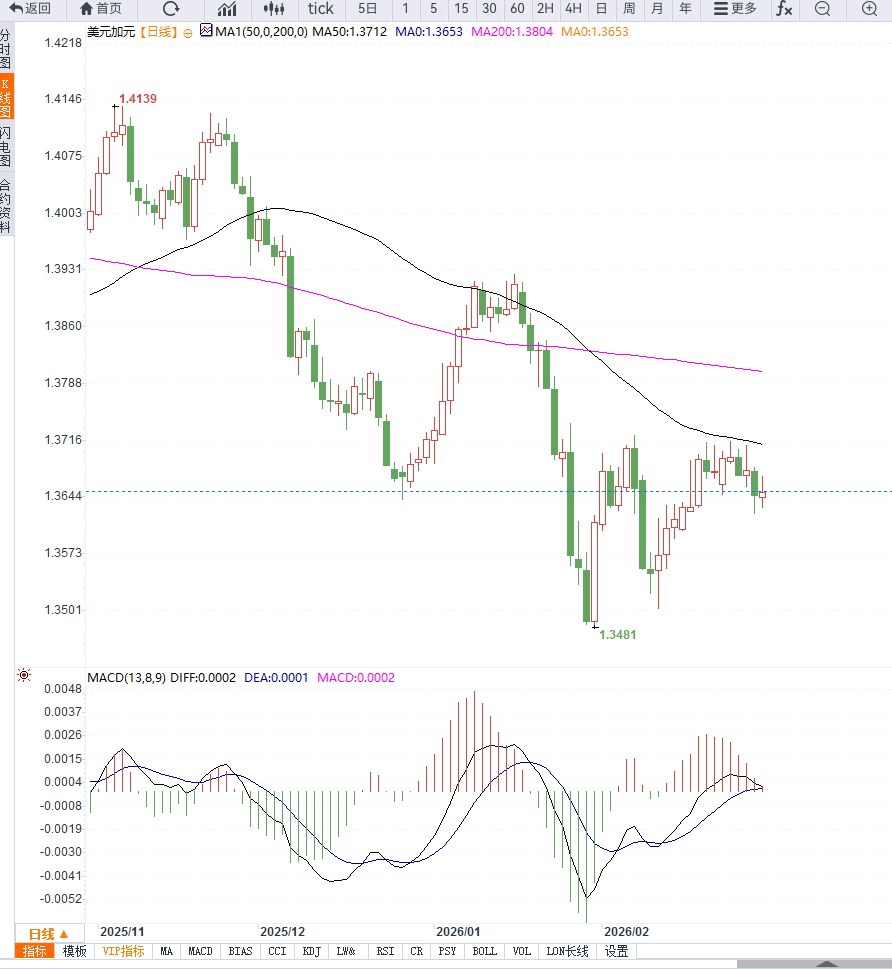
From the 4-hour chart, USD/CAD is showing a generally bearish consolidation pattern, with the price consistently trading below the gradually declining 200-period simple moving average (SMA), which currently constitutes significant dynamic resistance. Recent rebounds have repeatedly been met with resistance in the 1.3690-1.3700 area, which also corresponds to the upper edge of the previous consolidation phase, forming a double technical resistance.
If the exchange rate can effectively break through this resistance zone above the 4-hour closing price, it may weaken the short-term bearish structure and further test the 1.3740 area. Technically, the RSI remains around 40, indicating that the market is still in a weak zone but has not yet entered oversold territory, showing that the downward momentum is relatively mild rather than panic selling.
The MACD indicator remains below the zero line, and the negative momentum bars are small, indicating that the current decline is more of a structural adjustment than a trend collapse. On the downside, 1.3630 is the first short-term support level, corresponding to the previous pullback low.
A break below this level could lead to a further test of the 1.3590 area. As long as the price continues to trade below the 200-period SMA, any rebounds are more likely to be seen as shorting opportunities than a trend reversal signal.
Editor's Note:
The current USD/CAD exchange rate movement reflects a typical energy price-driven logic. Geopolitical conflicts often strengthen the advantages of commodity currencies in the short term, while stagflation concerns support the safe-haven demand for the US dollar to some extent, keeping the exchange rate in a range-bound trading pattern.
Whether USD/CAD can break out of its current trend depends crucially on whether the risk of crude oil supply continues to escalate and whether expectations for Federal Reserve policy diverge further. Overall, the pair is expected to remain range-bound in the short term, awaiting a directional move.
First, geopolitical risks continue to dominate the energy market. The US and Israel's military actions against Iran and shipping risks in the Strait of Hormuz caused international crude oil prices to rise by more than 5% in a single day. Rising oil prices typically benefit Canada, an energy-exporting economy, thus supporting the Canadian dollar and putting downward pressure on the USD/CAD exchange rate.
Secondly, the US dollar experienced a temporary pullback. Although the US Producer Price Index (PPI) was higher than market expectations, concerns about stagflation triggered by slowing economic growth led to divergence in market opinions regarding the Federal Reserve's policy path.
A coexistence of high inflation and economic slowdown often limits the dollar's unilateral upward potential, but risk aversion still provides some support, resulting in a relatively moderate decline in USD/CAD. Overall, the market is currently in a phase of balancing between the dollar's safe-haven appeal and the Canadian dollar's commodity currency characteristics, with no clear short-term directional trend.
From the 4-hour chart, USD/CAD is showing a generally bearish consolidation pattern, with the price consistently trading below the gradually declining 200-period simple moving average (SMA), which currently constitutes significant dynamic resistance. Recent rebounds have repeatedly been met with resistance in the 1.3690-1.3700 area, which also corresponds to the upper edge of the previous consolidation phase, forming a double technical resistance.
If the exchange rate can effectively break through this resistance zone above the 4-hour closing price, it may weaken the short-term bearish structure and further test the 1.3740 area. Technically, the RSI remains around 40, indicating that the market is still in a weak zone but has not yet entered oversold territory, showing that the downward momentum is relatively mild rather than panic selling.
The MACD indicator remains below the zero line, and the negative momentum bars are small, indicating that the current decline is more of a structural adjustment than a trend collapse. On the downside, 1.3630 is the first short-term support level, corresponding to the previous pullback low.
A break below this level could lead to a further test of the 1.3590 area. As long as the price continues to trade below the 200-period SMA, any rebounds are more likely to be seen as shorting opportunities than a trend reversal signal.
Editor's Note:
The current USD/CAD exchange rate movement reflects a typical energy price-driven logic. Geopolitical conflicts often strengthen the advantages of commodity currencies in the short term, while stagflation concerns support the safe-haven demand for the US dollar to some extent, keeping the exchange rate in a range-bound trading pattern.
Whether USD/CAD can break out of its current trend depends crucially on whether the risk of crude oil supply continues to escalate and whether expectations for Federal Reserve policy diverge further. Overall, the pair is expected to remain range-bound in the short term, awaiting a directional move.
- Risk Warning and Disclaimer
- The market involves risk, and trading may not be suitable for all investors. This article is for reference only and does not constitute personal investment advice, nor does it take into account certain users’ specific investment objectives, financial situation, or other needs. Any investment decisions made based on this information are at your own risk.