













Crude Oil Trading Alert: The Hormuz Risk Reprices the Oil Market, Short-Term Volatility May Further Amplify
2026-03-03 09:21:33
With the increasing risks of passage through the Strait of Hormuz, the global crude oil market has entered a highly sensitive phase. Previously, the market was still discussing a potential supply-demand surplus in 2026, but recent price performance shows that short-term pricing has clearly shifted towards geopolitical factors.
Brent crude surged on Monday, breaking through the $80 mark, before retreating as the market began pricing in longer-term supply disruptions. On Tuesday in Asian trading, WTI crude rose slightly, trading around $71.50. Although it failed to break yesterday's high, short-term bullish sentiment remains strong.

According to major investment banks, Citigroup: Short-term target is $85, with tail risk at $120.
Citigroup raised its short-term Brent crude oil forecast to $85 per barrel and expects oil prices to remain in the $80-90 range amid transport disruptions.
In a more aggressive scenario, if regional oil and gas infrastructure suffers a direct blow, Brent crude could potentially hit $120, with a probability assessed at 20%. This projection emphasizes not just the supply-demand gap, but also the issue of "transportation accessibility."
HSBC: Idle capacity cannot replace transportation channels. HSBC points out that the actual role of OPEC+’s approximately 4.6 million barrels per day of idle capacity depends on transportation conditions.
Approximately 19 to 20 million barrels of oil equivalent per day need to be exported through the Strait of Hormuz, accounting for nearly one-fifth of global supply. If the strait is closed to navigation, the capacity of alternative routes is insufficient to fully cover the original volume, and idle capacity may become merely a "paper figure."
This significantly tilts the risk to the upside for oil prices. Physical constraints: a blockade lasting more than 25 days could trigger passive production cuts. JPMorgan Chase estimates that the combined onshore and offshore storage capacity of Gulf oil-producing countries can only support about 25 days of normal production at most.
If the blockade continues for longer, storage facilities reaching capacity will force oil-producing countries to reduce or even halt production. This means the risk is no longer just price volatility, but a physical disruption of the supply chain. Goldman Sachs believes that the current risk premium of approximately $18 per barrel is equivalent to pricing in a six-week shipping shutdown.
Even with the use of backup pipelines and strategic reserves, price shocks are still difficult to fully offset. The oil market trading framework has shifted from the inventory cycle to the channel safety cycle.
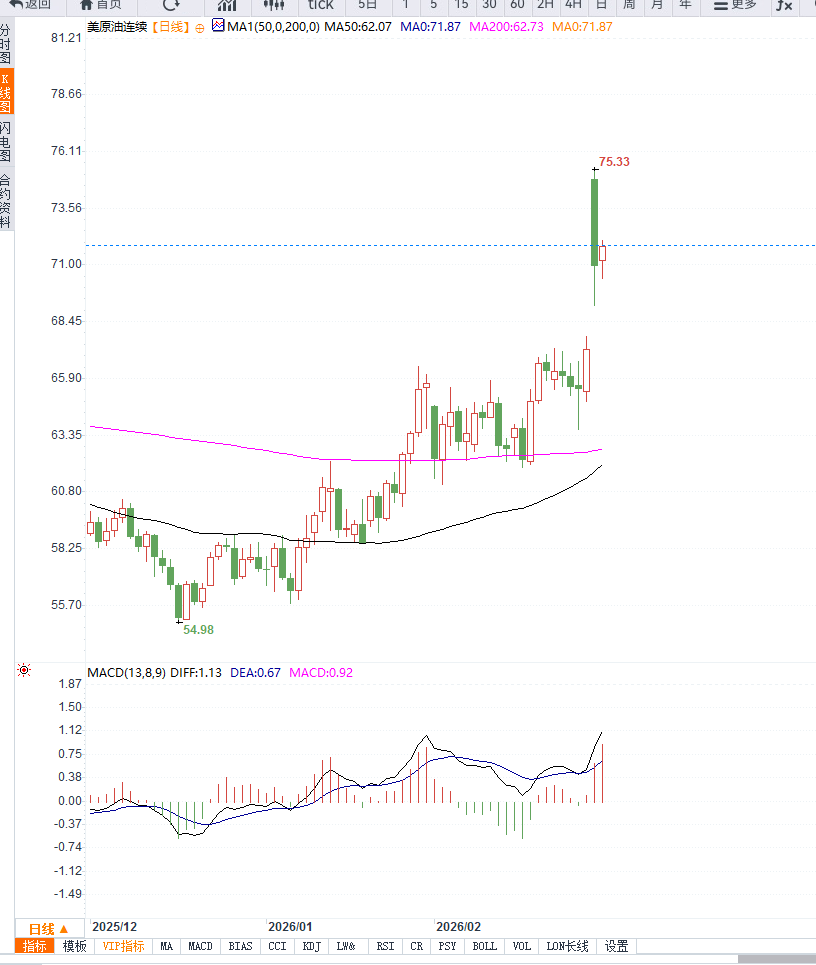
From a technical perspective, the price movement of WTI crude oil is more representative. On the daily chart, WTI has broken out of its previous consolidation range, with prices regaining a foothold above $71. The moving average system has begun to shift to a bullish alignment, with the 5-day and 10-day moving averages diverging upwards, indicating a short-term trend reversal.
The MACD indicator has formed a golden cross near the zero line, with the red bars gradually expanding, indicating a significant improvement in momentum. If the price holds above $71, it will open up further upside potential to the $75 range. First support level: $71. Key resistance level: the psychological level of $75.
The 4-hour chart shows that WTI has entered a high-level consolidation phase after a sharp rise. The Bollinger Bands are widening, and the price is trading around the upper band, indicating that short-term bullish momentum remains. If the price retraces but does not break below $70, it constitutes a strong consolidation structure; if it breaks below this level, it may fill the gap to around $68. Overall, the trend is bullish, but volatility has increased significantly.
Editor's Note:
The core variable in the current oil market has shifted from the "supply-demand gap" to the "transportation security premium." The Strait of Hormuz, carrying nearly one-fifth of global energy traffic, is a typical systemic node. If this node experiences sustained uncertainty, the price center will naturally rise.
In the short term, above $70 may become the new trading range; in the medium term, if the situation continues, WTI may test $80 or even higher; in extreme scenarios, Brent $120 is not unattainable. The oil market has entered a high-volatility phase, and the trading logic is significantly different from before.
Future price trends will depend more on the status of strait passage than on traditional inventory data.
Brent crude surged on Monday, breaking through the $80 mark, before retreating as the market began pricing in longer-term supply disruptions. On Tuesday in Asian trading, WTI crude rose slightly, trading around $71.50. Although it failed to break yesterday's high, short-term bullish sentiment remains strong.
According to major investment banks, Citigroup: Short-term target is $85, with tail risk at $120.
Citigroup raised its short-term Brent crude oil forecast to $85 per barrel and expects oil prices to remain in the $80-90 range amid transport disruptions.
In a more aggressive scenario, if regional oil and gas infrastructure suffers a direct blow, Brent crude could potentially hit $120, with a probability assessed at 20%. This projection emphasizes not just the supply-demand gap, but also the issue of "transportation accessibility."
HSBC: Idle capacity cannot replace transportation channels. HSBC points out that the actual role of OPEC+’s approximately 4.6 million barrels per day of idle capacity depends on transportation conditions.
Approximately 19 to 20 million barrels of oil equivalent per day need to be exported through the Strait of Hormuz, accounting for nearly one-fifth of global supply. If the strait is closed to navigation, the capacity of alternative routes is insufficient to fully cover the original volume, and idle capacity may become merely a "paper figure."
This significantly tilts the risk to the upside for oil prices. Physical constraints: a blockade lasting more than 25 days could trigger passive production cuts. JPMorgan Chase estimates that the combined onshore and offshore storage capacity of Gulf oil-producing countries can only support about 25 days of normal production at most.
If the blockade continues for longer, storage facilities reaching capacity will force oil-producing countries to reduce or even halt production. This means the risk is no longer just price volatility, but a physical disruption of the supply chain. Goldman Sachs believes that the current risk premium of approximately $18 per barrel is equivalent to pricing in a six-week shipping shutdown.
Even with the use of backup pipelines and strategic reserves, price shocks are still difficult to fully offset. The oil market trading framework has shifted from the inventory cycle to the channel safety cycle.
From a technical perspective, the price movement of WTI crude oil is more representative. On the daily chart, WTI has broken out of its previous consolidation range, with prices regaining a foothold above $71. The moving average system has begun to shift to a bullish alignment, with the 5-day and 10-day moving averages diverging upwards, indicating a short-term trend reversal.
The MACD indicator has formed a golden cross near the zero line, with the red bars gradually expanding, indicating a significant improvement in momentum. If the price holds above $71, it will open up further upside potential to the $75 range. First support level: $71. Key resistance level: the psychological level of $75.
The 4-hour chart shows that WTI has entered a high-level consolidation phase after a sharp rise. The Bollinger Bands are widening, and the price is trading around the upper band, indicating that short-term bullish momentum remains. If the price retraces but does not break below $70, it constitutes a strong consolidation structure; if it breaks below this level, it may fill the gap to around $68. Overall, the trend is bullish, but volatility has increased significantly.
Editor's Note:
The core variable in the current oil market has shifted from the "supply-demand gap" to the "transportation security premium." The Strait of Hormuz, carrying nearly one-fifth of global energy traffic, is a typical systemic node. If this node experiences sustained uncertainty, the price center will naturally rise.
In the short term, above $70 may become the new trading range; in the medium term, if the situation continues, WTI may test $80 or even higher; in extreme scenarios, Brent $120 is not unattainable. The oil market has entered a high-volatility phase, and the trading logic is significantly different from before.
Future price trends will depend more on the status of strait passage than on traditional inventory data.
- Risk Warning and Disclaimer
- The market involves risk, and trading may not be suitable for all investors. This article is for reference only and does not constitute personal investment advice, nor does it take into account certain users’ specific investment objectives, financial situation, or other needs. Any investment decisions made based on this information are at your own risk.

