Yellen warns: US-Iran situation makes the Fed "unwilling to act"! What's next for the market?
2026-03-03 09:45:49
The recent escalation of geopolitical tensions between the US and Iran, coupled with ongoing trade policy impacts, has significantly increased market uncertainty. Former Federal Reserve Chair Janet Yellen noted that this situation has made the Fed more cautious and hesitant in its interest rate decisions. Rising oil prices, particularly supply concerns stemming from potential disruptions in the Strait of Hormuz, have exacerbated already above-target inflationary pressures.
Former Federal Reserve Chair Janet Yellen recently stated via video link at the S&P Global TPM26 conference in Long Beach, California: "I think the recent situation in Iran has made the Fed more hesitant and less willing to cut interest rates than before the events occurred."
She pointed out that before the conflict broke out, the US inflation rate was already about 1 percentage point higher than the Federal Reserve's 2% target, and President Trump's tariff policies contributed about 0.5 percentage points to the current inflation level of about 3%. The latest geopolitical events have further increased uncertainty.
According to the latest data from CME's "FedWatch," the market expects a 97.5% probability that the Federal Reserve will keep interest rates unchanged at its March meeting, while the probability of a 25 basis point rate cut has dropped to 2.5%. The market has largely priced in the expectation of a rate cut in March.
Regarding subsequent meetings: By April, the probability of a cumulative 25 basis point rate cut is 16.3%, the probability of maintaining the current rate is 83.4%, and the probability of a cumulative 50 basis point rate cut is only 0.4%. By June, the probability of a cumulative 25 basis point rate cut is 40.3%, further narrowing compared to before, indicating that market expectations for a mid-year rate cut are also weakening.
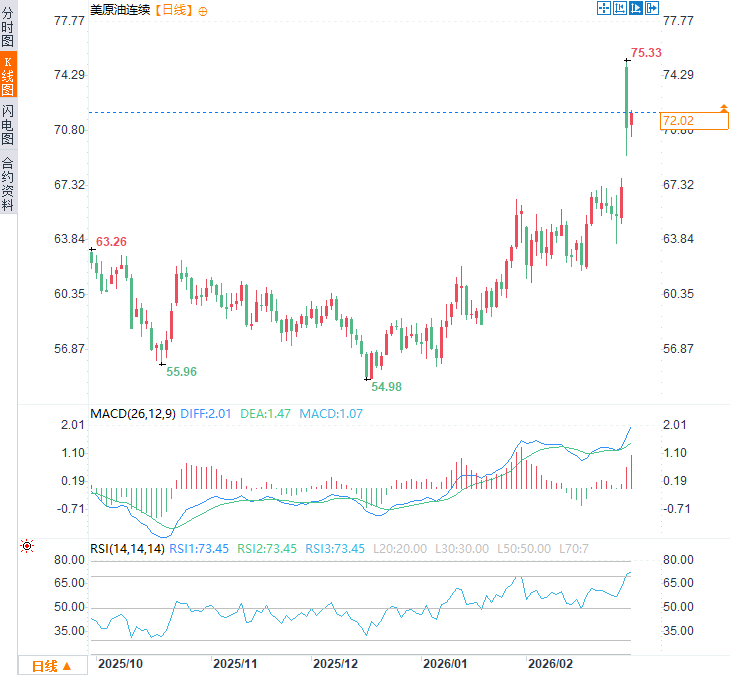
Recent tensions between the US and Iran have significantly boosted oil prices. On Tuesday (March 3rd) during Asian trading hours, US crude oil prices fluctuated upwards, currently trading around $72.05 per barrel, a daily increase of approximately 1.15%. On Monday, US crude oil prices rose to $75.33 per barrel, reaching a near nine-month high. The disruption to shipping in the Strait of Hormuz, a potential long-term disruption to this vital artery for approximately 20% of global oil transportation, has raised concerns about persistently high energy costs.
(US crude oil daily chart, source: FX678)
Economists from multiple institutions have expressed similar views. JPMorgan economist Joseph Lupton stated that the 2026 outlook, which was originally based on a "receding of caution" in US policy, is now at risk, as "military conflict coupled with an ongoing trade war could reignite concerns about global stability."
Natixis economist Christopher Hodge believes that "tail risks have increased significantly," with different scenarios ranging from rapid resolution to prolonged conflict disrupting global supply chains.
Carlyle's Jason Thomas views a "protracted asymmetric war" as a scenario with a baseline probability of over 70%, warning that the disruption effect could extend far beyond major chokepoints.
Federal Reserve officials have previously hinted that, following multiple rate cuts in 2025, they are gradually shifting towards a neutral stance. Minneapolis Fed President Neel Kashkari stated that policymakers need more data to determine "whether inflation or the labor market is a stronger force."
The current oil price shock, coupled with an existing high inflation base, presents the Federal Reserve with a more complex trade-off between maintaining its credibility, addressing potential double-dip inflation, and supporting employment. Market expectations for a rapid shift to easing by the Fed have clearly cooled.
Soaring oil prices and escalating conflicts in the Middle East have overshadowed the traditional appeal of safe-haven assets, directly raising mortgage financing costs and leading to market expectations of "higher and longer" interest rates, rather than a direct move towards an environment of low-cost funding.
Nevertheless, historical experience shows that tensions in the Middle East have not completely frozen mortgage lending activity. Data from the Mortgage Bankers Association (MBA) shows that in similar periods in the past, a slight increase in average interest rates coupled with global uncertainty has actually driven up some FHA refinancing demand, with applications rising rather than falling.
However, persistent inflation, conflict-driven energy costs, and political pressure on the Federal Reserve continue to pose greater challenges to secondary market liquidity and lending channels. Brokers need to be wary of wider trading ranges and sudden volatility.
Yellen also emphasized that despite the serious risks, "the U.S. economy is currently quite healthy, and I remain quite optimistic about the economic outlook." This indicates that the fundamentals remain resilient, but external shocks are significantly altering the pace of monetary policy and market pricing logic.
At 9:45 AM Beijing time, US crude oil futures were trading at $71.97 per barrel.
Escalating geopolitical conflict over Iran disrupts the Federal Reserve's interest rate cut path
Former Federal Reserve Chair Janet Yellen recently stated via video link at the S&P Global TPM26 conference in Long Beach, California: "I think the recent situation in Iran has made the Fed more hesitant and less willing to cut interest rates than before the events occurred."
She pointed out that before the conflict broke out, the US inflation rate was already about 1 percentage point higher than the Federal Reserve's 2% target, and President Trump's tariff policies contributed about 0.5 percentage points to the current inflation level of about 3%. The latest geopolitical events have further increased uncertainty.
According to the latest data from CME's "FedWatch," the market expects a 97.5% probability that the Federal Reserve will keep interest rates unchanged at its March meeting, while the probability of a 25 basis point rate cut has dropped to 2.5%. The market has largely priced in the expectation of a rate cut in March.
Regarding subsequent meetings: By April, the probability of a cumulative 25 basis point rate cut is 16.3%, the probability of maintaining the current rate is 83.4%, and the probability of a cumulative 50 basis point rate cut is only 0.4%. By June, the probability of a cumulative 25 basis point rate cut is 40.3%, further narrowing compared to before, indicating that market expectations for a mid-year rate cut are also weakening.
Soaring oil prices and obstruction of the Strait of Hormuz exacerbate inflationary pressures.
Recent tensions between the US and Iran have significantly boosted oil prices. On Tuesday (March 3rd) during Asian trading hours, US crude oil prices fluctuated upwards, currently trading around $72.05 per barrel, a daily increase of approximately 1.15%. On Monday, US crude oil prices rose to $75.33 per barrel, reaching a near nine-month high. The disruption to shipping in the Strait of Hormuz, a potential long-term disruption to this vital artery for approximately 20% of global oil transportation, has raised concerns about persistently high energy costs.
(US crude oil daily chart, source: FX678)
Economists from multiple institutions have expressed similar views. JPMorgan economist Joseph Lupton stated that the 2026 outlook, which was originally based on a "receding of caution" in US policy, is now at risk, as "military conflict coupled with an ongoing trade war could reignite concerns about global stability."
Natixis economist Christopher Hodge believes that "tail risks have increased significantly," with different scenarios ranging from rapid resolution to prolonged conflict disrupting global supply chains.
Carlyle's Jason Thomas views a "protracted asymmetric war" as a scenario with a baseline probability of over 70%, warning that the disruption effect could extend far beyond major chokepoints.
The Federal Reserve weighs oil prices, inflation, and labor market signals.
Federal Reserve officials have previously hinted that, following multiple rate cuts in 2025, they are gradually shifting towards a neutral stance. Minneapolis Fed President Neel Kashkari stated that policymakers need more data to determine "whether inflation or the labor market is a stronger force."
The current oil price shock, coupled with an existing high inflation base, presents the Federal Reserve with a more complex trade-off between maintaining its credibility, addressing potential double-dip inflation, and supporting employment. Market expectations for a rapid shift to easing by the Fed have clearly cooled.
Real-world impact on the mortgage lending market and market participants
Soaring oil prices and escalating conflicts in the Middle East have overshadowed the traditional appeal of safe-haven assets, directly raising mortgage financing costs and leading to market expectations of "higher and longer" interest rates, rather than a direct move towards an environment of low-cost funding.
Nevertheless, historical experience shows that tensions in the Middle East have not completely frozen mortgage lending activity. Data from the Mortgage Bankers Association (MBA) shows that in similar periods in the past, a slight increase in average interest rates coupled with global uncertainty has actually driven up some FHA refinancing demand, with applications rising rather than falling.
However, persistent inflation, conflict-driven energy costs, and political pressure on the Federal Reserve continue to pose greater challenges to secondary market liquidity and lending channels. Brokers need to be wary of wider trading ranges and sudden volatility.
Yellen also emphasized that despite the serious risks, "the U.S. economy is currently quite healthy, and I remain quite optimistic about the economic outlook." This indicates that the fundamentals remain resilient, but external shocks are significantly altering the pace of monetary policy and market pricing logic.
At 9:45 AM Beijing time, US crude oil futures were trading at $71.97 per barrel.
- Risk Warning and Disclaimer
- The market involves risk, and trading may not be suitable for all investors. This article is for reference only and does not constitute personal investment advice, nor does it take into account certain users’ specific investment objectives, financial situation, or other needs. Any investment decisions made based on this information are at your own risk.