Gold Trading Alert: US-Iran Conflict Continues! Gold Prices Stabilize and Rebound Nearly 1%, More Gains Await?
2026-03-05 07:16:09
Gold prices rebounded on Wednesday (March 4) amid a rapidly deteriorating geopolitical situation in the Middle East, with spot gold stabilizing around $5,140 per ounce, a daily gain of nearly 1%, quickly recovering from Tuesday's sharp correction. This rally was directly driven by the continued escalation of the US-Iran conflict and the resulting surge in global safe-haven demand, while a temporary weakening of the US dollar further supported gold prices. The market generally believes that as long as there are no substantial signs of de-escalation in the conflict, gold's status as the ultimate safe-haven asset will continue to strengthen, and it may even challenge historical highs. In early Asian trading on Thursday (March 5), spot gold fluctuated slightly higher, currently trading around $5,150 per ounce.

The core driving force behind the current international situation is undoubtedly the escalation of the full-scale military confrontation between the US and Iran. A US Navy submarine sank an Iranian warship near Sri Lanka, causing significant casualties; NATO air defense systems successfully intercepted Iranian ballistic missiles targeting Turkey; and shipping in the Strait of Hormuz has been disrupted for several days, posing a serious threat to global energy supplies. These events have dramatically increased investors' concerns about a prolonged or even further escalation of the situation in the Middle East.
Iran's Islamic Revolutionary Guard Corps announced multiple waves of high-intensity retaliatory operations, using hypersonic missiles and drones to precisely strike key Israeli targets, including the Ministry of Defense building and Ben Gurion Airport, and warned that future attacks would be more intense and widespread. The US Central Command confirmed it had carried out over 2,000 precision strikes against Iran, destroying numerous missiles, launchers, drones, and more than 20 ships. The White House stated that there are currently no plans to deploy ground troops, but no military options have been ruled out. Russian President Vladimir Putin publicly stated he was considering proactively cutting off natural gas supplies to Europe, further exacerbating panic in global energy markets. These multiple geopolitical risks have directly pushed gold into the spotlight; as a safe-haven asset with no credit risk and extremely high liquidity, its attractiveness has been amplified in an environment of uncertainty.
After gold prices plunged more than 4% on Tuesday, the market saw a significant reversal on Wednesday. Spot gold rallied strongly from its lows, with intraday gains ranging from 0.7% to 1.2%, and US gold futures contracts also settled slightly higher. Other precious metals rose in tandem, with spot silver gaining approximately 1.8%, spot platinum surging 3.3%, and spot palladium rising 1.6%. Although the precious metals sector as a whole benefited from rising inflation expectations, gold, with its irreplaceable safe-haven properties, showed the strongest and most sustained rebound.
Senior metals strategist Peter Grant pointed out that the brief pullback in the US dollar provided direct support for gold prices, while overall macroeconomic fundamentals remain favorable for gold. As long as the US-Iran war continues, safe-haven buying will not subside. He maintains a bullish stance, believing that while gold price volatility will persist, reaching new historical highs is highly probable.
US economic data showed some resilience. The ADP private sector employment report showed 63,000 new jobs added in February, exceeding market expectations and marking the largest monthly increase in recent times; the ISM non-manufacturing PMI jumped to 56.1, the highest level in three and a half years. These positive signals should have strengthened market expectations that the Federal Reserve would maintain high interest rates. The CME FedWatch tool showed that the probability of a rate cut in June had fallen to around 35.5%, and the yield on the 10-year US Treasury note rose for the third consecutive day, hovering in the 4.08%-4.10% range. The breakeven yield on inflation-protected bonds also indicated an average inflation expectation of about 2.3% over the next ten years.
However, in the current market environment dominated by geopolitical risks, the impact of these macroeconomic data points has been significantly weakened. While Federal Reserve officials have emphasized that the conflict in Iran has not fundamentally altered the path of monetary policy, investors are more focused on the long-term upward pressure on global inflation from soaring energy prices. Although the cost pressure of holding gold in a high-interest-rate environment exists, it is overshadowed by a stronger logic of safe-haven appeal and inflation protection.
The dollar index retreated from multi-month highs, falling 0.3% on Wednesday, while non-dollar currencies such as the euro and yen strengthened slightly. Market signals that Iran was willing to explore ways to end the war briefly boosted risk appetite, but the reality that the conflict is far from over made the optimism unsustainable. As for oil prices, both US crude and Brent crude remained volatile at high levels, having risen by 12% since the outbreak of the conflict. The disruption of the Strait of Hormuz has directly pushed up global energy costs, further reinforcing the inflation narrative.
Gold is currently maintaining a slightly bullish trend within the $5100-$5200/ounce range. If geopolitical tensions do not ease significantly, there is a high probability of breaking through previous highs. Conversely, if Iran demonstrates genuine willingness to negotiate, oil prices fall rapidly, or the upcoming US non-farm payroll data significantly exceeds expectations, gold may face downward pressure. However, overall, given the interplay of geopolitical uncertainty, inflationary concerns, and dollar volatility, the long-term logic for gold as a core asset allocation remains solid.
Overall, the escalating conflict between the US and Iran and the disruption of energy supply routes have become the biggest sources of uncertainty in the current financial markets, with gold demonstrating remarkable resilience and attractiveness amidst the sharp fluctuations. From Tuesday's panic selling to Wednesday's rapid rebound, it fully demonstrates its irreplaceable position in the face of systemic risks. Although macroeconomic data and monetary policy paths bring some hedging pressure, safe-haven demand and the logic of inflation hedging dominate, keeping the medium-term upward trend of gold intact. Increased volatility also breeds greater opportunities. Investors need to closely monitor the latest developments in the Middle East and Friday's non-farm payroll data to grasp short-term trends. The US initial jobless claims change and Challenger layoffs data will also be released today, which investors should also pay attention to.
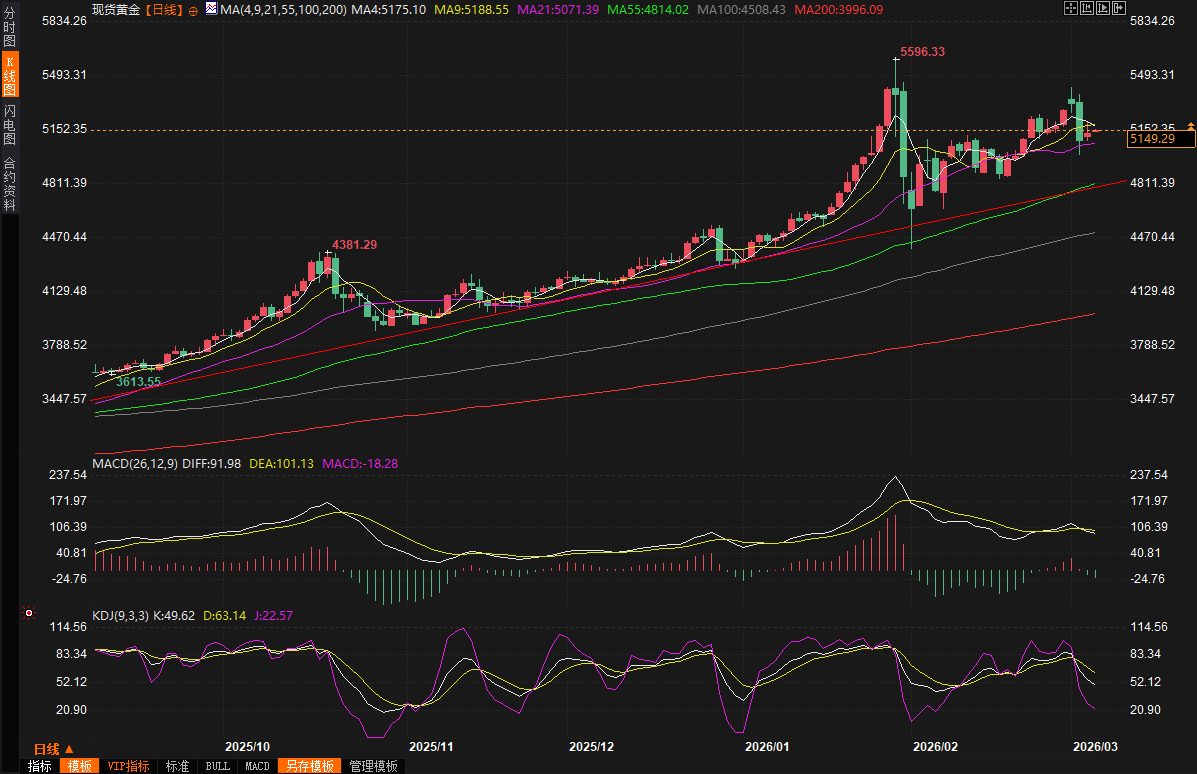
(Spot gold daily chart, source: FX678)
At 07:15 Beijing time, spot gold was trading at $5147.28 per ounce.
The war between the US and Iran enters its fifth day.
The core driving force behind the current international situation is undoubtedly the escalation of the full-scale military confrontation between the US and Iran. A US Navy submarine sank an Iranian warship near Sri Lanka, causing significant casualties; NATO air defense systems successfully intercepted Iranian ballistic missiles targeting Turkey; and shipping in the Strait of Hormuz has been disrupted for several days, posing a serious threat to global energy supplies. These events have dramatically increased investors' concerns about a prolonged or even further escalation of the situation in the Middle East.
Iran's Islamic Revolutionary Guard Corps announced multiple waves of high-intensity retaliatory operations, using hypersonic missiles and drones to precisely strike key Israeli targets, including the Ministry of Defense building and Ben Gurion Airport, and warned that future attacks would be more intense and widespread. The US Central Command confirmed it had carried out over 2,000 precision strikes against Iran, destroying numerous missiles, launchers, drones, and more than 20 ships. The White House stated that there are currently no plans to deploy ground troops, but no military options have been ruled out. Russian President Vladimir Putin publicly stated he was considering proactively cutting off natural gas supplies to Europe, further exacerbating panic in global energy markets. These multiple geopolitical risks have directly pushed gold into the spotlight; as a safe-haven asset with no credit risk and extremely high liquidity, its attractiveness has been amplified in an environment of uncertainty.
The precious metals market saw a collective recovery, with gold experiencing the strongest rebound.
After gold prices plunged more than 4% on Tuesday, the market saw a significant reversal on Wednesday. Spot gold rallied strongly from its lows, with intraday gains ranging from 0.7% to 1.2%, and US gold futures contracts also settled slightly higher. Other precious metals rose in tandem, with spot silver gaining approximately 1.8%, spot platinum surging 3.3%, and spot palladium rising 1.6%. Although the precious metals sector as a whole benefited from rising inflation expectations, gold, with its irreplaceable safe-haven properties, showed the strongest and most sustained rebound.
Senior metals strategist Peter Grant pointed out that the brief pullback in the US dollar provided direct support for gold prices, while overall macroeconomic fundamentals remain favorable for gold. As long as the US-Iran war continues, safe-haven buying will not subside. He maintains a bullish stance, believing that while gold price volatility will persist, reaching new historical highs is highly probable.
Strong macroeconomic data couldn't mask the geopolitical undercurrents, further cooling expectations for a Fed rate cut.
US economic data showed some resilience. The ADP private sector employment report showed 63,000 new jobs added in February, exceeding market expectations and marking the largest monthly increase in recent times; the ISM non-manufacturing PMI jumped to 56.1, the highest level in three and a half years. These positive signals should have strengthened market expectations that the Federal Reserve would maintain high interest rates. The CME FedWatch tool showed that the probability of a rate cut in June had fallen to around 35.5%, and the yield on the 10-year US Treasury note rose for the third consecutive day, hovering in the 4.08%-4.10% range. The breakeven yield on inflation-protected bonds also indicated an average inflation expectation of about 2.3% over the next ten years.
However, in the current market environment dominated by geopolitical risks, the impact of these macroeconomic data points has been significantly weakened. While Federal Reserve officials have emphasized that the conflict in Iran has not fundamentally altered the path of monetary policy, investors are more focused on the long-term upward pressure on global inflation from soaring energy prices. Although the cost pressure of holding gold in a high-interest-rate environment exists, it is overshadowed by a stronger logic of safe-haven appeal and inflation protection.
A weaker dollar coupled with high oil prices creating multiple positive factors for gold.
The dollar index retreated from multi-month highs, falling 0.3% on Wednesday, while non-dollar currencies such as the euro and yen strengthened slightly. Market signals that Iran was willing to explore ways to end the war briefly boosted risk appetite, but the reality that the conflict is far from over made the optimism unsustainable. As for oil prices, both US crude and Brent crude remained volatile at high levels, having risen by 12% since the outbreak of the conflict. The disruption of the Strait of Hormuz has directly pushed up global energy costs, further reinforcing the inflation narrative.
Gold is currently maintaining a slightly bullish trend within the $5100-$5200/ounce range. If geopolitical tensions do not ease significantly, there is a high probability of breaking through previous highs. Conversely, if Iran demonstrates genuine willingness to negotiate, oil prices fall rapidly, or the upcoming US non-farm payroll data significantly exceeds expectations, gold may face downward pressure. However, overall, given the interplay of geopolitical uncertainty, inflationary concerns, and dollar volatility, the long-term logic for gold as a core asset allocation remains solid.
Overall, the escalating conflict between the US and Iran and the disruption of energy supply routes have become the biggest sources of uncertainty in the current financial markets, with gold demonstrating remarkable resilience and attractiveness amidst the sharp fluctuations. From Tuesday's panic selling to Wednesday's rapid rebound, it fully demonstrates its irreplaceable position in the face of systemic risks. Although macroeconomic data and monetary policy paths bring some hedging pressure, safe-haven demand and the logic of inflation hedging dominate, keeping the medium-term upward trend of gold intact. Increased volatility also breeds greater opportunities. Investors need to closely monitor the latest developments in the Middle East and Friday's non-farm payroll data to grasp short-term trends. The US initial jobless claims change and Challenger layoffs data will also be released today, which investors should also pay attention to.
(Spot gold daily chart, source: FX678)
At 07:15 Beijing time, spot gold was trading at $5147.28 per ounce.
- Risk Warning and Disclaimer
- The market involves risk, and trading may not be suitable for all investors. This article is for reference only and does not constitute personal investment advice, nor does it take into account certain users’ specific investment objectives, financial situation, or other needs. Any investment decisions made based on this information are at your own risk.