India's NIFTY index has plummeted 10% from its January high, triggering a technical correction and market panic.
2026-03-09 13:18:02
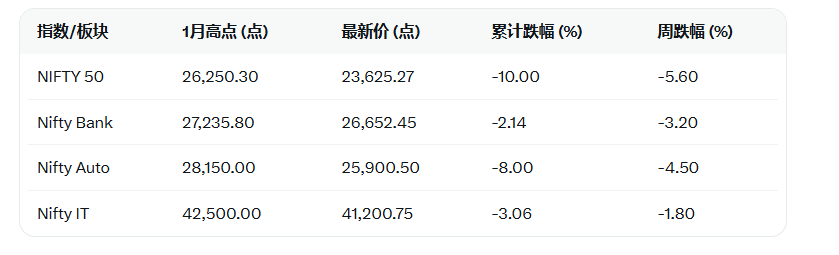
According to APP, India's NIFTY index has fallen more than 10% from its January 2026 high of 26,250.30 points, closing at 23,625.27 points, entering a technical correction phase. This correction is defined as a 10%-20% drop from the recent high, reflecting an increased need for short-term market adjustment.
The core driver of this decline stems from the escalating conflict in the Middle East. The confrontation between the United States, Israel, and Iran has increased the risk of disruption to shipping in the Strait of Hormuz , leading to a tightening of global crude oil supply.
Brent crude futures prices have surged to around $116 per barrel, up nearly 25% from last week, posing a serious challenge to India, one of the world's largest oil importers. India relies on imports for more than 85% of its crude oil needs; a $1 increase in oil prices per barrel will add approximately 1.6 trillion rupees to its import bill, directly pushing up inflation expectations and weakening the rupee's exchange rate.

Currently, the rupee has fallen below the 92 mark against the US dollar, hitting a new recent low, further amplifying the pressure for foreign capital outflow. Market data shows that the NIFTY index fell by about 5.6% last week, and plummeted by nearly 3% at the start of this week, while the Sensex index also dropped by more than 2,000 points.
Foreign institutional investors (FIIs) have net sold over 3 trillion rupees worth of Indian stocks this month, a record monthly figure, primarily due to heightened global risk aversion. The banking and automotive sectors led the decline, with the Nifty Bank index falling 2.14%, and auto stocks pressured by rising energy costs.
In contrast, the IT sector was relatively resilient, but the overall market volatility index (India VIX) surged above 25, indicating widespread panic. Analysts pointed out that this correction was not an isolated event, but rather a combination of global geopolitical risks and macroeconomic pressures in India.
A recent report from the International Energy Agency (IEA) indicates that if the conflict in the Middle East continues, global oil demand will exceed supply by 1.5 million barrels per day in 2026, and India, as an emerging economy, will face the risk of a 0.5%-1% slowdown in GDP growth.
US President Donald Trump recently made tough statements regarding the situation in the Middle East, stating, "Iranian provocations will have devastating consequences, and the US Navy is in position to protect global energy routes." While this statement was intended to stabilize oil prices, it has instead exacerbated market uncertainty, prompting investors to turn to safe-haven assets.
Indian Prime Minister Narendra Modi recently emphasized at an economic conference that "the government will buffer the impact of oil prices through strategic reserves and diplomatic efforts, but the market needs to be wary of short-term volatility." Meanwhile, the Reserve Bank of India (RBI) may postpone its interest rate cut plans to address a rebound in inflation.
Historical data shows that after events similar to the 2019 tanker attacks, the NIFTY index experienced a 12% pullback before rebounding within three months. However, the current weak global recovery may prolong the recovery period. Even if geopolitical tensions ease, the impact of the NIFTY index pullback will continue.
Suppliers and businesses face higher energy and logistics costs, and the Consumer Price Index (CPI) is expected to rise by 1-2 percentage points. Foreign capital outflows may further impact small- and mid-cap stocks; the Nifty Midcap Index has already fallen by 8%.
The following table compares the recent performance of the NIFTY Index with that of major sectors:
This pullback is not only a product of external shocks but also exposes India's structural problems, such as high import dependence and a widening fiscal deficit. If oil prices remain high, India's current account deficit could rise from 1.5% of GDP to 2.5%, forcing the RBI to intervene in the exchange rate. On the other hand, high volatility may stimulate domestic investor participation, with mutual funds already seeing net inflows of 2 trillion rupees this month.
Globally, the MSCI Emerging Markets Index (EM) fell 4% in unison, with India, as a weighted stock, facing pressure. Investors should pay attention to the OPEC+ meeting; an additional production cut of 1 million barrels per day could partially alleviate supply tightness. Overall, the NIFTY pullback presents a buying opportunity, but caution is advised if the conflict escalates to a complete blockade of the Strait, potentially pushing the index further down to 22,000 points.
Editor's Summary : The Indian NIFTY index entering a correction phase highlights the amplifying effect of geopolitical risks on emerging markets. Soaring oil prices and foreign capital outflows have deepened economic uncertainty. Coordination between the government and central bank will be crucial for stability, preventing runaway inflation and maintaining growth prospects. International diplomatic developments may be a turning point, requiring markets to balance short-term panic with long-term opportunities.
Frequently Asked Questions
Question 1: What are the main reasons for the 10% drop in the NIFTY index?
The decline was primarily driven by escalating conflicts in the Middle East, with the confrontation between the US, Israel, and Iran increasing the risk of disruption in the Strait of Hormuz, causing crude oil prices to surge to $116 per barrel. India's heavy reliance on oil imports fueled inflation expectations, and foreign selling exacerbated market pressure. Global risk aversion also led to net selling of over 3 trillion rupees by FIIs, with the banking and automotive sectors leading the decline.
Question 2: What impact will this correction have on the Indian economy?
A pullback will amplify energy costs, with CPI expected to rise by 1-2 percentage points and GDP growth slowing by 0.5%-1%. A depreciation of the rupee below 92 will increase import bills and widen the fiscal deficit. Corporate profits will be under pressure, particularly in manufacturing and transportation; however, the IT sector is relatively resilient and may attract safe-haven funds. In the long term, if oil prices stabilize, the pullback may present a buying opportunity.
Question 3: What is a technical correction, and how does it differ from a bear market?
A technical correction refers to a 10%-20% drop from a high point, which is considered a normal adjustment and is often triggered by external shocks. A bear market, on the other hand, involves a drop of more than 20%, accompanied by an economic recession. Currently, the NIFTY is in a correction phase, with volatility rising to 25. However, if the conflict persists, it could evolve into a bear market. Historically, the 2019 oil price crisis is an example, where a correction was followed by a rapid rebound.
Question 4: How large is the scale of foreign capital selling off, and how should we respond?
This month, the FII (Financial Institutional Investor) saw a record net outflow of over 3 trillion rupees, primarily due to global uncertainty. India can buffer against oil price shocks through its strategic petroleum reserves, and the RBI (Reserve Bank for India) can intervene in the exchange rate. Investors are advised to diversify their portfolios and pay attention to the support level of 2 trillion rupees inflows into domestic funds. Trump's hawkish rhetoric has exacerbated uncertainty, but diplomatic easing could reverse the outflows.
Question 5: When might NIFTY rebound, and what are its potential risks?
The rebound depends on a ceasefire in the Middle East and increased OPEC+ production. If oil prices fall back to $90, the index could rebound to 25,000 points. Risks include the conflict spilling over to Saudi Arabia and Iraq, creating a supply gap of 21 million barrels per day, potentially causing the index to bottom out at 22,000. Monitor India VIX; if it falls below 20, it signals stabilization.
The core driver of this decline stems from the escalating conflict in the Middle East. The confrontation between the United States, Israel, and Iran has increased the risk of disruption to shipping in the Strait of Hormuz , leading to a tightening of global crude oil supply.
Brent crude futures prices have surged to around $116 per barrel, up nearly 25% from last week, posing a serious challenge to India, one of the world's largest oil importers. India relies on imports for more than 85% of its crude oil needs; a $1 increase in oil prices per barrel will add approximately 1.6 trillion rupees to its import bill, directly pushing up inflation expectations and weakening the rupee's exchange rate.
Currently, the rupee has fallen below the 92 mark against the US dollar, hitting a new recent low, further amplifying the pressure for foreign capital outflow. Market data shows that the NIFTY index fell by about 5.6% last week, and plummeted by nearly 3% at the start of this week, while the Sensex index also dropped by more than 2,000 points.
Foreign institutional investors (FIIs) have net sold over 3 trillion rupees worth of Indian stocks this month, a record monthly figure, primarily due to heightened global risk aversion. The banking and automotive sectors led the decline, with the Nifty Bank index falling 2.14%, and auto stocks pressured by rising energy costs.
In contrast, the IT sector was relatively resilient, but the overall market volatility index (India VIX) surged above 25, indicating widespread panic. Analysts pointed out that this correction was not an isolated event, but rather a combination of global geopolitical risks and macroeconomic pressures in India.
A recent report from the International Energy Agency (IEA) indicates that if the conflict in the Middle East continues, global oil demand will exceed supply by 1.5 million barrels per day in 2026, and India, as an emerging economy, will face the risk of a 0.5%-1% slowdown in GDP growth.
US President Donald Trump recently made tough statements regarding the situation in the Middle East, stating, "Iranian provocations will have devastating consequences, and the US Navy is in position to protect global energy routes." While this statement was intended to stabilize oil prices, it has instead exacerbated market uncertainty, prompting investors to turn to safe-haven assets.
Indian Prime Minister Narendra Modi recently emphasized at an economic conference that "the government will buffer the impact of oil prices through strategic reserves and diplomatic efforts, but the market needs to be wary of short-term volatility." Meanwhile, the Reserve Bank of India (RBI) may postpone its interest rate cut plans to address a rebound in inflation.
Historical data shows that after events similar to the 2019 tanker attacks, the NIFTY index experienced a 12% pullback before rebounding within three months. However, the current weak global recovery may prolong the recovery period. Even if geopolitical tensions ease, the impact of the NIFTY index pullback will continue.
Suppliers and businesses face higher energy and logistics costs, and the Consumer Price Index (CPI) is expected to rise by 1-2 percentage points. Foreign capital outflows may further impact small- and mid-cap stocks; the Nifty Midcap Index has already fallen by 8%.
The following table compares the recent performance of the NIFTY Index with that of major sectors:
This pullback is not only a product of external shocks but also exposes India's structural problems, such as high import dependence and a widening fiscal deficit. If oil prices remain high, India's current account deficit could rise from 1.5% of GDP to 2.5%, forcing the RBI to intervene in the exchange rate. On the other hand, high volatility may stimulate domestic investor participation, with mutual funds already seeing net inflows of 2 trillion rupees this month.
Globally, the MSCI Emerging Markets Index (EM) fell 4% in unison, with India, as a weighted stock, facing pressure. Investors should pay attention to the OPEC+ meeting; an additional production cut of 1 million barrels per day could partially alleviate supply tightness. Overall, the NIFTY pullback presents a buying opportunity, but caution is advised if the conflict escalates to a complete blockade of the Strait, potentially pushing the index further down to 22,000 points.
Editor's Summary : The Indian NIFTY index entering a correction phase highlights the amplifying effect of geopolitical risks on emerging markets. Soaring oil prices and foreign capital outflows have deepened economic uncertainty. Coordination between the government and central bank will be crucial for stability, preventing runaway inflation and maintaining growth prospects. International diplomatic developments may be a turning point, requiring markets to balance short-term panic with long-term opportunities.
Frequently Asked Questions
Question 1: What are the main reasons for the 10% drop in the NIFTY index?
The decline was primarily driven by escalating conflicts in the Middle East, with the confrontation between the US, Israel, and Iran increasing the risk of disruption in the Strait of Hormuz, causing crude oil prices to surge to $116 per barrel. India's heavy reliance on oil imports fueled inflation expectations, and foreign selling exacerbated market pressure. Global risk aversion also led to net selling of over 3 trillion rupees by FIIs, with the banking and automotive sectors leading the decline.
Question 2: What impact will this correction have on the Indian economy?
A pullback will amplify energy costs, with CPI expected to rise by 1-2 percentage points and GDP growth slowing by 0.5%-1%. A depreciation of the rupee below 92 will increase import bills and widen the fiscal deficit. Corporate profits will be under pressure, particularly in manufacturing and transportation; however, the IT sector is relatively resilient and may attract safe-haven funds. In the long term, if oil prices stabilize, the pullback may present a buying opportunity.
Question 3: What is a technical correction, and how does it differ from a bear market?
A technical correction refers to a 10%-20% drop from a high point, which is considered a normal adjustment and is often triggered by external shocks. A bear market, on the other hand, involves a drop of more than 20%, accompanied by an economic recession. Currently, the NIFTY is in a correction phase, with volatility rising to 25. However, if the conflict persists, it could evolve into a bear market. Historically, the 2019 oil price crisis is an example, where a correction was followed by a rapid rebound.
Question 4: How large is the scale of foreign capital selling off, and how should we respond?
This month, the FII (Financial Institutional Investor) saw a record net outflow of over 3 trillion rupees, primarily due to global uncertainty. India can buffer against oil price shocks through its strategic petroleum reserves, and the RBI (Reserve Bank for India) can intervene in the exchange rate. Investors are advised to diversify their portfolios and pay attention to the support level of 2 trillion rupees inflows into domestic funds. Trump's hawkish rhetoric has exacerbated uncertainty, but diplomatic easing could reverse the outflows.
Question 5: When might NIFTY rebound, and what are its potential risks?
The rebound depends on a ceasefire in the Middle East and increased OPEC+ production. If oil prices fall back to $90, the index could rebound to 25,000 points. Risks include the conflict spilling over to Saudi Arabia and Iraq, creating a supply gap of 21 million barrels per day, potentially causing the index to bottom out at 22,000. Monitor India VIX; if it falls below 20, it signals stabilization.
- Risk Warning and Disclaimer
- The market involves risk, and trading may not be suitable for all investors. This article is for reference only and does not constitute personal investment advice, nor does it take into account certain users’ specific investment objectives, financial situation, or other needs. Any investment decisions made based on this information are at your own risk.