The situation in the Middle East is pushing up energy costs, putting silver bulls under double pressure.
2026-03-09 19:30:57
On Monday, March 9th, spot silver prices initially fell but subsequently recovered most of their losses, trading around $83.50 per ounce during the European session. This volatility occurred against the backdrop of crude oil prices surging above $100 per barrel due to geopolitical tensions, the US 10-year Treasury yield rising to around 4.18%, and the US dollar index hovering around 99.30. Traders noted a significant strengthening of expectations that the Federal Reserve would maintain interest rates, coupled with the transmission of energy costs to inflation, diminishing silver's appeal as a non-yielding asset.
Silver prices failed to escape overall downward pressure, primarily due to the squeeze on non-yielding assets caused by the high-interest-rate environment. The yield on the 10-year US Treasury bond recently rose to around 4.18%, an increase of about 0.05 percentage points during the day, a level approaching recent highs. Higher yields increase the attractiveness of holding interest-bearing assets such as bonds, consequently raising the opportunity cost of zero-interest assets like silver. Some analyses show that when real yields widen, the willingness to hold silver decreases, especially when inflation expectations are not fully anchored. The pullback in spot silver from its intraday high reflects investors' adaptive adjustments to the high-interest-rate era. The increase in global supply chain costs after crude oil prices broke through $100 per barrel further reinforced this logic.
The above comparison clearly shows that the negative correlation between silver and yields and the US dollar dominates the current market trend. Analysts believe that every 10 basis point increase in yields typically corresponds to a potential downward pressure on silver prices of 0.5%-1%, a pattern that has been validated in recent fluctuations.
Market expectations for the Federal Reserve's monetary policy have shifted significantly. According to the latest tool calculations, the probability of keeping interest rates unchanged at the March, April, and June meetings remains high, with the probability of maintaining rates at the July meeting rising to approximately 46.7% since last Friday. This change stems from inflation concerns triggered by soaring oil prices: high crude oil prices have pushed US gasoline retail prices to $3.48 per gallon, leading to increased consumer inflation expectations. Traders have observed a significant reduction in earlier dovish bets, as strong energy data has weakened the case for rapid easing. The Fed's decisions must balance its dual mandate of employment and price controls; under the energy shock, maintaining policy restraint has become the mainstream assessment. Silver's role as an inflation hedge has therefore weakened, and its price is unlikely to receive a direct boost from policy easing. Traders also need to monitor subsequent employment data; if inflationary pressures persist, the Fed's path will become more cautious, further limiting the upside potential for silver.
The US dollar index rose to around 99.30, a daily increase of about 0.4%, directly raising the cost threshold for overseas buyers of dollar-denominated silver. Non-US investors tend to reduce their commodity holdings in a strong dollar environment, thus suppressing silver demand. The simultaneous rise in oil prices exacerbated this effect: tensions in the Middle East pushed WTI crude oil above $103 per barrel, with energy costs being passed on to the global supply chain, strengthening inflation expectations and supporting the safe-haven appeal of the dollar. Analysts point out that for every 1% appreciation of the dollar, silver prices typically face downward pressure of 0.8%-1.2%, a correlation particularly pronounced in the current cycle. The positive feedback loop between oil prices and the dollar creates a double squeeze, and silver bulls need to be wary of the erosion of liquidity caused by this combination. Overall, the linkage between energy and monetary factors is reshaping the valuation center of silver.
Macroeconomic drivers putting downward pressure on silver prices
Silver prices failed to escape overall downward pressure, primarily due to the squeeze on non-yielding assets caused by the high-interest-rate environment. The yield on the 10-year US Treasury bond recently rose to around 4.18%, an increase of about 0.05 percentage points during the day, a level approaching recent highs. Higher yields increase the attractiveness of holding interest-bearing assets such as bonds, consequently raising the opportunity cost of zero-interest assets like silver. Some analyses show that when real yields widen, the willingness to hold silver decreases, especially when inflation expectations are not fully anchored. The pullback in spot silver from its intraday high reflects investors' adaptive adjustments to the high-interest-rate era. The increase in global supply chain costs after crude oil prices broke through $100 per barrel further reinforced this logic.
| Key Indicators | Latest values | Intraday changes |
|---|---|---|
| spot silver | $83.50/ounce | -1.20% |
| 10-year US Treasury yield | 4.18% | +0.05 percentage points |
| US Dollar Index | 99.30 | +0.40% |
| Average price of gasoline in the United States | $3.48 per gallon | +0.03 USD |
The underlying logic of the Fed's policy expectation adjustment
Market expectations for the Federal Reserve's monetary policy have shifted significantly. According to the latest tool calculations, the probability of keeping interest rates unchanged at the March, April, and June meetings remains high, with the probability of maintaining rates at the July meeting rising to approximately 46.7% since last Friday. This change stems from inflation concerns triggered by soaring oil prices: high crude oil prices have pushed US gasoline retail prices to $3.48 per gallon, leading to increased consumer inflation expectations. Traders have observed a significant reduction in earlier dovish bets, as strong energy data has weakened the case for rapid easing. The Fed's decisions must balance its dual mandate of employment and price controls; under the energy shock, maintaining policy restraint has become the mainstream assessment. Silver's role as an inflation hedge has therefore weakened, and its price is unlikely to receive a direct boost from policy easing. Traders also need to monitor subsequent employment data; if inflationary pressures persist, the Fed's path will become more cautious, further limiting the upside potential for silver.
The combined effect of a stronger US dollar and rising oil prices
The US dollar index rose to around 99.30, a daily increase of about 0.4%, directly raising the cost threshold for overseas buyers of dollar-denominated silver. Non-US investors tend to reduce their commodity holdings in a strong dollar environment, thus suppressing silver demand. The simultaneous rise in oil prices exacerbated this effect: tensions in the Middle East pushed WTI crude oil above $103 per barrel, with energy costs being passed on to the global supply chain, strengthening inflation expectations and supporting the safe-haven appeal of the dollar. Analysts point out that for every 1% appreciation of the dollar, silver prices typically face downward pressure of 0.8%-1.2%, a correlation particularly pronounced in the current cycle. The positive feedback loop between oil prices and the dollar creates a double squeeze, and silver bulls need to be wary of the erosion of liquidity caused by this combination. Overall, the linkage between energy and monetary factors is reshaping the valuation center of silver.
Frequently Asked Questions
Question 1: Why does a rise in US Treasury yields directly suppress silver prices?
A: Silver does not generate interest. When yields rise to 4.18%, investors shift their funds to interest-bearing instruments such as bonds, significantly increasing the opportunity cost of holding silver, leading to weakened demand and downward pressure on prices. This mechanism is particularly evident in high-interest-rate environments, and traders often use it to assess asset rotation risk.
Question 2: How does rising oil prices indirectly affect silver prices through expectations of the Federal Reserve?
A: Crude oil breaking through $100 per barrel pushed gasoline prices to $3.48 per gallon. Rising inflation expectations led the market to significantly reduce its bets on a Fed rate cut, increasing the probability of maintaining interest rates to nearly 50%. As an inflation-sensitive asset, silver lost policy support, and traders need to pay attention to the locking effect of energy transmission on the currency path.
Question 3: What do the current technical indicators suggest about the short-term risks for silver?
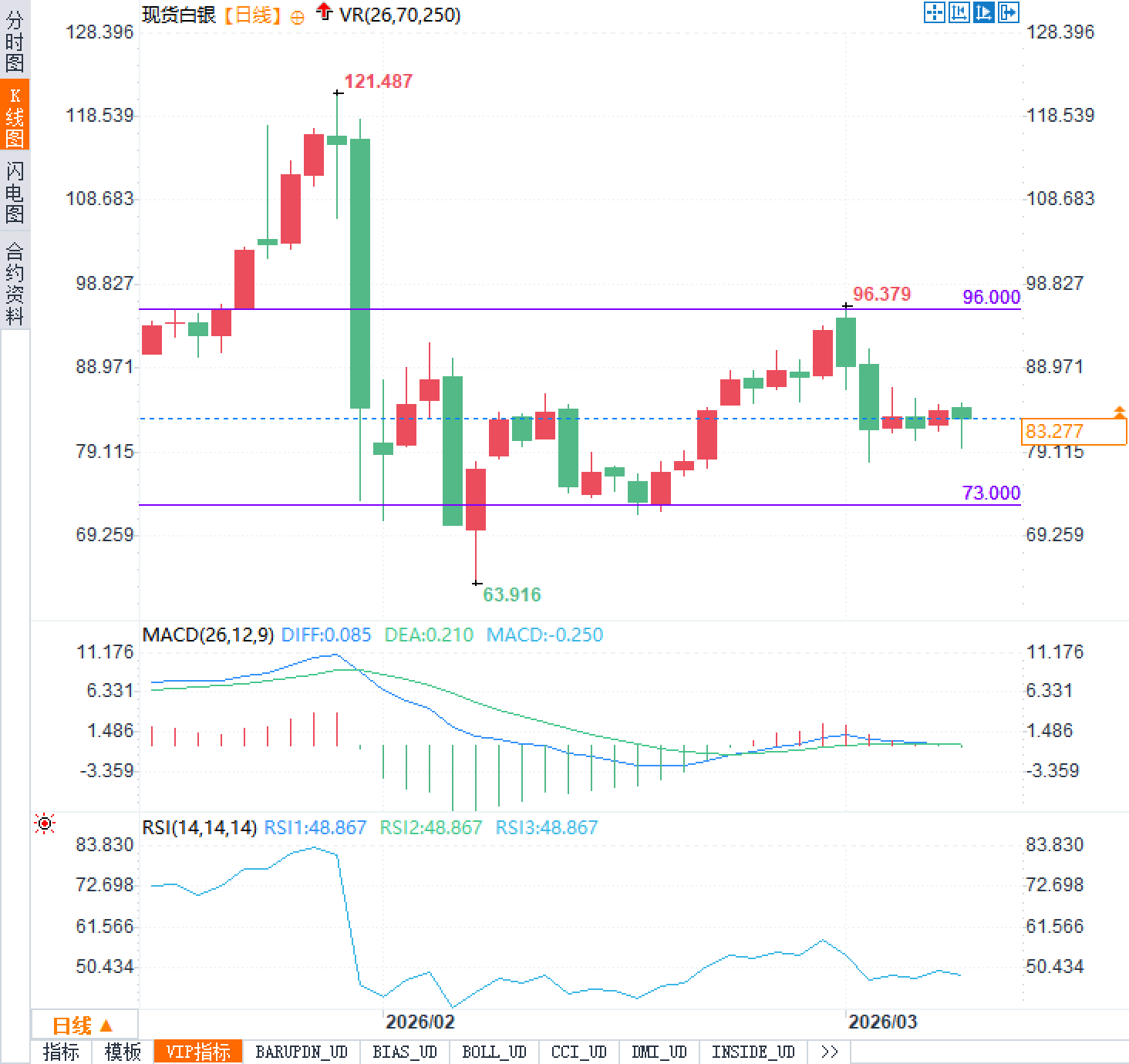
A: The MACD indicator is showing a negative value, and the RSI is around 48.87, indicating a neutral to weak bias. The price is fluctuating around $83. A break below the $79 support level could accelerate the decline; strong resistance lies at $96. Traders use this to assess momentum and combine it with macroeconomic factors to evaluate the probability of a breakout.
- Risk Warning and Disclaimer
- The market involves risk, and trading may not be suitable for all investors. This article is for reference only and does not constitute personal investment advice, nor does it take into account certain users’ specific investment objectives, financial situation, or other needs. Any investment decisions made based on this information are at your own risk.