Rabobank issues a major warning: The war with Iran is dragging the United States into a "stagflation dead end"!
2026-03-10 14:38:54
Rabobank released a new report on Monday (March 9) systematically assessing the comprehensive impact of the current US-Israel war against Iran on the US economy. The report points out that the conflict shows no signs of abating, the closure of the Strait of Hormuz has disrupted approximately 20% of global oil supply, oil prices remain volatile at high levels, triggering renewed inflation, soaring energy costs, and supply chain disruptions.
The report simulates multiple scenarios (short-term disruption, protracted war, and worst-case scenario, a full lockdown), emphasizing that the US economy faces "stagflationary" pressures: slowing growth coupled with persistent inflation, putting the Federal Reserve in a dilemma.
In the short term, war will drive up inflation and real interest rates. In the medium to long term, if it evolves into a protracted war of attrition, it will significantly amplify fiscal deficits, weaken the credibility of the US dollar, and pose a systemic risk to global economic growth.
Simulations show that if the Hormuz Intervention is interrupted for four weeks: Brent crude oil prices will rise to an average of $110-130 per barrel, and the average price of gasoline in the United States will rise to $4.5-5.5 per gallon;
Three-month interruption of the Hormuz test: Oil prices may test above $150 per barrel, triggering a full-blown global energy crisis;
Worst-case scenario (full blockade + Iranian escalation of attacks): Oil prices may exceed $200 per barrel, similar to the oil crisis of the 1970s.
The United States, as a net energy exporter, benefits in the short term from high oil prices (increased shale oil profits), but in the long term, inflation transmission, weak consumption, and declining global demand will offset the positive effects.
The report warns that the energy shock will be transmitted across the transportation, chemical, and manufacturing sectors, pushing up core PCE inflation by 0.5-1.5 percentage points.
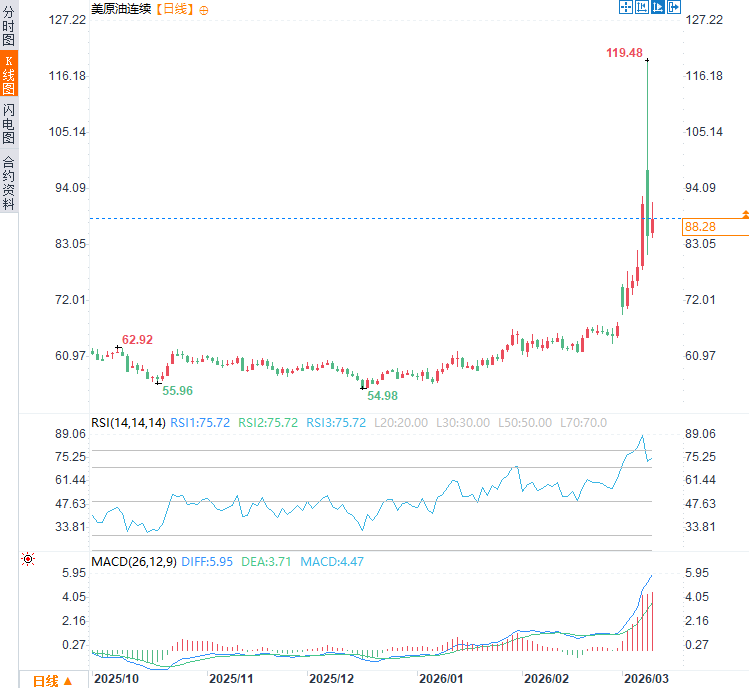
(US crude oil daily chart, source: FX678)
Core PCE inflation is expected to rebound from current levels to the 3.5%-4.5% range, well above the Fed's 2% target; the Fed's rate-cutting path will be significantly delayed, with the number of rate cuts in 2026 reduced from the original expectation of 3-4 to 1-2, and there is even a possibility of "pausing rate cuts within the year" or "restarting discussions on rate hikes"; rising real interest rates will suppress stock market valuations and the real estate market, and the 10-year US Treasury yield may test the 4.5%-5% range.
Rabobank believes that the Federal Reserve will face a "stagflation dilemma": interest rate cuts to stimulate growth will exacerbate inflation, while tightening to control prices will drag down economic recovery, significantly compressing policy space .
Simulating the impact on US GDP growth under different scenarios:
Short term (within 3 months): Growth slowed by 0.3-0.7 percentage points, mainly due to declining consumer and investment confidence;
Medium term (6-12 months): If oil prices rebound to triple digits, GDP growth may fall below 1%, and the probability of recession will rise to 40%-60%.
Worst-case scenario: With oil prices remaining high and global demand shrinking, the US economy may fall into a technical recession, with the unemployment rate rising to over 5%.
The spillover effects of war will amplify the negative impacts through supply chain disruptions, soaring shipping costs, and declining confidence, with consumption and business investment bearing the brunt.
The war has led to a surge in military spending (ammunition consumption, naval escorts, energy subsidies, etc.), coupled with high oil prices pushing up inflationary spending, which will further expand the US fiscal deficit.
The report projects that the deficit may increase by $200-400 billion in fiscal year 2026; the yield curve of US Treasury bonds will shift upward overall, and the fiscal risk premium at the long end will rise; if the Federal Reserve is forced to maintain high interest rates, debt interest payments will be exacerbated, and credit rating risks will emerge.
The safe-haven appeal of US Treasuries has lost its effectiveness in the short term, and the selling trend by investors may continue.
Soaring inflation, if forcing the Federal Reserve to postpone interest rate cuts, would provide short-term support for the dollar as US Treasury yields rise. However, this support is being offset by the risk of an economic recession—markets are beginning to question: Can high interest rates be sustained? Can the US economy withstand this?
This conflict has directly impacted the US domestic economy (widening fiscal deficit and weak consumption), causing the dollar to transform from a "pure safe-haven asset" into a "risk-exposed asset." Stagflationary pressures, fiscal deficits, and policy lapses will constitute a triple negative factor.
On Tuesday, during the Asian and European sessions, the US dollar index fluctuated narrowly around 98.75.
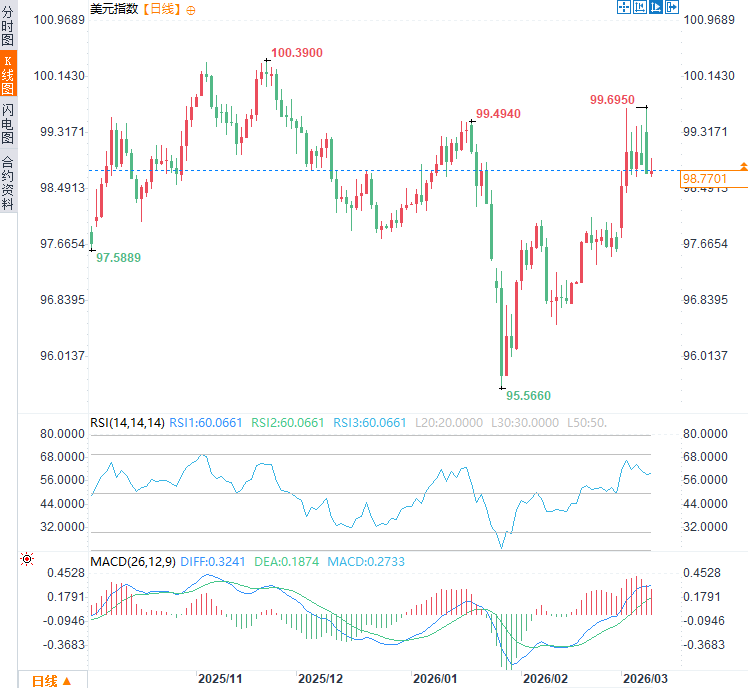
(US Dollar Index Daily Chart, Source: FX678)
The report points out that the US economic slowdown will spill over globally through trade, finance, and commodities: Asian importers (China, India, Japan, and South Korea) will be most affected by energy shocks, with rising inflation and slowing growth; Europe relies on Middle Eastern LNG, and faces a high risk of a renewed energy crisis; emerging markets will experience capital outflows and increased pressure on currency devaluation.
The report points out that if the conflict drags on, it will trigger a new round of global stagflation risks, similar to the oil crisis of the 1970s .
Rabobank's reporting system assesses the multi-dimensional impact of the Iran war on the US economy: the disruption of the Hormuz trade agreement pushes up oil prices, triggering renewed inflation, soaring energy costs, and supply chain disruptions. The Federal Reserve's room for interest rate cuts is limited, real interest rates are rising, the risk of slowing economic growth or even recession is increasing, the fiscal deficit is widening further, and US Treasury yields are under pressure.
In the short term, the United States, as a net energy exporter, may benefit to some extent, but in the long term, inflation transmission, weak consumption, and declining global demand will dominate the negative effects.
The report emphasizes that the duration of the conflict is a key variable; if it evolves into a protracted war, it will amplify the risk of stagflation and pose a systemic threat to the global economy.
The market has already partially priced in a "persistent disruption" scenario. Investors need to pay attention to the progress of the G7's reserve release, the signal of the opening of the Strait of Hormuz, and the latest statements from the Federal Reserve. Any unexpected developments by any of these factors could trigger a sharp correction.
At 14:36 Beijing time, the US dollar index is currently at 98.72.
The report simulates multiple scenarios (short-term disruption, protracted war, and worst-case scenario, a full lockdown), emphasizing that the US economy faces "stagflationary" pressures: slowing growth coupled with persistent inflation, putting the Federal Reserve in a dilemma.
In the short term, war will drive up inflation and real interest rates. In the medium to long term, if it evolves into a protracted war of attrition, it will significantly amplify fiscal deficits, weaken the credibility of the US dollar, and pose a systemic risk to global economic growth.
Scenario Simulation of Soaring Oil Prices and Energy Supply Disruptions
Simulations show that if the Hormuz Intervention is interrupted for four weeks: Brent crude oil prices will rise to an average of $110-130 per barrel, and the average price of gasoline in the United States will rise to $4.5-5.5 per gallon;
Three-month interruption of the Hormuz test: Oil prices may test above $150 per barrel, triggering a full-blown global energy crisis;
Worst-case scenario (full blockade + Iranian escalation of attacks): Oil prices may exceed $200 per barrel, similar to the oil crisis of the 1970s.
The United States, as a net energy exporter, benefits in the short term from high oil prices (increased shale oil profits), but in the long term, inflation transmission, weak consumption, and declining global demand will offset the positive effects.
The report warns that the energy shock will be transmitted across the transportation, chemical, and manufacturing sectors, pushing up core PCE inflation by 0.5-1.5 percentage points.
(US crude oil daily chart, source: FX678)
Inflation reignites, Fed's policy space shrinks
Core PCE inflation is expected to rebound from current levels to the 3.5%-4.5% range, well above the Fed's 2% target; the Fed's rate-cutting path will be significantly delayed, with the number of rate cuts in 2026 reduced from the original expectation of 3-4 to 1-2, and there is even a possibility of "pausing rate cuts within the year" or "restarting discussions on rate hikes"; rising real interest rates will suppress stock market valuations and the real estate market, and the 10-year US Treasury yield may test the 4.5%-5% range.
Rabobank believes that the Federal Reserve will face a "stagflation dilemma": interest rate cuts to stimulate growth will exacerbate inflation, while tightening to control prices will drag down economic recovery, significantly compressing policy space .
Assessment of the Risk of Slowing US Economic Growth and Recession
Simulating the impact on US GDP growth under different scenarios:
Short term (within 3 months): Growth slowed by 0.3-0.7 percentage points, mainly due to declining consumer and investment confidence;
Medium term (6-12 months): If oil prices rebound to triple digits, GDP growth may fall below 1%, and the probability of recession will rise to 40%-60%.
Worst-case scenario: With oil prices remaining high and global demand shrinking, the US economy may fall into a technical recession, with the unemployment rate rising to over 5%.
The spillover effects of war will amplify the negative impacts through supply chain disruptions, soaring shipping costs, and declining confidence, with consumption and business investment bearing the brunt.
Widening fiscal deficit and pressure on US Treasury yields
The war has led to a surge in military spending (ammunition consumption, naval escorts, energy subsidies, etc.), coupled with high oil prices pushing up inflationary spending, which will further expand the US fiscal deficit.
The report projects that the deficit may increase by $200-400 billion in fiscal year 2026; the yield curve of US Treasury bonds will shift upward overall, and the fiscal risk premium at the long end will rise; if the Federal Reserve is forced to maintain high interest rates, debt interest payments will be exacerbated, and credit rating risks will emerge.
The safe-haven appeal of US Treasuries has lost its effectiveness in the short term, and the selling trend by investors may continue.
The US dollar is caught in a stagflation dilemma, which may systematically undermine its credibility.
Soaring inflation, if forcing the Federal Reserve to postpone interest rate cuts, would provide short-term support for the dollar as US Treasury yields rise. However, this support is being offset by the risk of an economic recession—markets are beginning to question: Can high interest rates be sustained? Can the US economy withstand this?
This conflict has directly impacted the US domestic economy (widening fiscal deficit and weak consumption), causing the dollar to transform from a "pure safe-haven asset" into a "risk-exposed asset." Stagflationary pressures, fiscal deficits, and policy lapses will constitute a triple negative factor.
On Tuesday, during the Asian and European sessions, the US dollar index fluctuated narrowly around 98.75.
(US Dollar Index Daily Chart, Source: FX678)
Global economic spillover effects and the impact on the Asia-Pacific region
The report points out that the US economic slowdown will spill over globally through trade, finance, and commodities: Asian importers (China, India, Japan, and South Korea) will be most affected by energy shocks, with rising inflation and slowing growth; Europe relies on Middle Eastern LNG, and faces a high risk of a renewed energy crisis; emerging markets will experience capital outflows and increased pressure on currency devaluation.
The report points out that if the conflict drags on, it will trigger a new round of global stagflation risks, similar to the oil crisis of the 1970s .
Editor's Summary
Rabobank's reporting system assesses the multi-dimensional impact of the Iran war on the US economy: the disruption of the Hormuz trade agreement pushes up oil prices, triggering renewed inflation, soaring energy costs, and supply chain disruptions. The Federal Reserve's room for interest rate cuts is limited, real interest rates are rising, the risk of slowing economic growth or even recession is increasing, the fiscal deficit is widening further, and US Treasury yields are under pressure.
In the short term, the United States, as a net energy exporter, may benefit to some extent, but in the long term, inflation transmission, weak consumption, and declining global demand will dominate the negative effects.
The report emphasizes that the duration of the conflict is a key variable; if it evolves into a protracted war, it will amplify the risk of stagflation and pose a systemic threat to the global economy.
The market has already partially priced in a "persistent disruption" scenario. Investors need to pay attention to the progress of the G7's reserve release, the signal of the opening of the Strait of Hormuz, and the latest statements from the Federal Reserve. Any unexpected developments by any of these factors could trigger a sharp correction.
At 14:36 Beijing time, the US dollar index is currently at 98.72.
- Risk Warning and Disclaimer
- The market involves risk, and trading may not be suitable for all investors. This article is for reference only and does not constitute personal investment advice, nor does it take into account certain users’ specific investment objectives, financial situation, or other needs. Any investment decisions made based on this information are at your own risk.