The Middle East conflict has caused market expectations for a Federal Reserve rate cut this year to plummet to less than two.
2026-03-10 14:52:46
According to APP, BNY Americas macro strategist John Velis's latest analysis points out that the Middle East conflict, through three channels—higher oil prices, weaker asset portfolios, and increased uncertainty—has created a typical negative supply shock to the US economy. This has led to a significant reduction in market expectations for the number of Fed rate cuts this year, from slightly more than two pre-conflict estimates to well below two currently. Velis himself still maintains his judgment of three rate cuts this year, based on the fact that signs of weakness in the labor market are gradually emerging and may dominate the policy path.
John Velis emphasizes that the impact of the Middle East conflict on the US economy and interest rate outlook is not singular, but rather transmitted through three intertwined channels, forming a complex negative effect.
1. Higher Oil Prices: Inflationary Pressures and Yield Curve Repricing. The conflict directly pushes up international oil prices (currently, WTI crude oil prices are fluctuating wildly between $88-90/barrel, having previously reached a high of $119 before falling back), constituting a classic negative supply shock. This shifts the aggregate supply curve to the upper left, leading to higher price levels while suppressing real output. Rising oil prices significantly increase US Treasury yields through the expectation channel; the recent significant rebound in the 10-year US Treasury yield reflects the market's re-anchoring of medium-term inflation expectations, further compressing the Federal Reserve's easing space.
2. Channels of Financial Market Instability: The Wealth Effect and the Dual Suppression of Consumption/Investment. Sharp asset price fluctuations triggered by geopolitical risks directly weaken the value of household and institutional investment portfolios, significantly suppressing consumer spending through the wealth effect. Simultaneously, the real income loss caused by high oil prices further squeezes household disposable income, weakening consumer demand under these dual effects. Furthermore, increased volatility interferes with long-term financial planning for businesses and households, leading to delayed investment decisions and a slowdown in hiring, creating a negative feedback loop.
3. Channels of Rising Uncertainty: Behavioral Repression and Growth-Inflation Dual Distortions. The superposition of the first two channels creates a widespread atmosphere of economic uncertainty. Consumers increase precautionary savings, and businesses postpone capital expenditures and expansion plans, ultimately manifesting as "stagflation" characteristics of slowing economic growth and short-term inflation. Velis points out that this is the core macroeconomic manifestation of negative supply shocks, placing the Federal Reserve in a dilemma between persistent sticky inflation and weak demand.
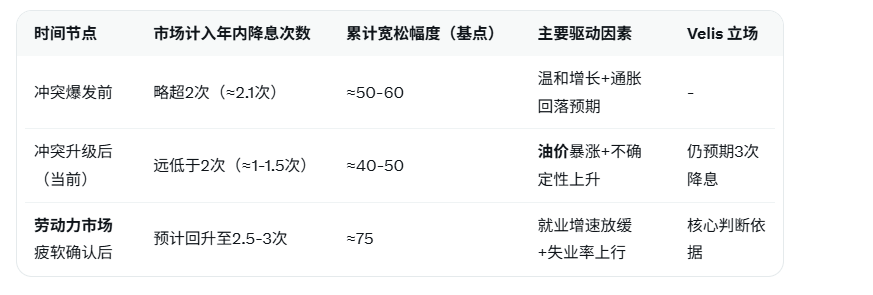
Before the conflict erupted, the market priced in slightly more than two rate cuts this year (approximately 2.1). After the conflict escalated, the market quickly shifted to hawkish pricing, and the number of rate cuts priced in this year is now far below two (the latest CME FedWatch data shows a cumulative easing of approximately 40-50 basis points for the year, implying a low probability of 1-2 25 basis point rate cuts), reflecting a strengthened expectation that the Fed will maintain high interest rates for a longer period due to inflationary pressures. Velis believes this creates a significant dilemma for the Fed: on the one hand, sticky inflation and oil price shocks coexist; on the other hand, signs of weakness in the labor market are intensifying (the latest February non-farm payrolls unexpectedly fell by 92,000, and the unemployment rate rose to 4.4%). Supply-side shocks will dominate in the short term, but accumulating evidence of weakening demand will open a window for easing. Therefore, BNY maintains its benchmark of three rate cuts this year, expecting the Fed to gradually implement a dovish shift after further confirmation of weakness in employment data.
The table below compares key changes in market expectations for a Fed rate cut this year before and after the conflict (based on the latest CME FedWatch and market data):
In the short term, oil price dynamics remain the dominant variable. If the situation in the Middle East continues to ease and oil prices stabilize in the $85-95 range, the market's pessimistic pricing of a Fed rate cut this year may be partially corrected, leading to a phased rebound in US stocks and bonds. However, if the conflict recurs, a renewed surge in oil prices will intensify stagflation concerns, further pushing up long-term yields and suppressing risk assets. From a medium-term perspective, labor market signals are the decisive turning point. Once non-farm payrolls continue to fall short of expectations and the unemployment rate rises moderately to above 4.5%, the Fed's easing window will open, and Velis's three-rate-cut path will regain market consensus. Investors need to closely monitor the dynamic interplay between oil price stabilization, the steepness of the US Treasury yield curve, and employment data.
Risk Warnings: 1. The Middle East conflict escalates beyond expectations, oil prices return to above $100 and trigger runaway inflation. 2. The labor market deteriorates faster than expected, forcing the Federal Reserve to implement large-scale easing ahead of schedule, but amplifying recession fears. 3. Weak global demand coupled with supply shocks increases the probability of the economy falling into stagflation.
Editor's Summary:
The Middle East conflict, through three channels—higher oil prices, a diminishing wealth effect, and increased uncertainty—has exerted a negative supply shock on the US economy, driving markets to significantly lower their expectations for a Federal Reserve rate cut this year. BNY strategist John Velis maintains his prediction of three rate cuts, emphasizing that a weak labor market will gradually dominate the policy path. Short-term volatility has increased, but medium-term easing space remains; however, caution is needed regarding the potential for confirmation from both oil price and employment data.
Frequently Asked Questions
1. Question: How will the Middle East conflict specifically impact the US economy through three main channels?
A: John Velis identified three main channels: First, rising oil prices directly push up inflation, creating a negative supply shock and raising US Treasury yields; second, geopolitical volatility weakens the value of household investment portfolios, suppressing consumption through the wealth effect, while high oil prices compress real income; and third, increased overall uncertainty leads to conservative behavior by businesses and consumers, postponing investment, hiring, and large expenditures, ultimately causing stagflationary pressures such as slower economic growth and short-term upward pressure on inflation.
2. Question: Why has the market's expectation for the Federal Reserve to cut interest rates this year plummeted from slightly more than two to well below two?
A: Before the conflict, the market priced in approximately 2.1 rate cuts based on the logic of moderate growth and declining inflation. After the conflict, the surge in oil prices intensified inflation concerns, and the market believed that the Federal Reserve would postpone or reduce easing due to sticky inflation. Currently, the CME FedWatch implies an easing range of only 40-50 basis points for the whole year, equivalent to 1-1.5 25 basis point rate cuts, with hawkish pricing dominating.
3. Question: What is the core basis for Velis's insistence on three interest rate cuts this year?
A: Velis believes the supply shock (driven by oil prices) is short-term, while the weakness in the labor market is a more structural and long-term problem. The latest signals, such as the unexpected 92,000 drop in non-farm payrolls in February and the unemployment rate rising to 4.4%, are already intensifying. Once the employment data further confirms the weakness, the Federal Reserve will be forced to shift to easing to prevent a hard landing; therefore, three rate cuts remain the baseline scenario.
4. Question: Is the current market's pessimistic pricing of interest rate cuts excessive?
A: There is some excessive pessimism. Short-term sentiment is dominated by high oil prices and geopolitical uncertainties, but the weak labor market logic has not yet been fully reflected in pricing. If oil prices fall and stabilize, and employment data remains weak, there is significant room for market correction in expectations of interest rate cuts this year, and US stocks and bonds may experience a corrective rebound.
5. Question: What indicators should investors focus on monitoring to determine the Fed's path?
A: First, monitor whether oil prices stabilize and decline (this determines the intensity of the supply shock and inflation expectations); second, pay attention to changes in the US Treasury yield curve (reflecting the growth-inflation game); third, closely monitor labor market data such as non-farm payrolls, unemployment rate, and initial jobless claims (this determines the pace of easing measures). The convergence of these three factors will dominate short-term asset direction. It is recommended to control positions, make dynamic adjustments, and avoid excessively chasing extreme pricing.
John Velis emphasizes that the impact of the Middle East conflict on the US economy and interest rate outlook is not singular, but rather transmitted through three intertwined channels, forming a complex negative effect.
1. Higher Oil Prices: Inflationary Pressures and Yield Curve Repricing. The conflict directly pushes up international oil prices (currently, WTI crude oil prices are fluctuating wildly between $88-90/barrel, having previously reached a high of $119 before falling back), constituting a classic negative supply shock. This shifts the aggregate supply curve to the upper left, leading to higher price levels while suppressing real output. Rising oil prices significantly increase US Treasury yields through the expectation channel; the recent significant rebound in the 10-year US Treasury yield reflects the market's re-anchoring of medium-term inflation expectations, further compressing the Federal Reserve's easing space.
2. Channels of Financial Market Instability: The Wealth Effect and the Dual Suppression of Consumption/Investment. Sharp asset price fluctuations triggered by geopolitical risks directly weaken the value of household and institutional investment portfolios, significantly suppressing consumer spending through the wealth effect. Simultaneously, the real income loss caused by high oil prices further squeezes household disposable income, weakening consumer demand under these dual effects. Furthermore, increased volatility interferes with long-term financial planning for businesses and households, leading to delayed investment decisions and a slowdown in hiring, creating a negative feedback loop.
3. Channels of Rising Uncertainty: Behavioral Repression and Growth-Inflation Dual Distortions. The superposition of the first two channels creates a widespread atmosphere of economic uncertainty. Consumers increase precautionary savings, and businesses postpone capital expenditures and expansion plans, ultimately manifesting as "stagflation" characteristics of slowing economic growth and short-term inflation. Velis points out that this is the core macroeconomic manifestation of negative supply shocks, placing the Federal Reserve in a dilemma between persistent sticky inflation and weak demand.
Before the conflict erupted, the market priced in slightly more than two rate cuts this year (approximately 2.1). After the conflict escalated, the market quickly shifted to hawkish pricing, and the number of rate cuts priced in this year is now far below two (the latest CME FedWatch data shows a cumulative easing of approximately 40-50 basis points for the year, implying a low probability of 1-2 25 basis point rate cuts), reflecting a strengthened expectation that the Fed will maintain high interest rates for a longer period due to inflationary pressures. Velis believes this creates a significant dilemma for the Fed: on the one hand, sticky inflation and oil price shocks coexist; on the other hand, signs of weakness in the labor market are intensifying (the latest February non-farm payrolls unexpectedly fell by 92,000, and the unemployment rate rose to 4.4%). Supply-side shocks will dominate in the short term, but accumulating evidence of weakening demand will open a window for easing. Therefore, BNY maintains its benchmark of three rate cuts this year, expecting the Fed to gradually implement a dovish shift after further confirmation of weakness in employment data.
The table below compares key changes in market expectations for a Fed rate cut this year before and after the conflict (based on the latest CME FedWatch and market data):
In the short term, oil price dynamics remain the dominant variable. If the situation in the Middle East continues to ease and oil prices stabilize in the $85-95 range, the market's pessimistic pricing of a Fed rate cut this year may be partially corrected, leading to a phased rebound in US stocks and bonds. However, if the conflict recurs, a renewed surge in oil prices will intensify stagflation concerns, further pushing up long-term yields and suppressing risk assets. From a medium-term perspective, labor market signals are the decisive turning point. Once non-farm payrolls continue to fall short of expectations and the unemployment rate rises moderately to above 4.5%, the Fed's easing window will open, and Velis's three-rate-cut path will regain market consensus. Investors need to closely monitor the dynamic interplay between oil price stabilization, the steepness of the US Treasury yield curve, and employment data.
Risk Warnings: 1. The Middle East conflict escalates beyond expectations, oil prices return to above $100 and trigger runaway inflation. 2. The labor market deteriorates faster than expected, forcing the Federal Reserve to implement large-scale easing ahead of schedule, but amplifying recession fears. 3. Weak global demand coupled with supply shocks increases the probability of the economy falling into stagflation.
Editor's Summary:
The Middle East conflict, through three channels—higher oil prices, a diminishing wealth effect, and increased uncertainty—has exerted a negative supply shock on the US economy, driving markets to significantly lower their expectations for a Federal Reserve rate cut this year. BNY strategist John Velis maintains his prediction of three rate cuts, emphasizing that a weak labor market will gradually dominate the policy path. Short-term volatility has increased, but medium-term easing space remains; however, caution is needed regarding the potential for confirmation from both oil price and employment data.
Frequently Asked Questions
1. Question: How will the Middle East conflict specifically impact the US economy through three main channels?
A: John Velis identified three main channels: First, rising oil prices directly push up inflation, creating a negative supply shock and raising US Treasury yields; second, geopolitical volatility weakens the value of household investment portfolios, suppressing consumption through the wealth effect, while high oil prices compress real income; and third, increased overall uncertainty leads to conservative behavior by businesses and consumers, postponing investment, hiring, and large expenditures, ultimately causing stagflationary pressures such as slower economic growth and short-term upward pressure on inflation.
2. Question: Why has the market's expectation for the Federal Reserve to cut interest rates this year plummeted from slightly more than two to well below two?
A: Before the conflict, the market priced in approximately 2.1 rate cuts based on the logic of moderate growth and declining inflation. After the conflict, the surge in oil prices intensified inflation concerns, and the market believed that the Federal Reserve would postpone or reduce easing due to sticky inflation. Currently, the CME FedWatch implies an easing range of only 40-50 basis points for the whole year, equivalent to 1-1.5 25 basis point rate cuts, with hawkish pricing dominating.
3. Question: What is the core basis for Velis's insistence on three interest rate cuts this year?
A: Velis believes the supply shock (driven by oil prices) is short-term, while the weakness in the labor market is a more structural and long-term problem. The latest signals, such as the unexpected 92,000 drop in non-farm payrolls in February and the unemployment rate rising to 4.4%, are already intensifying. Once the employment data further confirms the weakness, the Federal Reserve will be forced to shift to easing to prevent a hard landing; therefore, three rate cuts remain the baseline scenario.
4. Question: Is the current market's pessimistic pricing of interest rate cuts excessive?
A: There is some excessive pessimism. Short-term sentiment is dominated by high oil prices and geopolitical uncertainties, but the weak labor market logic has not yet been fully reflected in pricing. If oil prices fall and stabilize, and employment data remains weak, there is significant room for market correction in expectations of interest rate cuts this year, and US stocks and bonds may experience a corrective rebound.
5. Question: What indicators should investors focus on monitoring to determine the Fed's path?
A: First, monitor whether oil prices stabilize and decline (this determines the intensity of the supply shock and inflation expectations); second, pay attention to changes in the US Treasury yield curve (reflecting the growth-inflation game); third, closely monitor labor market data such as non-farm payrolls, unemployment rate, and initial jobless claims (this determines the pace of easing measures). The convergence of these three factors will dominate short-term asset direction. It is recommended to control positions, make dynamic adjustments, and avoid excessively chasing extreme pricing.
- Risk Warning and Disclaimer
- The market involves risk, and trading may not be suitable for all investors. This article is for reference only and does not constitute personal investment advice, nor does it take into account certain users’ specific investment objectives, financial situation, or other needs. Any investment decisions made based on this information are at your own risk.