Is the Hormuz blockade a deadlock that's hard to break, and the oil price pullback just a bear trap?
2026-03-11 15:48:07
On Wednesday (March 11), WTI crude oil futures contracts for April delivery experienced a sharp rise followed by a significant fall during the Asian and European sessions. On Monday and Tuesday, international oil prices fell by more than 25% due to Trump's statement that the war would end soon, the rapid progress and significant achievements of the US military, and threats against Iran to keep the Strait of Hormuz open.
However, the military conflict between the US and Israel and Iran is actually escalating, with both sides launching airstrikes against each other without any sign of stopping. The conditions indicating that the Strait of Hormuz is effectively blocked have not changed, and one-fifth of the world's fossil fuel supply is at risk of being disrupted.
Although international oil prices briefly retreated after hitting a high of $120 per barrel on Monday, multiple signals beneath the surface—including mine threats driving up insurance costs, soaring global shipping rates, and GPS navigation interference exacerbating navigation difficulties—all point to the Strait of Hormuz being unlikely to reopen in the short term, and the logic for the continued rise in the crude oil market is constantly being strengthened.
Since the US and Israel launched airstrikes on February 28, the geopolitical conflict has resulted in the deaths of more than 1,300 Iranian civilians and the destruction of nearly 8,000 homes. Israel's attacks on Lebanon and Iran's retaliation have also caused dozens of deaths.
Military confrontation is spreading from land to sea: Tuesday night and Wednesday, Iran launched missiles and drones at U.S. military facilities in Qatar, Iraqi Kurdish regions, the UAE, and Bahrain in response to previous U.S. strikes.
The U.S. Central Command claimed to have "cleared" 16 Iranian mine-laying vessels (including 10 non-active vessels), and President Trump issued a strong warning, demanding that Iran immediately dismantle the mines or face "unprecedented military consequences."
However, the tough stance failed to break the deadlock, with the Iranian Revolutionary Guard explicitly vowing to completely blockade Gulf oil shipments unless the US and Israel cease their attacks—a threat that was far from empty rhetoric.
Although the Wall Street Journal reported that fewer than 10 mines have actually been laid in the Strait of Hormuz, sources say that Iran has recently started mine-laying operations and still maintains more than 80% of its small vessels and mine-laying capacity. Industry estimates put its naval mine stockpile at 2,000 to 6,000, which is enough to completely paralyze this global energy "choke point" in a short period of time.
More importantly, the U.S. military's countermeasures capabilities have obvious shortcomings: after the decommissioning of four Avenger-class minesweepers by the end of 2025, the replacement Independence-class littoral combat ships "failed to meet the requirements for actual minesweeping." Even though Trump promised that "the Navy will provide escorts as soon as possible," the U.S. military "almost daily rejected escort applications from the shipping industry" due to the high risks, and the safety of navigation in the Taiwan Strait lacks substantial guarantees.
Iran is well-versed in the asymmetric tactic of "minor mine laying + strategic deterrence," a strategy that has been rapidly transmitted to the marine insurance market, creating a suppressive effect equivalent to a direct blockade.
A declassified CIA report from 2009 pointed out that Iran, aware of its limitations in mine warfare capabilities, resorted to "minor mine laying or threats" to inflate insurance rates and deter ships from heading to the Persian Gulf. This prediction has now come true.
Marine war risk premiums soared from 0.25% before the war to 1%, and had to be renewed every 7 days. The cost of insurance for a single voyage for a VLCC tanker increased nearly tenfold, reaching $2 million to $3 million.
Several core insurance institutions in the London market have completely suspended marine insurance coverage in the Persian Gulf waters, and ship owners have chosen to avoid the waters. As of March 7, only three oil tankers had passed through the Strait of Hormuz in seven days, and traffic was almost at a standstill.
Even with the U.S. International Development Finance Corporation offering political risk insurance guarantees, it is difficult to offset market concerns about the threat of sea mines—after all, Iranian small vessels can carry 2 to 3 sea mines for flexible deployment, and can cover 80% of the strait's main shipping lanes with drifting sea mines within 4 hours. Smart sea mines can also more accurately strike high-value oil tankers.
The surge in insurance costs is essentially the market's pricing of the long-term blockade of the strait, and this cost is rapidly being passed on to the entire industry chain.
The ripple effects of the Strait of Hormuz blockade have spread to the global shipping market. Coupled with supply contraction in the Middle East, a key export region for marine fuel oil (accounting for nearly 35% of Singapore's fuel oil imports), the price of low-sulfur marine fuel oil has broken through the $800 per ton mark for the first time since 2022. Expectations of increased fuel surcharges have further pushed up shipping costs, leading to a collective surge in freight rates on major global routes.
Asia-Europe routes: The Shanghai Container Freight Index shows that freight rates on the Asia-Europe route rose 2% month-on-month to US$1,452 per TEU and US$2,383 per 40-foot container; freight rates on the Asia-Europe-Mediterranean route also rose 2%, with 40-foot containers seeing a 5% increase to US$3,238.
Shipping companies plan to significantly raise prices starting in mid-March, increasing freight rates on Asia-Europe and Northern Europe routes to US$2,200 per TEU and US$4,000 per 40-foot container, while the target for Mediterranean routes is set at US$4,200 per TEU and US$5,600 per 40-foot container.
Trans-Pacific routes: Freight rates on the Shanghai-US West Coast route rose by nearly 5% to US$1,940 per 40-foot container, while those on the US East Coast route rose slightly by 1% to US$2,717. Shipping companies have even requested a further increase of US$2,000 to US$3,000 in 40-foot container freight rates during annual contract negotiations.
Regional transshipment pressure: The conflict has forced goods destined for the Persian Gulf to be transshipped through inland Turkey, further exacerbating the capacity shortage on the Asia-Europe-Mediterranean route. Shipping data analysis agency Linerlytica has clearly pointed out that the probability of freight rates on this route being raised is extremely high.
It is worth noting that China has raised objections to the soaring freight rates, and the Ministry of Transport has held talks with leading companies such as Denmark's Maersk and Switzerland's Mediterranean Shipping Company. However, this has not changed the trend of shipping companies taking advantage of the conflict to push up freight rates. In essence, the shipping market is betting that the Strait of Hormuz blockade will last longer, locking in long-term risk premiums in advance.
In addition to the threat of mines, GPS navigation interference caused by conflicts is becoming a new problem for ship navigation.
Although the specific source of the interference was not disclosed, several shipping industry insiders revealed that GPS signal drift and interruption have been frequently occurring in the Strait of Hormuz and surrounding waters recently, making it difficult for ships to accurately locate themselves, significantly reducing navigation efficiency, and increasing the risk of mine strikes and collisions.
Since the outbreak of the conflict, several cargo ships have chosen to speed through the strait or change course, further exacerbating the tight shipping capacity situation.
GPS interference and mine deterrence create a "double whammy": on the one hand, navigation failure makes it difficult for ships to avoid potential minefields; on the other hand, detours significantly increase sailing time and fuel consumption, further driving up transportation costs.
This hidden risk has reinforced the market's perception of the difficulty of navigation across the strait and completely dashed expectations of a "short-term opening of the Strait of Hormuz".
The current short-term decline in international oil prices is more of an emotional bet on "Trump seeking a swift ceasefire," but the long-term upward trend supported by fundamentals remains unchanged.
The core contradiction of the risk of supply contraction remains prominent: the daily crude oil volume through the Strait of Hormuz will reach 13 million barrels by 2025, accounting for 31% of the total global maritime crude oil transportation. The continued blockade of the strait will directly lead to a significant contraction in global crude oil supply.
Policy countermeasures are ineffective: Although the International Energy Agency (IEA) is planning the largest release of oil reserves in history, there are significant divisions within the G7, and opposition from France and Portugal may delay the plan, making it difficult to offset the supply gap caused by the blockade of the Strait of Hormuz.
More importantly, the surge in shipping freight rates has begun to transmit to crude oil prices: daily charter rates for supertankers have jumped fourfold to $800,000 compared to pre-war levels, and the price of low-sulfur fuel oil has exceeded $800 per ton. These costs will ultimately be reflected in the landed price of crude oil, further pushing up global inflation and the central level of oil prices.
A clear warning from an institution: Danish global risk management consultancy points out that the market has underestimated the duration of the conflict. As traders recognize the protracted nature of the Iranian entanglement, oil prices may experience a snowballing rise. If the Straits of Hormuz is closed for several weeks, Brent crude oil could break through $150 per barrel.
The stalemate in the blockade of the Strait of Hormuz is essentially the result of a game between Iran's asymmetric strategy and the US military's shortcomings in countermeasures.
The threat of mines is driving up insurance costs, GPS interference is exacerbating navigation difficulties, and global freight rates are all surging. These market signals all point to the same conclusion: the strait is unlikely to open in the short term, and the long-term bullish logic for the crude oil market has solid support.
For traders, the current focus should be on three key variables: first, the "blockade premium" in the Straits caused by insurance premiums and difficulties in US military escort; second, market risk expectations reflected in rising global shipping freight rates; and third, the implementation of the joint release of crude oil reserves by G7 countries.
As geopolitical conflicts continue, the market will gradually shift from "short-term sentiment fluctuations" to "long-term fundamental pricing," and the trading logic of betting on the extension of the Strait of Hormuz blockade is becoming the core theme of the crude oil market.
From a technical perspective, WTI crude oil futures are currently finding support around the 0.382 level of the recent oil price increase, but are facing resistance at the 0.500 level. A pullback to the 0.500 level is highly probable; if it breaks through, oil prices could continue to rise. The 5-day moving average is also a key resistance level, and it's highly likely that oil prices will close above it during the New York session.
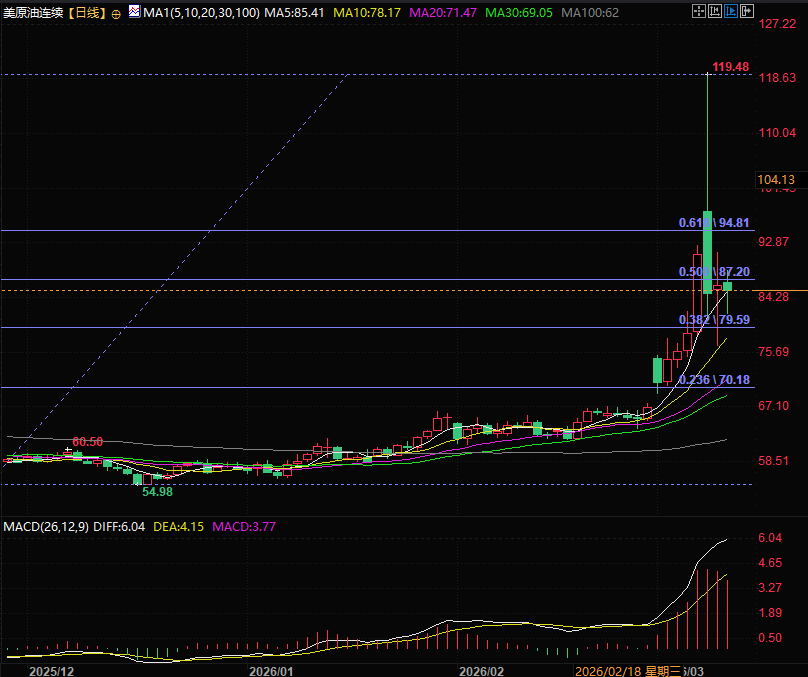
(WTI crude oil futures daily chart, source: EasyForex)
At 15:43 Beijing time, WTI crude oil futures were trading at $85.43 per barrel.
However, the military conflict between the US and Israel and Iran is actually escalating, with both sides launching airstrikes against each other without any sign of stopping. The conditions indicating that the Strait of Hormuz is effectively blocked have not changed, and one-fifth of the world's fossil fuel supply is at risk of being disrupted.
Although international oil prices briefly retreated after hitting a high of $120 per barrel on Monday, multiple signals beneath the surface—including mine threats driving up insurance costs, soaring global shipping rates, and GPS navigation interference exacerbating navigation difficulties—all point to the Strait of Hormuz being unlikely to reopen in the short term, and the logic for the continued rise in the crude oil market is constantly being strengthened.
Conflict Escalates: Strait Blockade a Foregone Conclusion, Military Standoff Shows No Signs of De-escalation
Since the US and Israel launched airstrikes on February 28, the geopolitical conflict has resulted in the deaths of more than 1,300 Iranian civilians and the destruction of nearly 8,000 homes. Israel's attacks on Lebanon and Iran's retaliation have also caused dozens of deaths.
Military confrontation is spreading from land to sea: Tuesday night and Wednesday, Iran launched missiles and drones at U.S. military facilities in Qatar, Iraqi Kurdish regions, the UAE, and Bahrain in response to previous U.S. strikes.
The U.S. Central Command claimed to have "cleared" 16 Iranian mine-laying vessels (including 10 non-active vessels), and President Trump issued a strong warning, demanding that Iran immediately dismantle the mines or face "unprecedented military consequences."
However, the tough stance failed to break the deadlock, with the Iranian Revolutionary Guard explicitly vowing to completely blockade Gulf oil shipments unless the US and Israel cease their attacks—a threat that was far from empty rhetoric.
Although the Wall Street Journal reported that fewer than 10 mines have actually been laid in the Strait of Hormuz, sources say that Iran has recently started mine-laying operations and still maintains more than 80% of its small vessels and mine-laying capacity. Industry estimates put its naval mine stockpile at 2,000 to 6,000, which is enough to completely paralyze this global energy "choke point" in a short period of time.
More importantly, the U.S. military's countermeasures capabilities have obvious shortcomings: after the decommissioning of four Avenger-class minesweepers by the end of 2025, the replacement Independence-class littoral combat ships "failed to meet the requirements for actual minesweeping." Even though Trump promised that "the Navy will provide escorts as soon as possible," the U.S. military "almost daily rejected escort applications from the shipping industry" due to the high risks, and the safety of navigation in the Taiwan Strait lacks substantial guarantees.
Mine deterrence: Soaring insurance costs intensify shipping industry's avoidance trend.
Iran is well-versed in the asymmetric tactic of "minor mine laying + strategic deterrence," a strategy that has been rapidly transmitted to the marine insurance market, creating a suppressive effect equivalent to a direct blockade.
A declassified CIA report from 2009 pointed out that Iran, aware of its limitations in mine warfare capabilities, resorted to "minor mine laying or threats" to inflate insurance rates and deter ships from heading to the Persian Gulf. This prediction has now come true.
Marine war risk premiums soared from 0.25% before the war to 1%, and had to be renewed every 7 days. The cost of insurance for a single voyage for a VLCC tanker increased nearly tenfold, reaching $2 million to $3 million.
Several core insurance institutions in the London market have completely suspended marine insurance coverage in the Persian Gulf waters, and ship owners have chosen to avoid the waters. As of March 7, only three oil tankers had passed through the Strait of Hormuz in seven days, and traffic was almost at a standstill.
Even with the U.S. International Development Finance Corporation offering political risk insurance guarantees, it is difficult to offset market concerns about the threat of sea mines—after all, Iranian small vessels can carry 2 to 3 sea mines for flexible deployment, and can cover 80% of the strait's main shipping lanes with drifting sea mines within 4 hours. Smart sea mines can also more accurately strike high-value oil tankers.
The surge in insurance costs is essentially the market's pricing of the long-term blockade of the strait, and this cost is rapidly being passed on to the entire industry chain.
Soaring freight rates: Global routes collectively raise prices, market bets on prolonged blockades.
The ripple effects of the Strait of Hormuz blockade have spread to the global shipping market. Coupled with supply contraction in the Middle East, a key export region for marine fuel oil (accounting for nearly 35% of Singapore's fuel oil imports), the price of low-sulfur marine fuel oil has broken through the $800 per ton mark for the first time since 2022. Expectations of increased fuel surcharges have further pushed up shipping costs, leading to a collective surge in freight rates on major global routes.
Asia-Europe routes: The Shanghai Container Freight Index shows that freight rates on the Asia-Europe route rose 2% month-on-month to US$1,452 per TEU and US$2,383 per 40-foot container; freight rates on the Asia-Europe-Mediterranean route also rose 2%, with 40-foot containers seeing a 5% increase to US$3,238.
Shipping companies plan to significantly raise prices starting in mid-March, increasing freight rates on Asia-Europe and Northern Europe routes to US$2,200 per TEU and US$4,000 per 40-foot container, while the target for Mediterranean routes is set at US$4,200 per TEU and US$5,600 per 40-foot container.
Trans-Pacific routes: Freight rates on the Shanghai-US West Coast route rose by nearly 5% to US$1,940 per 40-foot container, while those on the US East Coast route rose slightly by 1% to US$2,717. Shipping companies have even requested a further increase of US$2,000 to US$3,000 in 40-foot container freight rates during annual contract negotiations.
Regional transshipment pressure: The conflict has forced goods destined for the Persian Gulf to be transshipped through inland Turkey, further exacerbating the capacity shortage on the Asia-Europe-Mediterranean route. Shipping data analysis agency Linerlytica has clearly pointed out that the probability of freight rates on this route being raised is extremely high.
It is worth noting that China has raised objections to the soaring freight rates, and the Ministry of Transport has held talks with leading companies such as Denmark's Maersk and Switzerland's Mediterranean Shipping Company. However, this has not changed the trend of shipping companies taking advantage of the conflict to push up freight rates. In essence, the shipping market is betting that the Strait of Hormuz blockade will last longer, locking in long-term risk premiums in advance.
Navigation challenges: GPS interference exacerbates operational risks, and the opening of the strait adds insult to injury.
In addition to the threat of mines, GPS navigation interference caused by conflicts is becoming a new problem for ship navigation.
Although the specific source of the interference was not disclosed, several shipping industry insiders revealed that GPS signal drift and interruption have been frequently occurring in the Strait of Hormuz and surrounding waters recently, making it difficult for ships to accurately locate themselves, significantly reducing navigation efficiency, and increasing the risk of mine strikes and collisions.
Since the outbreak of the conflict, several cargo ships have chosen to speed through the strait or change course, further exacerbating the tight shipping capacity situation.
GPS interference and mine deterrence create a "double whammy": on the one hand, navigation failure makes it difficult for ships to avoid potential minefields; on the other hand, detours significantly increase sailing time and fuel consumption, further driving up transportation costs.
This hidden risk has reinforced the market's perception of the difficulty of navigation across the strait and completely dashed expectations of a "short-term opening of the Strait of Hormuz".
Multiple factors are at play; short-term fluctuations do not change the long-term bullish outlook.
The current short-term decline in international oil prices is more of an emotional bet on "Trump seeking a swift ceasefire," but the long-term upward trend supported by fundamentals remains unchanged.
The core contradiction of the risk of supply contraction remains prominent: the daily crude oil volume through the Strait of Hormuz will reach 13 million barrels by 2025, accounting for 31% of the total global maritime crude oil transportation. The continued blockade of the strait will directly lead to a significant contraction in global crude oil supply.
Policy countermeasures are ineffective: Although the International Energy Agency (IEA) is planning the largest release of oil reserves in history, there are significant divisions within the G7, and opposition from France and Portugal may delay the plan, making it difficult to offset the supply gap caused by the blockade of the Strait of Hormuz.
More importantly, the surge in shipping freight rates has begun to transmit to crude oil prices: daily charter rates for supertankers have jumped fourfold to $800,000 compared to pre-war levels, and the price of low-sulfur fuel oil has exceeded $800 per ton. These costs will ultimately be reflected in the landed price of crude oil, further pushing up global inflation and the central level of oil prices.
A clear warning from an institution: Danish global risk management consultancy points out that the market has underestimated the duration of the conflict. As traders recognize the protracted nature of the Iranian entanglement, oil prices may experience a snowballing rise. If the Straits of Hormuz is closed for several weeks, Brent crude oil could break through $150 per barrel.
Summary and Technical Analysis:
The stalemate in the blockade of the Strait of Hormuz is essentially the result of a game between Iran's asymmetric strategy and the US military's shortcomings in countermeasures.
The threat of mines is driving up insurance costs, GPS interference is exacerbating navigation difficulties, and global freight rates are all surging. These market signals all point to the same conclusion: the strait is unlikely to open in the short term, and the long-term bullish logic for the crude oil market has solid support.
For traders, the current focus should be on three key variables: first, the "blockade premium" in the Straits caused by insurance premiums and difficulties in US military escort; second, market risk expectations reflected in rising global shipping freight rates; and third, the implementation of the joint release of crude oil reserves by G7 countries.
As geopolitical conflicts continue, the market will gradually shift from "short-term sentiment fluctuations" to "long-term fundamental pricing," and the trading logic of betting on the extension of the Strait of Hormuz blockade is becoming the core theme of the crude oil market.
From a technical perspective, WTI crude oil futures are currently finding support around the 0.382 level of the recent oil price increase, but are facing resistance at the 0.500 level. A pullback to the 0.500 level is highly probable; if it breaks through, oil prices could continue to rise. The 5-day moving average is also a key resistance level, and it's highly likely that oil prices will close above it during the New York session.
(WTI crude oil futures daily chart, source: EasyForex)
At 15:43 Beijing time, WTI crude oil futures were trading at $85.43 per barrel.
- Risk Warning and Disclaimer
- The market involves risk, and trading may not be suitable for all investors. This article is for reference only and does not constitute personal investment advice, nor does it take into account certain users’ specific investment objectives, financial situation, or other needs. Any investment decisions made based on this information are at your own risk.