Gold Trading Alert: Gold prices plunged nearly 3% last week! The Iranian conflict helped the US dollar break through 100, breaching the $5,000 mark, and is expected to continue its sharp decline this week?
2026-03-16 07:47:37
Last Friday, spot gold fell slightly by 1.14%, marking its second consecutive week of decline, with a cumulative weekly drop of nearly 2.9%. This correction was swift and relentless, with gold even briefly falling below the $5,000 mark in early Asian trading on Monday (March 16), hitting a near one-month low of $4,967.44 per ounce. The market had initially placed high hopes on gold, believing it would shine amidst geopolitical conflicts, but reality has been thoroughly dampened by the strength of the US dollar and the inflationary cloud cast by the Middle East conflict. Independent precious metals trader Tai Wong pointed out that although the long-term asset allocation logic still supports a bullish outlook for gold, since the outbreak of the Iranian conflict, the US dollar has risen to a near four-month high, and gold prices are continuing to decline. This double whammy of "dollar + war" has placed gold in an unprecedentedly awkward position in the short term.
The surge in the US dollar is undoubtedly the most direct culprit behind this round of gold price declines. Last Friday, the US dollar index rose 0.75%, breaking through the 100 mark and closing near 100.54, a 10-month high. Its weekly gain was a staggering 1.67%, the largest weekly increase in nearly a year and a half. Gold, priced in US dollars, suddenly became more expensive for investors holding euros, yen, or other currencies, naturally leading to a significant decrease in their willingness to buy.
In its latest report, Commerzbank stated bluntly that market expectations of a tightening monetary policy are the core reason for the downward pressure on gold prices. After all, rising interest rates significantly increase the opportunity cost of holding physical gold—no interest and storage fees—and gold's safe-haven appeal quickly fades in a high-interest-rate environment.
Meanwhile, U.S. economic data further solidified this strength. Consumer spending rose 0.4% month-over-month in January, slightly exceeding expectations; the core PCE price index rose 0.4% month-over-month, with the year-over-year increase reaching its highest level since March 2024. These figures, coupled with tensions in the Middle East, have led economists to generally believe that the Federal Reserve will not resume interest rate cuts for a considerable period of time.
Barclays even postponed the timing of the Fed's first rate cut this year from June to September, and reduced the number of rate cuts for the whole year to just one 25 basis point cut.
Traders' expectations for interest rate cuts by the end of 2026 have plummeted from over 50 basis points before the outbreak of war to 22 basis points. This significant revision in expectations has directly removed the biggest support for gold as a "beneficiary asset of interest rate cuts."
The escalation of the conflict in the Middle East has put gold's traditional safe-haven status in a dilemma. After announcing a 30-day partial waiver for sanctioned Russian oil, President Trump immediately threatened a "very severe strike" against Iran "within the next week." This nearly three-week-long war between the US and Israel against Iran has resulted in over 2,000 deaths, and the Strait of Hormuz has been virtually brought to a standstill—blocking one-fifth of the world's oil shipping routes and causing the largest oil supply disruption in history. Brent crude futures have risen nearly 40% since the conflict began, and although they retreated slightly on Friday, they are still expected to close higher for the week.
The surge in oil prices has directly pushed up global inflation expectations. Wells Fargo macro strategists point out that short-term dollar interest rates are likely to continue fluctuating with energy prices in the short term, and if the conflict persists, market focus will shift from inflation to concerns about economic growth. Matt Bush, an economist at Guggenheim Investments, also cautions that while sustained and significant energy price increases over several months are needed to substantially impact core inflation, the already fragile labor market means that oil price shocks could simultaneously drag down economic growth. The Federal Reserve's dual mandate—controlling inflation and stabilizing employment—will face challenges, making policymakers more cautious.
Interestingly, while gold has traditionally been the preferred hedge against inflation and uncertainty, in the current environment, the fear of stagflation stemming from high oil prices has actually suppressed gold prices. This is because investors are more inclined to hold higher-yielding dollar assets rather than non-interest-bearing gold. Some analysts have even warned that if oil prices continue to reach new highs, gold prices could potentially retreat further to around $4,200.
The performance of the US bond market also reflected the cautious sentiment. On Friday, US Treasury yields were mixed: the two-year yield fell 3 basis points to 3.732%, while the 10-year yield rose slightly to 4.283%, briefly hitting a one-and-a-half-month high. While the PCE data slightly eased some concerns, inflationary anxieties stemming from oil prices continued to dominate the market.
This week, traders will be closely watching Powell's speech following the Fed's meeting on Wednesday, as well as the latest interest rate forecasts. Wells Fargo believes that the threshold for the Fed to be more "hawkish" than the market expects is actually not high, which means the path of rate cuts has been further lengthened.
Meanwhile, the European Central Bank will also hold a meeting on Thursday. Soaring oil prices may prompt it to consider raising interest rates, but economists remain cautious about tightening policy in energy-import-dependent economies – after all, high energy costs have begun to drag down economic growth in the eurozone and Japan, and energy-sensitive currencies such as the euro and yen are already under significant pressure.
In this complex environment, market participants are clearly divided. Daniel Pavilonis, senior commodities broker at RJO Futures, believes that gold and silver will continue to follow stock market movements in the short term, while stock and government bond yields have an inverse relationship. As long as energy prices drive yields up, metal prices will be under pressure. He even stated bluntly that developments in the Middle East—whether there will be more naval escorts and whether Indian oil tankers can continue to pass through the Strait of Hormuz—will be a key turning point.
Kitco News' gold survey last week showed that among Wall Street analysts, 40% were bullish, 40% were bearish, and 20% were neutral; retail investors were relatively optimistic, with 63% expecting a rise this week. Independent trader Tai Wong also emphasized that although gold prices have continued to decline in the short term due to the influence of the US dollar and the war, the long-term asset allocation logic remains firmly bullish. The partial resumption of gold outflows from Dubai also suggests that physical demand has not completely dried up.
On the geopolitical front, Trump's statements have added further uncertainty. He not only threatened further strikes against Kharg Island, Iran's oil export hub, but also called on major Asian powers, France, Japan, South Korea, and the United Kingdom to form a "Hormuz Strait maritime escort coalition," and publicly declared on Truth Social that "the United States will provide substantial assistance."
Iran has vowed retaliation, announcing "precise and devastating" strikes against four US bases. Both sides have rejected ceasefire negotiations pushed by their Middle Eastern allies, and mediation efforts by Oman and Egypt have stalled. The war shows no signs of ending, and there are even reports that the US government is preparing to formally declare a maritime coalition, suggesting the energy crisis could be prolonged.
However, Trump's temporary waivers for Russian oil and Iran's decision to allow Indian oil tankers to pass through the Strait of Hormuz also suggest that both sides have a potential incentive to return to the negotiating table. Foreign exchange market strategist Karl Schamotta warned that the foreign exchange market faces two-way risks—risk assets could rebound quickly if a "decent agreement" is reached this weekend.
In summary, the current gold price correction is a result of a confluence of factors: a strong US dollar, rising inflation expectations, and a delayed Fed rate cut path. In the short term, as long as oil prices remain high and yields continue to face upward pressure, gold will continue to face challenges and may even test lower support levels. However, from a medium- to long-term perspective, the persistent uncertainty of the Iranian conflict, the risk of global supply chain disruptions, and gold's traditional status as the ultimate safe-haven asset still provide a solid foundation for a rebound. If the Fed shows even the slightest sign of a policy shift, or if the situation in the Middle East shows substantial easing, gold is highly likely to experience a retaliatory surge.
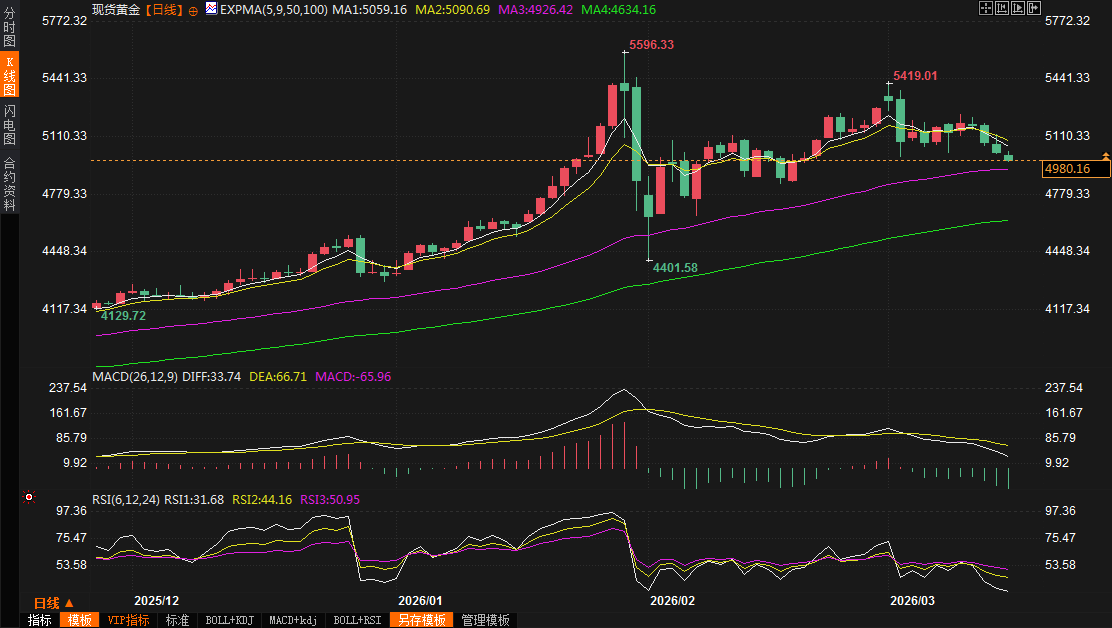
(Spot gold daily chart, source: FX678)
At 07:45 Beijing time, spot gold was trading at $4980.58 per ounce.
The US dollar index surged past 100, instantly turning gold into a "luxury item."
The surge in the US dollar is undoubtedly the most direct culprit behind this round of gold price declines. Last Friday, the US dollar index rose 0.75%, breaking through the 100 mark and closing near 100.54, a 10-month high. Its weekly gain was a staggering 1.67%, the largest weekly increase in nearly a year and a half. Gold, priced in US dollars, suddenly became more expensive for investors holding euros, yen, or other currencies, naturally leading to a significant decrease in their willingness to buy.
In its latest report, Commerzbank stated bluntly that market expectations of a tightening monetary policy are the core reason for the downward pressure on gold prices. After all, rising interest rates significantly increase the opportunity cost of holding physical gold—no interest and storage fees—and gold's safe-haven appeal quickly fades in a high-interest-rate environment.
Meanwhile, U.S. economic data further solidified this strength. Consumer spending rose 0.4% month-over-month in January, slightly exceeding expectations; the core PCE price index rose 0.4% month-over-month, with the year-over-year increase reaching its highest level since March 2024. These figures, coupled with tensions in the Middle East, have led economists to generally believe that the Federal Reserve will not resume interest rate cuts for a considerable period of time.
Barclays even postponed the timing of the Fed's first rate cut this year from June to September, and reduced the number of rate cuts for the whole year to just one 25 basis point cut.
Traders' expectations for interest rate cuts by the end of 2026 have plummeted from over 50 basis points before the outbreak of war to 22 basis points. This significant revision in expectations has directly removed the biggest support for gold as a "beneficiary asset of interest rate cuts."
The Iran war triggered an energy crisis, with inflation concerns overshadowing everything else.
The escalation of the conflict in the Middle East has put gold's traditional safe-haven status in a dilemma. After announcing a 30-day partial waiver for sanctioned Russian oil, President Trump immediately threatened a "very severe strike" against Iran "within the next week." This nearly three-week-long war between the US and Israel against Iran has resulted in over 2,000 deaths, and the Strait of Hormuz has been virtually brought to a standstill—blocking one-fifth of the world's oil shipping routes and causing the largest oil supply disruption in history. Brent crude futures have risen nearly 40% since the conflict began, and although they retreated slightly on Friday, they are still expected to close higher for the week.
The surge in oil prices has directly pushed up global inflation expectations. Wells Fargo macro strategists point out that short-term dollar interest rates are likely to continue fluctuating with energy prices in the short term, and if the conflict persists, market focus will shift from inflation to concerns about economic growth. Matt Bush, an economist at Guggenheim Investments, also cautions that while sustained and significant energy price increases over several months are needed to substantially impact core inflation, the already fragile labor market means that oil price shocks could simultaneously drag down economic growth. The Federal Reserve's dual mandate—controlling inflation and stabilizing employment—will face challenges, making policymakers more cautious.
Interestingly, while gold has traditionally been the preferred hedge against inflation and uncertainty, in the current environment, the fear of stagflation stemming from high oil prices has actually suppressed gold prices. This is because investors are more inclined to hold higher-yielding dollar assets rather than non-interest-bearing gold. Some analysts have even warned that if oil prices continue to reach new highs, gold prices could potentially retreat further to around $4,200.
Increased volatility in bond yields and clear hawkish signals from the Federal Reserve.
The performance of the US bond market also reflected the cautious sentiment. On Friday, US Treasury yields were mixed: the two-year yield fell 3 basis points to 3.732%, while the 10-year yield rose slightly to 4.283%, briefly hitting a one-and-a-half-month high. While the PCE data slightly eased some concerns, inflationary anxieties stemming from oil prices continued to dominate the market.
This week, traders will be closely watching Powell's speech following the Fed's meeting on Wednesday, as well as the latest interest rate forecasts. Wells Fargo believes that the threshold for the Fed to be more "hawkish" than the market expects is actually not high, which means the path of rate cuts has been further lengthened.
Meanwhile, the European Central Bank will also hold a meeting on Thursday. Soaring oil prices may prompt it to consider raising interest rates, but economists remain cautious about tightening policy in energy-import-dependent economies – after all, high energy costs have begun to drag down economic growth in the eurozone and Japan, and energy-sensitive currencies such as the euro and yen are already under significant pressure.
Divergent Expert Opinions and Market Sentiment: Short-Term Pressure, Long-Term Hope Remains
In this complex environment, market participants are clearly divided. Daniel Pavilonis, senior commodities broker at RJO Futures, believes that gold and silver will continue to follow stock market movements in the short term, while stock and government bond yields have an inverse relationship. As long as energy prices drive yields up, metal prices will be under pressure. He even stated bluntly that developments in the Middle East—whether there will be more naval escorts and whether Indian oil tankers can continue to pass through the Strait of Hormuz—will be a key turning point.
Kitco News' gold survey last week showed that among Wall Street analysts, 40% were bullish, 40% were bearish, and 20% were neutral; retail investors were relatively optimistic, with 63% expecting a rise this week. Independent trader Tai Wong also emphasized that although gold prices have continued to decline in the short term due to the influence of the US dollar and the war, the long-term asset allocation logic remains firmly bullish. The partial resumption of gold outflows from Dubai also suggests that physical demand has not completely dried up.
Uncertainty Amid Trump's Tough Stance: A Tug-of-War Between the Maritime Coalition and Ceasefire Negotiations
On the geopolitical front, Trump's statements have added further uncertainty. He not only threatened further strikes against Kharg Island, Iran's oil export hub, but also called on major Asian powers, France, Japan, South Korea, and the United Kingdom to form a "Hormuz Strait maritime escort coalition," and publicly declared on Truth Social that "the United States will provide substantial assistance."
Iran has vowed retaliation, announcing "precise and devastating" strikes against four US bases. Both sides have rejected ceasefire negotiations pushed by their Middle Eastern allies, and mediation efforts by Oman and Egypt have stalled. The war shows no signs of ending, and there are even reports that the US government is preparing to formally declare a maritime coalition, suggesting the energy crisis could be prolonged.
However, Trump's temporary waivers for Russian oil and Iran's decision to allow Indian oil tankers to pass through the Strait of Hormuz also suggest that both sides have a potential incentive to return to the negotiating table. Foreign exchange market strategist Karl Schamotta warned that the foreign exchange market faces two-way risks—risk assets could rebound quickly if a "decent agreement" is reached this weekend.
Gold Market Outlook: Short-term storms persist, but long-term safe-haven value remains strong.
In summary, the current gold price correction is a result of a confluence of factors: a strong US dollar, rising inflation expectations, and a delayed Fed rate cut path. In the short term, as long as oil prices remain high and yields continue to face upward pressure, gold will continue to face challenges and may even test lower support levels. However, from a medium- to long-term perspective, the persistent uncertainty of the Iranian conflict, the risk of global supply chain disruptions, and gold's traditional status as the ultimate safe-haven asset still provide a solid foundation for a rebound. If the Fed shows even the slightest sign of a policy shift, or if the situation in the Middle East shows substantial easing, gold is highly likely to experience a retaliatory surge.
(Spot gold daily chart, source: FX678)
At 07:45 Beijing time, spot gold was trading at $4980.58 per ounce.
- Risk Warning and Disclaimer
- The market involves risk, and trading may not be suitable for all investors. This article is for reference only and does not constitute personal investment advice, nor does it take into account certain users’ specific investment objectives, financial situation, or other needs. Any investment decisions made based on this information are at your own risk.