Gold prices pulled back to test the $5,000 mark, quietly building momentum for a longer-term outlook.
2026-03-16 13:54:08
The gold market has once again left investors feeling somewhat disheartened. Last week, precious metal prices remained defensive, currently caught in a familiar short-term tug-of-war after a strong previous rally, with prices repeatedly testing support around $5,000 per ounce. The market is struggling to digest the combined effects of slowing economic growth and persistently stubborn inflation, a combination that is increasingly confusing investors about the outlook.
The latest economic data has further complicated market expectations. US GDP growth slowed sharply to just 0.7% in the fourth quarter, while inflationary pressures remained stubborn. This coexistence of weak growth and rising prices has reignited concerns about stagflation, a situation in which policymakers have very limited tools at their disposal.
For gold, the story behind the current price movement is far more complex than it appears on the surface.
The Federal Reserve's policy stance remains a major headwind for gold. With inflation still high, central banks have little room to cut interest rates significantly, even if economic momentum weakens. This means interest rates are likely to remain high, supporting the dollar and bond yields—two factors that traditionally exert significant downward pressure on gold prices.
This development helps explain the recent consolidation in gold prices. Investors who had expected a shift in monetary policy to easing are now being forced to adjust their expectations.
The war between the US and Israel and Iran has exacerbated rising consumer prices, and the Federal Reserve is more inclined to maintain a cautious stance in the face of the risk of accelerating inflation. The prolonged period of high interest rates increases the opportunity cost of holding gold, a non-interest-bearing asset, in the short term, thus creating significant friction on its price.
However, the same forces that created short-term pressure are gradually providing stronger support for gold's long-term rise.
Maintaining a prudent or even tight monetary policy for an extended period could further exacerbate an already fragile economic environment. Global sovereign debt levels have climbed to historic highs, and rising borrowing costs are putting increasing pressure on government balance sheets. Meanwhile, geopolitical tensions, ranging from ongoing conflicts in the Middle East to strategic competition among major powers, continue to inject uncertainty into global markets.
Against this backdrop, large institutional investors continue to view gold from a long-term perspective. Several major asset management firms believe that gold offers rare diversification protection in an environment where both stocks and bonds face increasingly severe structural risks. In other words, gold's current weakness may be more a matter of timing than a deterioration in fundamentals.
In the short term, investor disappointment with gold prices may continue to dominate market headlines. However, beneath the surface volatility, the core forces supporting gold's long-term rise are steadily accumulating: sovereign debt crises, geopolitical uncertainties, trust pressures on the financial system, and limited policy space for central banks—these structural factors collectively form the solid foundation for gold as the ultimate safe-haven and store of value asset.
Although high interest rates and a strong dollar may continue to suppress prices in the short term, if the risk of stagflation becomes more apparent or geopolitical conflicts become protracted, gold, as the ultimate asset with "no counterparty risk," will have an even greater strategic value.
The current consolidation may be a build-up phase before a future breakout. While focusing on short-term fluctuations, investors should examine gold allocation opportunities from a long-term structural perspective.
In the coming months, if inflation remains sticky and the Fed's room for easing is limited, gold is expected to regain its strength and may even challenge higher prices.
Overall , gold's defensive stance last week reflected a short-term tug-of-war between stagflation concerns and the Federal Reserve's cautious policy. However, the fundamental logic has not reversed.
Continued buying by large institutions, persistently high levels of central bank gold purchases, and heightened global uncertainty are all supporting a long-term bull market for gold. Short-term setbacks may dominate current sentiment, but long-term upward momentum continues to steadily accumulate.
Investors need to patiently wait for catalysts to emerge. Whether it's escalating geopolitical risks or continued stronger-than-expected inflation data, these could be turning points for gold to regain its strength.
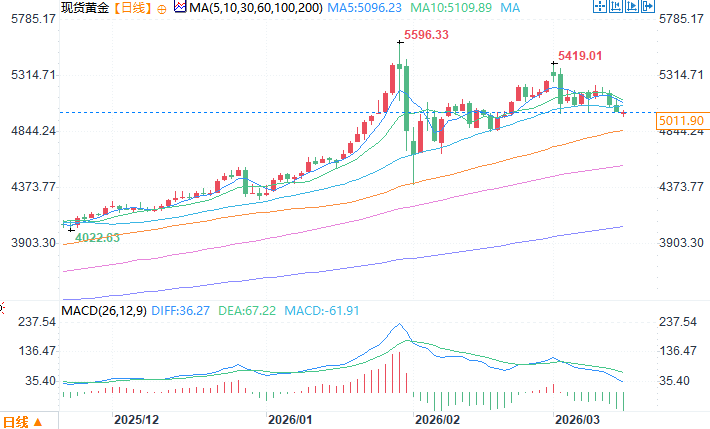
Spot gold daily chart source: EasyForex
At 13:53 Beijing time on March 16, spot gold was trading at $5018.90 per ounce.
The latest economic data has further complicated market expectations. US GDP growth slowed sharply to just 0.7% in the fourth quarter, while inflationary pressures remained stubborn. This coexistence of weak growth and rising prices has reignited concerns about stagflation, a situation in which policymakers have very limited tools at their disposal.
For gold, the story behind the current price movement is far more complex than it appears on the surface.
In the short term, Federal Reserve policy remains the biggest obstacle.
The Federal Reserve's policy stance remains a major headwind for gold. With inflation still high, central banks have little room to cut interest rates significantly, even if economic momentum weakens. This means interest rates are likely to remain high, supporting the dollar and bond yields—two factors that traditionally exert significant downward pressure on gold prices.
This development helps explain the recent consolidation in gold prices. Investors who had expected a shift in monetary policy to easing are now being forced to adjust their expectations.
The war between the US and Israel and Iran has exacerbated rising consumer prices, and the Federal Reserve is more inclined to maintain a cautious stance in the face of the risk of accelerating inflation. The prolonged period of high interest rates increases the opportunity cost of holding gold, a non-interest-bearing asset, in the short term, thus creating significant friction on its price.
The long-term logic is quietly being reinforced.
However, the same forces that created short-term pressure are gradually providing stronger support for gold's long-term rise.
Maintaining a prudent or even tight monetary policy for an extended period could further exacerbate an already fragile economic environment. Global sovereign debt levels have climbed to historic highs, and rising borrowing costs are putting increasing pressure on government balance sheets. Meanwhile, geopolitical tensions, ranging from ongoing conflicts in the Middle East to strategic competition among major powers, continue to inject uncertainty into global markets.
Against this backdrop, large institutional investors continue to view gold from a long-term perspective. Several major asset management firms believe that gold offers rare diversification protection in an environment where both stocks and bonds face increasingly severe structural risks. In other words, gold's current weakness may be more a matter of timing than a deterioration in fundamentals.
Short-term setbacks dominate headlines, but long-term upward momentum continues to build.
In the short term, investor disappointment with gold prices may continue to dominate market headlines. However, beneath the surface volatility, the core forces supporting gold's long-term rise are steadily accumulating: sovereign debt crises, geopolitical uncertainties, trust pressures on the financial system, and limited policy space for central banks—these structural factors collectively form the solid foundation for gold as the ultimate safe-haven and store of value asset.
Although high interest rates and a strong dollar may continue to suppress prices in the short term, if the risk of stagflation becomes more apparent or geopolitical conflicts become protracted, gold, as the ultimate asset with "no counterparty risk," will have an even greater strategic value.
The current consolidation may be a build-up phase before a future breakout. While focusing on short-term fluctuations, investors should examine gold allocation opportunities from a long-term structural perspective.
In the coming months, if inflation remains sticky and the Fed's room for easing is limited, gold is expected to regain its strength and may even challenge higher prices.
Overall , gold's defensive stance last week reflected a short-term tug-of-war between stagflation concerns and the Federal Reserve's cautious policy. However, the fundamental logic has not reversed.
Continued buying by large institutions, persistently high levels of central bank gold purchases, and heightened global uncertainty are all supporting a long-term bull market for gold. Short-term setbacks may dominate current sentiment, but long-term upward momentum continues to steadily accumulate.
Investors need to patiently wait for catalysts to emerge. Whether it's escalating geopolitical risks or continued stronger-than-expected inflation data, these could be turning points for gold to regain its strength.
Spot gold daily chart source: EasyForex
At 13:53 Beijing time on March 16, spot gold was trading at $5018.90 per ounce.
- Risk Warning and Disclaimer
- The market involves risk, and trading may not be suitable for all investors. This article is for reference only and does not constitute personal investment advice, nor does it take into account certain users’ specific investment objectives, financial situation, or other needs. Any investment decisions made based on this information are at your own risk.