A prediction of the Iran war: 60% chance of it ending within two weeks? How should one position themselves in the oil market?
2026-03-17 10:08:49
Marco Papich, chief geopolitical and macro strategist at BCA Research, proposed a "formula" for calculating the duration of a war with Iran: Duration of war = Iran's pain threshold (scale and intensity of US punitive bombing + joint response from the rest of the world).
He believes Iran's pain threshold is far lower than the market and conflict participants imagine, predicting a 60% probability that the conflict will end in about two weeks. He also suggests investors focus on assets that benefit from the ongoing conflict, such as Brent crude futures and oil equipment ETFs. On Tuesday (March 17) during Asian trading hours, US crude oil prices fluctuated upwards, currently trading around $96.15 per barrel, a daily increase of approximately 2.78%.
Papich emphasized that the United States is unleashing punitive firepower in a manner of "death, war, and anger," which will ultimately force Tehran to sue for peace.
Papich points out that Iran's threshold for suffering has been severely underestimated; the scale and intensity of the US punitive bombing exceeded expectations; and a coordinated response from the rest of the world is taking shape.
Taking all three factors into account, the formula suggests a 60% probability of the conflict ending in the short term. He believes Iran cannot withstand sustained high-intensity attacks in the long term, and the pressure on the regime's survival will force it to compromise at some point.
Papich emphasized that people underestimate the destructive power of the US B-52 bomber (the effect of large-scale conventional bombing on infrastructure and military targets); Iran's ability to retaliate with drones is limited (the number, accuracy, and sustainability are insufficient to change the course of the war).
The U.S. air superiority and precision strike capabilities far exceed Iran's expectations, and continued bombing will rapidly deplete Iran's military and economic resilience.
Papich believes the Strait of Hormuz could be forcibly opened, not only by the US "blitzkrieg," but also by the coordinated response from other parts of the world: India has ensured that its two oil tankers can pass through the strait without interference; France, Italy, and Pakistan are negotiating with Tehran or planning escort missions; and during the Iran-Iraq War in the 1980s, a multinational naval force worked together to open the strait through minesweeping operations.
Many countries are unwilling to tolerate the long-term restriction of one-fifth of the world's oil supply, and the possibility of joint escort and mine-clearing operations is increasing.
Papich analyzes Iran's trade-off logic: blocking the Straits can establish deterrence, but the longer it lasts, the less the rest of the world will tolerate it; restricting one-fifth of the world's oil supply will trigger a multi-country alliance to increase the punishment of Iran; Iran will ultimately have to choose between the "benefits of deterrence" and the "costs of isolation".
He believes that Iran has a low threshold for rationality, and once a coordinated multinational response is formed, Tehran will find it difficult to bear the cost of a continued blockade.
Papich recommends trades that benefit from ongoing conflict: Brent crude oil futures: high oil prices are likely to persist; US oil equipment ETFs: high oil prices stimulate demand for US shale oil production and equipment; tanker shipping: escort demand and freight premiums are rising.
He believes that even if there is a 60% probability of the end in the short term, medium-term uncertainty will still support the performance of energy-related assets.
Despite Papich's optimism about a coordinated response from multiple countries, public comments by German, Italian, and British officials on Monday indicated a lukewarm reception to Trump's call for military support.
European countries are highly dependent on energy, but have limited willingness to directly intervene militarily. They prefer diplomatic pressure and limited logistical support to avoid full involvement in the Middle East conflict.
BCA's chief geostrategist, Papech, proposed a "war formula": Iran's pain threshold (intensity of US punitive bombing + global coordinated response) = duration of conflict. He predicts a 60% probability of ending the conflict within two weeks, believing that Iran's pain threshold is underestimated, the destructive power of the US B-52 is underestimated, and Iran's drone retaliation is limited. The Strait of Hormuz is expected to be forcibly breached, and a multinational coordinated response has been initiated (Indian oil tankers are allowed passage, and France, Italy, and Pakistan are negotiating and providing escort).
Iran needs to weigh the costs of the blockade; the world cannot tolerate a fifth of its supply being permanently restricted. However, Europe's lukewarm response to Trump's calls for military support has led to high-level volatility in oil prices. The contradiction between short-term optimistic signals and battlefield realities means investors should be wary of a potential price reversal triggered by extreme Iranian retaliation, and should pay close attention to the progress of multinational escort efforts and Iran's response.
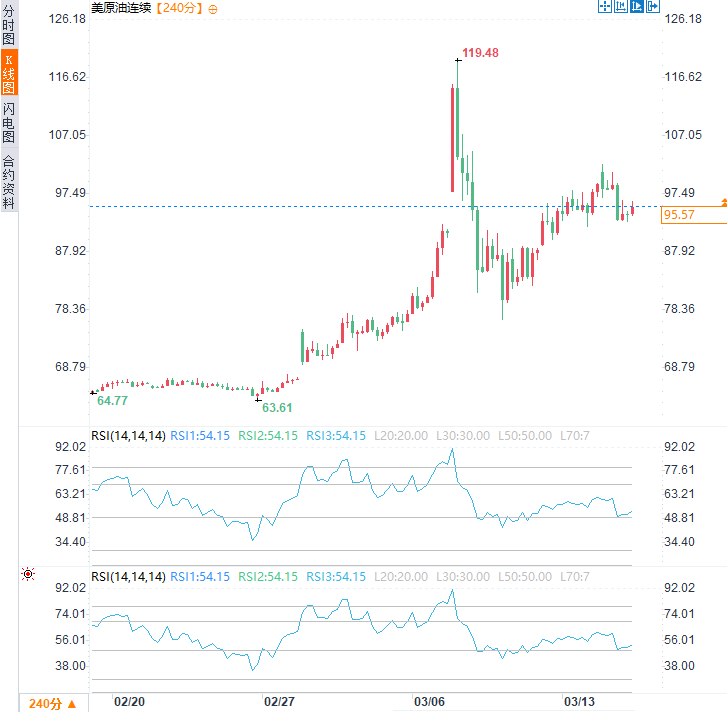
(US crude oil 4-hour chart, source: FX678)
At 10:08 Beijing time, US crude oil futures were trading at $96.15 per barrel.
He believes Iran's pain threshold is far lower than the market and conflict participants imagine, predicting a 60% probability that the conflict will end in about two weeks. He also suggests investors focus on assets that benefit from the ongoing conflict, such as Brent crude futures and oil equipment ETFs. On Tuesday (March 17) during Asian trading hours, US crude oil prices fluctuated upwards, currently trading around $96.15 per barrel, a daily increase of approximately 2.78%.
Papich emphasized that the United States is unleashing punitive firepower in a manner of "death, war, and anger," which will ultimately force Tehran to sue for peace.
Low pain threshold + intense US punitive bombing: 60% chance of ending in two weeks.
Papich points out that Iran's threshold for suffering has been severely underestimated; the scale and intensity of the US punitive bombing exceeded expectations; and a coordinated response from the rest of the world is taking shape.
Taking all three factors into account, the formula suggests a 60% probability of the conflict ending in the short term. He believes Iran cannot withstand sustained high-intensity attacks in the long term, and the pressure on the regime's survival will force it to compromise at some point.
The destructive power of the B-52 bomber has been underestimated; Iranian drone retaliation has been limited.
Papich emphasized that people underestimate the destructive power of the US B-52 bomber (the effect of large-scale conventional bombing on infrastructure and military targets); Iran's ability to retaliate with drones is limited (the number, accuracy, and sustainability are insufficient to change the course of the war).
The U.S. air superiority and precision strike capabilities far exceed Iran's expectations, and continued bombing will rapidly deplete Iran's military and economic resilience.
The Strait of Hormuz is expected to be forcibly opened, and a coordinated response from multiple countries has been initiated.
Papich believes the Strait of Hormuz could be forcibly opened, not only by the US "blitzkrieg," but also by the coordinated response from other parts of the world: India has ensured that its two oil tankers can pass through the strait without interference; France, Italy, and Pakistan are negotiating with Tehran or planning escort missions; and during the Iran-Iraq War in the 1980s, a multinational naval force worked together to open the strait through minesweeping operations.
Many countries are unwilling to tolerate the long-term restriction of one-fifth of the world's oil supply, and the possibility of joint escort and mine-clearing operations is increasing.
Iran needs to weigh the costs of the blockade; the world will not tolerate one-fifth of its supplies being restricted.
Papich analyzes Iran's trade-off logic: blocking the Straits can establish deterrence, but the longer it lasts, the less the rest of the world will tolerate it; restricting one-fifth of the world's oil supply will trigger a multi-country alliance to increase the punishment of Iran; Iran will ultimately have to choose between the "benefits of deterrence" and the "costs of isolation".
He believes that Iran has a low threshold for rationality, and once a coordinated multinational response is formed, Tehran will find it difficult to bear the cost of a continued blockade.
Recommended trades that benefit from ongoing conflict: Brent futures, oil equipment ETFs, and tanker shipping.
Papich recommends trades that benefit from ongoing conflict: Brent crude oil futures: high oil prices are likely to persist; US oil equipment ETFs: high oil prices stimulate demand for US shale oil production and equipment; tanker shipping: escort demand and freight premiums are rising.
He believes that even if there is a 60% probability of the end in the short term, medium-term uncertainty will still support the performance of energy-related assets.
Germany, Italy, and the UK reacted coldly to Trump's call for military support.
Despite Papich's optimism about a coordinated response from multiple countries, public comments by German, Italian, and British officials on Monday indicated a lukewarm reception to Trump's call for military support.
European countries are highly dependent on energy, but have limited willingness to directly intervene militarily. They prefer diplomatic pressure and limited logistical support to avoid full involvement in the Middle East conflict.
Editor's Summary
BCA's chief geostrategist, Papech, proposed a "war formula": Iran's pain threshold (intensity of US punitive bombing + global coordinated response) = duration of conflict. He predicts a 60% probability of ending the conflict within two weeks, believing that Iran's pain threshold is underestimated, the destructive power of the US B-52 is underestimated, and Iran's drone retaliation is limited. The Strait of Hormuz is expected to be forcibly breached, and a multinational coordinated response has been initiated (Indian oil tankers are allowed passage, and France, Italy, and Pakistan are negotiating and providing escort).
Iran needs to weigh the costs of the blockade; the world cannot tolerate a fifth of its supply being permanently restricted. However, Europe's lukewarm response to Trump's calls for military support has led to high-level volatility in oil prices. The contradiction between short-term optimistic signals and battlefield realities means investors should be wary of a potential price reversal triggered by extreme Iranian retaliation, and should pay close attention to the progress of multinational escort efforts and Iran's response.
(US crude oil 4-hour chart, source: FX678)
At 10:08 Beijing time, US crude oil futures were trading at $96.15 per barrel.
- Risk Warning and Disclaimer
- The market involves risk, and trading may not be suitable for all investors. This article is for reference only and does not constitute personal investment advice, nor does it take into account certain users’ specific investment objectives, financial situation, or other needs. Any investment decisions made based on this information are at your own risk.