Supply cutoff and nuclear explosion! Middle Eastern oil exports plummet by 61%, is the Hormuz "strangled"?
2026-03-18 14:15:49
According to the latest data from global commodities monitoring company Kpler, the average daily oil exports from the Middle East fell sharply by about 61% in the week ending March 15, due to shipping disruptions and supply disruptions caused by the US-Israel military conflict with Iran.
This drop far exceeded previous market expectations, highlighting the severe impact of the Strait of Hormuz blockade and surrounding threats on global energy supplies. Oil prices remained above pre-conflict levels, but on Wednesday (March 18) during Asian trading hours, US crude oil prices fluctuated and fell, currently trading around $92.05 per barrel, a daily decline of approximately 3.6%.
Kpler's calculations show that the average exports of eight countries—Saudi Arabia, Kuwait, Iran, Iraq, Oman, Qatar, Bahrain, and the UAE—this week totaled 9.71 million barrels per day (including crude oil, condensate, and refined fuels); the average exports in February were 25.13 million barrels per day; representing a week-on-week decrease of 61%.
Before the conflict broke out, these eight countries accounted for 36% of global seaborne oil exports (70.43 million barrels per day), and now the sharp contraction in supply has directly amplified the global gap.
Before the conflict, the G8 countries were the core pillars of global seaborne oil supply, contributing a combined 36%. The near-total standstill of shipping in the Hormuz, frequent attacks on agents, and soaring insurance premiums leading to shipowners collectively avoiding the region have nearly severed this crucial source of supply.
With Gulf oil-producing countries facing saturated storage facilities and forced to cut production, the increase in floating storage has further reduced the amount of oil actually reaching the market, leading to a sharp rise in procurement pressure on global refineries.
Kpler specifically pointed out that although current data shows a sharp 61% drop in exports, the actual supply reaching the international market may be even lower. Large quantities of crude oil are stored in floating storage facilities (VLCCs and other very large crude carriers used as temporary warehouses) and have not actually left the Gulf region.
This means that nominal export data already includes "false supply," and the actual supply available in the market has further shrunk. Increased floating reserves are a typical characteristic of the current crisis and are unlikely to be released quickly in the short term.
A 61% plunge in supply from the eight Gulf states has directly amplified the global supply gap, with Asian importers facing the biggest impact. Refinery procurement costs have surged, inventories are tight, and the risk of supply chain disruptions has increased. While the IEA's release of 400 million barrels from reserves is unprecedented, logistical delays have limited effect compared to the actual supply gap.
Oil prices continue to fluctuate at high levels, while inflationary pressures and economic slowdown are intensifying. Market concerns about prolonged disruptions are rising again.
In the short term, key attention should be paid to changes in floating oil storage, signals of the resumption of navigation in the Taiwan Strait, and Iran's response. If floating storage continues to increase, actual supply will shrink further; if Iranian retaliation escalates or proxies expand attacks, the gap could widen to several million barrels per day or more.
Investors should be wary of unforeseen events triggering a reversal in oil prices, and pay attention to expectations of additional IEA reserve releases and the progress of the multinational coalition supporting oil prices. The energy market faces extremely high uncertainty, and volatility is expected to remain high.
According to Kpler's latest calculations, the average daily oil exports of eight Middle Eastern countries (Saudi Arabia, Kuwait, Iran, Iraq, Oman, Qatar, Bahrain, and the UAE) plummeted by 61% in the week ending March 15, from 25.13 million barrels per day in February to 9.71 million barrels per day. These countries accounted for 36% of global seaborne oil exports before the conflict, and the sharp contraction in supply has directly amplified the gap.
Kpler specifically pointed out that the actual supply reaching the international market may be even lower, with a large amount of crude oil stored in floating storage facilities and not actually leaving the Gulf. The ongoing disruption to shipping through the Hormuz region has blocked one-fifth of global oil transport, exacerbating production cuts by Gulf oil-producing countries.
Oil prices remain volatile at high levels, and the pressure from inflationary transmission and economic slowdown is intensifying. Investors need to closely monitor changes in floating storage, the resumption of navigation in the Taiwan Strait, and Iran's response; the energy market is highly uncertain.
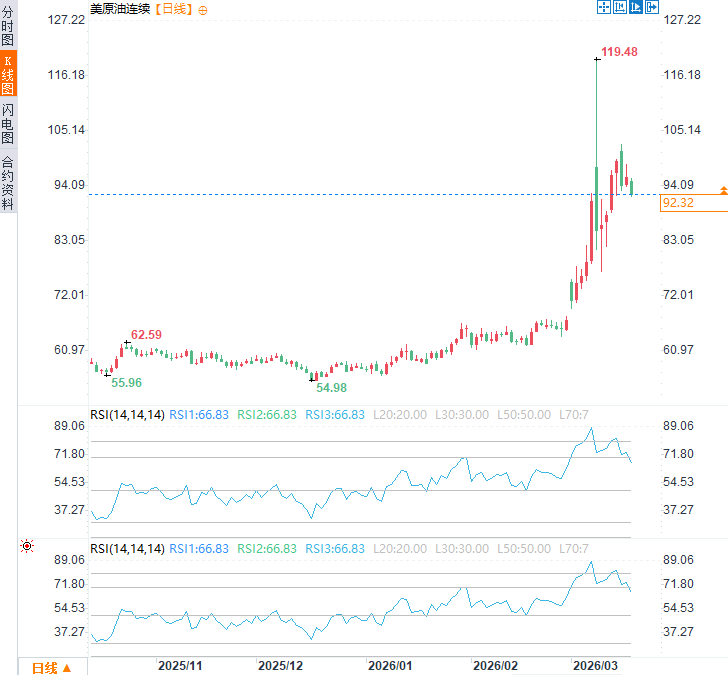
(US crude oil daily chart, source: FX678)
At 14:15 Beijing time, US crude oil futures were trading at $92.05 per barrel.
This drop far exceeded previous market expectations, highlighting the severe impact of the Strait of Hormuz blockade and surrounding threats on global energy supplies. Oil prices remained above pre-conflict levels, but on Wednesday (March 18) during Asian trading hours, US crude oil prices fluctuated and fell, currently trading around $92.05 per barrel, a daily decline of approximately 3.6%.
Kpler's calculations show that the average exports of eight countries—Saudi Arabia, Kuwait, Iran, Iraq, Oman, Qatar, Bahrain, and the UAE—this week totaled 9.71 million barrels per day (including crude oil, condensate, and refined fuels); the average exports in February were 25.13 million barrels per day; representing a week-on-week decrease of 61%.
Before the conflict broke out, these eight countries accounted for 36% of global seaborne oil exports (70.43 million barrels per day), and now the sharp contraction in supply has directly amplified the global gap.
Before the conflict, it accounted for 36% of global seaborne exports; now its supply has shrunk dramatically.
Before the conflict, the G8 countries were the core pillars of global seaborne oil supply, contributing a combined 36%. The near-total standstill of shipping in the Hormuz, frequent attacks on agents, and soaring insurance premiums leading to shipowners collectively avoiding the region have nearly severed this crucial source of supply.
With Gulf oil-producing countries facing saturated storage facilities and forced to cut production, the increase in floating storage has further reduced the amount of oil actually reaching the market, leading to a sharp rise in procurement pressure on global refineries.
With the increase in floating oil storage, the actual amount reaching the market may be lower.
Kpler specifically pointed out that although current data shows a sharp 61% drop in exports, the actual supply reaching the international market may be even lower. Large quantities of crude oil are stored in floating storage facilities (VLCCs and other very large crude carriers used as temporary warehouses) and have not actually left the Gulf region.
This means that nominal export data already includes "false supply," and the actual supply available in the market has further shrunk. Increased floating reserves are a typical characteristic of the current crisis and are unlikely to be released quickly in the short term.
Supply disruptions in the Gulf are worsening, and the risk of oil prices fluctuating at high levels persists.
A 61% plunge in supply from the eight Gulf states has directly amplified the global supply gap, with Asian importers facing the biggest impact. Refinery procurement costs have surged, inventories are tight, and the risk of supply chain disruptions has increased. While the IEA's release of 400 million barrels from reserves is unprecedented, logistical delays have limited effect compared to the actual supply gap.
Oil prices continue to fluctuate at high levels, while inflationary pressures and economic slowdown are intensifying. Market concerns about prolonged disruptions are rising again.
Pay attention to changes in floating storage and the resumption of navigation in the strait; the gap may widen further.
In the short term, key attention should be paid to changes in floating oil storage, signals of the resumption of navigation in the Taiwan Strait, and Iran's response. If floating storage continues to increase, actual supply will shrink further; if Iranian retaliation escalates or proxies expand attacks, the gap could widen to several million barrels per day or more.
Investors should be wary of unforeseen events triggering a reversal in oil prices, and pay attention to expectations of additional IEA reserve releases and the progress of the multinational coalition supporting oil prices. The energy market faces extremely high uncertainty, and volatility is expected to remain high.
Editor's Summary
According to Kpler's latest calculations, the average daily oil exports of eight Middle Eastern countries (Saudi Arabia, Kuwait, Iran, Iraq, Oman, Qatar, Bahrain, and the UAE) plummeted by 61% in the week ending March 15, from 25.13 million barrels per day in February to 9.71 million barrels per day. These countries accounted for 36% of global seaborne oil exports before the conflict, and the sharp contraction in supply has directly amplified the gap.
Kpler specifically pointed out that the actual supply reaching the international market may be even lower, with a large amount of crude oil stored in floating storage facilities and not actually leaving the Gulf. The ongoing disruption to shipping through the Hormuz region has blocked one-fifth of global oil transport, exacerbating production cuts by Gulf oil-producing countries.
Oil prices remain volatile at high levels, and the pressure from inflationary transmission and economic slowdown is intensifying. Investors need to closely monitor changes in floating storage, the resumption of navigation in the Taiwan Strait, and Iran's response; the energy market is highly uncertain.
(US crude oil daily chart, source: FX678)
At 14:15 Beijing time, US crude oil futures were trading at $92.05 per barrel.
- Risk Warning and Disclaimer
- The market involves risk, and trading may not be suitable for all investors. This article is for reference only and does not constitute personal investment advice, nor does it take into account certain users’ specific investment objectives, financial situation, or other needs. Any investment decisions made based on this information are at your own risk.