The 3 PM peace plan triggered a rebound in risk assets, while the dollar fluctuated.
2026-03-25 20:00:07
On Wednesday (March 25), during the European session, the US dollar index remained flat, trading around 99.25, up 0.03%, with a daily range of 99.07-99.43. The dollar had recently rebounded and tested above the 100 level multiple times, driven by tensions in the Middle East. Today's trading was range-bound, without a sustained downward trend. Overall, the dollar remains near the upper end of its nine-month range, maintaining its strong safe-haven appeal.
The reason for this situation with the US dollar is that the market reacted initially to reports that the US had submitted a 15-point peace plan to Iran, risk assets rebounded, oil prices fell, and some profit-taking occurred; however, the core contradictions of the geopolitical conflict (the closure of the Strait of Hormuz and energy leverage) have not been truly resolved, safe-haven support remains, and the downside potential of the US dollar is clearly limited.
Fundamental analysis
Reports indicate that the United States, through Pakistan, has submitted a 15-point peace plan to Iran, potentially including core terms such as a one-month ceasefire, dismantling of some nuclear facilities, restrictions on ballistic missile programs, and full opening of the Strait of Hormuz. In exchange, the US may lift some sanctions and assist Iran's civilian nuclear program. Negotiations are expected to begin on Thursday in Islamabad. While risk assets rebounded in European trading and oil prices fell, Iran has not yet explicitly accepted the plan, the Strait of Hormuz remains effectively closed, and some countries have implemented fuel rationing.
Mainstream institutions believe that Iran holds significant leverage in negotiations due to high energy prices, while the US and Israel hold military leverage, making a sharp drop in energy prices or a significant weakening of the US dollar unlikely in the short term.
Federal Reserve Policy and Money Market Pricing: The US money market curve has completely ruled out any Fed rate cuts in 2026. Recent inflation is unlikely to fall back to the 2% target quickly due to the energy shock, temporarily halting the easing cycle. As long as the US job market does not deteriorate significantly, the market may begin pricing in a Fed rate hike. This provides solid policy support for the US dollar; even if short-term geopolitical news causes a pullback, the long-term logic remains bullish.
US Economic Data Forecast: Today's focus is on US February durable goods orders and core durable goods orders (high impact). Stronger-than-expected data could further strengthen the dollar's resilience, but the market is currently in a cautious wait-and-see mode, with no major PCE or central bank statements expected. Recently, US manufacturing orders have shown an irregular upward trend, indicating that the economy still possesses a certain degree of resilience.
Global Energy and Cross-Currency Impacts: The UK's February CPI annual rate was released at 3%, fully in line with expectations, and had a neutral impact on the pound; high energy prices continued to provide indirect support for the US dollar, while limiting the upside potential for risk assets.
Technical Analysis
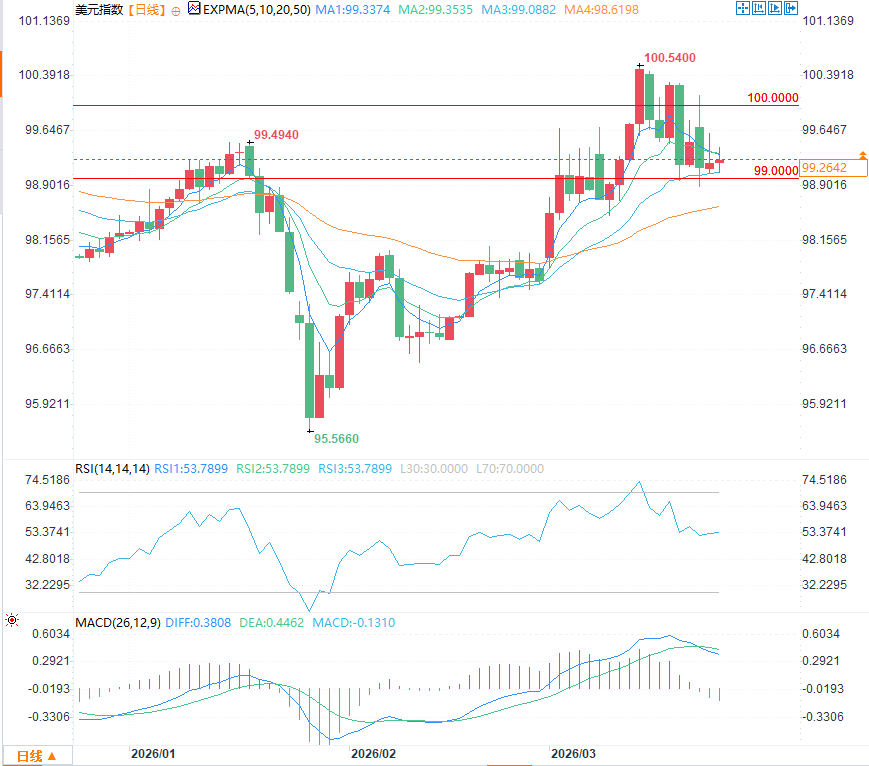
(US Dollar Index Daily Chart Source: FX678)
Range-bound trading pattern: The US dollar index found strong support in the 99.00-100.00 range. Short-term moving average indicators show neutral to slight selling pressure, but sustained selling is unlikely to form before there is a decisive development in the geopolitical conflict.
Key price levels for support and resistance: Strong support is located around 99.00, while resistance is at 100.00. If the 99 level is held, a rebound can be expected, and a break above the 100 level could open up further upside potential.
Financial Calendar (Major Events and Reminders for Today)
UK February CPI year-on-year rate (released at 3%, fully in line with market expectations, with a neutral impact on pound cross rates)
US February durable goods orders month-on-month rate and core durable goods orders (high impact, pay attention to the potential impact on the Fed's policy path)
US Treasury auction: 17-week notes, 2-year FRNs, 5-year notes
Reminder: Pay close attention to the difference between the actual and expected value of US durable goods orders. A significant difference exceeding expectations could boost the US dollar. Also, closely monitor the latest developments in the 15-point peace plan for the Middle East. Any breakthrough in negotiations could drive sharp market fluctuations. Be aware of slippage risk during periods of low liquidity and consider setting reasonable stop-loss orders.
Frequently Asked Questions
The reason for this situation with the US dollar is that the market reacted initially to reports that the US had submitted a 15-point peace plan to Iran, risk assets rebounded, oil prices fell, and some profit-taking occurred; however, the core contradictions of the geopolitical conflict (the closure of the Strait of Hormuz and energy leverage) have not been truly resolved, safe-haven support remains, and the downside potential of the US dollar is clearly limited.
Fundamental analysis
Reports indicate that the United States, through Pakistan, has submitted a 15-point peace plan to Iran, potentially including core terms such as a one-month ceasefire, dismantling of some nuclear facilities, restrictions on ballistic missile programs, and full opening of the Strait of Hormuz. In exchange, the US may lift some sanctions and assist Iran's civilian nuclear program. Negotiations are expected to begin on Thursday in Islamabad. While risk assets rebounded in European trading and oil prices fell, Iran has not yet explicitly accepted the plan, the Strait of Hormuz remains effectively closed, and some countries have implemented fuel rationing.
Mainstream institutions believe that Iran holds significant leverage in negotiations due to high energy prices, while the US and Israel hold military leverage, making a sharp drop in energy prices or a significant weakening of the US dollar unlikely in the short term.
Federal Reserve Policy and Money Market Pricing: The US money market curve has completely ruled out any Fed rate cuts in 2026. Recent inflation is unlikely to fall back to the 2% target quickly due to the energy shock, temporarily halting the easing cycle. As long as the US job market does not deteriorate significantly, the market may begin pricing in a Fed rate hike. This provides solid policy support for the US dollar; even if short-term geopolitical news causes a pullback, the long-term logic remains bullish.
US Economic Data Forecast: Today's focus is on US February durable goods orders and core durable goods orders (high impact). Stronger-than-expected data could further strengthen the dollar's resilience, but the market is currently in a cautious wait-and-see mode, with no major PCE or central bank statements expected. Recently, US manufacturing orders have shown an irregular upward trend, indicating that the economy still possesses a certain degree of resilience.
Global Energy and Cross-Currency Impacts: The UK's February CPI annual rate was released at 3%, fully in line with expectations, and had a neutral impact on the pound; high energy prices continued to provide indirect support for the US dollar, while limiting the upside potential for risk assets.
Technical Analysis
(US Dollar Index Daily Chart Source: FX678)
Range-bound trading pattern: The US dollar index found strong support in the 99.00-100.00 range. Short-term moving average indicators show neutral to slight selling pressure, but sustained selling is unlikely to form before there is a decisive development in the geopolitical conflict.
Key price levels for support and resistance: Strong support is located around 99.00, while resistance is at 100.00. If the 99 level is held, a rebound can be expected, and a break above the 100 level could open up further upside potential.
Financial Calendar (Major Events and Reminders for Today)
UK February CPI year-on-year rate (released at 3%, fully in line with market expectations, with a neutral impact on pound cross rates)
US February durable goods orders month-on-month rate and core durable goods orders (high impact, pay attention to the potential impact on the Fed's policy path)
US Treasury auction: 17-week notes, 2-year FRNs, 5-year notes
Reminder: Pay close attention to the difference between the actual and expected value of US durable goods orders. A significant difference exceeding expectations could boost the US dollar. Also, closely monitor the latest developments in the 15-point peace plan for the Middle East. Any breakthrough in negotiations could drive sharp market fluctuations. Be aware of slippage risk during periods of low liquidity and consider setting reasonable stop-loss orders.
Frequently Asked Questions
Q1: Why did the US dollar decline slightly today instead of continuing to rise due to safe-haven demand?
A1: The market initially reacted to reports of the US submitting a 15-point peace plan, with risk assets rebounding and oil prices falling, triggering some profit-taking. However, institutions such as ING and FXStreet have clearly pointed out that this is only a short-term adjustment, because the core contradictions of the conflict—the closure of the Strait of Hormuz and Iran's energy price leverage—have not been truly resolved, and the safe-haven support for the US dollar remains solid, not a signal of a trend reversal.
Q2: What are the specific contents of the US 15-point peace plan? What are its short-term and medium-term impacts on the US dollar?
A2: The plan reportedly involves a one-month ceasefire, Iran dismantling some of its nuclear facilities, limiting its ballistic missile program, reducing support for regional allies, and fully opening the Strait of Hormuz. In exchange, the US may lift some sanctions and assist Iran's civilian nuclear program. This would be beneficial for risk assets in the short term, but suppress oil prices and the US dollar. However, Iran has not yet accepted this and emphasizes its own energy leverage. The prevailing view is that "expecting continued dollar selling too early" is premature, and the dollar index is likely to continue fluctuating between 99 and 100 until a decisive next chapter in the conflict occurs.
Q3: Is the Federal Reserve really not going to cut interest rates this year? How is the money market pricing?
A3: The money market curve has fully priced in any easing in 2026, and Fed officials have repeatedly emphasized "patience." Recent inflation is unlikely to fall back to the 2% target quickly due to the energy shock, pausing the easing cycle. As long as the job market does not deteriorate significantly, it may even begin pricing in rate hikes. This provides long-term policy support for the dollar, and even if short-term geopolitical news causes a pullback, the dollar remains resilient.
Q4: What is the real impact of the closure of the Strait of Hormuz on the global economy and the US dollar?
A4: The closure of the Strait of Hormuz has led to fuel rationing in some countries, posing a significant energy shock to the global economy. High oil prices, on the one hand, push up inflation and support the US dollar as a safe-haven asset, and on the other hand, limit the rise of risk assets. As long as the Strait of Hormuz remains unreopened and Iran's economic leverage is significant, the US dollar is unlikely to weaken substantially, and the conflict premium will continue to provide support for the dollar.
Q5: What is the current overall macroeconomic position of the US dollar? How should we assess its trend this week and in the short term?
A5: The US dollar index is near the upper limit of its nine-month range. Geopolitical conflicts are providing significant conflict premium support, and investors remain over-allocated to stocks and betting on a quick resolution. The prevailing view is that the dollar will fluctuate between 99.00 and 100.00 this week until there is clear progress in the Middle East situation. Today's slight pullback is a normal profit-taking move and not a signal of long-term weakness. Investors are advised to continue monitoring the progress of negotiations and US data.
- Risk Warning and Disclaimer
- The market involves risk, and trading may not be suitable for all investors. This article is for reference only and does not constitute personal investment advice, nor does it take into account certain users’ specific investment objectives, financial situation, or other needs. Any investment decisions made based on this information are at your own risk.