Former Goldman Sachs CEO warns the damage from the war with Iran "will last a long time," the scars of the Strait of Hormuz will be difficult to heal.
2026-03-26 09:25:33
Goldman Sachs senior chairman and former CEO Lloyd Blankfein warned on Wednesday (March 25) that the damage from a war with Iran "will last a long time" and that even if an agreement is reached "on Thursday," the impact will be difficult to quickly eliminate. He urged investors to prioritize contingency planning amid the current turmoil.
Blankfein points out that market reactions to the conflict can be either overly optimistic or overly pessimistic, and traders should not operate based on extreme assumptions such as "everything will be resolved" or "it will never be resolved." The war has entered its fourth week, shipping in the Strait of Hormuz is severely disrupted, and the energy market is experiencing significant volatility.
During Thursday's Asian trading session, US crude oil prices fluctuated upwards and are currently trading around $91.50 per barrel, with a daily increase of about 1.4%.

Blankfein said on Wednesday, "People know that even if the conflict stops tomorrow, the infrastructure has been severely damaged, and the pressure will continue for much longer. Even if an agreement is reached on Thursday, there is no reason to believe that there will be an agreement tomorrow." He emphasized that Iran's attacks on neighboring countries' energy infrastructure and the blockade of the Straits have caused lasting damage.
As a veteran who led Goldman Sachs through the 2008 global financial crisis, Blankfein believes that the pre-war investment environment had "more tailwinds than headwinds"—robust economic growth and a downward interest rate path—but these factors have now taken a backseat, with war and energy prices becoming the dominant variables.
Since the US and Israel launched their strikes against Iran on February 28, the conflict has rapidly escalated into a regional war. Iran's retaliation against neighboring countries' energy facilities and its de facto blockade of the Strait of Hormuz have caused a major shock to global oil supplies and led to sharp fluctuations in oil prices.
Blankfein points out that the sharp fluctuations in the energy market reflect investors pricing in the long-term impact of supply disruptions. Even if a ceasefire agreement is reached, infrastructure repairs and supply chain restoration will take months or even longer, which will continue to push up energy costs and affect global inflation expectations.
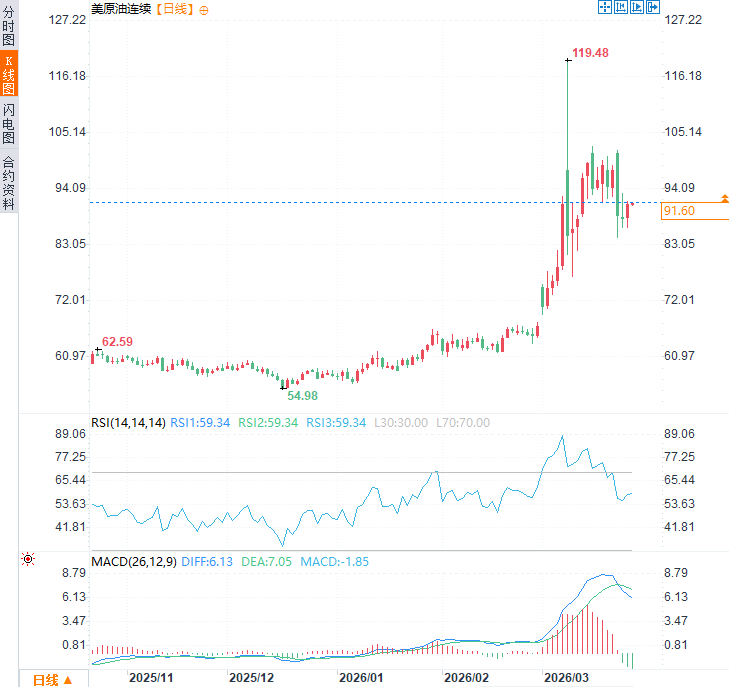
(US crude oil daily chart, source: FX678)
Blankfein advises investors to avoid "conviction trades" and instead adopt a more cautious and flexible strategy. He states, "You can set up hedges, but if things go the other way, those hedges could be worthless tomorrow."
He emphasized, "At this time, people should become excellent contingency planners. They need to be very flexible and strictly protect their positions." In an environment of heightened uncertainty, risk management is more important than directional betting.
Blankfein also questioned the accuracy of portfolio valuations for private market funds. He pointed out that assets have not yet been adequately tested during a stock market rally, and "a liquidation is necessary—we haven't experienced that yet, and the longer the interval between liquidations, the more severe the potential consequences could be."
In the short term, the direct impact of the war with Iran will continue to dominate the market, with energy price volatility, geopolitical uncertainty, and inflationary pressures intertwined. Even with a diplomatic breakthrough, delayed infrastructure repairs will prolong the economic impact.
Blankfein believes the current environment requires investors to remain highly vigilant, prioritize capital protection, and prepare contingency plans for multiple scenarios. In the long term, the market may gradually recover after the war is resolved, but potential risks in the private market and the financial situation still require continued monitoring.
At 9:25 AM Beijing time, US crude oil futures were trading at $91.41 per barrel.
Blankfein points out that market reactions to the conflict can be either overly optimistic or overly pessimistic, and traders should not operate based on extreme assumptions such as "everything will be resolved" or "it will never be resolved." The war has entered its fourth week, shipping in the Strait of Hormuz is severely disrupted, and the energy market is experiencing significant volatility.
During Thursday's Asian trading session, US crude oil prices fluctuated upwards and are currently trading around $91.50 per barrel, with a daily increase of about 1.4%.
Blankfein Core Warning
Blankfein said on Wednesday, "People know that even if the conflict stops tomorrow, the infrastructure has been severely damaged, and the pressure will continue for much longer. Even if an agreement is reached on Thursday, there is no reason to believe that there will be an agreement tomorrow." He emphasized that Iran's attacks on neighboring countries' energy infrastructure and the blockade of the Straits have caused lasting damage.
As a veteran who led Goldman Sachs through the 2008 global financial crisis, Blankfein believes that the pre-war investment environment had "more tailwinds than headwinds"—robust economic growth and a downward interest rate path—but these factors have now taken a backseat, with war and energy prices becoming the dominant variables.
Impact of damage to energy infrastructure
Since the US and Israel launched their strikes against Iran on February 28, the conflict has rapidly escalated into a regional war. Iran's retaliation against neighboring countries' energy facilities and its de facto blockade of the Strait of Hormuz have caused a major shock to global oil supplies and led to sharp fluctuations in oil prices.
Blankfein points out that the sharp fluctuations in the energy market reflect investors pricing in the long-term impact of supply disruptions. Even if a ceasefire agreement is reached, infrastructure repairs and supply chain restoration will take months or even longer, which will continue to push up energy costs and affect global inflation expectations.
(US crude oil daily chart, source: FX678)
Investment strategy recommendations
Blankfein advises investors to avoid "conviction trades" and instead adopt a more cautious and flexible strategy. He states, "You can set up hedges, but if things go the other way, those hedges could be worthless tomorrow."
He emphasized, "At this time, people should become excellent contingency planners. They need to be very flexible and strictly protect their positions." In an environment of heightened uncertainty, risk management is more important than directional betting.
Private market valuation risk
Blankfein also questioned the accuracy of portfolio valuations for private market funds. He pointed out that assets have not yet been adequately tested during a stock market rally, and "a liquidation is necessary—we haven't experienced that yet, and the longer the interval between liquidations, the more severe the potential consequences could be."
Market Outlook and Risks
In the short term, the direct impact of the war with Iran will continue to dominate the market, with energy price volatility, geopolitical uncertainty, and inflationary pressures intertwined. Even with a diplomatic breakthrough, delayed infrastructure repairs will prolong the economic impact.
Blankfein believes the current environment requires investors to remain highly vigilant, prioritize capital protection, and prepare contingency plans for multiple scenarios. In the long term, the market may gradually recover after the war is resolved, but potential risks in the private market and the financial situation still require continued monitoring.
At 9:25 AM Beijing time, US crude oil futures were trading at $91.41 per barrel.
- Risk Warning and Disclaimer
- The market involves risk, and trading may not be suitable for all investors. This article is for reference only and does not constitute personal investment advice, nor does it take into account certain users’ specific investment objectives, financial situation, or other needs. Any investment decisions made based on this information are at your own risk.