Despite recent volatility, gold's importance as a store of value continues to grow.
2026-03-27 12:29:34
Nina-Alessa Michel, advisor on regulation and economic policy at the Swiss Bankers Association, recently stated that in today's more fragmented and politically sensitive global financial system, gold's importance as a store of value will continue to rise, but this process may not necessarily be achieved through a significant price increase.
In an analysis report released on Wednesday (March 25), she pointed out that a series of recent events have once again demonstrated the close link between gold prices and global uncertainty.
Nina-Alessa Michel wrote, “Amid escalating geopolitical and economic tensions and rising government debt, demand for safe-haven assets is increasing. However, despite gold’s role as a safe-haven asset, its price performance has been more volatile than expected. Gold prices have recently experienced sharp fluctuations in different market phases; for example, after President Trump nominated the next Federal Reserve Chairman, gold prices fell by 14% in three days, which also put pressure on assets such as silver.”
She further stated, "These price fluctuations clearly demonstrate that gold is not always the safest safe-haven asset. It is actually very sensitive to geopolitical developments and changes in monetary policy, with geopolitical events often serving as powerful catalysts for gold demand. Analysis shows that when global capital markets face fragmentation, conflict, and shifts in the balance of power, investors increasingly tend to seek safe-haven assets."
Michel specifically pointed out that Switzerland, as one of the key hubs in the global gold market, is particularly sensitive to these changes in demand.
She wrote: "Switzerland's refineries, trading networks, and international connections make its financial centers, which finance it, extremely sensitive to global political news flows. Rising demand, potential export restrictions, or international sanctions can have a direct impact, first affecting the real economy."
This reality is clearly reflected in Swiss trade data. She pointed out, "In the first half of 2025 alone, Switzerland exported over 476 tons of gold to the United States, worth 39 billion Swiss francs. At that time, uncertainty in the US, inflationary pressures, and concerns about further increases in government debt significantly boosted gold demand. Besides private investors and central banks, stablecoins like Tether also played a crucial role. In 2025, Tether purchased approximately 70 tons of gold, exceeding the gold purchases of most central banks."
Michelle stated that changes in trade policy, whether actual or merely speculative, can trigger significant fluctuations in gold prices. For example, gold prices initially rose when the U.S. government seemed to hint at imposing tariffs on gold; however, they quickly fell back after the government announced it would not implement such tariffs.
Speaking about gold's dramatic performance so far in 2026, Michelle pointed out that the start of the year has been a "good start" for gold.
In her report, she wrote: “After a strong performance in 2025, gold’s upward trend continued into early 2026, even faster and stronger than many market participants had anticipated. At the start of the year, gold was around $4,330 per troy ounce, rising rapidly amid sustained demand and a market environment rife with uncertainty. Records were being broken almost daily in mid-January, reaching an all-time high of nearly $5,600 per ounce on January 28, decisively breaking through the important psychological barrier of $5,000 in just a few weeks.”
However, this strong upward momentum could not be sustained. After reaching an intraday high of $5,597.23 per ounce, gold prices experienced a significant pullback and entered a period of high volatility.
Michelle noted, "Profit-taking and speculation about the future direction of US monetary policy led to a significant pullback in gold prices from late January to early February. Gold prices briefly fell below $5,000 before slowly stabilizing. Since the outbreak of the Iran-Iraq War on February 28, gold prices have fallen again."
The Swiss Bankers Association believes that future gold price movements will not only be determined by isolated events, but will also be influenced by fundamental structural trends.
Michelle writes, “Geopolitical uncertainty will play a central role, and the greater the shift in the global balance of power, the more attractive gold will be as a strategic reserve. At the same time, many central banks’ desire to diversify their reserves and reduce their reliance on traditional hard currencies will further enhance the importance of gold to central banks.”
She added, "In this context, monetary policy remains a key influencing factor, but its role is not reflected in individual interest rate decisions, but rather in influencing risk perception and liquidity conditions. Volatile inflation and fluctuating interest rate expectations will continue to favor relatively stable investment demand."
She warned that political signals and regulatory decisions could trigger stronger market reactions in the short term than fundamental factors. She stated, "Last year's discussions about international trade and sanctions policies showed that even rumors about new barriers can impact the gold market, regardless of whether those rumors ultimately materialize."
Overall, there is ample reason to believe that gold's importance as a store of value will continue to rise in a more fragmented and politically sensitive global financial system. This process will not necessarily be achieved through significant price increases, but rather through its increasingly important strategic anchoring role in investment portfolios, government reserves, and international trade.
Michel believes that gold prices are telling a "complex story," reflecting both global uncertainty and sensitivity to political and economic shocks, while also providing important decision-making references for institutional and private investors.
She concluded, “ Gold can be an important part of a diversified portfolio, but it must be part of the overall investment strategy . Today’s stability depends less on a single asset class and more on forward-looking risk management that takes geopolitical and regulatory developments into account.”
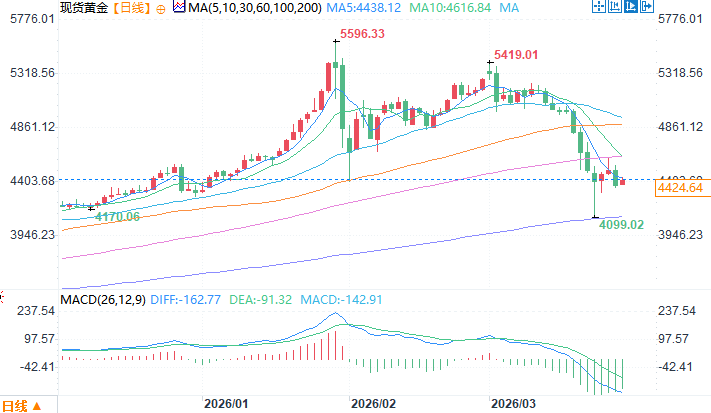
Spot gold daily chart source: EasyForex
At 12:29 Beijing time on March 27, spot gold was trading at $4433.64 per ounce.
In an analysis report released on Wednesday (March 25), she pointed out that a series of recent events have once again demonstrated the close link between gold prices and global uncertainty.
Nina-Alessa Michel wrote, “Amid escalating geopolitical and economic tensions and rising government debt, demand for safe-haven assets is increasing. However, despite gold’s role as a safe-haven asset, its price performance has been more volatile than expected. Gold prices have recently experienced sharp fluctuations in different market phases; for example, after President Trump nominated the next Federal Reserve Chairman, gold prices fell by 14% in three days, which also put pressure on assets such as silver.”
She further stated, "These price fluctuations clearly demonstrate that gold is not always the safest safe-haven asset. It is actually very sensitive to geopolitical developments and changes in monetary policy, with geopolitical events often serving as powerful catalysts for gold demand. Analysis shows that when global capital markets face fragmentation, conflict, and shifts in the balance of power, investors increasingly tend to seek safe-haven assets."
Switzerland, as a key hub in the gold market, is extremely sensitive to changes in global demand.
Michel specifically pointed out that Switzerland, as one of the key hubs in the global gold market, is particularly sensitive to these changes in demand.
She wrote: "Switzerland's refineries, trading networks, and international connections make its financial centers, which finance it, extremely sensitive to global political news flows. Rising demand, potential export restrictions, or international sanctions can have a direct impact, first affecting the real economy."
This reality is clearly reflected in Swiss trade data. She pointed out, "In the first half of 2025 alone, Switzerland exported over 476 tons of gold to the United States, worth 39 billion Swiss francs. At that time, uncertainty in the US, inflationary pressures, and concerns about further increases in government debt significantly boosted gold demand. Besides private investors and central banks, stablecoins like Tether also played a crucial role. In 2025, Tether purchased approximately 70 tons of gold, exceeding the gold purchases of most central banks."
Changes in trade policy can trigger sharp fluctuations in gold prices.
Michelle stated that changes in trade policy, whether actual or merely speculative, can trigger significant fluctuations in gold prices. For example, gold prices initially rose when the U.S. government seemed to hint at imposing tariffs on gold; however, they quickly fell back after the government announced it would not implement such tariffs.
Gold's performance in 2026: A surge followed by a sharp correction.
Speaking about gold's dramatic performance so far in 2026, Michelle pointed out that the start of the year has been a "good start" for gold.
In her report, she wrote: “After a strong performance in 2025, gold’s upward trend continued into early 2026, even faster and stronger than many market participants had anticipated. At the start of the year, gold was around $4,330 per troy ounce, rising rapidly amid sustained demand and a market environment rife with uncertainty. Records were being broken almost daily in mid-January, reaching an all-time high of nearly $5,600 per ounce on January 28, decisively breaking through the important psychological barrier of $5,000 in just a few weeks.”
However, this strong upward momentum could not be sustained. After reaching an intraday high of $5,597.23 per ounce, gold prices experienced a significant pullback and entered a period of high volatility.
Michelle noted, "Profit-taking and speculation about the future direction of US monetary policy led to a significant pullback in gold prices from late January to early February. Gold prices briefly fell below $5,000 before slowly stabilizing. Since the outbreak of the Iran-Iraq War on February 28, gold prices have fallen again."
Long-term outlook: Structural trends determine the value of gold
The Swiss Bankers Association believes that future gold price movements will not only be determined by isolated events, but will also be influenced by fundamental structural trends.
Michelle writes, “Geopolitical uncertainty will play a central role, and the greater the shift in the global balance of power, the more attractive gold will be as a strategic reserve. At the same time, many central banks’ desire to diversify their reserves and reduce their reliance on traditional hard currencies will further enhance the importance of gold to central banks.”
She added, "In this context, monetary policy remains a key influencing factor, but its role is not reflected in individual interest rate decisions, but rather in influencing risk perception and liquidity conditions. Volatile inflation and fluctuating interest rate expectations will continue to favor relatively stable investment demand."
She warned that political signals and regulatory decisions could trigger stronger market reactions in the short term than fundamental factors. She stated, "Last year's discussions about international trade and sanctions policies showed that even rumors about new barriers can impact the gold market, regardless of whether those rumors ultimately materialize."
Conclusion: Gold will occupy a more important position in diversification strategies.
Overall, there is ample reason to believe that gold's importance as a store of value will continue to rise in a more fragmented and politically sensitive global financial system. This process will not necessarily be achieved through significant price increases, but rather through its increasingly important strategic anchoring role in investment portfolios, government reserves, and international trade.
Michel believes that gold prices are telling a "complex story," reflecting both global uncertainty and sensitivity to political and economic shocks, while also providing important decision-making references for institutional and private investors.
She concluded, “ Gold can be an important part of a diversified portfolio, but it must be part of the overall investment strategy . Today’s stability depends less on a single asset class and more on forward-looking risk management that takes geopolitical and regulatory developments into account.”
Spot gold daily chart source: EasyForex
At 12:29 Beijing time on March 27, spot gold was trading at $4433.64 per ounce.
- Risk Warning and Disclaimer
- The market involves risk, and trading may not be suitable for all investors. This article is for reference only and does not constitute personal investment advice, nor does it take into account certain users’ specific investment objectives, financial situation, or other needs. Any investment decisions made based on this information are at your own risk.