Gold Trading Alert: Middle East Conflict Rekindles! Houthi Rebellion Boosts Safe-Haven Demand for Gold; Can Gold Prices Return to $5,000?
2026-03-30 07:48:38
On Saturday (March 28), the Houthi rebels in Yemen launched their first attack on Israel since the start of the war, and quickly announced a second round of strikes, using cruise missiles, drones, and even powerful ballistic missiles, targeting key facilities in southern Israel. This move marks the Houthis' formal entry into the war, directly supporting Iran and the regional resistance front. Houthi spokesman Yahya Sarreya stated explicitly that military operations would continue in the coming days until the United States and Israel "cease their aggression." The Israel Defense Forces responded swiftly, stating they were prepared and warning that any attack would come at a cost.
On Monday (March 30) in early Asian trading, the US dollar index continued its upward trend, rising as much as 0.17% to 100.33, a new high since March 16 and marking its fifth consecutive day of gains. Spot gold rose and then fell back, initially reaching $4514.42 per ounce before retreating to around $4450 per ounce, a drop of nearly 1%. Although safe-haven buying provided some support for gold prices, the escalating conflict in the Middle East and the continued rise in international oil prices, with US crude oil jumping more than 3% to a three-week high of $103.38 per barrel, exacerbated inflation concerns, dampened expectations of a Federal Reserve rate cut, and contributed to the continued rise in the US dollar index, putting downward pressure on gold prices.
Meanwhile, US military actions have escalated simultaneously. Washington has deployed two batches of thousands of Marines to the Middle East, with the first batch arriving around March 28 aboard amphibious assault ships. The Pentagon also plans to deploy thousands of soldiers from the 82nd Airborne Division. Reports indicate that US officials are preparing for a possible ground operation in Iran lasting several weeks, although final approval rests with President Trump. Tehran has responded in kind, with a spokesperson for the Iranian Armed Forces' Hatem Anbia Central Headquarters announcing that the residences of US and Israeli military commanders and political officials would be legitimate targets. On the evening of March 29, Tehran, the Iranian capital, was subjected to two large-scale airstrikes within a few minutes, damaging some power transmission facilities and causing power outages in several areas. The Israeli military stated that this action was aimed at further disrupting Iran's weapons production capabilities. The conflict remains intense and escalating, with no signs of de-escalation in the short term.

The Houthi intervention has not only opened a new front but also directly threatens global energy transport security. The Strait of Hormuz, already effectively blocked, handles approximately one-fifth of the world's oil and liquefied natural gas supplies. If the Houthis escalate their operations, the Bab el-Mandeb Strait—a vital maritime chokepoint leading to the Suez Canal—could become the next target. Global shipping faces new risks, and traders are closely assessing the impact of this escalation on oil supplies.
As a potential mediator, Pakistan held two days of talks with the foreign ministers of Saudi Arabia, Turkey, and Egypt starting March 29, seeking to ease tensions. The Pakistani foreign minister stated that he was prepared to host "substantive talks" in the coming days aimed at ending the conflict, including promoting potential dialogue between the US and Iran. However, the Iranian Foreign Ministry spokesperson has clearly stated that the proposals submitted by the US through mediators are "extreme and unreasonable," involving Iranian national sovereignty and lacking diplomatic seriousness. Iran emphasizes that it must rely on its own strength to ensure its security, and that military action is only aimed at US and Israeli military bases and assets involved in the aggression. The US has privately informed its allies that reaching an agreement with Iran will take time, and intense fighting could continue for another 2-4 weeks. Although Trump extended the deadline for striking Iranian energy facilities to April 7, market doubts about the prospects for a ceasefire have not dissipated.
The escalating conflict has directly driven up energy prices. Following the Houthi attacks, international oil prices jumped more than 3% on Monday, with WTI crude hitting a high of $103.38 per barrel and Brent crude remaining above $110. Some options markets even predicted that prices could reach a record high of $150 by the end of April. The high oil and fertilizer prices have quickly spread to the global economy, exacerbating inflation concerns.
The US market reacted strongly: the March consumer confidence index fell to a three-month low, and the CME FedWatch tool showed that traders have completely ruled out the possibility of a Fed rate cut in 2026, and have even begun pricing in the probability of a later rate hike. US Treasury yields rose across the board, with the 10-year yield briefly reaching its highest level since July, and the 30-year yield approaching 5%. The US dollar index also strengthened due to both safe-haven demand and expectations of a rate hike, and its gains so far in March are on track for their best performance in nearly a year. In the stock market, the Dow Jones Industrial Average confirmed it had entered correction territory, and all three major indices fell for the fifth consecutive week, with technology stocks and consumer discretionary sectors particularly under pressure.
In this environment, gold, as a traditional safe-haven asset, should have received strong support. However, the actual situation presented a complex tug-of-war: bargain hunting once pushed gold prices up by nearly 3%, with spot gold rebounding from near a four-month low around March 28, reaching a high of around $4,554 per ounce, and closing up about 2.6% at around $4,495 on Friday. But on Monday (March 30), it rose again in early trading and fell back to around $4,450, a drop of about 1%. A stronger dollar and rising inflation expectations dampened the prospect of interest rate cuts, putting significant downward pressure on gold prices; at the same time, safe-haven demand brought about by the uncertainty of the war provided support, resulting in volatile gold price movements.
Commerzbank raised its year-end gold price target from $4,900 to $5,000, believing the war with Iran may end in the spring, at which point the Federal Reserve is expected to resume interest rate cuts. However, in the short term, market sentiment remains influenced by both geopolitical and macroeconomic factors. Former U.S. Central Command Commander Frank McKenzie believes the Houthi involvement will not be a "decisive factor," as while their ability to disrupt shipping exists, the U.S. military has the resources to counter it. Nevertheless, any signs of a prolonged conflict could further amplify energy risks and inflationary pressures.
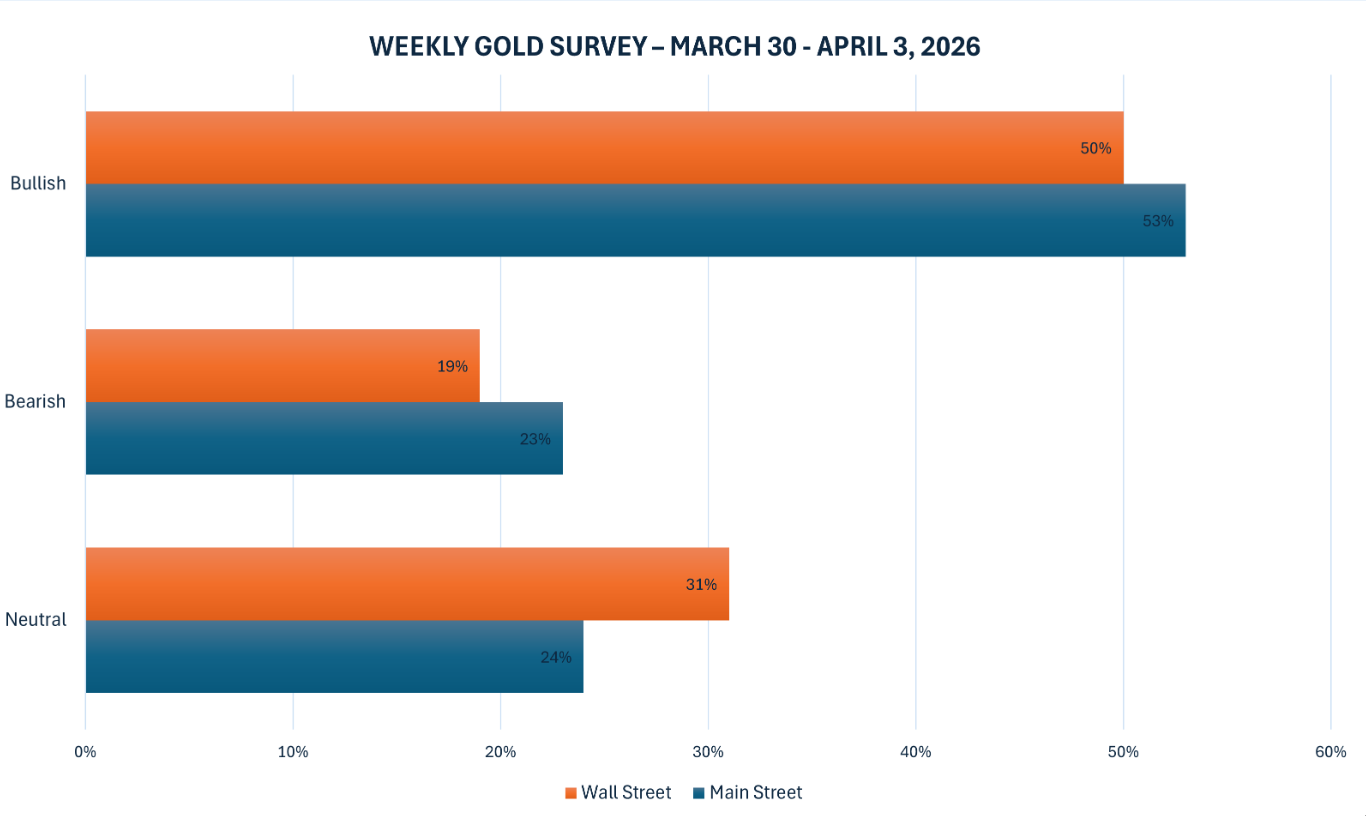
Kitco's weekly gold survey shows that Wall Street sentiment has shifted towards equilibrium, with half expecting gold prices to rise in the coming week, and Main Street investors returning to a mildly bullish bias. However, analysts' opinions are divided: some believe that the uncertainty of the war makes the trend difficult to predict, with technical factors and geopolitical events intertwined; others point out that the stock market decline and the rise of the dollar create a "toxic environment," and gold's safe-haven status may be limited in the short term, with only a clear easing signal from central banks able to turn into a clear bullish stance.
This week, the US will release its March ISM Manufacturing and Non-Manufacturing PMIs, February Retail Sales, and March Non-Farm Payrolls reports. Federal Reserve Chairman Jerome Powell will also deliver a speech. These data will further test inflation and economic resilience, and are crucial to gold price movements. Furthermore, US and European stock markets will be closed on Friday for Good Friday; investors should be aware of the risks associated with position adjustments.
In summary, the escalating conflict in the Middle East—from the Houthi "joining the war" and the increase in US troops to the increased frequency of Tehran airstrikes and threats to shipping—is continuously increasing global uncertainty. High oil prices, inflationary concerns, and safe-haven demand provide fundamental support for gold; however, a stronger dollar and a reversal in expectations of interest rate cuts are creating temporary downward pressure. In the short term, gold prices may maintain a high-level consolidation pattern, depending on the progress of ceasefire negotiations, the duration of the conflict, and policy signals from the Federal Reserve.
From a medium- to long-term perspective, if the conflict drags on or spills over further, the deepening energy crisis will strengthen gold's safe-haven appeal; conversely, if diplomatic efforts such as Pakistan's mediation achieve a breakthrough, a rebound in risk appetite may put downward pressure on gold prices. Investors need to closely monitor geopolitical dynamics and macroeconomic data, seizing opportunities to buy on dips during market volatility. For ordinary investors, in the current complex environment, gold can still serve as part of a diversified portfolio to hedge against systemic risks.
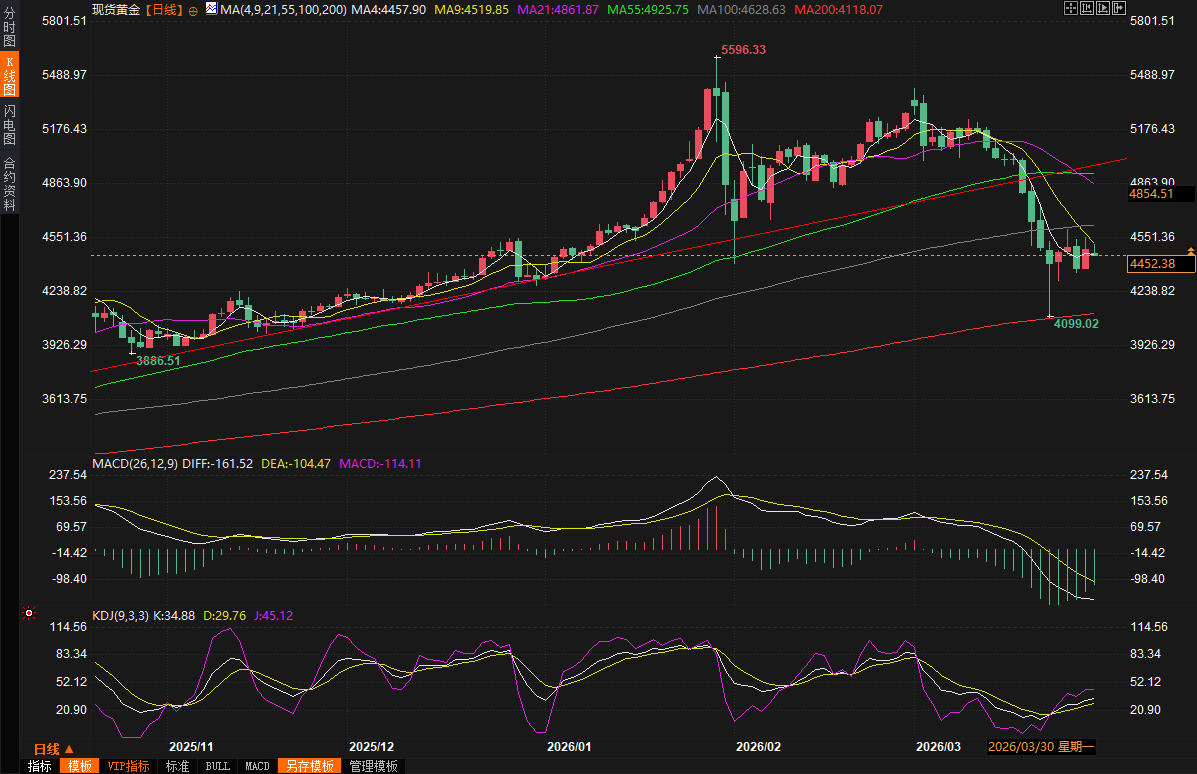
(Spot gold daily chart, source: FX678)
At 07:45 Beijing time, spot gold was trading at $4451.89 per ounce.
On Monday (March 30) in early Asian trading, the US dollar index continued its upward trend, rising as much as 0.17% to 100.33, a new high since March 16 and marking its fifth consecutive day of gains. Spot gold rose and then fell back, initially reaching $4514.42 per ounce before retreating to around $4450 per ounce, a drop of nearly 1%. Although safe-haven buying provided some support for gold prices, the escalating conflict in the Middle East and the continued rise in international oil prices, with US crude oil jumping more than 3% to a three-week high of $103.38 per barrel, exacerbated inflation concerns, dampened expectations of a Federal Reserve rate cut, and contributed to the continued rise in the US dollar index, putting downward pressure on gold prices.
Meanwhile, US military actions have escalated simultaneously. Washington has deployed two batches of thousands of Marines to the Middle East, with the first batch arriving around March 28 aboard amphibious assault ships. The Pentagon also plans to deploy thousands of soldiers from the 82nd Airborne Division. Reports indicate that US officials are preparing for a possible ground operation in Iran lasting several weeks, although final approval rests with President Trump. Tehran has responded in kind, with a spokesperson for the Iranian Armed Forces' Hatem Anbia Central Headquarters announcing that the residences of US and Israeli military commanders and political officials would be legitimate targets. On the evening of March 29, Tehran, the Iranian capital, was subjected to two large-scale airstrikes within a few minutes, damaging some power transmission facilities and causing power outages in several areas. The Israeli military stated that this action was aimed at further disrupting Iran's weapons production capabilities. The conflict remains intense and escalating, with no signs of de-escalation in the short term.
Conflict Escalates: A Dual Threat to New Fronts and Shipping Chokepoints
The Houthi intervention has not only opened a new front but also directly threatens global energy transport security. The Strait of Hormuz, already effectively blocked, handles approximately one-fifth of the world's oil and liquefied natural gas supplies. If the Houthis escalate their operations, the Bab el-Mandeb Strait—a vital maritime chokepoint leading to the Suez Canal—could become the next target. Global shipping faces new risks, and traders are closely assessing the impact of this escalation on oil supplies.
As a potential mediator, Pakistan held two days of talks with the foreign ministers of Saudi Arabia, Turkey, and Egypt starting March 29, seeking to ease tensions. The Pakistani foreign minister stated that he was prepared to host "substantive talks" in the coming days aimed at ending the conflict, including promoting potential dialogue between the US and Iran. However, the Iranian Foreign Ministry spokesperson has clearly stated that the proposals submitted by the US through mediators are "extreme and unreasonable," involving Iranian national sovereignty and lacking diplomatic seriousness. Iran emphasizes that it must rely on its own strength to ensure its security, and that military action is only aimed at US and Israeli military bases and assets involved in the aggression. The US has privately informed its allies that reaching an agreement with Iran will take time, and intense fighting could continue for another 2-4 weeks. Although Trump extended the deadline for striking Iranian energy facilities to April 7, market doubts about the prospects for a ceasefire have not dissipated.
Soaring oil prices and inflationary pressures: a double-edged sword for gold.
The escalating conflict has directly driven up energy prices. Following the Houthi attacks, international oil prices jumped more than 3% on Monday, with WTI crude hitting a high of $103.38 per barrel and Brent crude remaining above $110. Some options markets even predicted that prices could reach a record high of $150 by the end of April. The high oil and fertilizer prices have quickly spread to the global economy, exacerbating inflation concerns.
The US market reacted strongly: the March consumer confidence index fell to a three-month low, and the CME FedWatch tool showed that traders have completely ruled out the possibility of a Fed rate cut in 2026, and have even begun pricing in the probability of a later rate hike. US Treasury yields rose across the board, with the 10-year yield briefly reaching its highest level since July, and the 30-year yield approaching 5%. The US dollar index also strengthened due to both safe-haven demand and expectations of a rate hike, and its gains so far in March are on track for their best performance in nearly a year. In the stock market, the Dow Jones Industrial Average confirmed it had entered correction territory, and all three major indices fell for the fifth consecutive week, with technology stocks and consumer discretionary sectors particularly under pressure.
In this environment, gold, as a traditional safe-haven asset, should have received strong support. However, the actual situation presented a complex tug-of-war: bargain hunting once pushed gold prices up by nearly 3%, with spot gold rebounding from near a four-month low around March 28, reaching a high of around $4,554 per ounce, and closing up about 2.6% at around $4,495 on Friday. But on Monday (March 30), it rose again in early trading and fell back to around $4,450, a drop of about 1%. A stronger dollar and rising inflation expectations dampened the prospect of interest rate cuts, putting significant downward pressure on gold prices; at the same time, safe-haven demand brought about by the uncertainty of the war provided support, resulting in volatile gold price movements.
Commerzbank raised its year-end gold price target from $4,900 to $5,000, believing the war with Iran may end in the spring, at which point the Federal Reserve is expected to resume interest rate cuts. However, in the short term, market sentiment remains influenced by both geopolitical and macroeconomic factors. Former U.S. Central Command Commander Frank McKenzie believes the Houthi involvement will not be a "decisive factor," as while their ability to disrupt shipping exists, the U.S. military has the resources to counter it. Nevertheless, any signs of a prolonged conflict could further amplify energy risks and inflationary pressures.
Gold Market Sentiment: Divergence Between Professionals and Retail Investors
Kitco's weekly gold survey shows that Wall Street sentiment has shifted towards equilibrium, with half expecting gold prices to rise in the coming week, and Main Street investors returning to a mildly bullish bias. However, analysts' opinions are divided: some believe that the uncertainty of the war makes the trend difficult to predict, with technical factors and geopolitical events intertwined; others point out that the stock market decline and the rise of the dollar create a "toxic environment," and gold's safe-haven status may be limited in the short term, with only a clear easing signal from central banks able to turn into a clear bullish stance.
This week, the US will release its March ISM Manufacturing and Non-Manufacturing PMIs, February Retail Sales, and March Non-Farm Payrolls reports. Federal Reserve Chairman Jerome Powell will also deliver a speech. These data will further test inflation and economic resilience, and are crucial to gold price movements. Furthermore, US and European stock markets will be closed on Friday for Good Friday; investors should be aware of the risks associated with position adjustments.
Outlook: Short-term fluctuations expected, but investment value remains in the medium to long term.
In summary, the escalating conflict in the Middle East—from the Houthi "joining the war" and the increase in US troops to the increased frequency of Tehran airstrikes and threats to shipping—is continuously increasing global uncertainty. High oil prices, inflationary concerns, and safe-haven demand provide fundamental support for gold; however, a stronger dollar and a reversal in expectations of interest rate cuts are creating temporary downward pressure. In the short term, gold prices may maintain a high-level consolidation pattern, depending on the progress of ceasefire negotiations, the duration of the conflict, and policy signals from the Federal Reserve.
From a medium- to long-term perspective, if the conflict drags on or spills over further, the deepening energy crisis will strengthen gold's safe-haven appeal; conversely, if diplomatic efforts such as Pakistan's mediation achieve a breakthrough, a rebound in risk appetite may put downward pressure on gold prices. Investors need to closely monitor geopolitical dynamics and macroeconomic data, seizing opportunities to buy on dips during market volatility. For ordinary investors, in the current complex environment, gold can still serve as part of a diversified portfolio to hedge against systemic risks.
(Spot gold daily chart, source: FX678)
At 07:45 Beijing time, spot gold was trading at $4451.89 per ounce.
- Risk Warning and Disclaimer
- The market involves risk, and trading may not be suitable for all investors. This article is for reference only and does not constitute personal investment advice, nor does it take into account certain users’ specific investment objectives, financial situation, or other needs. Any investment decisions made based on this information are at your own risk.