The Gulf "safe haven" shifts: Why are Gulf stock markets diverging amid soaring oil prices?
2026-03-30 09:11:32
Since the outbreak of the war with Iran on February 28, stock markets in the Gulf region have shown a significant divergence. Investors have sought different safe havens amid sharp fluctuations in energy prices and geopolitical uncertainty, resulting in some markets benefiting from rising oil prices, while others have been dragged down by the real estate market and overall risk sentiment.
Since March 1st (the day after the outbreak of war), the Saudi and Omani stock markets have performed exceptionally well, while the Dubai, Qatari, and Bahrain indices have seen significant pullbacks. This divergence reflects the varying sensitivities of the Gulf countries to external shocks due to differences in their economic structures.
On Monday (March 30) during the Asian session, the ongoing conflict with Iran caused US crude oil prices to fluctuate upwards, currently trading around $103 per barrel, up about 3.3% from the previous trading day's settlement price.
The Saudi Tadawul index has risen by approximately 5.8% since March 1, while the Oman index has surged by a remarkable 9.3%. The Saudi stock market is highly correlated with the energy market and is directly driven by rising oil prices; Oman, on the other hand, has benefited from the inflow of funds from investors seeking a safe haven in the region.
Oman's Vision 2040 plan, emphasizing reducing dependence on oil and promoting economic diversification, has attracted some long-term investors amid a volatile environment. Large energy companies like Saudi Aramco dominate the market, and their ability to export crude oil through pipelines outside the Strait of Hormuz further strengthens market confidence.
Dubai's DFM General Index fell sharply by nearly 16% during the same period, making it the hardest-hit market. The Qatar Index declined by about 4%, and the Bahrain BAX Index fell by 7.2%. Dubai's high sensitivity to the real estate market and broader geopolitical events contributed to its weakness amid risk aversion.
Last Wednesday, the Dubai index surged as much as 4.2% (the largest single-day gain since December 2024), mainly driven by real estate and banking stocks, but the cumulative weekly gain was limited, and the index is still in a correction phase.
Oil prices surged after the outbreak of the oil price war, and then remained high and volatile. High oil prices have a net positive impact on energy-dominated markets such as Saudi Arabia, especially as companies like Aramco can avoid the risks of the Strait of Hormuz through Mediterranean pipelines.
Analysts point out that oil prices remaining above $80 per barrel are generally beneficial to regional energy companies, but markets with lower diversification levels or higher real estate exposure, such as Dubai, are unlikely to benefit directly.
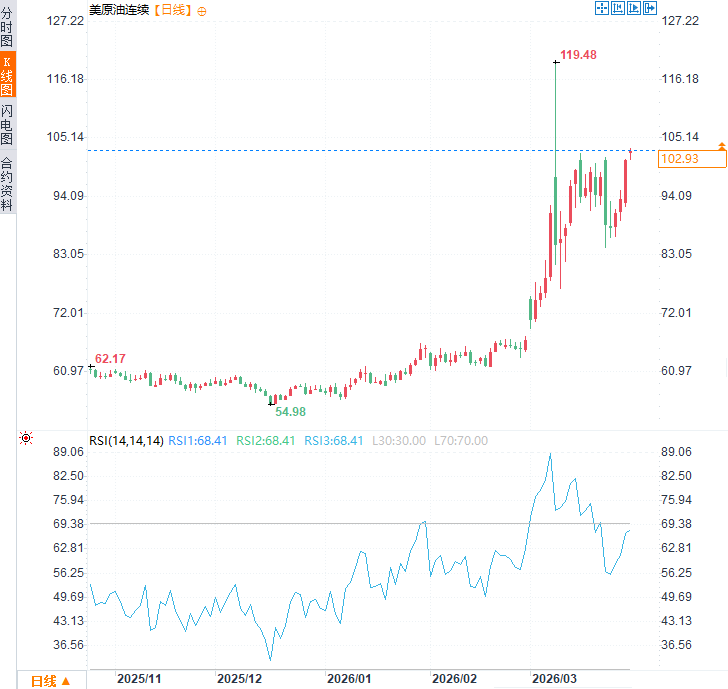
(US crude oil daily chart, source: FX678)
Damanick Dantes, founder of Dantes Outlook, stated that high oil prices remain a net benefit for energy companies like Saudi Arabia, while Oman's safe-haven status is highlighted amidst the turmoil. He cautioned investors that the short-term rebound may be short-lived and advised focusing on resilient, high-quality assets.
Fahd Iqbal, Head of Investment Services at UBP Dubai, pointed out that the downgrade signal will boost market sentiment, but a full resolution may take longer. He warned that attacks on "red lines" such as energy infrastructure or desalination facilities could trigger further escalation. Meanwhile, the dollar's peg to the dollar poses a risk under inflationary pressures, and gold, a traditional safe-haven asset, is also exhibiting characteristics of a risk asset.
Dantes advises against excessive risk-taking in Middle Eastern investments, suggesting a focus on high-quality assets that perform well in uncertain environments. He also points out that high-risk-appetite opportunities still exist in the Saudi IPO market, and investors should not be overly defensive, as a breakthrough in negotiations could trigger a significant rebound.
Iqbal stated that most investors are currently remaining cautious, waiting for the situation to become clearer before taking aggressive positions. Market volatility offers opportunities for price mismatches, but these should be capitalized on with caution.
The ongoing conflict with Iran has led to a significant divergence in Gulf stock markets. Energy-related markets have benefited from rising oil prices, while real estate and risk-sensitive markets have come under pressure and declined. High oil prices are providing support for countries like Saudi Arabia, but risks in the Strait of Hormuz and geopolitical uncertainties continue to weigh on overall sentiment. Future market trends will depend on the evolution of the conflict, the progress of negotiations, and the stability of oil prices. Investors need to balance defense and opportunity, and capitalize on the resilience of high-quality assets.
At 9:10 AM Beijing time, US crude oil futures were trading at $103.04 per barrel.
Since March 1st (the day after the outbreak of war), the Saudi and Omani stock markets have performed exceptionally well, while the Dubai, Qatari, and Bahrain indices have seen significant pullbacks. This divergence reflects the varying sensitivities of the Gulf countries to external shocks due to differences in their economic structures.
On Monday (March 30) during the Asian session, the ongoing conflict with Iran caused US crude oil prices to fluctuate upwards, currently trading around $103 per barrel, up about 3.3% from the previous trading day's settlement price.
Saudi Arabia and Oman indices rise sharply
The Saudi Tadawul index has risen by approximately 5.8% since March 1, while the Oman index has surged by a remarkable 9.3%. The Saudi stock market is highly correlated with the energy market and is directly driven by rising oil prices; Oman, on the other hand, has benefited from the inflow of funds from investors seeking a safe haven in the region.
Oman's Vision 2040 plan, emphasizing reducing dependence on oil and promoting economic diversification, has attracted some long-term investors amid a volatile environment. Large energy companies like Saudi Aramco dominate the market, and their ability to export crude oil through pipelines outside the Strait of Hormuz further strengthens market confidence.
Dubai and other markets saw significant declines.
Dubai's DFM General Index fell sharply by nearly 16% during the same period, making it the hardest-hit market. The Qatar Index declined by about 4%, and the Bahrain BAX Index fell by 7.2%. Dubai's high sensitivity to the real estate market and broader geopolitical events contributed to its weakness amid risk aversion.
Last Wednesday, the Dubai index surged as much as 4.2% (the largest single-day gain since December 2024), mainly driven by real estate and banking stocks, but the cumulative weekly gain was limited, and the index is still in a correction phase.
The boost to energy stocks from high oil prices
Oil prices surged after the outbreak of the oil price war, and then remained high and volatile. High oil prices have a net positive impact on energy-dominated markets such as Saudi Arabia, especially as companies like Aramco can avoid the risks of the Strait of Hormuz through Mediterranean pipelines.
Analysts point out that oil prices remaining above $80 per barrel are generally beneficial to regional energy companies, but markets with lower diversification levels or higher real estate exposure, such as Dubai, are unlikely to benefit directly.
(US crude oil daily chart, source: FX678)
Latest views from analysts Dantes and Iqbal
Damanick Dantes, founder of Dantes Outlook, stated that high oil prices remain a net benefit for energy companies like Saudi Arabia, while Oman's safe-haven status is highlighted amidst the turmoil. He cautioned investors that the short-term rebound may be short-lived and advised focusing on resilient, high-quality assets.
Fahd Iqbal, Head of Investment Services at UBP Dubai, pointed out that the downgrade signal will boost market sentiment, but a full resolution may take longer. He warned that attacks on "red lines" such as energy infrastructure or desalination facilities could trigger further escalation. Meanwhile, the dollar's peg to the dollar poses a risk under inflationary pressures, and gold, a traditional safe-haven asset, is also exhibiting characteristics of a risk asset.
Current investment strategy recommendations
Dantes advises against excessive risk-taking in Middle Eastern investments, suggesting a focus on high-quality assets that perform well in uncertain environments. He also points out that high-risk-appetite opportunities still exist in the Saudi IPO market, and investors should not be overly defensive, as a breakthrough in negotiations could trigger a significant rebound.
Iqbal stated that most investors are currently remaining cautious, waiting for the situation to become clearer before taking aggressive positions. Market volatility offers opportunities for price mismatches, but these should be capitalized on with caution.
Editor's Summary
The ongoing conflict with Iran has led to a significant divergence in Gulf stock markets. Energy-related markets have benefited from rising oil prices, while real estate and risk-sensitive markets have come under pressure and declined. High oil prices are providing support for countries like Saudi Arabia, but risks in the Strait of Hormuz and geopolitical uncertainties continue to weigh on overall sentiment. Future market trends will depend on the evolution of the conflict, the progress of negotiations, and the stability of oil prices. Investors need to balance defense and opportunity, and capitalize on the resilience of high-quality assets.
At 9:10 AM Beijing time, US crude oil futures were trading at $103.04 per barrel.
- Risk Warning and Disclaimer
- The market involves risk, and trading may not be suitable for all investors. This article is for reference only and does not constitute personal investment advice, nor does it take into account certain users’ specific investment objectives, financial situation, or other needs. Any investment decisions made based on this information are at your own risk.