Gold reversed its downward trend and rose for the second consecutive day, as Powell's speech led the market to no longer expect an interest rate hike this year.
2026-03-31 00:17:22
On Monday (March 30), spot gold rose approximately 0.9%-1.3% in US trading, settling around $4,531-$4,567 per ounce; US gold futures (GCcv1, June contract) rose approximately 0.8%-1.7%, briefly touching $4,568-$4,596. Gold prices had previously hit their lowest level since November early last week.

KitcoMetals senior analyst Jim Wyckoff said, "The war continues with no end in sight, which is pushing up gold prices as safe-haven demand picks up again. In the short term, market focus will be on the war, oil prices, bond yields, and the US dollar index."
Despite today's rebound, gold has fallen about 14% so far in March, impacted by soaring energy prices due to ongoing Middle East conflict, heightened inflation concerns, and adjustments in interest rate expectations. This is expected to be its worst monthly performance since 2008. Gold, traditionally a hedge against inflation and geopolitical uncertainty, has become less attractive in a high-interest-rate environment because it does not generate interest.
A month into the war, both sides are still exchanging fire fiercely, and the uncertainty surrounding its end is exacerbating market anxieties.
The Middle East conflict has lasted for about a month, with the United States and Israel continuing to launch intensive strikes against Iranian military, nuclear facilities and energy targets. Iran, in turn, has launched multiple rounds of missiles and rockets into Israel and the Gulf region in conjunction with the Houthi rebels and other forces. Recently, there have been rocket attacks on northern and central Israel as well as attacks on targets such as the Haifa oil refinery. The situation of "frenzied mutual firing" between the two sides has not shown any significant signs of abating.
As the war entered its second month, market concerns that the conflict would not end in the short term increased significantly. Traffic in the Strait of Hormuz plummeted to crisis levels, leading to a global oil supply shortage of approximately 15 million barrels per day, and the energy crisis continued to worsen.
Iran has called the US-proposed peace plan "unrealistic" and deemed its demands too harsh. Analysts and investors are beginning to worry that a prolonged war could lead to a similar stagnation in global economic growth as seen during the COVID-19 pandemic, with fuel shortages further amplifying economic uncertainty. This protracted concern has fueled risk aversion and intensified assessments of dual pressures on inflation and growth.
US President Trump stated that he would destroy Iranian energy facilities unless Iran immediately opens the Strait of Hormuz, expressing a desire to "seize Iranian oil resources" and potentially even control Hag Island, a key export base. He compared this to his previous actions in Venezuela.
The U.S. military continues to build up forces in the Persian Gulf region, including amphibious assault teams, the 82nd Airborne Division, and the recently deployed 3,500 Marines. Trump stated on Sunday that an agreement to end the war could be reached soon, but Iran denied this and warned the U.S. against a ground invasion.
Federal Reserve Chairman Jerome Powell stated that he is closely monitoring the impact of the war, leading to a reversal in market expectations for interest rate hikes.
Federal Reserve Chairman Jerome Powell stated that the Fed is fully prepared to closely monitor the impact of the war with Iran on the U.S. economy and inflation. He emphasized, "In the near term, rising energy prices will push up overall inflation, but it is too early to judge the scope and duration of its impact on the economy. We will continue to monitor potential risks to our dual mandate (full employment and price stability)."
Powell has repeatedly stated that "no one knows" the full economic impact of the war, and it is too early to make a judgment. Earlier this month, the Federal Reserve kept the overnight benchmark interest rate unchanged at 3.50%-3.75%.
Powell's cautious remarks reflect market uncertainty about the long-term impact of the war: while soaring oil prices have brought temporary inflationary pressures, a prolonged conflict leading to slower economic growth would complicate the Fed's policy space. Previously, rising oil prices reinforced market expectations of interest rate hikes, but as concerns about a global economic slowdown intensified (energy shortages could trigger economic stagnation), investors turned to government bonds as a safe haven, driving up bond prices and lowering yields. Market pricing indicates that bets on Fed rate hikes have been withdrawn, with investors now pricing in the possibility of rate cuts this year.
City Index market analysts point out that the $4,700-$4,750 area will be a key resistance level for a short-term gold rally. "If gold prices fail to break through this area effectively, this rally could fade quickly, just like previous ones."
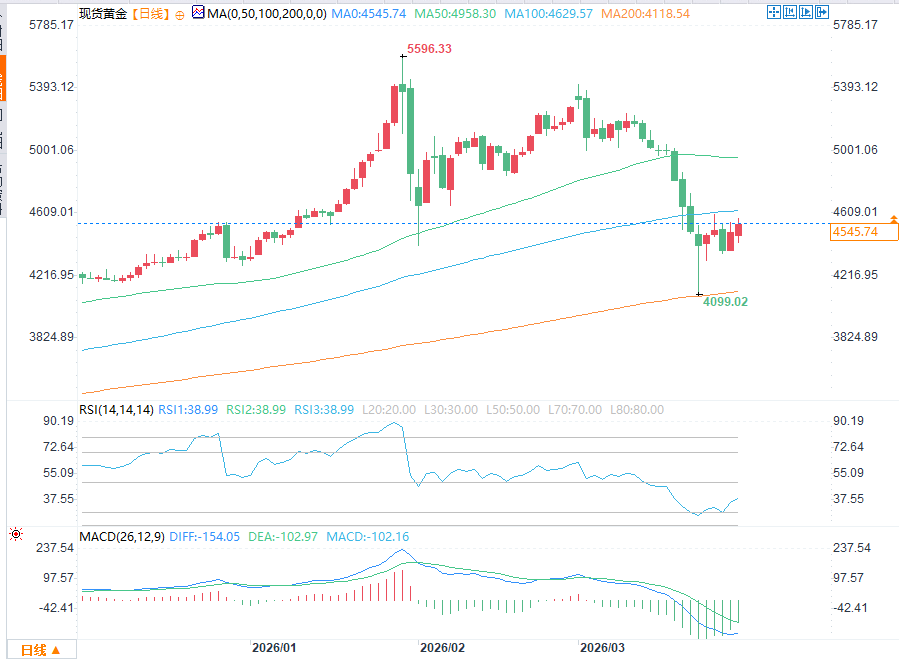
(Spot gold daily chart source: FX678)
Energy and bond market performance
Crude oil prices surged: Brent crude approached or exceeded $115 per barrel, while WTI crude was around $99-104 per barrel (around $103.45 during the session).
Global government bond prices saw safe-haven buying amid concerns about economic growth, with sovereign bond prices rising in countries such as the United States, the United Kingdom, and Japan, as bonds previously sold off due to inflation expectations rebounded.
Macquarie Group strategist Gareth Berry said that if the war remains unresolved, markets will have to imagine a more severe global economic landscape a month from now.
In terms of external markets, the US dollar index rose slightly in the morning, and the yield on 10-year US Treasury bonds fluctuated around 4.35%-4.4%.
In the short term, the price movements of gold and other precious metals will remain highly dependent on the progress of the Middle East war (especially the ongoing military confrontation between the two sides), oil price dynamics, and the Federal Reserve's further assessment of the balance between inflation and growth.
This week, the US will release a series of important economic data, including job openings, retail sales, the ADP employment report, and non-farm payrolls. The market will use this data to further assess the resilience of the economy.
KitcoMetals senior analyst Jim Wyckoff said, "The war continues with no end in sight, which is pushing up gold prices as safe-haven demand picks up again. In the short term, market focus will be on the war, oil prices, bond yields, and the US dollar index."
Despite today's rebound, gold has fallen about 14% so far in March, impacted by soaring energy prices due to ongoing Middle East conflict, heightened inflation concerns, and adjustments in interest rate expectations. This is expected to be its worst monthly performance since 2008. Gold, traditionally a hedge against inflation and geopolitical uncertainty, has become less attractive in a high-interest-rate environment because it does not generate interest.
A month into the war, both sides are still exchanging fire fiercely, and the uncertainty surrounding its end is exacerbating market anxieties.
The Middle East conflict has lasted for about a month, with the United States and Israel continuing to launch intensive strikes against Iranian military, nuclear facilities and energy targets. Iran, in turn, has launched multiple rounds of missiles and rockets into Israel and the Gulf region in conjunction with the Houthi rebels and other forces. Recently, there have been rocket attacks on northern and central Israel as well as attacks on targets such as the Haifa oil refinery. The situation of "frenzied mutual firing" between the two sides has not shown any significant signs of abating.
As the war entered its second month, market concerns that the conflict would not end in the short term increased significantly. Traffic in the Strait of Hormuz plummeted to crisis levels, leading to a global oil supply shortage of approximately 15 million barrels per day, and the energy crisis continued to worsen.
Iran has called the US-proposed peace plan "unrealistic" and deemed its demands too harsh. Analysts and investors are beginning to worry that a prolonged war could lead to a similar stagnation in global economic growth as seen during the COVID-19 pandemic, with fuel shortages further amplifying economic uncertainty. This protracted concern has fueled risk aversion and intensified assessments of dual pressures on inflation and growth.
US President Trump stated that he would destroy Iranian energy facilities unless Iran immediately opens the Strait of Hormuz, expressing a desire to "seize Iranian oil resources" and potentially even control Hag Island, a key export base. He compared this to his previous actions in Venezuela.
The U.S. military continues to build up forces in the Persian Gulf region, including amphibious assault teams, the 82nd Airborne Division, and the recently deployed 3,500 Marines. Trump stated on Sunday that an agreement to end the war could be reached soon, but Iran denied this and warned the U.S. against a ground invasion.
Federal Reserve Chairman Jerome Powell stated that he is closely monitoring the impact of the war, leading to a reversal in market expectations for interest rate hikes.
Federal Reserve Chairman Jerome Powell stated that the Fed is fully prepared to closely monitor the impact of the war with Iran on the U.S. economy and inflation. He emphasized, "In the near term, rising energy prices will push up overall inflation, but it is too early to judge the scope and duration of its impact on the economy. We will continue to monitor potential risks to our dual mandate (full employment and price stability)."
Powell has repeatedly stated that "no one knows" the full economic impact of the war, and it is too early to make a judgment. Earlier this month, the Federal Reserve kept the overnight benchmark interest rate unchanged at 3.50%-3.75%.
Powell's cautious remarks reflect market uncertainty about the long-term impact of the war: while soaring oil prices have brought temporary inflationary pressures, a prolonged conflict leading to slower economic growth would complicate the Fed's policy space. Previously, rising oil prices reinforced market expectations of interest rate hikes, but as concerns about a global economic slowdown intensified (energy shortages could trigger economic stagnation), investors turned to government bonds as a safe haven, driving up bond prices and lowering yields. Market pricing indicates that bets on Fed rate hikes have been withdrawn, with investors now pricing in the possibility of rate cuts this year.
City Index market analysts point out that the $4,700-$4,750 area will be a key resistance level for a short-term gold rally. "If gold prices fail to break through this area effectively, this rally could fade quickly, just like previous ones."
(Spot gold daily chart source: FX678)
Energy and bond market performance
Crude oil prices surged: Brent crude approached or exceeded $115 per barrel, while WTI crude was around $99-104 per barrel (around $103.45 during the session).
Global government bond prices saw safe-haven buying amid concerns about economic growth, with sovereign bond prices rising in countries such as the United States, the United Kingdom, and Japan, as bonds previously sold off due to inflation expectations rebounded.
Macquarie Group strategist Gareth Berry said that if the war remains unresolved, markets will have to imagine a more severe global economic landscape a month from now.
In terms of external markets, the US dollar index rose slightly in the morning, and the yield on 10-year US Treasury bonds fluctuated around 4.35%-4.4%.
In the short term, the price movements of gold and other precious metals will remain highly dependent on the progress of the Middle East war (especially the ongoing military confrontation between the two sides), oil price dynamics, and the Federal Reserve's further assessment of the balance between inflation and growth.
This week, the US will release a series of important economic data, including job openings, retail sales, the ADP employment report, and non-farm payrolls. The market will use this data to further assess the resilience of the economy.
- Risk Warning and Disclaimer
- The market involves risk, and trading may not be suitable for all investors. This article is for reference only and does not constitute personal investment advice, nor does it take into account certain users’ specific investment objectives, financial situation, or other needs. Any investment decisions made based on this information are at your own risk.