Why is it difficult for Brent crude oil to fall further?
2026-03-31 01:12:43
The US government has now completely lost its dominance in public opinion regarding the Middle East situation. Previously, the Trump administration first issued a 24-hour ultimatum to Iran, which was later extended to five days, threatening to "destroy" Iran's entire power grid if it did not compromise, in an attempt to force Iran to make concessions. However, Iran chose to respond strongly and resolutely follow suit.
After its pressure efforts failed, the US revealed its true colors: deploying 2,500 additional Marines to the Middle East theater, with reports suggesting that Kharg Island, Iran's largest oil export hub, will be among the first locations to be deployed. To date, the total number of US troops stationed in the Middle East has exceeded 50,000, further escalating the military standoff between the two sides.
It's worth noting that the current US administration is shifting its previous stance of unconditional support for the Netanyahu government in Israel, with Vance leading peace talks with Iran. If these talks succeed in breaking the current deadlock, it will significantly boost Vance's chances of winning the next presidential election; however, we will not elaborate on this further here.
So, what does this series of developments mean for oil prices? The answer is clear—oil prices will continue to rise significantly. The current conflict between the US and Iran is still escalating and far from its peak. The continued development of geopolitical risks will further support high oil prices.
From the perspective of oil price pricing logic, multiple signals indicate that Brent crude oil is unlikely to fall back below $70 per barrel in the long term, and this judgment is well supported by evidence.
The core reason for the persistently high oil prices
First, the futures contract structure is sending a clear signal of high levels. The December 2026 Brent crude oil futures contract is showing a premium to the spot price, with the current price more than 10% higher than the pre-war contract for the same month, reflecting market concerns about long-term crude oil supply.
Secondly, crude oil supply capacity is severely constrained. Global paper idle crude oil capacity once reached 6.75 million barrels per day, but only 3.5 million barrels per day were actually usable, all concentrated in Saudi Arabia. Although Saudi Arabia can export nearly 5 million barrels per day of crude oil to Yanbu Port, the bottleneck of the Strait of Hormuz continues to restrict global crude oil transportation—this strait handles nearly 30% of global seaborne oil trade, with an average daily throughput of about 20 million barrels, and currently still holds back about 15 million barrels per day of capacity. However, it should be noted that some crude oil tankers from China and India can still pass through this strait smoothly. Furthermore, global floating crude oil storage is almost exhausted, further weakening the market's supply regulation capacity.
Finally, the collapse of liquefied natural gas (LNG) supply has dragged down crude oil production. The global LNG supply system is currently paralyzed, forcing the shutdown of a large amount of crude oil production. Qatar's LNG production capacity has decreased by 17%, and the shutdown is expected to last for 3 to 5 years. This supply gap is unlikely to be filled in the short term, further exacerbating the tense situation in the global energy market.
The quietly emerging cracks in the global economy
High energy prices have begun to trigger a chain reaction in the global economy. Last week, UBS froze $469 million in its Euroinvest real estate fund due to investor redemption requests exhausting the fund's liquidity; investors' funds will be locked up for up to 36 months. Affected by similar liquidity pressures, prominent asset management firms such as Apollo, Blackstone, and Ares have all implemented redemption limits on their private credit funds. This is the first major European real estate fund to "close and limit liquidity" since the outbreak of the current Middle East conflict, and industry insiders generally believe this will not be the last.
Faced with the economic pressure brought about by the energy shock, the European Central Bank (ECB) is also caught in a dilemma. ECB President Christine Lagarde publicly proposed three response scenarios: wait-and-see approach, gradual adjustment, and strong intervention. This statement is tantamount to an open admission that the central bank has not yet determined its final response path, highlighting the complexity of the current economic situation.
There is another set of data that has been completely ignored by the market and deserves serious attention. Steve Hank of Johns Hopkins University and former U.S. Comptroller David Walker published an article in Fortune magazine last week, citing data from the U.S. Treasury Department's fiscal year 2025 financial statements (which were almost unreported by the media when they were released), pointing out that U.S. federal assets are only $6.06 trillion, while liabilities are as high as $47.78 trillion; if the funding gaps for Social Security, Medicare, and other non-reserved areas are included, the total committed federal liabilities exceed $136 trillion.
The two authors used a simple analogy to make the data easier to understand: dividing all the data by 100 million equates to a family's annual income of $52,446, annual expenses of $73,378, liabilities of $1,361,788, and assets of only $60,554—meaning the United States is mired in a $1.3 million "household debt hole." It's worth noting that the U.S. Government Accountability Office has refused to issue certification opinions on federal financial statements for 29 consecutive years, highlighting the severity of its fiscal situation.
US Debt: Seemingly Normal, But Hidden Crisis
On the surface, the US debt-to-GDP ratio of 264% appears lower than that of Japan (372%), Hong Kong (380%), and Singapore (347%), suggesting that the debt level is not extreme. However, in reality, the US debt exhibits three major anomalies, concealing significant risks:
First, the debt growth rate is abnormal. In peacetime and with full employment, the US debt is expanding at a rate of about 7% of GDP per year, a rate far exceeding that of almost all developed economies, and is unsustainable in the long run.
Second, there is a huge hidden gap. The total debt of $136 trillion includes committed liabilities such as social security and health insurance that are not included in the official balance sheet. Currently, no country has a welfare program without cash reserves that is as large as the tax base as the United States.
Third, there is an over-reliance on overseas investors. Japan's government debt ratio has reached 199% but has been able to maintain it, mainly because almost all of its debt is held by domestic investors in yen. In contrast, the United States is highly dependent on overseas investors to purchase US Treasury bonds. These overseas buyers are closely monitoring the oil price of $112 per barrel, the rising inflation, and the seemingly endless conflict in the Middle East. If overseas investors reduce their bond purchases in the future, it will directly impact the stability of the US debt.
Asian Markets: China Stockpiles Goods to Cope with Supply Shortages
Affected by tight global crude oil supply and increased transportation risks, crude oil arrivals have dropped sharply recently. Against this backdrop, China is making every effort to increase its crude oil reserves to cope with potential future supply gaps, which also reflects market concerns about crude oil supply.
Conclusions and Future Prospects
The global situation will be highly volatile over the next 24 months, and the current crude oil forward price curve has not yet fully factored in the impending escalation of hostility. It is worth noting that the main battleground between Iran and the United States is no longer limited to physical sea areas such as the Strait of Hormuz and the Bab el-Mandeb Strait, but has shifted to the global economic landscape. Currently, Iran appears to be holding a certain advantage.
The long-tail effect of high oil prices and disruptions to global shipping and logistics will force central banks around the world to act in unison with politicians and the military—choosing to raise interest rates rather than lower them to combat inflationary pressures. Against this backdrop, I recommend going long on 1000 lots of double-layered, extra-thick toilet paper contracts at market price.
WTI crude oil traders' positions
The market is currently experiencing a high concentration of long positions, while short positions continue to exit. Specifically, the "Other Reporting Traders" category has seen significant changes, with these accounts closing out 15,538 short positions, a 29% decrease week-on-week.
Specifically, in the Brent crude oil market last week, swap traders' short positions hit a record high, while their clients went long aggressively. In the WTI crude oil market this week, swap traders' clients' bullish sentiment did not weaken, with a slight increase of 0.81% week-on-week, further consolidating the bullish market trend.
Brent crude oil price forecast
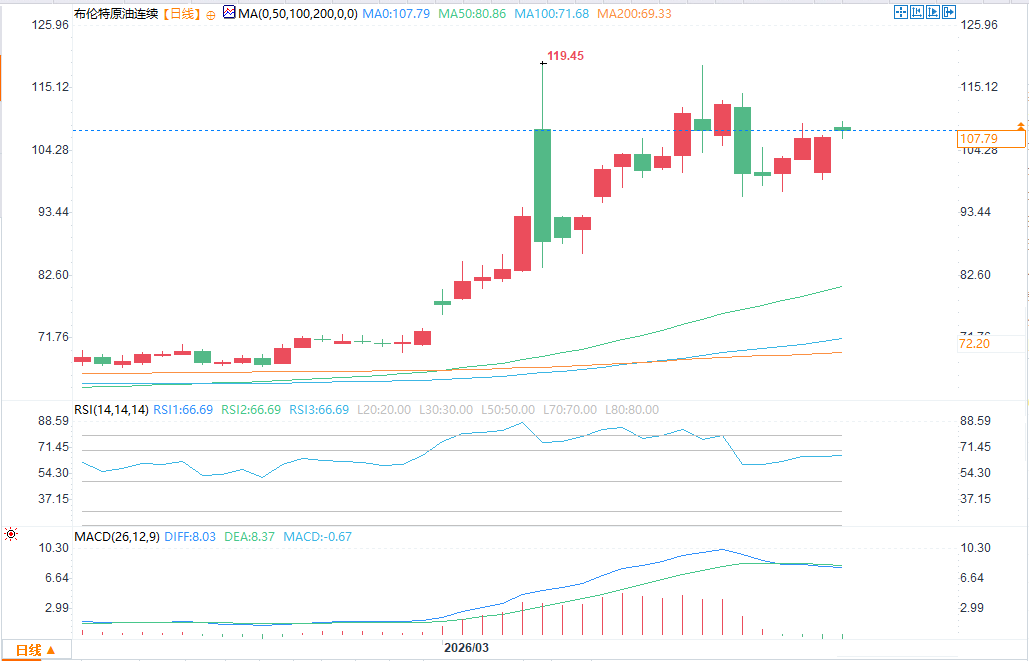
(Brent crude oil daily chart source: EasyForex)
Looking at the average cost of oil prices from a long-term perspective, the volume-weighted average price (VWAP) of Brent crude oil since 2000 is $73.22 per barrel. Current oil prices are significantly higher than this long-term average, reflecting the current tense market situation.
From a short- to medium-term perspective, oil price trends mainly depend on the situation in the Middle East: as long as the conflict maintains its current intensity and Iran does not negotiate with the US and its envoy through third-party channels such as Pakistan, oil prices will remain firm. However, if the situation reverses, oil prices will plummet.
As for the timing of short selling, extreme bullish signals from swap traders are worth noting for short sellers, but it is far from the right time to short. This signal only means that if oil prices rise excessively, there may be a short-term pullback trading opportunity.
Two core conditions must be met to trigger a bearish trend: first, there must be clear signs of easing tensions in the Middle East conflict; and second, swap traders must continue to increase their short positions.
This week's weekly chart structure is crucial for oil price movements: if oil prices fail to hold above $106.27/barrel, they will at least fall back to the previous gap range; however, the probability of oil prices continuing to rise after testing $106.27/barrel is higher.
Oil prices are currently fluctuating wildly, and short-term trends are highly uncertain. Too much prediction is not very meaningful—as previously mentioned, the trading assumptions given at 8 a.m. on Monday may have become invalid by 10 a.m. that same day.
After its pressure efforts failed, the US revealed its true colors: deploying 2,500 additional Marines to the Middle East theater, with reports suggesting that Kharg Island, Iran's largest oil export hub, will be among the first locations to be deployed. To date, the total number of US troops stationed in the Middle East has exceeded 50,000, further escalating the military standoff between the two sides.
It's worth noting that the current US administration is shifting its previous stance of unconditional support for the Netanyahu government in Israel, with Vance leading peace talks with Iran. If these talks succeed in breaking the current deadlock, it will significantly boost Vance's chances of winning the next presidential election; however, we will not elaborate on this further here.
So, what does this series of developments mean for oil prices? The answer is clear—oil prices will continue to rise significantly. The current conflict between the US and Iran is still escalating and far from its peak. The continued development of geopolitical risks will further support high oil prices.
From the perspective of oil price pricing logic, multiple signals indicate that Brent crude oil is unlikely to fall back below $70 per barrel in the long term, and this judgment is well supported by evidence.
The core reason for the persistently high oil prices
First, the futures contract structure is sending a clear signal of high levels. The December 2026 Brent crude oil futures contract is showing a premium to the spot price, with the current price more than 10% higher than the pre-war contract for the same month, reflecting market concerns about long-term crude oil supply.
Secondly, crude oil supply capacity is severely constrained. Global paper idle crude oil capacity once reached 6.75 million barrels per day, but only 3.5 million barrels per day were actually usable, all concentrated in Saudi Arabia. Although Saudi Arabia can export nearly 5 million barrels per day of crude oil to Yanbu Port, the bottleneck of the Strait of Hormuz continues to restrict global crude oil transportation—this strait handles nearly 30% of global seaborne oil trade, with an average daily throughput of about 20 million barrels, and currently still holds back about 15 million barrels per day of capacity. However, it should be noted that some crude oil tankers from China and India can still pass through this strait smoothly. Furthermore, global floating crude oil storage is almost exhausted, further weakening the market's supply regulation capacity.
Finally, the collapse of liquefied natural gas (LNG) supply has dragged down crude oil production. The global LNG supply system is currently paralyzed, forcing the shutdown of a large amount of crude oil production. Qatar's LNG production capacity has decreased by 17%, and the shutdown is expected to last for 3 to 5 years. This supply gap is unlikely to be filled in the short term, further exacerbating the tense situation in the global energy market.
The quietly emerging cracks in the global economy
High energy prices have begun to trigger a chain reaction in the global economy. Last week, UBS froze $469 million in its Euroinvest real estate fund due to investor redemption requests exhausting the fund's liquidity; investors' funds will be locked up for up to 36 months. Affected by similar liquidity pressures, prominent asset management firms such as Apollo, Blackstone, and Ares have all implemented redemption limits on their private credit funds. This is the first major European real estate fund to "close and limit liquidity" since the outbreak of the current Middle East conflict, and industry insiders generally believe this will not be the last.
Faced with the economic pressure brought about by the energy shock, the European Central Bank (ECB) is also caught in a dilemma. ECB President Christine Lagarde publicly proposed three response scenarios: wait-and-see approach, gradual adjustment, and strong intervention. This statement is tantamount to an open admission that the central bank has not yet determined its final response path, highlighting the complexity of the current economic situation.
There is another set of data that has been completely ignored by the market and deserves serious attention. Steve Hank of Johns Hopkins University and former U.S. Comptroller David Walker published an article in Fortune magazine last week, citing data from the U.S. Treasury Department's fiscal year 2025 financial statements (which were almost unreported by the media when they were released), pointing out that U.S. federal assets are only $6.06 trillion, while liabilities are as high as $47.78 trillion; if the funding gaps for Social Security, Medicare, and other non-reserved areas are included, the total committed federal liabilities exceed $136 trillion.
The two authors used a simple analogy to make the data easier to understand: dividing all the data by 100 million equates to a family's annual income of $52,446, annual expenses of $73,378, liabilities of $1,361,788, and assets of only $60,554—meaning the United States is mired in a $1.3 million "household debt hole." It's worth noting that the U.S. Government Accountability Office has refused to issue certification opinions on federal financial statements for 29 consecutive years, highlighting the severity of its fiscal situation.
US Debt: Seemingly Normal, But Hidden Crisis
On the surface, the US debt-to-GDP ratio of 264% appears lower than that of Japan (372%), Hong Kong (380%), and Singapore (347%), suggesting that the debt level is not extreme. However, in reality, the US debt exhibits three major anomalies, concealing significant risks:
First, the debt growth rate is abnormal. In peacetime and with full employment, the US debt is expanding at a rate of about 7% of GDP per year, a rate far exceeding that of almost all developed economies, and is unsustainable in the long run.
Second, there is a huge hidden gap. The total debt of $136 trillion includes committed liabilities such as social security and health insurance that are not included in the official balance sheet. Currently, no country has a welfare program without cash reserves that is as large as the tax base as the United States.
Third, there is an over-reliance on overseas investors. Japan's government debt ratio has reached 199% but has been able to maintain it, mainly because almost all of its debt is held by domestic investors in yen. In contrast, the United States is highly dependent on overseas investors to purchase US Treasury bonds. These overseas buyers are closely monitoring the oil price of $112 per barrel, the rising inflation, and the seemingly endless conflict in the Middle East. If overseas investors reduce their bond purchases in the future, it will directly impact the stability of the US debt.
Asian Markets: China Stockpiles Goods to Cope with Supply Shortages
Affected by tight global crude oil supply and increased transportation risks, crude oil arrivals have dropped sharply recently. Against this backdrop, China is making every effort to increase its crude oil reserves to cope with potential future supply gaps, which also reflects market concerns about crude oil supply.
Conclusions and Future Prospects
The global situation will be highly volatile over the next 24 months, and the current crude oil forward price curve has not yet fully factored in the impending escalation of hostility. It is worth noting that the main battleground between Iran and the United States is no longer limited to physical sea areas such as the Strait of Hormuz and the Bab el-Mandeb Strait, but has shifted to the global economic landscape. Currently, Iran appears to be holding a certain advantage.
The long-tail effect of high oil prices and disruptions to global shipping and logistics will force central banks around the world to act in unison with politicians and the military—choosing to raise interest rates rather than lower them to combat inflationary pressures. Against this backdrop, I recommend going long on 1000 lots of double-layered, extra-thick toilet paper contracts at market price.
WTI crude oil traders' positions
The market is currently experiencing a high concentration of long positions, while short positions continue to exit. Specifically, the "Other Reporting Traders" category has seen significant changes, with these accounts closing out 15,538 short positions, a 29% decrease week-on-week.
Specifically, in the Brent crude oil market last week, swap traders' short positions hit a record high, while their clients went long aggressively. In the WTI crude oil market this week, swap traders' clients' bullish sentiment did not weaken, with a slight increase of 0.81% week-on-week, further consolidating the bullish market trend.
Brent crude oil price forecast
(Brent crude oil daily chart source: EasyForex)
Looking at the average cost of oil prices from a long-term perspective, the volume-weighted average price (VWAP) of Brent crude oil since 2000 is $73.22 per barrel. Current oil prices are significantly higher than this long-term average, reflecting the current tense market situation.
From a short- to medium-term perspective, oil price trends mainly depend on the situation in the Middle East: as long as the conflict maintains its current intensity and Iran does not negotiate with the US and its envoy through third-party channels such as Pakistan, oil prices will remain firm. However, if the situation reverses, oil prices will plummet.
As for the timing of short selling, extreme bullish signals from swap traders are worth noting for short sellers, but it is far from the right time to short. This signal only means that if oil prices rise excessively, there may be a short-term pullback trading opportunity.
Two core conditions must be met to trigger a bearish trend: first, there must be clear signs of easing tensions in the Middle East conflict; and second, swap traders must continue to increase their short positions.
This week's weekly chart structure is crucial for oil price movements: if oil prices fail to hold above $106.27/barrel, they will at least fall back to the previous gap range; however, the probability of oil prices continuing to rise after testing $106.27/barrel is higher.
Oil prices are currently fluctuating wildly, and short-term trends are highly uncertain. Too much prediction is not very meaningful—as previously mentioned, the trading assumptions given at 8 a.m. on Monday may have become invalid by 10 a.m. that same day.
- Risk Warning and Disclaimer
- The market involves risk, and trading may not be suitable for all investors. This article is for reference only and does not constitute personal investment advice, nor does it take into account certain users’ specific investment objectives, financial situation, or other needs. Any investment decisions made based on this information are at your own risk.