Analysts: Gold's performance this year resembles a sell-off of risk assets, but the trend of de-dollarization still supports its long-term investment value.
2026-03-31 10:23:45
HSBC commodities analysts point out that gold's performance in 2026 is increasingly resembling that of a risk asset, experiencing significant sell-offs amid escalating geopolitical tensions and a stronger dollar, but the global trend of de-dollarization still makes it a worthwhile long-term investment.
HSBC Asset Management analysts wrote: "Gold prices have moved in ways that have completely defied market expectations since the outbreak of the conflict in Iran. Traditional trading logic suggests that escalating geopolitical tensions and economic uncertainty would naturally drive up gold prices, just like the 'Liberation Day' event last year, continuing the spectacular bull market of the past two years."
However, they pointed out that gold has reacted in the opposite way, falling by about 13% so far in March.
Analysts stated, "A stronger dollar undoubtedly poses a headwind, suppressing demand from non-US buyers, while the market's hawkish repricing of interest rates also increases the opportunity cost of holding non-yielding assets." "However, gold successfully withstood a similar sharp rise in the dollar and interest rates in 2022, which weakens the persuasiveness of conventional theories."
HSBC believes that gold is actually behaving more like a risk asset in 2026. They point out: "The gold holding population has shifted to retail investors and other leveraged buyers who are often forced to liquidate their positions during periods of market stress."
Analysts added, "Nevertheless, gold still has a sound long-term investment rationale, especially given the ongoing global trend of de-dollarization . However, recent sharp fluctuations also remind us that a more diversified strategy is necessary to achieve a sound asset allocation."
On February 15, HSBC’s chief precious metals analyst James Steel said that the precious metals market in 2026 will be characterized by volatility, with Federal Reserve policy and the dollar’s performance continuing to dominate market demand.
When asked why gold prices did not react to the decline in the yield on the 10-year U.S. Treasury note, which fell rapidly from 4.30% to 4.00% in just a few days, Steele was asked why gold prices did not react to the decline in the yield on the 10-year U.S. Treasury note.
He said, "You've hit the nail on the head. The change happened in 2022. Before that, if you looked at the 10-year real interest rate (the 10-year yield minus the inflation rate), it had a very nice negative correlation with the price of gold, a relationship that can be traced back to after the collapse of the Bretton Woods system and the decoupling of gold from the dollar."
Steele stated that this relationship has completely broken down in recent years. He said, " Gold is no longer as sensitive to real interest rates, especially the 10-year real interest rate, as it used to be ." "At the same time, we have also seen a large influx of retail investors, rising geopolitical risks, and continued gold purchases by central banks around the world."
He added, "I'm not saying the relationship will never be restored, but it's certainly not as strong as it used to be."
Steele was then asked whether Kevin Warsh's nomination was related to the recent trend of declining interest rates but a failure to rise gold prices, given that Warsh had expressed a desire to reduce the Federal Reserve's balance sheet.
He said, "As far as the Fed is concerned, as long as the Fed remains independent, I believe it will continue to remain independent, and that's the key point. Any threat to the Fed's independence will push up gold prices."
Steele was also asked how much of the current high price of gold can be attributed to its role as a hedge against currency devaluation.
He replied, “We don’t entirely see currency devaluation that way. We believe that the US dollar will remain the global reserve currency for the foreseeable future, and that ‘future’ will last a long time. But that doesn’t mean every central bank needs to hold as many dollars as it has in the past… One way to reduce dollar exposure is to buy gold.”
“I believe this is a key reason why central banks continue to buy gold. Since 2022, central bank gold purchases have consistently been two to two and a half times, and sometimes even three times, the average level of the previous 10 years.”
Steele also shared his views on the current market: while the artificial intelligence sector continues to reshape the broader stock market, funds do not appear to be flowing significantly into emerging market countries or the gold market.
He said, "Until recently, there was indeed an inflow of funds. The market has seen amazing gains over the past few years. For comparison, the long-term high for gold in January 1980 was $850, and when we broke through that level..."
Steele continued, “You hear a lot of talk about gold hitting new highs, but I personally prefer to look at it in terms of actual prices, that is, prices adjusted for inflation. At today’s prices, those highs were roughly equivalent to $3,400, and we broke that level in April. Gold has hit new highs many times, and although it hasn’t risen sharply recently, I don’t think that necessarily means the bull market is over.”
He said, "Don't forget, a lot of new money has poured into the market, and there was a parabolic rise in January. When the market rises in this way, it naturally causes volatility. I think 'volatility' will be the keyword for the gold market this year. " "Just because gold is a safe-haven asset and a quality asset doesn't mean it doesn't have volatility."
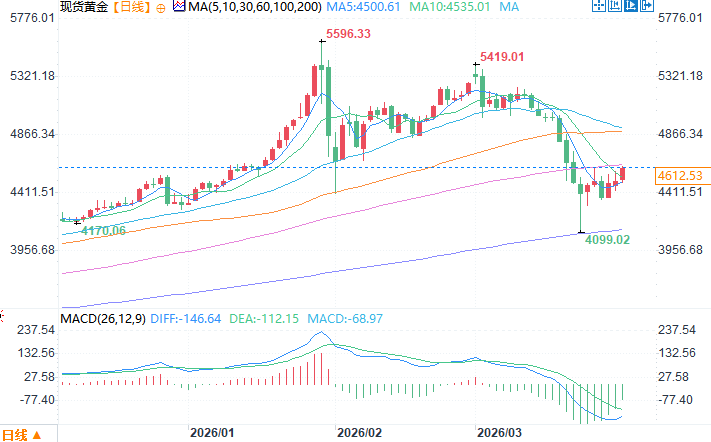
Spot gold daily chart source: EasyForex
At 10:23 AM Beijing time on March 31, spot gold was trading at $4584.53 per ounce.
HSBC Asset Management analysts wrote: "Gold prices have moved in ways that have completely defied market expectations since the outbreak of the conflict in Iran. Traditional trading logic suggests that escalating geopolitical tensions and economic uncertainty would naturally drive up gold prices, just like the 'Liberation Day' event last year, continuing the spectacular bull market of the past two years."
However, they pointed out that gold has reacted in the opposite way, falling by about 13% so far in March.
Analysts stated, "A stronger dollar undoubtedly poses a headwind, suppressing demand from non-US buyers, while the market's hawkish repricing of interest rates also increases the opportunity cost of holding non-yielding assets." "However, gold successfully withstood a similar sharp rise in the dollar and interest rates in 2022, which weakens the persuasiveness of conventional theories."
HSBC believes that gold is actually behaving more like a risk asset in 2026. They point out: "The gold holding population has shifted to retail investors and other leveraged buyers who are often forced to liquidate their positions during periods of market stress."
Analysts added, "Nevertheless, gold still has a sound long-term investment rationale, especially given the ongoing global trend of de-dollarization . However, recent sharp fluctuations also remind us that a more diversified strategy is necessary to achieve a sound asset allocation."
On February 15, HSBC’s chief precious metals analyst James Steel said that the precious metals market in 2026 will be characterized by volatility, with Federal Reserve policy and the dollar’s performance continuing to dominate market demand.
When asked why gold prices did not react to the decline in the yield on the 10-year U.S. Treasury note, which fell rapidly from 4.30% to 4.00% in just a few days, Steele was asked why gold prices did not react to the decline in the yield on the 10-year U.S. Treasury note.
He said, "You've hit the nail on the head. The change happened in 2022. Before that, if you looked at the 10-year real interest rate (the 10-year yield minus the inflation rate), it had a very nice negative correlation with the price of gold, a relationship that can be traced back to after the collapse of the Bretton Woods system and the decoupling of gold from the dollar."
Steele stated that this relationship has completely broken down in recent years. He said, " Gold is no longer as sensitive to real interest rates, especially the 10-year real interest rate, as it used to be ." "At the same time, we have also seen a large influx of retail investors, rising geopolitical risks, and continued gold purchases by central banks around the world."
He added, "I'm not saying the relationship will never be restored, but it's certainly not as strong as it used to be."
Steele was then asked whether Kevin Warsh's nomination was related to the recent trend of declining interest rates but a failure to rise gold prices, given that Warsh had expressed a desire to reduce the Federal Reserve's balance sheet.
He said, "As far as the Fed is concerned, as long as the Fed remains independent, I believe it will continue to remain independent, and that's the key point. Any threat to the Fed's independence will push up gold prices."
Steele was also asked how much of the current high price of gold can be attributed to its role as a hedge against currency devaluation.
He replied, “We don’t entirely see currency devaluation that way. We believe that the US dollar will remain the global reserve currency for the foreseeable future, and that ‘future’ will last a long time. But that doesn’t mean every central bank needs to hold as many dollars as it has in the past… One way to reduce dollar exposure is to buy gold.”
“I believe this is a key reason why central banks continue to buy gold. Since 2022, central bank gold purchases have consistently been two to two and a half times, and sometimes even three times, the average level of the previous 10 years.”
Steele also shared his views on the current market: while the artificial intelligence sector continues to reshape the broader stock market, funds do not appear to be flowing significantly into emerging market countries or the gold market.
He said, "Until recently, there was indeed an inflow of funds. The market has seen amazing gains over the past few years. For comparison, the long-term high for gold in January 1980 was $850, and when we broke through that level..."
Steele continued, “You hear a lot of talk about gold hitting new highs, but I personally prefer to look at it in terms of actual prices, that is, prices adjusted for inflation. At today’s prices, those highs were roughly equivalent to $3,400, and we broke that level in April. Gold has hit new highs many times, and although it hasn’t risen sharply recently, I don’t think that necessarily means the bull market is over.”
He said, "Don't forget, a lot of new money has poured into the market, and there was a parabolic rise in January. When the market rises in this way, it naturally causes volatility. I think 'volatility' will be the keyword for the gold market this year. " "Just because gold is a safe-haven asset and a quality asset doesn't mean it doesn't have volatility."
Spot gold daily chart source: EasyForex
At 10:23 AM Beijing time on March 31, spot gold was trading at $4584.53 per ounce.
- Risk Warning and Disclaimer
- The market involves risk, and trading may not be suitable for all investors. This article is for reference only and does not constitute personal investment advice, nor does it take into account certain users’ specific investment objectives, financial situation, or other needs. Any investment decisions made based on this information are at your own risk.