Gold Trading Alert: Dollar Collapse + Hopes for Iranian Ceasefire Drive Gold Prices to Rebound for Four Consecutive Days; Market Focuses on Trump's Speech!
2026-04-02 07:32:40
Gold prices rose for the fourth consecutive trading day on Wednesday (April 1), boosted by a weaker dollar and expectations of easing tensions in the Middle East. Spot gold briefly touched a high of $4,792 before closing up 1.9% at $4,758 per ounce, while U.S. gold futures surged 2.9% to $4,813.10. Currently, investors are focused on Trump's upcoming national address. Will the conflict truly de-escalate? Will expectations of a Federal Reserve rate cut be rekindled? These uncertainties are making the gold market a focal point of global investment.
The dollar index fell for the second consecutive trading day on Tuesday, closing at 99.55, down 0.33%, after hitting a one-week low during the session. This directly increased the attractiveness of dollar-denominated gold to holders of other currencies. A weaker dollar is usually a significant supporting factor for gold prices, as it lowers the barrier for non-US investors to purchase gold.
Meanwhile, cautious optimism in the market regarding a potential de-escalation of the Middle East conflict further boosted risk assets. Trump tweeted on Truth Social that Iran had requested a ceasefire, a claim quickly denied by the Iranian Foreign Ministry, but discussions are indeed underway. Trump is scheduled to deliver a national address on Thursday morning Beijing time, offering "significant progress" on the Iran issue. These signals have caused some safe-haven funds to flow out of gold and into riskier assets such as stocks, but they have also opened up new upside potential for gold—if the situation truly develops in a de-escalation direction, expectations of interest rate cuts may resurface, providing more sustained support for gold prices.
Bob Haberkorn, senior market strategist at RJO Futures, pointed out that if the situation in the Middle East eases, gold prices are expected to return above $5,000 per ounce, and the return of expectations for interest rate cuts will further strengthen this trend. Currently, gold prices have gradually recovered from the previous correction caused by the war-driven rise in oil prices and inflation concerns, but volatility remains significant. Investors need to closely monitor the dynamics of the Strait of Hormuz, a key choke point.
Since the start of the US-Israeli military action against Iran in late February, the ongoing attacks in the Middle East have made gold a preferred safe-haven asset. However, recent developments suggest that hopes for a ceasefire are rising. In an interview with Reuters, Trump stated that the US would soon end the war against Iran and might conduct "targeted strikes" if necessary. White House officials have also hinted that Trump will reiterate his timeline of ending the war within two to three weeks in a national address.
Iran, on the other hand, is demanding a guaranteed ceasefire to permanently end the conflict. A senior Iranian source revealed that intermediaries have contacted Iran, but negotiations for a temporary ceasefire have not yet begun. Meanwhile, US Vice President Vance, through Pakistani intermediaries, continues communication, emphasizing that Trump is willing to accept a ceasefire if demands such as the reopening of the Strait of Hormuz are met. Although spokespeople for the Iranian Ministry of Defense and Ministry of Foreign Affairs stressed their preparedness for any attack and targeted the withdrawal of US troops from the Middle East, the overall atmosphere has shifted from intense confrontation to diplomatic mediation.
This expectation of easing tensions directly dampened safe-haven buying of the dollar. The dollar, which had previously benefited from safe-haven demand due to conflict, saw a significant reversal in trading as risk appetite recovered. Oil prices also fell, with Brent crude dropping 2.7% to $101.16 per barrel, having briefly dipped below $100 to $98.46 during the session. This eased market concerns about persistent inflation triggered by supply shocks. Eugene Epstein, head of Moneycorp, analyzed that while short-term inflation may rise, this is essentially a supply shock that will ultimately manifest as slower economic growth. The Federal Reserve is unlikely to raise interest rates in the context of an economic slowdown, and the trading logic behind the previous sharp dollar appreciation is being dismantled.
Despite this, attacks continue in various parts of the Middle East, such as drone strikes on fuel tanks at Kuwait Airport and missile attacks on oil tankers, keeping markets cautious. The International Energy Agency, the IMF, and the World Bank have coordinated their responses to the global impact of the war, warning of its "significant, global, and highly asymmetric" effects. These factors have prevented gold's safe-haven appeal from completely disappearing, instead leading to trading based on expectations of "post-easing monetary policy."
While geopolitical factors are a focus, domestic US economic data has also become a significant variable influencing gold prices. Wednesday's ADP National Employment Report showed that the US private sector added 62,000 jobs in March, better than expected, continuing its steady growth after an upward revision in February. Retail sales also rebounded strongly in February, climbing 0.6%, exceeding expectations.
In the manufacturing sector, the ISM Manufacturing PMI rose to 52.7, the highest since August 2022, while the Prices Paid index surged to 78.3, indicating increased pressure on input costs. These data reinforced market confidence in the resilience of the US economy, briefly pushing up US Treasury yields, with the 10-year Treasury yield rising slightly to 4.313%. However, analysts pointed out that the ADP report lacked breadth, and actual retail sales, adjusted for inflation, may have shown negative cumulative growth in the first quarter.
This week's focus will shift to Friday's March non-farm payrolls report, with economists predicting 60,000 new jobs. A sharp deterioration in the labor market would reignite expectations of a Federal Reserve rate cut this year. Previously, the market had largely ruled out a rate cut due to concerns about rising oil prices and inflation caused by the Iran war. Now, with the war potentially ending and the assessment that energy prices have peaked gaining traction, interest rate futures have shifted from pricing in a rate hike to anticipating a small rate cut, priced in around 7 basis points.
Kevin Flanagan, head of fixed income strategy at WisdomTree, said the Federal Reserve is highly likely to hold rates steady in the short to medium term to assess the impact of the war, inflation, and the economy. If the war ends before the new Fed chair takes office this summer, the market will refocus on traditional monetary policy factors. These changes are a double-edged sword for gold: a strong economy may suppress the benefits of rate cuts, but expectations of easing due to a de-escalation of the conflict will provide positive support.
Trump's statements extend beyond Iran. He stated he was "absolutely" considering withdrawing the US from NATO, criticizing NATO for failing to support the US in the war and calling it a "paper tiger." This further exacerbated the divide between the US and Europe and added uncertainty to the global geopolitical landscape. European countries, meanwhile, emphasized that NATO's actions in the Strait of Hormuz could violate international law.
Furthermore, Trump emphasized that U.S. actions have ensured Iran cannot possess nuclear weapons and planned to announce related progress in his speech. While these remarks indicate a U.S. desire for a swift withdrawal, they also suggest that military options have not been completely ruled out. Iranian intelligence assessments, believing themselves to be in a favorable position, have no intention of substantive negotiations, further complicating the situation.
In summary, gold prices will continue to be driven by expectations of a ceasefire in the Middle East and the performance of the US dollar in the short term. If Trump's speech releases clear signals of de-escalation, gold prices may test higher resistance levels; conversely, if the conflict continues or new attacks escalate, safe-haven demand will push gold prices up again. In the long term, the Fed's policy shift, expectations of slower economic growth, and the recovery process of the global energy market will determine whether gold can break through the $5,000 mark and establish a foothold.
Overall, the gold market is currently in a sensitive window where geopolitical easing and macroeconomic policy expectations intertwine. Investors need to remain vigilant and closely monitor Trump's speeches, Middle East diplomatic developments, and upcoming US employment and inflation data. Against the backdrop of continued uncertainty, gold's value as a diversification tool remains prominent, but short-term volatility may intensify. In the coming days, market sentiment may determine whether this rebound can evolve into a new upward trend.
On Thursday (April 2) in early Asian trading, spot gold continued its upward trend, reaching a high of $4,800.33 per ounce as of 07:31, the highest level since March 19, with an increase of about 0.89%.
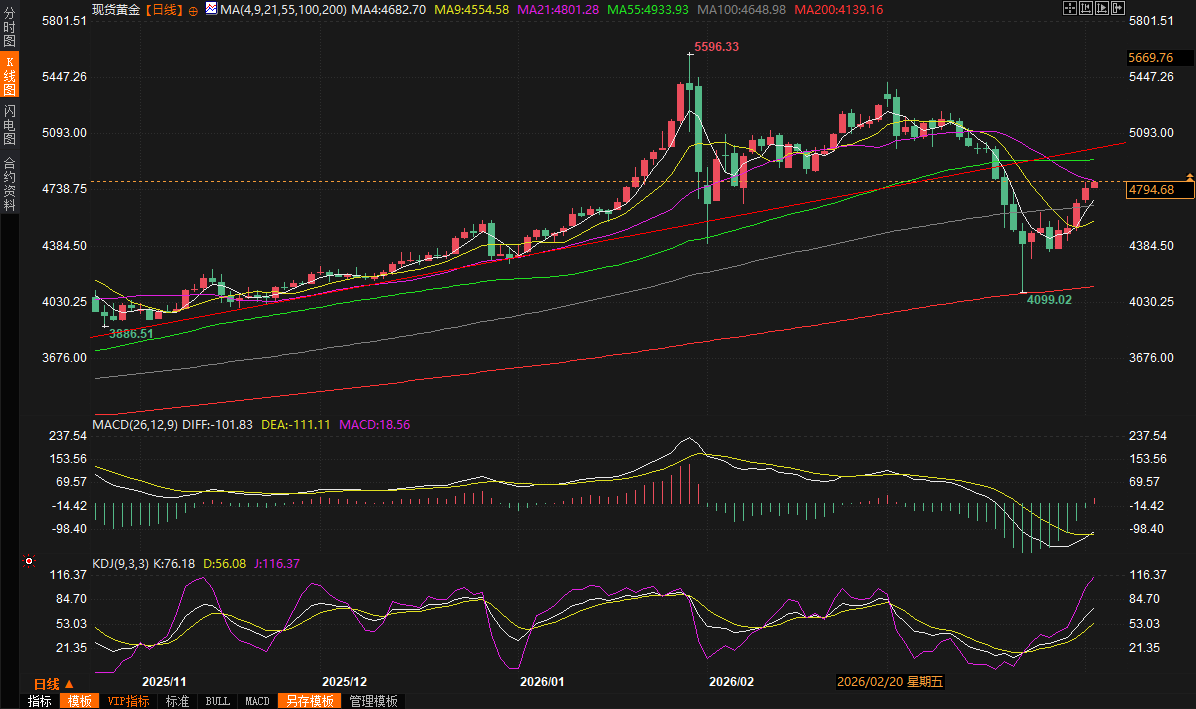
(Spot gold daily chart, source: FX678)
At 07:31 Beijing time, spot gold was trading at $4796.24 per ounce.
A weaker dollar and improved risk appetite led to a technical rebound in gold prices.
The dollar index fell for the second consecutive trading day on Tuesday, closing at 99.55, down 0.33%, after hitting a one-week low during the session. This directly increased the attractiveness of dollar-denominated gold to holders of other currencies. A weaker dollar is usually a significant supporting factor for gold prices, as it lowers the barrier for non-US investors to purchase gold.
Meanwhile, cautious optimism in the market regarding a potential de-escalation of the Middle East conflict further boosted risk assets. Trump tweeted on Truth Social that Iran had requested a ceasefire, a claim quickly denied by the Iranian Foreign Ministry, but discussions are indeed underway. Trump is scheduled to deliver a national address on Thursday morning Beijing time, offering "significant progress" on the Iran issue. These signals have caused some safe-haven funds to flow out of gold and into riskier assets such as stocks, but they have also opened up new upside potential for gold—if the situation truly develops in a de-escalation direction, expectations of interest rate cuts may resurface, providing more sustained support for gold prices.
Bob Haberkorn, senior market strategist at RJO Futures, pointed out that if the situation in the Middle East eases, gold prices are expected to return above $5,000 per ounce, and the return of expectations for interest rate cuts will further strengthen this trend. Currently, gold prices have gradually recovered from the previous correction caused by the war-driven rise in oil prices and inflation concerns, but volatility remains significant. Investors need to closely monitor the dynamics of the Strait of Hormuz, a key choke point.
Market sentiment was dominated by expectations of easing tensions in the Middle East, leading to a divergence in safe-haven demand.
Since the start of the US-Israeli military action against Iran in late February, the ongoing attacks in the Middle East have made gold a preferred safe-haven asset. However, recent developments suggest that hopes for a ceasefire are rising. In an interview with Reuters, Trump stated that the US would soon end the war against Iran and might conduct "targeted strikes" if necessary. White House officials have also hinted that Trump will reiterate his timeline of ending the war within two to three weeks in a national address.
Iran, on the other hand, is demanding a guaranteed ceasefire to permanently end the conflict. A senior Iranian source revealed that intermediaries have contacted Iran, but negotiations for a temporary ceasefire have not yet begun. Meanwhile, US Vice President Vance, through Pakistani intermediaries, continues communication, emphasizing that Trump is willing to accept a ceasefire if demands such as the reopening of the Strait of Hormuz are met. Although spokespeople for the Iranian Ministry of Defense and Ministry of Foreign Affairs stressed their preparedness for any attack and targeted the withdrawal of US troops from the Middle East, the overall atmosphere has shifted from intense confrontation to diplomatic mediation.
This expectation of easing tensions directly dampened safe-haven buying of the dollar. The dollar, which had previously benefited from safe-haven demand due to conflict, saw a significant reversal in trading as risk appetite recovered. Oil prices also fell, with Brent crude dropping 2.7% to $101.16 per barrel, having briefly dipped below $100 to $98.46 during the session. This eased market concerns about persistent inflation triggered by supply shocks. Eugene Epstein, head of Moneycorp, analyzed that while short-term inflation may rise, this is essentially a supply shock that will ultimately manifest as slower economic growth. The Federal Reserve is unlikely to raise interest rates in the context of an economic slowdown, and the trading logic behind the previous sharp dollar appreciation is being dismantled.
Despite this, attacks continue in various parts of the Middle East, such as drone strikes on fuel tanks at Kuwait Airport and missile attacks on oil tankers, keeping markets cautious. The International Energy Agency, the IMF, and the World Bank have coordinated their responses to the global impact of the war, warning of its "significant, global, and highly asymmetric" effects. These factors have prevented gold's safe-haven appeal from completely disappearing, instead leading to trading based on expectations of "post-easing monetary policy."
US economic data remains resilient, but the Federal Reserve's interest rate path faces repricing.
While geopolitical factors are a focus, domestic US economic data has also become a significant variable influencing gold prices. Wednesday's ADP National Employment Report showed that the US private sector added 62,000 jobs in March, better than expected, continuing its steady growth after an upward revision in February. Retail sales also rebounded strongly in February, climbing 0.6%, exceeding expectations.
In the manufacturing sector, the ISM Manufacturing PMI rose to 52.7, the highest since August 2022, while the Prices Paid index surged to 78.3, indicating increased pressure on input costs. These data reinforced market confidence in the resilience of the US economy, briefly pushing up US Treasury yields, with the 10-year Treasury yield rising slightly to 4.313%. However, analysts pointed out that the ADP report lacked breadth, and actual retail sales, adjusted for inflation, may have shown negative cumulative growth in the first quarter.
This week's focus will shift to Friday's March non-farm payrolls report, with economists predicting 60,000 new jobs. A sharp deterioration in the labor market would reignite expectations of a Federal Reserve rate cut this year. Previously, the market had largely ruled out a rate cut due to concerns about rising oil prices and inflation caused by the Iran war. Now, with the war potentially ending and the assessment that energy prices have peaked gaining traction, interest rate futures have shifted from pricing in a rate hike to anticipating a small rate cut, priced in around 7 basis points.
Kevin Flanagan, head of fixed income strategy at WisdomTree, said the Federal Reserve is highly likely to hold rates steady in the short to medium term to assess the impact of the war, inflation, and the economy. If the war ends before the new Fed chair takes office this summer, the market will refocus on traditional monetary policy factors. These changes are a double-edged sword for gold: a strong economy may suppress the benefits of rate cuts, but expectations of easing due to a de-escalation of the conflict will provide positive support.
Trump's comments about withdrawing from NATO add uncertainty; outlook for gold.
Trump's statements extend beyond Iran. He stated he was "absolutely" considering withdrawing the US from NATO, criticizing NATO for failing to support the US in the war and calling it a "paper tiger." This further exacerbated the divide between the US and Europe and added uncertainty to the global geopolitical landscape. European countries, meanwhile, emphasized that NATO's actions in the Strait of Hormuz could violate international law.
Furthermore, Trump emphasized that U.S. actions have ensured Iran cannot possess nuclear weapons and planned to announce related progress in his speech. While these remarks indicate a U.S. desire for a swift withdrawal, they also suggest that military options have not been completely ruled out. Iranian intelligence assessments, believing themselves to be in a favorable position, have no intention of substantive negotiations, further complicating the situation.
In summary, gold prices will continue to be driven by expectations of a ceasefire in the Middle East and the performance of the US dollar in the short term. If Trump's speech releases clear signals of de-escalation, gold prices may test higher resistance levels; conversely, if the conflict continues or new attacks escalate, safe-haven demand will push gold prices up again. In the long term, the Fed's policy shift, expectations of slower economic growth, and the recovery process of the global energy market will determine whether gold can break through the $5,000 mark and establish a foothold.
Overall, the gold market is currently in a sensitive window where geopolitical easing and macroeconomic policy expectations intertwine. Investors need to remain vigilant and closely monitor Trump's speeches, Middle East diplomatic developments, and upcoming US employment and inflation data. Against the backdrop of continued uncertainty, gold's value as a diversification tool remains prominent, but short-term volatility may intensify. In the coming days, market sentiment may determine whether this rebound can evolve into a new upward trend.
On Thursday (April 2) in early Asian trading, spot gold continued its upward trend, reaching a high of $4,800.33 per ounce as of 07:31, the highest level since March 19, with an increase of about 0.89%.
(Spot gold daily chart, source: FX678)
At 07:31 Beijing time, spot gold was trading at $4796.24 per ounce.
- Risk Warning and Disclaimer
- The market involves risk, and trading may not be suitable for all investors. This article is for reference only and does not constitute personal investment advice, nor does it take into account certain users’ specific investment objectives, financial situation, or other needs. Any investment decisions made based on this information are at your own risk.