From low hiring and low layoffs to zero hiring, the oil price shock exposes the weakest link in the US economy.
2026-04-03 15:20:35
U.S. job growth has virtually stalled. While this might have been tolerable for policymakers or investors before the Iran war, it is likely no longer so.
The labor market has been deteriorating for some time, but this trend has been masked by the overall unemployment rate. The current unemployment rate is 4.4%, which is still relatively low by historical standards; however, the labor market is practically stagnant.

The U.S. Department of Labor's Job Openings and Labor Turnover Survey (JOLTS) released this week shows that overall hiring levels have fallen to near the lows of April 2020. A significant recovery in hiring is unlikely in the coming months, and may even remain stagnant.
The U.S. Bureau of Labor Statistics is scheduled to release its March non-farm payroll data at 8:30 PM on Friday (April 3), which is expected to show a net increase of only 60,000 non-farm jobs. This means that the average monthly increase in non-farm payrolls in the first quarter was approximately 30,000. The average monthly increase in non-farm payrolls over the past six months has been close to zero, and even showed negative growth a few months ago.
For the world’s largest economy, with a workforce of approximately 170 million and an economic scale of $30 trillion, such a “zero hiring” situation is neither sustainable nor ideal.
The phenomenon of near-stagnant job growth while the unemployment rate remains relatively stable can be explained by a decline in "break-even" job growth. Break-even job growth refers to the number of new jobs required to maintain a stable unemployment rate.
According to a report released this week by the Dallas Federal Reserve, this number was approximately 250,000 jobs per month three years ago, but has since declined steadily and is now almost zero. This means that even if the economy creates virtually no more jobs, the unemployment rate can remain stable.
Normally, a slowdown in labor demand should be a warning sign of rising unemployment, slower economic growth, and increased risk of recession. This signal is even more severe when job growth falls below the break-even point.
The labor supply is also shrinking rapidly, primarily due to the Trump administration's policies to reduce net immigration, the long-term effects of which remain to be seen. Currently, this policy is offsetting the decline in hiring, keeping the unemployment rate seemingly stable.
On the surface, the labor supply and demand are roughly balanced and the unemployment rate is basically stable, but this is not a healthy labor market, but a delicate and fragile balance.
This delicate balance is becoming increasingly fragile and vulnerable to mounting economic headwinds. Affected by supply shocks triggered by the Middle East conflict, the United States is facing structural increases in energy prices and intensifying inflationary pressures, a situation that is expected to persist at least until the end of this year, and possibly longer.
With markets closed on Friday, U.S. crude oil prices closed at $112.06 a barrel on Thursday, up 13.29%, and the average price for the remainder of the year may approach $100. Gasoline prices have exceeded $4 per gallon, squeezing U.S. household budgets. Businesses are struggling to cope with rising input costs such as energy and transportation, while also facing pressure from tightening financial conditions.
The Federal Reserve paused its rate-cutting cycle in January, with Chairman Powell stating that strong productivity growth driven by artificial intelligence could complement a labor market characterized by "low hiring, low layoffs." However, this view has become increasingly untenable since the outbreak of the Iran-Iraq War.
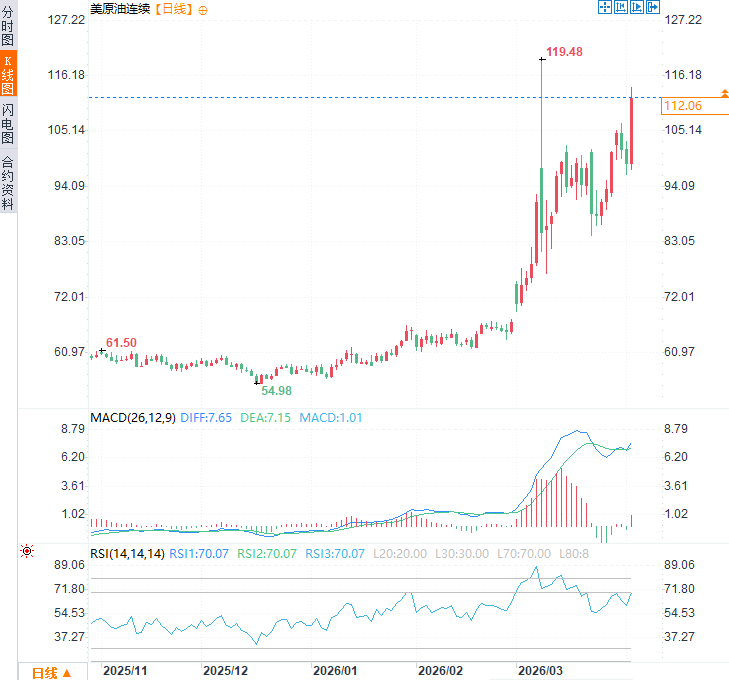
(US crude oil daily chart, source: FX678)
The energy supply shock triggered by the Iran war is exacerbating the already fragile "zero-hiring" labor market in the United States. Hiring levels have fallen to near the lows of 2020, non-farm payroll growth is close to stagnation, and break-even job growth has dropped to near zero. While the Trump administration's tightening immigration policies have temporarily stabilized the unemployment rate, the balance between labor supply and demand is extremely fragile. High oil prices and inflationary pressures are further amplifying economic headwinds, and the Federal Reserve's policy space is limited. The US economy is facing the risk of being squeezed by both stagnant hiring and high energy costs.
The labor market has been deteriorating for some time, but this trend has been masked by the overall unemployment rate. The current unemployment rate is 4.4%, which is still relatively low by historical standards; however, the labor market is practically stagnant.
JOLTS hiring data hits a low.
The U.S. Department of Labor's Job Openings and Labor Turnover Survey (JOLTS) released this week shows that overall hiring levels have fallen to near the lows of April 2020. A significant recovery in hiring is unlikely in the coming months, and may even remain stagnant.
The U.S. Bureau of Labor Statistics is scheduled to release its March non-farm payroll data at 8:30 PM on Friday (April 3), which is expected to show a net increase of only 60,000 non-farm jobs. This means that the average monthly increase in non-farm payrolls in the first quarter was approximately 30,000. The average monthly increase in non-farm payrolls over the past six months has been close to zero, and even showed negative growth a few months ago.
For the world’s largest economy, with a workforce of approximately 170 million and an economic scale of $30 trillion, such a “zero hiring” situation is neither sustainable nor ideal.
Break-even point and near-zero job growth
The phenomenon of near-stagnant job growth while the unemployment rate remains relatively stable can be explained by a decline in "break-even" job growth. Break-even job growth refers to the number of new jobs required to maintain a stable unemployment rate.
According to a report released this week by the Dallas Federal Reserve, this number was approximately 250,000 jobs per month three years ago, but has since declined steadily and is now almost zero. This means that even if the economy creates virtually no more jobs, the unemployment rate can remain stable.
Normally, a slowdown in labor demand should be a warning sign of rising unemployment, slower economic growth, and increased risk of recession. This signal is even more severe when job growth falls below the break-even point.
Tighter immigration policies exacerbate supply and demand imbalance
The labor supply is also shrinking rapidly, primarily due to the Trump administration's policies to reduce net immigration, the long-term effects of which remain to be seen. Currently, this policy is offsetting the decline in hiring, keeping the unemployment rate seemingly stable.
On the surface, the labor supply and demand are roughly balanced and the unemployment rate is basically stable, but this is not a healthy labor market, but a delicate and fragile balance.
The energy shock of the war in Iran amplifies vulnerability
This delicate balance is becoming increasingly fragile and vulnerable to mounting economic headwinds. Affected by supply shocks triggered by the Middle East conflict, the United States is facing structural increases in energy prices and intensifying inflationary pressures, a situation that is expected to persist at least until the end of this year, and possibly longer.
With markets closed on Friday, U.S. crude oil prices closed at $112.06 a barrel on Thursday, up 13.29%, and the average price for the remainder of the year may approach $100. Gasoline prices have exceeded $4 per gallon, squeezing U.S. household budgets. Businesses are struggling to cope with rising input costs such as energy and transportation, while also facing pressure from tightening financial conditions.
The Federal Reserve paused its rate-cutting cycle in January, with Chairman Powell stating that strong productivity growth driven by artificial intelligence could complement a labor market characterized by "low hiring, low layoffs." However, this view has become increasingly untenable since the outbreak of the Iran-Iraq War.
(US crude oil daily chart, source: FX678)
Editor's Summary
The energy supply shock triggered by the Iran war is exacerbating the already fragile "zero-hiring" labor market in the United States. Hiring levels have fallen to near the lows of 2020, non-farm payroll growth is close to stagnation, and break-even job growth has dropped to near zero. While the Trump administration's tightening immigration policies have temporarily stabilized the unemployment rate, the balance between labor supply and demand is extremely fragile. High oil prices and inflationary pressures are further amplifying economic headwinds, and the Federal Reserve's policy space is limited. The US economy is facing the risk of being squeezed by both stagnant hiring and high energy costs.
- Risk Warning and Disclaimer
- The market involves risk, and trading may not be suitable for all investors. This article is for reference only and does not constitute personal investment advice, nor does it take into account certain users’ specific investment objectives, financial situation, or other needs. Any investment decisions made based on this information are at your own risk.