With Trump's ultimatum to Iran entering its final countdown, gold prices are under pressure and fluctuating slightly.
2026-04-07 02:22:52
On Monday (April 6), during the US trading session, as the Tuesday deadline for US President Trump's "hellish" ultimatum to Iran approached, international gold prices fell slightly, reaching $4,659.41 per ounce, a drop of 0.35%.
Investors are awaiting the latest developments in the US-Iran situation while closely watching this week's Federal Reserve meeting minutes and US inflation data. The interplay of geopolitical risks and macroeconomic policy uncertainty is keeping the precious metals market cautious. The current situation is quite serious; Trump's series of hawkish signals at White House press conferences have further heightened market concerns about high oil prices and inflation, putting significant downward pressure on gold.
US crude oil (WTI) rose more than 2% intraday, reaching $113.8 per barrel, influenced by Trump's latest stern threats. Despite safe-haven demand triggered by the Middle East conflict, a modest rise in US stocks at the start of the week limited gains for gold and silver. Strong US jobs data released on Friday further solidified expectations that interest rates will remain high for an extended period, putting downward pressure on gold and silver prices.
Geopolitical Focus: Trump's tough stance, Iran's refusal of a temporary ceasefire, and escalation of military action.
Iran has made it clear that it hopes to permanently end the war with the United States and Israel, but submitted a ten-point response to the US through Pakistan, explicitly ruling out the possibility of a temporary ceasefire, emphasizing the need for a permanent end to the conflict, and demanding the drafting of a protocol for safe passage through the Strait of Hormuz, the lifting of sanctions, and post-war reconstruction. The Iranian military also announced the use of drones to strike US military bases in Saudi Arabia and Kuwait, and released satellite images showing eight targets hit at the Uderi helicopter base; explosions were also heard in Tehran, and research and industrial facilities in Fars province were attacked.
Trump escalated his rhetoric further at a White House press conference on Monday, saying that "the entire country of Iran could be destroyed overnight, and that night could be Tuesday night." He reiterated that the 8 p.m. Eastern Time deadline on Tuesday was "non-negotiable," "extremely unlikely to be postponed again," and "will not be changed," adding that Iran's latest peace proposal was "significant, but not good enough." He continued, "They just won't admit defeat, but they will eventually give in—if they don't, they will have nothing."
In his latest statement, Trump emphasized: "I want to take Iran's oil because it's readily available and they can't do anything about it."
The five-week-long conflict has caused oil prices to surge since its inception, with the prospect of the Strait of Hormuz reopening becoming a key market focus. Trump emphasized that if no agreement is reached, the US will launch its largest attack on Iranian infrastructure to date, adding, "The strikes will be even stronger tomorrow." Defense Secretary Hergsays added, "Trump is not joking," and "Peace through strength is not just a slogan." Israel also acted in tandem, destroying Iran's largest petrochemical complex, paralyzing 85% of its petrochemical export capacity.
These latest military and diplomatic developments have significantly increased investors' concerns about high oil prices and high inflation, further diminishing gold's appeal as a safe-haven asset.
Bart Melek, global head of commodities strategy at TD Securities, noted: "The market focus remains on the war and interest rates. If the conflict continues, tighter supply will drive oil prices up slowly, exacerbating inflationary pressures. This will limit the room for central banks, including the Federal Reserve, to ease policy, and may even reignite discussions about raising interest rates, which is a negative factor for gold."
Macroeconomic factors: The upcoming release of the Fed minutes and inflation data will intensify the correlation between oil prices and inflation.
This week is packed with key data releases: the minutes of the Federal Reserve's March policy meeting will be released on Wednesday, U.S. Personal Consumption Expenditures (PCE) data will be released on Thursday, and the Consumer Price Index (CPI) will be released on Friday. The Chicago Mercantile Exchange's FedWatch tool shows that traders currently believe the probability of a Fed rate cut this year is extremely low, having already kept rates unchanged last month.
The US ISM Services PMI for March, released Monday, fell to 54 from 56.1 in February, below the expected 55; the employment index declined to 45.2 from 51.8, indicating a slowdown in the labor market; however, the prices paid index rose to 70.7, suggesting that inflationary pressures are still accumulating. These data have exacerbated market concerns about the US economic outlook and strengthened the dollar's support. More importantly, soaring oil prices are rapidly transmitting to inflation: approximately 50% of the world's urea is transported through the Strait of Hormuz, and the sharp price increase has forced some US farmers to abandon corn and switch to soybeans; gasoline and diesel prices are nearing historical highs, mortgage rates have rebounded to 6.4%, and the spring housing market recovery has been hampered; fuel rationing has begun in parts of Europe, and working from home is being encouraged in Asia. The war has also exposed supply chain vulnerabilities, with fertilizer and shipping costs surging, putting long-term upward pressure on food prices. These factors combined have pushed up expectations of "sticky inflation," further compressing the Federal Reserve's policy space and creating a double negative for non-interest-bearing gold.
Technical Outlook: Gold bears are consolidating, and downside risks remain in the short term.
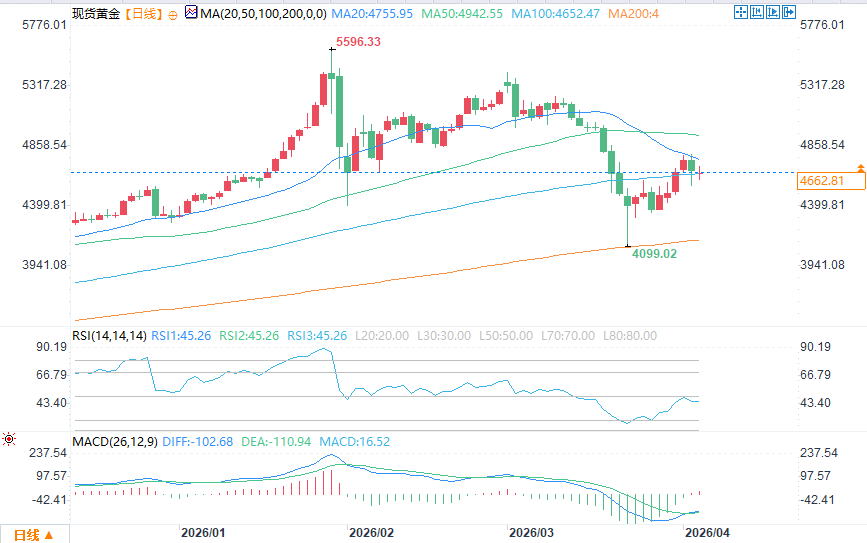
(Spot gold daily chart source: FX678)
FXStreet analyst Valeria Bednarik points out that spot prices are currently hovering around $4,650-$4,660, essentially flat for the day but lower than Friday's close. The 4-hour chart shows prices have fallen below the 20-period SMA (approximately $4,686), while the 100-period and 200-period SMAs continue to decline. Momentum indicators have entered negative territory, and the RSI has fallen to around 50, indicating cooling buying interest and short sellers taking control of the short-term trend.
On the daily chart, gold recorded both lower lows and lower highs, with the 20-day SMA (around $4,755) acting as significant resistance. Initial support is at $4,610, with a further break potentially targeting $4,580 and even $4,550; on the upside, a decisive break above $4,686 is needed to retest the recent high of $4,787.
Overall, while geopolitical risks have provided some safe-haven support for gold, Trump's latest tough rhetoric, escalating military action, the correlation between oil prices and inflation, the high-interest-rate environment, a stronger dollar, and expectations of Fed tightening have collectively limited the upside potential for gold prices. In the short term, the market will be fiercely oscillating around Trump's ultimatum, developments in the Strait of Hormuz, Iran's response, and this week's US economic data; investors need to remain highly vigilant.
Investors are awaiting the latest developments in the US-Iran situation while closely watching this week's Federal Reserve meeting minutes and US inflation data. The interplay of geopolitical risks and macroeconomic policy uncertainty is keeping the precious metals market cautious. The current situation is quite serious; Trump's series of hawkish signals at White House press conferences have further heightened market concerns about high oil prices and inflation, putting significant downward pressure on gold.
US crude oil (WTI) rose more than 2% intraday, reaching $113.8 per barrel, influenced by Trump's latest stern threats. Despite safe-haven demand triggered by the Middle East conflict, a modest rise in US stocks at the start of the week limited gains for gold and silver. Strong US jobs data released on Friday further solidified expectations that interest rates will remain high for an extended period, putting downward pressure on gold and silver prices.
Geopolitical Focus: Trump's tough stance, Iran's refusal of a temporary ceasefire, and escalation of military action.
Iran has made it clear that it hopes to permanently end the war with the United States and Israel, but submitted a ten-point response to the US through Pakistan, explicitly ruling out the possibility of a temporary ceasefire, emphasizing the need for a permanent end to the conflict, and demanding the drafting of a protocol for safe passage through the Strait of Hormuz, the lifting of sanctions, and post-war reconstruction. The Iranian military also announced the use of drones to strike US military bases in Saudi Arabia and Kuwait, and released satellite images showing eight targets hit at the Uderi helicopter base; explosions were also heard in Tehran, and research and industrial facilities in Fars province were attacked.
Trump escalated his rhetoric further at a White House press conference on Monday, saying that "the entire country of Iran could be destroyed overnight, and that night could be Tuesday night." He reiterated that the 8 p.m. Eastern Time deadline on Tuesday was "non-negotiable," "extremely unlikely to be postponed again," and "will not be changed," adding that Iran's latest peace proposal was "significant, but not good enough." He continued, "They just won't admit defeat, but they will eventually give in—if they don't, they will have nothing."
In his latest statement, Trump emphasized: "I want to take Iran's oil because it's readily available and they can't do anything about it."
The five-week-long conflict has caused oil prices to surge since its inception, with the prospect of the Strait of Hormuz reopening becoming a key market focus. Trump emphasized that if no agreement is reached, the US will launch its largest attack on Iranian infrastructure to date, adding, "The strikes will be even stronger tomorrow." Defense Secretary Hergsays added, "Trump is not joking," and "Peace through strength is not just a slogan." Israel also acted in tandem, destroying Iran's largest petrochemical complex, paralyzing 85% of its petrochemical export capacity.
These latest military and diplomatic developments have significantly increased investors' concerns about high oil prices and high inflation, further diminishing gold's appeal as a safe-haven asset.
Bart Melek, global head of commodities strategy at TD Securities, noted: "The market focus remains on the war and interest rates. If the conflict continues, tighter supply will drive oil prices up slowly, exacerbating inflationary pressures. This will limit the room for central banks, including the Federal Reserve, to ease policy, and may even reignite discussions about raising interest rates, which is a negative factor for gold."
Macroeconomic factors: The upcoming release of the Fed minutes and inflation data will intensify the correlation between oil prices and inflation.
This week is packed with key data releases: the minutes of the Federal Reserve's March policy meeting will be released on Wednesday, U.S. Personal Consumption Expenditures (PCE) data will be released on Thursday, and the Consumer Price Index (CPI) will be released on Friday. The Chicago Mercantile Exchange's FedWatch tool shows that traders currently believe the probability of a Fed rate cut this year is extremely low, having already kept rates unchanged last month.
The US ISM Services PMI for March, released Monday, fell to 54 from 56.1 in February, below the expected 55; the employment index declined to 45.2 from 51.8, indicating a slowdown in the labor market; however, the prices paid index rose to 70.7, suggesting that inflationary pressures are still accumulating. These data have exacerbated market concerns about the US economic outlook and strengthened the dollar's support. More importantly, soaring oil prices are rapidly transmitting to inflation: approximately 50% of the world's urea is transported through the Strait of Hormuz, and the sharp price increase has forced some US farmers to abandon corn and switch to soybeans; gasoline and diesel prices are nearing historical highs, mortgage rates have rebounded to 6.4%, and the spring housing market recovery has been hampered; fuel rationing has begun in parts of Europe, and working from home is being encouraged in Asia. The war has also exposed supply chain vulnerabilities, with fertilizer and shipping costs surging, putting long-term upward pressure on food prices. These factors combined have pushed up expectations of "sticky inflation," further compressing the Federal Reserve's policy space and creating a double negative for non-interest-bearing gold.
Technical Outlook: Gold bears are consolidating, and downside risks remain in the short term.
(Spot gold daily chart source: FX678)
FXStreet analyst Valeria Bednarik points out that spot prices are currently hovering around $4,650-$4,660, essentially flat for the day but lower than Friday's close. The 4-hour chart shows prices have fallen below the 20-period SMA (approximately $4,686), while the 100-period and 200-period SMAs continue to decline. Momentum indicators have entered negative territory, and the RSI has fallen to around 50, indicating cooling buying interest and short sellers taking control of the short-term trend.
On the daily chart, gold recorded both lower lows and lower highs, with the 20-day SMA (around $4,755) acting as significant resistance. Initial support is at $4,610, with a further break potentially targeting $4,580 and even $4,550; on the upside, a decisive break above $4,686 is needed to retest the recent high of $4,787.
Overall, while geopolitical risks have provided some safe-haven support for gold, Trump's latest tough rhetoric, escalating military action, the correlation between oil prices and inflation, the high-interest-rate environment, a stronger dollar, and expectations of Fed tightening have collectively limited the upside potential for gold prices. In the short term, the market will be fiercely oscillating around Trump's ultimatum, developments in the Strait of Hormuz, Iran's response, and this week's US economic data; investors need to remain highly vigilant.
- Risk Warning and Disclaimer
- The market involves risk, and trading may not be suitable for all investors. This article is for reference only and does not constitute personal investment advice, nor does it take into account certain users’ specific investment objectives, financial situation, or other needs. Any investment decisions made based on this information are at your own risk.