Japan releases another 20 days' worth of oil reserves: What signal does this send?
2026-04-09 15:25:27
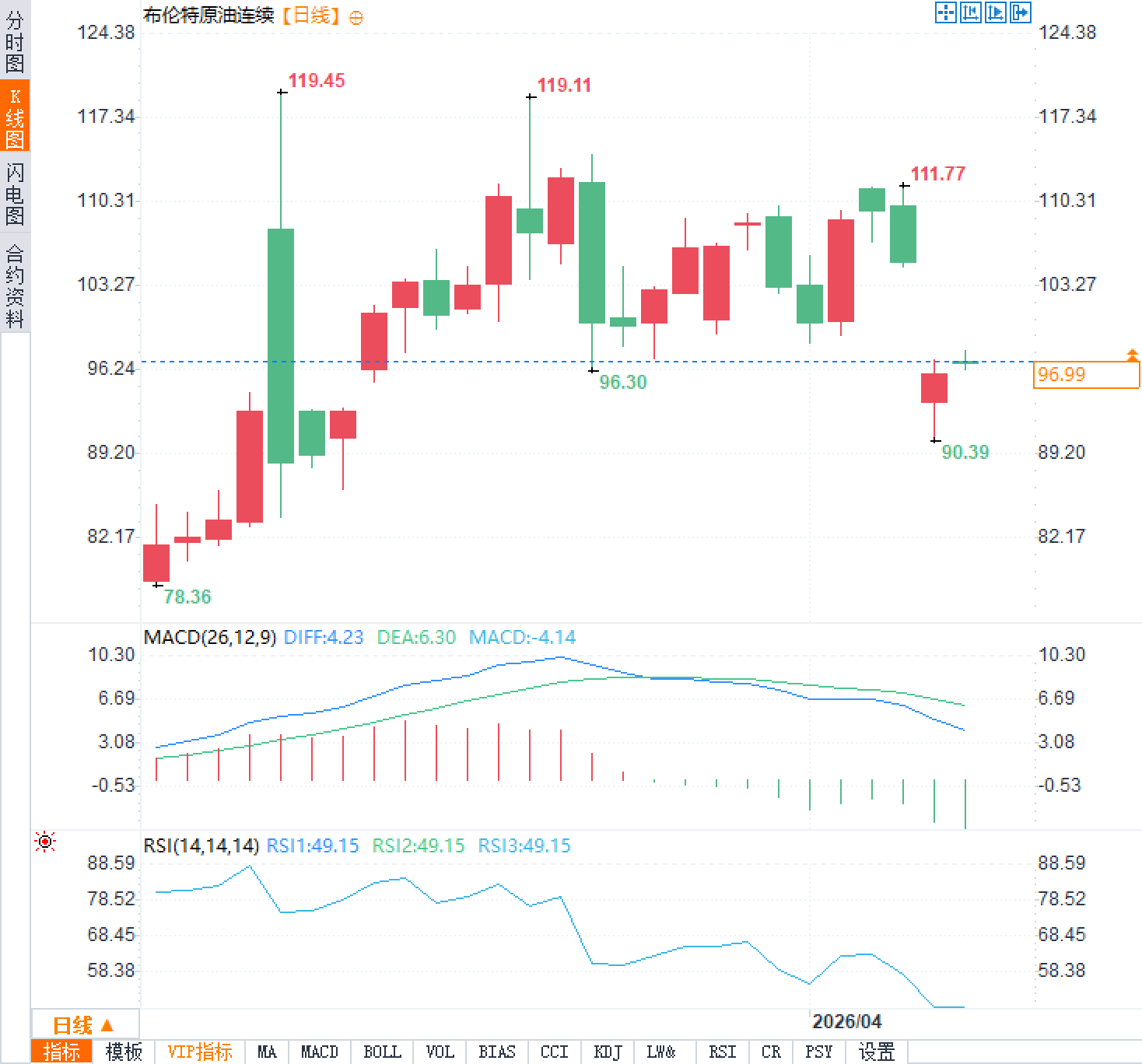
On Thursday, April 9, Brent crude oil futures prices fluctuated around $97 per barrel. Despite the ceasefire agreement reached between the US and Iran, the prospect of reopening the Strait of Hormuz remains uncertain. Japan's consideration of releasing an additional 20 days' worth of oil reserves as early as May further highlights the fragility of the global oil supply chain. This news, coupled with the International Energy Agency's previously coordinated large-scale release of 400 million barrels of reserves, makes the market's weighing of short-term supply buffers against long-term geopolitical risks particularly urgent.
The Strait of Hormuz, a crucial passage for approximately 20% of global oil transportation, has seen its passage disrupted, directly driving up market risk premiums. Even with a ceasefire agreement, reopening the strait faces multiple obstacles, including shipping coordination and security guarantees, causing crude oil spot premiums to reach record highs and widening the spread between Brent near-month and far-month contracts. This reflects traders' strong concerns about immediate supply, and the impact of the disruption to approximately 10 million barrels of crude oil exports per day from the Middle East is gradually emerging. Global crude oil inventories are declining at an accelerated pace, putting pressure on major Asian importers due to rising costs of alternative routes. Historically, similar disruptions have caused oil prices to surge by more than 20% in the short term. Although the current situation has a ceasefire buffer, continued uncertainty is supporting prices at high levels. Traders are closely monitoring signals of the daily recovery of strait traffic; if reopening is delayed, the Brent futures curve could steepen further, amplifying volatility.
Japan relies on the Middle East for approximately 95% of its oil supply. Since March 16, it has released about 50 days' worth of oil reserves, totaling approximately 80 million barrels, through domestic coordination and international cooperation. This marks the largest release since the establishment of the national oil reserve system in 1978. Currently, Japan's domestic oil reserves can sustain normal demand for 230 days. Data from Japan's Ministry of Economy, Trade and Industry shows that this release first utilized private reserves, then activated national reserves, and lowered mandatory holding requirements for refiners to stabilize domestic product supply.
Japanese Prime Minister Sanae Takaichi recently stated that Japan will continue to assess the possibility of releasing an additional 20 days' worth of reserves in May and has requested the International Energy Agency to consider coordinating a second batch of actions. Japan is simultaneously pursuing alternative transport routes around the Hormuz, including sourcing through the Red Sea pipeline and from Central and South America, and expects its imports in May to recover to approximately 60% of the level of the same period last year.
The following is a comparison of Japan's oil reserves before and after their release:
While current crude oil prices have fallen from their March peak, they are still up about 10% this month and more than 50% year-on-year. This trend stems from the combined effects of supply-side disruptions and reserve releases. Global daily crude oil demand growth has slowed due to high prices, with non-OPEC+ production increases providing some offset. The International Energy Agency's latest assessment indicates that the supply crisis in April may be more severe than in March, with shortages of jet fuel and diesel being particularly prominent.
As the global pricing benchmark, Brent crude's price dynamics are directly transmitted to Asian refining crack spreads. Reserve releases have increased the supply of crude oil in the near term, which is expected to slow the pace of inventory depletion; however, uncertainty in the Straits of Columbia continues to keep risk premiums at a high level. Traders are focusing on production responses from the US and other oil-producing countries, as well as changes in global refinery utilization rates.
The International Energy Agency (IEA) coordinated the release of 400 million barrels of oil reserves from its 32 member countries, the largest such operation in its history. Approximately 72% of the released reserves were crude oil, and 28% were refined products. IEA Executive Director Fatih Birol recently emphasized that the possibility of further releases will be assessed as needed by the market. Large-scale reserve releases typically alleviate upward price pressures within weeks, but the sustainability of the effect depends on the progress of resolving the sources of disruption.
Supply risks under the uncertainty of the Strait of Hormuz
The Strait of Hormuz, a crucial passage for approximately 20% of global oil transportation, has seen its passage disrupted, directly driving up market risk premiums. Even with a ceasefire agreement, reopening the strait faces multiple obstacles, including shipping coordination and security guarantees, causing crude oil spot premiums to reach record highs and widening the spread between Brent near-month and far-month contracts. This reflects traders' strong concerns about immediate supply, and the impact of the disruption to approximately 10 million barrels of crude oil exports per day from the Middle East is gradually emerging. Global crude oil inventories are declining at an accelerated pace, putting pressure on major Asian importers due to rising costs of alternative routes. Historically, similar disruptions have caused oil prices to surge by more than 20% in the short term. Although the current situation has a ceasefire buffer, continued uncertainty is supporting prices at high levels. Traders are closely monitoring signals of the daily recovery of strait traffic; if reopening is delayed, the Brent futures curve could steepen further, amplifying volatility.
Japan's oil reserve release
Japan relies on the Middle East for approximately 95% of its oil supply. Since March 16, it has released about 50 days' worth of oil reserves, totaling approximately 80 million barrels, through domestic coordination and international cooperation. This marks the largest release since the establishment of the national oil reserve system in 1978. Currently, Japan's domestic oil reserves can sustain normal demand for 230 days. Data from Japan's Ministry of Economy, Trade and Industry shows that this release first utilized private reserves, then activated national reserves, and lowered mandatory holding requirements for refiners to stabilize domestic product supply.
Japanese Prime Minister Sanae Takaichi recently stated that Japan will continue to assess the possibility of releasing an additional 20 days' worth of reserves in May and has requested the International Energy Agency to consider coordinating a second batch of actions. Japan is simultaneously pursuing alternative transport routes around the Hormuz, including sourcing through the Red Sea pipeline and from Central and South America, and expects its imports in May to recover to approximately 60% of the level of the same period last year.
The following is a comparison of Japan's oil reserves before and after their release:
| project | Before release (end of 2025) | Released amount | Remaining reserves (current) |
|---|---|---|---|
| Total reserve days | 254 days | Approximately 50 days | Approximately 230 days |
| National Reserves | 146 days | Main part | adequate |
| Private reserves | 101 days | Release in advance | Buffer domestic products |
Crude oil supply and demand balance and price dynamics
While current crude oil prices have fallen from their March peak, they are still up about 10% this month and more than 50% year-on-year. This trend stems from the combined effects of supply-side disruptions and reserve releases. Global daily crude oil demand growth has slowed due to high prices, with non-OPEC+ production increases providing some offset. The International Energy Agency's latest assessment indicates that the supply crisis in April may be more severe than in March, with shortages of jet fuel and diesel being particularly prominent.
As the global pricing benchmark, Brent crude's price dynamics are directly transmitted to Asian refining crack spreads. Reserve releases have increased the supply of crude oil in the near term, which is expected to slow the pace of inventory depletion; however, uncertainty in the Straits of Columbia continues to keep risk premiums at a high level. Traders are focusing on production responses from the US and other oil-producing countries, as well as changes in global refinery utilization rates.
Impact of global energy market coordination mechanisms
The International Energy Agency (IEA) coordinated the release of 400 million barrels of oil reserves from its 32 member countries, the largest such operation in its history. Approximately 72% of the released reserves were crude oil, and 28% were refined products. IEA Executive Director Fatih Birol recently emphasized that the possibility of further releases will be assessed as needed by the market. Large-scale reserve releases typically alleviate upward price pressures within weeks, but the sustainability of the effect depends on the progress of resolving the sources of disruption.
- Risk Warning and Disclaimer
- The market involves risk, and trading may not be suitable for all investors. This article is for reference only and does not constitute personal investment advice, nor does it take into account certain users’ specific investment objectives, financial situation, or other needs. Any investment decisions made based on this information are at your own risk.