Euro/dollar rebound stalls: Can the ECB's sticky pricing strategy counter the risks from the US and Iran?
2026-04-09 19:48:09
On Thursday (April 9), during the European session, the euro/dollar pair rose slightly to around 1.1680, rebounding from the intraday low of 1.1650, but remained below the previous day's high of 1.1721. Influenced by the situation in the Middle East, market sentiment was cautious, and demand for the dollar as a safe haven diminished, resulting in a moderate rebound in the euro against the dollar. The euro/dollar pair had rebounded sharply from its March low of 1.1412, reaching a high of 1.1723, a significant increase.
This rebound was mainly driven by a weaker dollar and lower oil prices, while President Trump's actions against Iran triggered a reassessment of the risk of war. Although the fragile ceasefire agreement brought a brief recovery in risk appetite, Iranian complaints about its implementation and tough statements from the US and Israel continued to suppress market optimism. Overall, the euro found some short-term support, but geopolitical uncertainty remained a concern for bulls.
Fundamental analysis
Federal Reserve policy and interest rate differentials remain the dominant factors. The minutes of the March FOMC meeting showed that officials were concerned that the war with Iran would drive up energy prices, leading to increased inflationary pressures and potentially delaying rate cuts or even triggering discussions about rate hikes. Most members believed that a protracted conflict would cause inflation to rise higher than expected, with core PCE potentially increasing further, while the job market faced downside risks. This strengthened the relative strength of the dollar, but the uncertainty brought about by the war also limited the dollar's unilateral appreciation.
A flurry of US economic data is about to be released. The second estimate for fourth-quarter GDP growth is only 0.7%, far below the previous 4.4%, indicating a significant economic slowdown. The upcoming PCE data is expected to show a headline PCE of 2.8% and a core PCE of 3.0%; Friday's CPI is expected to be 3.4% (previous value 2.4%), with core CPI at 2.7%. These data will directly reflect the impact of the war on inflation and influence the Federal Reserve's subsequent path. If the data is stronger than expected, the dollar may be supported; conversely, the euro's rebound potential may expand.
Geopolitical factors and risk sentiment are significantly correlated. While the two-week ceasefire agreement between the US and Iran has temporarily eased the conflict, Iran's closure of the Strait of Hormuz and the uncertainty surrounding subsequent negotiations continue to drive up oil price volatility. The VIX volatility index remains sensitive, and US stocks, especially the Nasdaq, provide indirect support as risk appetite recovers, but any sign of a ceasefire breakdown could quickly trigger safe-haven buying of the US dollar.
mainstream view
Mainstream media believe that the current environment is unfavorable for a unilateral strengthening of the euro, with investors favoring high-beta currencies. However, the stickiness of ECB pricing may provide relative support for the euro. Although the decline in energy prices has driven a dovish repricing of the euro swap curve, the market still expects a tightening space of about 58 basis points by the end of the year.
Analysts point out that the ECB's policy cycle typically involves two 25bp adjustments or remaining unchanged, and a drop in oil prices alone is insufficient to significantly lower pricing. Given the absence of a permanent ceasefire and lingering uncertainty regarding oil flows, the ECB is unlikely to quickly shift to a dovish stance, which could make the euro more resilient against the dollar.
ING analyst Francesco Pesole emphasized: "The lingering volatility in the Gulf region makes a direct jump to 1.180 seem premature, but the ECB's sticky hawkish bets are favorable for EUR/USD to return to the 1.170-1.173 area."
Some believe that a short-term rebound in EUR/USD to the 1.170-1.173 range is reasonable, but a direct push towards 1.180 would be premature, as geopolitical volatility remains the main constraint.
A Reuters article argues that the euro/dollar's recovery is weak, and a death cross is imminent. The 50-day moving average for euro/dollar has fallen below the 100-day moving average, and it's only 4 pips away from breaking the 200-day moving average. The increasingly thick and sinking Ichimoku cloud further supports the bearish structure. The cloud bottom (1.1723) forms resistance.
Technical Analysis
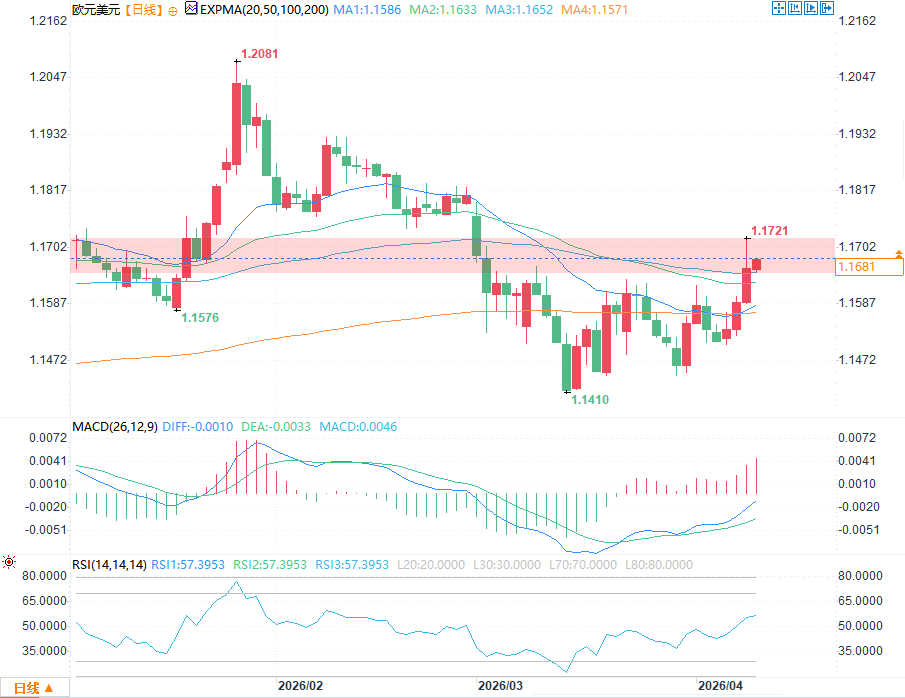
(EUR/USD daily chart source: FX678)
The daily chart shows that EUR/USD rebounded to a high of 1.1723, but remains below the Supertrend indicator, indicating that bearish control remains. The price is also below the key support/resistance pivot point of 1.1788. If geopolitical concerns persist, the price may resume its downward trend, with the psychological level of 1.1600 becoming a key target.
On the 4-hour chart, the short-term bias remains bullish. The RSI is in bullish territory, and the MACD is slightly positive, indicating that upward momentum has not completely subsided. Resistance is seen in the 1.1721-1.1740 area, with further resistance near the late February high of 1.1830. On the downside, the 1.1630-1.1640 area provides initial support; a break below this level could lead to a test of lower weekly lows.
Economic Calendar (Beijing Time)
April 9 (Thursday): Third estimate of US fourth-quarter GDP (20:30), personal income and spending, and February PCE price index (20:30).
April 10 (Friday): US March CPI (20:30), Factory Orders (22:00).
These data will directly examine the impact of the war on US inflation and growth, becoming a key catalyst for short-term fluctuations in the euro/dollar exchange rate.
Summarize
The euro/dollar pair is expected to fluctuate between 1.1650 and 1.1720 in the short term. The rebound momentum depends on improved risk sentiment and a weaker dollar, but geopolitical uncertainties and the upcoming release of key US inflation data pose a double challenge.
A bearish view suggests selling, with a target of 1.1600 and a stop-loss at 1.1750; a bullish view suggests buying, with a target of 1.1750 and a stop-loss at 1.1600. Traders should closely monitor PCE and CPI data, as well as the progress of Middle East negotiations, and adjust their positions flexibly.
Frequently Asked Questions
Q1: What are the main impacts of the Iran war on the euro/dollar exchange rate?
A: The war has driven up oil prices and energy costs, leading to market expectations of higher US inflation. The Federal Reserve may maintain higher interest rates or postpone rate cuts, thus supporting the dollar and suppressing the euro. However, the improved risk appetite resulting from the ceasefire agreement provides the euro with room for a short-term rebound. Overall, increased geopolitical risks lead to market volatility, making the euro more susceptible to risk aversion.
Q2: Why is inflation data still being closely watched despite the slowdown in US GDP?
A: Fourth-quarter GDP grew by only 0.7%, indicating weakening economic momentum. However, rising energy prices due to the war may push up inflation indicators (such as PCE and CPI). The Federal Reserve is more focused on the path of inflation than short-term growth. If inflation exceeds expectations, interest rate policy will become more cautious, which directly affects the dollar exchange rate and the euro/dollar exchange rate.
Q3: How does the policy divergence between the ECB and the Federal Reserve affect the euro?
A: The Federal Reserve has adopted a hawkish stance due to the risks of war and inflation, while the ECB's pricing is relatively sticky due to pressures on European economic growth and falling energy prices. This divergence makes it difficult for the euro to strengthen significantly, but the ECB's reluctance to be overly dovish also provides some downside protection for the euro.
Q4: Does the ceasefire agreement mean that the risks in the Middle East have been completely eliminated?
A: The current ceasefire is only temporary, lasting two weeks. Iran objects to its implementation, and the US and Israel maintain a hardline stance. The outcome of subsequent negotiations with Pakistan remains uncertain. Any violation or escalation could quickly reignite oil prices and safe-haven demand, impacting the euro/dollar exchange rate.
Q5: How should traders interpret upcoming data releases?
A: If PCE and CPI data show inflation significantly higher than expected, it will strengthen the US dollar and put downward pressure on the euro/dollar exchange rate. Conversely, if the data is moderate or lower than expected, it may alleviate expectations of a hawkish stance from the Federal Reserve and support a euro rebound. Considering geopolitical dynamics, the data will be a key indicator of short-term direction.
This rebound was mainly driven by a weaker dollar and lower oil prices, while President Trump's actions against Iran triggered a reassessment of the risk of war. Although the fragile ceasefire agreement brought a brief recovery in risk appetite, Iranian complaints about its implementation and tough statements from the US and Israel continued to suppress market optimism. Overall, the euro found some short-term support, but geopolitical uncertainty remained a concern for bulls.
Fundamental analysis
Federal Reserve policy and interest rate differentials remain the dominant factors. The minutes of the March FOMC meeting showed that officials were concerned that the war with Iran would drive up energy prices, leading to increased inflationary pressures and potentially delaying rate cuts or even triggering discussions about rate hikes. Most members believed that a protracted conflict would cause inflation to rise higher than expected, with core PCE potentially increasing further, while the job market faced downside risks. This strengthened the relative strength of the dollar, but the uncertainty brought about by the war also limited the dollar's unilateral appreciation.
A flurry of US economic data is about to be released. The second estimate for fourth-quarter GDP growth is only 0.7%, far below the previous 4.4%, indicating a significant economic slowdown. The upcoming PCE data is expected to show a headline PCE of 2.8% and a core PCE of 3.0%; Friday's CPI is expected to be 3.4% (previous value 2.4%), with core CPI at 2.7%. These data will directly reflect the impact of the war on inflation and influence the Federal Reserve's subsequent path. If the data is stronger than expected, the dollar may be supported; conversely, the euro's rebound potential may expand.
Geopolitical factors and risk sentiment are significantly correlated. While the two-week ceasefire agreement between the US and Iran has temporarily eased the conflict, Iran's closure of the Strait of Hormuz and the uncertainty surrounding subsequent negotiations continue to drive up oil price volatility. The VIX volatility index remains sensitive, and US stocks, especially the Nasdaq, provide indirect support as risk appetite recovers, but any sign of a ceasefire breakdown could quickly trigger safe-haven buying of the US dollar.
mainstream view
Mainstream media believe that the current environment is unfavorable for a unilateral strengthening of the euro, with investors favoring high-beta currencies. However, the stickiness of ECB pricing may provide relative support for the euro. Although the decline in energy prices has driven a dovish repricing of the euro swap curve, the market still expects a tightening space of about 58 basis points by the end of the year.
Analysts point out that the ECB's policy cycle typically involves two 25bp adjustments or remaining unchanged, and a drop in oil prices alone is insufficient to significantly lower pricing. Given the absence of a permanent ceasefire and lingering uncertainty regarding oil flows, the ECB is unlikely to quickly shift to a dovish stance, which could make the euro more resilient against the dollar.
ING analyst Francesco Pesole emphasized: "The lingering volatility in the Gulf region makes a direct jump to 1.180 seem premature, but the ECB's sticky hawkish bets are favorable for EUR/USD to return to the 1.170-1.173 area."
Some believe that a short-term rebound in EUR/USD to the 1.170-1.173 range is reasonable, but a direct push towards 1.180 would be premature, as geopolitical volatility remains the main constraint.
A Reuters article argues that the euro/dollar's recovery is weak, and a death cross is imminent. The 50-day moving average for euro/dollar has fallen below the 100-day moving average, and it's only 4 pips away from breaking the 200-day moving average. The increasingly thick and sinking Ichimoku cloud further supports the bearish structure. The cloud bottom (1.1723) forms resistance.
Technical Analysis
(EUR/USD daily chart source: FX678)
The daily chart shows that EUR/USD rebounded to a high of 1.1723, but remains below the Supertrend indicator, indicating that bearish control remains. The price is also below the key support/resistance pivot point of 1.1788. If geopolitical concerns persist, the price may resume its downward trend, with the psychological level of 1.1600 becoming a key target.
On the 4-hour chart, the short-term bias remains bullish. The RSI is in bullish territory, and the MACD is slightly positive, indicating that upward momentum has not completely subsided. Resistance is seen in the 1.1721-1.1740 area, with further resistance near the late February high of 1.1830. On the downside, the 1.1630-1.1640 area provides initial support; a break below this level could lead to a test of lower weekly lows.
Economic Calendar (Beijing Time)
April 9 (Thursday): Third estimate of US fourth-quarter GDP (20:30), personal income and spending, and February PCE price index (20:30).
April 10 (Friday): US March CPI (20:30), Factory Orders (22:00).
These data will directly examine the impact of the war on US inflation and growth, becoming a key catalyst for short-term fluctuations in the euro/dollar exchange rate.
Summarize
The euro/dollar pair is expected to fluctuate between 1.1650 and 1.1720 in the short term. The rebound momentum depends on improved risk sentiment and a weaker dollar, but geopolitical uncertainties and the upcoming release of key US inflation data pose a double challenge.
A bearish view suggests selling, with a target of 1.1600 and a stop-loss at 1.1750; a bullish view suggests buying, with a target of 1.1750 and a stop-loss at 1.1600. Traders should closely monitor PCE and CPI data, as well as the progress of Middle East negotiations, and adjust their positions flexibly.
Frequently Asked Questions
Q1: What are the main impacts of the Iran war on the euro/dollar exchange rate?
A: The war has driven up oil prices and energy costs, leading to market expectations of higher US inflation. The Federal Reserve may maintain higher interest rates or postpone rate cuts, thus supporting the dollar and suppressing the euro. However, the improved risk appetite resulting from the ceasefire agreement provides the euro with room for a short-term rebound. Overall, increased geopolitical risks lead to market volatility, making the euro more susceptible to risk aversion.
Q2: Why is inflation data still being closely watched despite the slowdown in US GDP?
A: Fourth-quarter GDP grew by only 0.7%, indicating weakening economic momentum. However, rising energy prices due to the war may push up inflation indicators (such as PCE and CPI). The Federal Reserve is more focused on the path of inflation than short-term growth. If inflation exceeds expectations, interest rate policy will become more cautious, which directly affects the dollar exchange rate and the euro/dollar exchange rate.
Q3: How does the policy divergence between the ECB and the Federal Reserve affect the euro?
A: The Federal Reserve has adopted a hawkish stance due to the risks of war and inflation, while the ECB's pricing is relatively sticky due to pressures on European economic growth and falling energy prices. This divergence makes it difficult for the euro to strengthen significantly, but the ECB's reluctance to be overly dovish also provides some downside protection for the euro.
Q4: Does the ceasefire agreement mean that the risks in the Middle East have been completely eliminated?
A: The current ceasefire is only temporary, lasting two weeks. Iran objects to its implementation, and the US and Israel maintain a hardline stance. The outcome of subsequent negotiations with Pakistan remains uncertain. Any violation or escalation could quickly reignite oil prices and safe-haven demand, impacting the euro/dollar exchange rate.
Q5: How should traders interpret upcoming data releases?
A: If PCE and CPI data show inflation significantly higher than expected, it will strengthen the US dollar and put downward pressure on the euro/dollar exchange rate. Conversely, if the data is moderate or lower than expected, it may alleviate expectations of a hawkish stance from the Federal Reserve and support a euro rebound. Considering geopolitical dynamics, the data will be a key indicator of short-term direction.
- Risk Warning and Disclaimer
- The market involves risk, and trading may not be suitable for all investors. This article is for reference only and does not constitute personal investment advice, nor does it take into account certain users’ specific investment objectives, financial situation, or other needs. Any investment decisions made based on this information are at your own risk.