Institutions: Bullish on gold in the long term, expecting it to continue rising until early 2027.
2026-04-10 10:57:21
Montreal-based BCA Research has been bullish on gold since the end of 2022. Although the firm has been tactically cautious since the beginning of this year, its long-term allocation to the precious metal has not changed.
Roukaya Ibrahim, chief commodities strategist at BCA Research, said that although gold prices appear vulnerable due to short-term risks such as speculative positioning, real interest rates, and geopolitical factors, she expects gold prices to continue to rise until early 2027.
She explained that the current bull market in gold has shown clear phases: initially driven by strong buying from central banks, then boosted by geopolitical demand, and recently marked by a significant surge in speculative activity. She said, "The speculative nature of this recent phase is very evident."
She pointed out that inflows from Asian investors, particularly in ETF purchases, played a significant role. She said, "The risk is that these inflows could reverse rapidly once prices begin to fall, making the market vulnerable."
This speculative accumulation has led to gold behaving more like a risk asset in recent months, with a stronger correlation to the stock market.
Meanwhile, Ibrahim stated that gold has re-established its traditional inverse relationship with real interest rates, making monetary policy expectations a key driver of gold prices.
She pointed out that, historically, gold's recent weakness is not uncommon. During supply-driven inflationary shocks, gold typically struggles in the initial stages as rising inflation expectations push up bond yields, thus supporting tighter monetary policy. However, as the price shock gradually transforms into slower economic growth, gold's performance tends to improve over time.
She stated, "Gold typically falls in the early stages of a supply shock but tends to recover after 12 months. The key turning point is when the shock shifts from inflation-driven to growth-driven, which leads to lower yields and provides support for gold."
Geopolitical developments, particularly those related to energy markets, remain a key factor in the outlook. Ibrahim believes that oil flows and broader inflationary pressures will determine whether the market shifts towards slower economic growth, a scenario that would ultimately benefit gold.
She stated, "If the disturbances gradually subside in the coming months and inflation concerns ease, we will return to the previous environment, and the bullish logic for gold will remain intact."
One of the key pillars of the long-term bullish outlook is the sustained demand from central banks. Ibrahim believes that official sector purchases provide structural support for gold prices, even if it is not the primary driver of price increases.
She said, "Central bank purchases are ongoing in the background, providing support. It may not directly push up prices, but it helps establish an overall upward trend."
However, she added that sustained central bank selling, rather than isolated incidents, could weaken this outlook. Some countries, such as Turkey, have temporarily monetized their gold reserves to meet liquidity needs due to the turmoil in the Middle East.
While gold continues to receive solid support, Ibrahim is more cautious about silver.
She explained that, unlike gold, silver lacks meaningful central bank demand and is more dependent on industrial activity, making it more vulnerable to a global economic slowdown.
She stated, "Our concerns about gold have been amplified in silver, and there is little justification for the current surge in silver prices, especially given the lack of support from industrial demand data."
Looking ahead, Ibrahim said that gold will remain her preferred asset over the next 12 months, but she is not yet ready to pinpoint a specific short-term entry point due to ongoing geopolitical uncertainty and potential further volatility from inflation expectations.
She ultimately predicted that if economic conditions worsen, the Federal Reserve will prioritize economic growth over inflation, and this policy shift could be a significant turning point for gold.
She stated, "I think they will be more inclined to support growth rather than closely monitor inflation, but gold may need to go through more growing pains before it gets to that point. When we actually reach that point, it could very well be a good buying opportunity."
Overall , despite short-term pressures from speculative position adjustments, real interest rate volatility, and geopolitical uncertainties, BCA Research maintains a long-term bullish stance on gold. Structural buying by central banks, potential economic slowdown, and expectations of a shift in monetary policy collectively form the core logic supporting continued gold price increases until early 2027.
Investors need to remain patient and distinguish between short-term fluctuations and long-term trends in order to seize structural opportunities in the precious metals market.
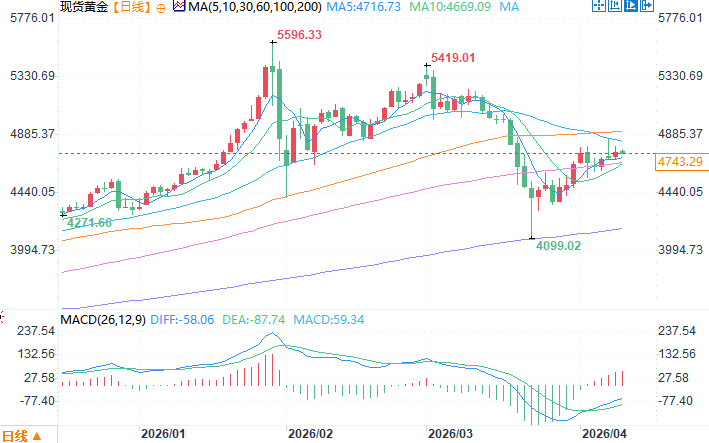
Spot gold daily chart source: EasyForex
At 10:56 AM Beijing time on April 10, spot gold was trading at $4750.29 per ounce.
Roukaya Ibrahim, chief commodities strategist at BCA Research, said that although gold prices appear vulnerable due to short-term risks such as speculative positioning, real interest rates, and geopolitical factors, she expects gold prices to continue to rise until early 2027.
She explained that the current bull market in gold has shown clear phases: initially driven by strong buying from central banks, then boosted by geopolitical demand, and recently marked by a significant surge in speculative activity. She said, "The speculative nature of this recent phase is very evident."
She pointed out that inflows from Asian investors, particularly in ETF purchases, played a significant role. She said, "The risk is that these inflows could reverse rapidly once prices begin to fall, making the market vulnerable."
This speculative accumulation has led to gold behaving more like a risk asset in recent months, with a stronger correlation to the stock market.
Meanwhile, Ibrahim stated that gold has re-established its traditional inverse relationship with real interest rates, making monetary policy expectations a key driver of gold prices.
Slowing economic growth will be a turning point for gold prices.
She pointed out that, historically, gold's recent weakness is not uncommon. During supply-driven inflationary shocks, gold typically struggles in the initial stages as rising inflation expectations push up bond yields, thus supporting tighter monetary policy. However, as the price shock gradually transforms into slower economic growth, gold's performance tends to improve over time.
She stated, "Gold typically falls in the early stages of a supply shock but tends to recover after 12 months. The key turning point is when the shock shifts from inflation-driven to growth-driven, which leads to lower yields and provides support for gold."
Geopolitical developments, particularly those related to energy markets, remain a key factor in the outlook. Ibrahim believes that oil flows and broader inflationary pressures will determine whether the market shifts towards slower economic growth, a scenario that would ultimately benefit gold.
She stated, "If the disturbances gradually subside in the coming months and inflation concerns ease, we will return to the previous environment, and the bullish logic for gold will remain intact."
The central bank's continued buying provides long-term structural support.
One of the key pillars of the long-term bullish outlook is the sustained demand from central banks. Ibrahim believes that official sector purchases provide structural support for gold prices, even if it is not the primary driver of price increases.
She said, "Central bank purchases are ongoing in the background, providing support. It may not directly push up prices, but it helps establish an overall upward trend."
However, she added that sustained central bank selling, rather than isolated incidents, could weaken this outlook. Some countries, such as Turkey, have temporarily monetized their gold reserves to meet liquidity needs due to the turmoil in the Middle East.
The outlook for silver is relatively cautious.
While gold continues to receive solid support, Ibrahim is more cautious about silver.
She explained that, unlike gold, silver lacks meaningful central bank demand and is more dependent on industrial activity, making it more vulnerable to a global economic slowdown.
She stated, "Our concerns about gold have been amplified in silver, and there is little justification for the current surge in silver prices, especially given the lack of support from industrial demand data."
Future Outlook: Gold Remains the Top Asset Choice Over the Next 12 Months
Looking ahead, Ibrahim said that gold will remain her preferred asset over the next 12 months, but she is not yet ready to pinpoint a specific short-term entry point due to ongoing geopolitical uncertainty and potential further volatility from inflation expectations.
She ultimately predicted that if economic conditions worsen, the Federal Reserve will prioritize economic growth over inflation, and this policy shift could be a significant turning point for gold.
She stated, "I think they will be more inclined to support growth rather than closely monitor inflation, but gold may need to go through more growing pains before it gets to that point. When we actually reach that point, it could very well be a good buying opportunity."
Overall , despite short-term pressures from speculative position adjustments, real interest rate volatility, and geopolitical uncertainties, BCA Research maintains a long-term bullish stance on gold. Structural buying by central banks, potential economic slowdown, and expectations of a shift in monetary policy collectively form the core logic supporting continued gold price increases until early 2027.
Investors need to remain patient and distinguish between short-term fluctuations and long-term trends in order to seize structural opportunities in the precious metals market.
Spot gold daily chart source: EasyForex
At 10:56 AM Beijing time on April 10, spot gold was trading at $4750.29 per ounce.
- Risk Warning and Disclaimer
- The market involves risk, and trading may not be suitable for all investors. This article is for reference only and does not constitute personal investment advice, nor does it take into account certain users’ specific investment objectives, financial situation, or other needs. Any investment decisions made based on this information are at your own risk.