Rising inflation expectations suppressed gold price rebounds, with gold remaining in a consolidation phase around 4750.
2026-04-10 14:26:36
On Friday during the Asian session, spot gold continued its high-level consolidation, trading around $4760. After failing to break through the $4800 mark, bullish momentum weakened somewhat, but the overall decline was limited, indicating that the market is still in a phase of tug-of-war between bulls and bears.

From a fundamental perspective, the situation in the Middle East remains a crucial variable influencing the market. While the regional conflict has not escalated fully, the implementation of the ceasefire agreement remains highly uncertain, and restrictions on shipping through the Strait of Hormuz are raising concerns about global energy supply. Market estimates suggest that the Strait of Hormuz handles approximately 20% of global seaborne crude oil transport , and disruptions to this transport significantly support oil prices. As a result, international oil prices have remained high, further pushing up global inflation expectations.
Rising inflation expectations are a significant factor currently suppressing gold prices. The market widely expects the US March CPI year-on-year growth rate to rise to approximately 3.3%, significantly higher than the previous level. Rising energy prices are considered one of the key factors driving the inflation rebound. Against this backdrop, expectations that the Federal Reserve will maintain high interest rates have further strengthened. Previously released meeting minutes showed that policymakers remain vigilant about the upside risks to inflation and are not in a hurry to initiate a rate-cutting cycle.
Meanwhile, the US dollar remained strong, supported by safe-haven demand and interest rate expectations, which directly suppressed gold prices denominated in US dollars. Although gold possesses safe-haven attributes in the context of geopolitical risks, its characteristic of not generating interest income reduces its attractiveness in a high-interest-rate environment.
However, geopolitical tensions continue to provide some support for gold prices. News of potential negotiations between Israel and Lebanon has offered some reassurance to the market, but overall uncertainty remains high. Furthermore, ongoing negotiations between the US and Iran, with differing opinions on the final outcome, limit the downside potential for gold prices.
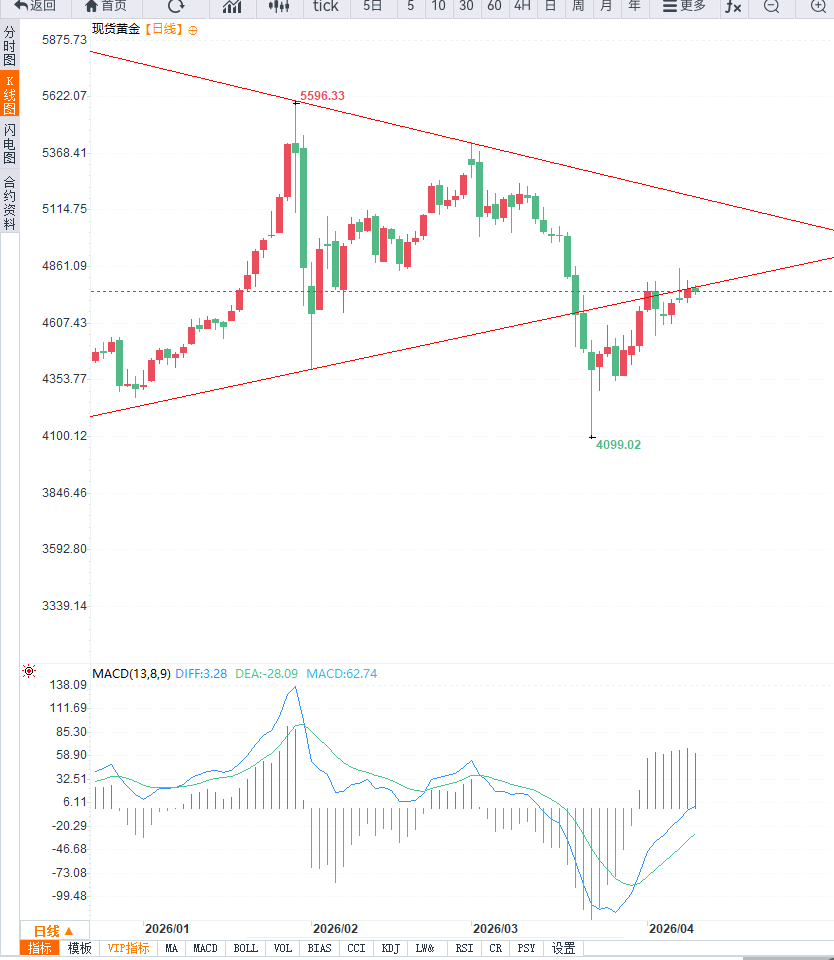
From a technical perspective, the daily chart shows that gold remains in a high-level consolidation range. The price has encountered significant resistance around $4800, with multiple failed attempts to break through indicating strong selling pressure. Currently, the price is still above major moving averages, and the overall trend has not completely weakened. The $4750 level forms a key support area; a break below this level could lead to a further pullback to around $4600. Momentum indicators show that the RSI has fallen from a high level to the neutral zone, and the MACD momentum is weakening, indicating that upward momentum is slowing, but no trend reversal signal has yet appeared.
On the 4-hour chart, gold is exhibiting a weak, oscillating pattern. Prices continue to be capped by key moving averages, with the $4880-$4900 area forming a technical resistance zone. The RSI remains around 50, indicating a relatively balanced power between buyers and sellers, while the MACD has fallen below the zero line, suggesting weak short-term momentum. In the short term, if prices fail to break through the upper resistance, they may continue to oscillate within the range or even experience a pullback; a break below $4750 could open up further downside potential.
Editor's Summary : The current gold market is in a complex environment of mixed bullish and bearish sentiment. On the one hand, geopolitical risks and energy supply uncertainties provide support for gold prices; on the other hand, rising inflation and expectations of persistently high interest rates put downward pressure on gold. In the short term, the market will be driven primarily by US CPI data, which will determine the direction of gold prices. In the medium term, before a significant shift in the high-interest-rate environment, the upside potential for gold may be limited, but given the continued existence of geopolitical risks, the downside potential is also limited, and the overall market may maintain a high-level consolidation pattern.
From a fundamental perspective, the situation in the Middle East remains a crucial variable influencing the market. While the regional conflict has not escalated fully, the implementation of the ceasefire agreement remains highly uncertain, and restrictions on shipping through the Strait of Hormuz are raising concerns about global energy supply. Market estimates suggest that the Strait of Hormuz handles approximately 20% of global seaborne crude oil transport , and disruptions to this transport significantly support oil prices. As a result, international oil prices have remained high, further pushing up global inflation expectations.
Rising inflation expectations are a significant factor currently suppressing gold prices. The market widely expects the US March CPI year-on-year growth rate to rise to approximately 3.3%, significantly higher than the previous level. Rising energy prices are considered one of the key factors driving the inflation rebound. Against this backdrop, expectations that the Federal Reserve will maintain high interest rates have further strengthened. Previously released meeting minutes showed that policymakers remain vigilant about the upside risks to inflation and are not in a hurry to initiate a rate-cutting cycle.
Meanwhile, the US dollar remained strong, supported by safe-haven demand and interest rate expectations, which directly suppressed gold prices denominated in US dollars. Although gold possesses safe-haven attributes in the context of geopolitical risks, its characteristic of not generating interest income reduces its attractiveness in a high-interest-rate environment.
However, geopolitical tensions continue to provide some support for gold prices. News of potential negotiations between Israel and Lebanon has offered some reassurance to the market, but overall uncertainty remains high. Furthermore, ongoing negotiations between the US and Iran, with differing opinions on the final outcome, limit the downside potential for gold prices.
From a technical perspective, the daily chart shows that gold remains in a high-level consolidation range. The price has encountered significant resistance around $4800, with multiple failed attempts to break through indicating strong selling pressure. Currently, the price is still above major moving averages, and the overall trend has not completely weakened. The $4750 level forms a key support area; a break below this level could lead to a further pullback to around $4600. Momentum indicators show that the RSI has fallen from a high level to the neutral zone, and the MACD momentum is weakening, indicating that upward momentum is slowing, but no trend reversal signal has yet appeared.
On the 4-hour chart, gold is exhibiting a weak, oscillating pattern. Prices continue to be capped by key moving averages, with the $4880-$4900 area forming a technical resistance zone. The RSI remains around 50, indicating a relatively balanced power between buyers and sellers, while the MACD has fallen below the zero line, suggesting weak short-term momentum. In the short term, if prices fail to break through the upper resistance, they may continue to oscillate within the range or even experience a pullback; a break below $4750 could open up further downside potential.
Editor's Summary : The current gold market is in a complex environment of mixed bullish and bearish sentiment. On the one hand, geopolitical risks and energy supply uncertainties provide support for gold prices; on the other hand, rising inflation and expectations of persistently high interest rates put downward pressure on gold. In the short term, the market will be driven primarily by US CPI data, which will determine the direction of gold prices. In the medium term, before a significant shift in the high-interest-rate environment, the upside potential for gold may be limited, but given the continued existence of geopolitical risks, the downside potential is also limited, and the overall market may maintain a high-level consolidation pattern.
- Risk Warning and Disclaimer
- The market involves risk, and trading may not be suitable for all investors. This article is for reference only and does not constitute personal investment advice, nor does it take into account certain users’ specific investment objectives, financial situation, or other needs. Any investment decisions made based on this information are at your own risk.