CPI data is about to ignite the market! With the Strait of Hormuz closed to shipping and the Fed's hawkish stance, can gold prices still rise?
2026-04-10 14:20:30
Amidst continued volatility in global financial markets, spot gold prices have recently faced renewed downward pressure. Although an attempt was made to break through the key psychological level of $4,800 on Thursday (April 9th), it ultimately failed, subsequently attracting a new wave of selling. During Asian trading hours on Friday (April 10th), gold prices briefly fell to around $4,738. Currently, spot gold is trading around $4,755 per ounce, a decline of approximately 0.2%. Despite this slight pullback, precious metals as a whole remain within a familiar trading range, and market participants are closely watching the upcoming release of the latest US Consumer Price Index (CPI) data for clearer trading direction.

After failing to hold the $4,800 mark on Thursday, gold (XAU/USD) saw a significant shift in market sentiment, with new selling pressure quickly emerging and pushing prices down to some extent. This movement reflects a weakening of investors' short-term holding intentions for gold in the current uncertain environment.
However, overall, gold prices have not broken out of their previous trading range, indicating that the market remains in a wait-and-see mode and lacks clear directional drivers. Traders generally believe that only after the release of key macroeconomic data will gold see a clearer breakout signal. Current price levels are relatively balanced, exhibiting neither a sharp collapse nor strong upward momentum, displaying an overall cautious and balanced characteristic.
The upcoming US March Consumer Price Index (CPI) report is highly anticipated. The market widely expects inflation data to rise further this month due to the recent surge in oil prices triggered by the Middle East situation. This potential upward pressure on inflation will directly reduce the likelihood of the Federal Reserve implementing an interest rate cut in the near term.
In fact, the minutes of the March 17-18 Federal Open Market Committee (FOMC) meeting released this Wednesday clearly showed that Federal Reserve officials were cautious in the face of inflation risks from the Middle East energy price shock and did not show any inclination to ease monetary policy. This hawkish signal further strengthened market expectations that the Federal Reserve would maintain a high level of interest rates, thus exerting a certain restraining effect on gold assets that do not generate interest income.
One of the most pressing concerns in global markets right now is the tensions surrounding the Strait of Hormuz. This strategic waterway is a vital route for global oil transportation, and any disruption there can quickly impact energy prices and even overall inflation. Iran has announced a suspension of shipping through the strait following Israel's heavy attacks on Lebanon. Meanwhile, US President Donald Trump has publicly criticized Iran's handling of oil transport through the Strait of Hormuz, stating explicitly that this was not part of a previous agreement. Trump further warned that if the relevant agreements with Iran ultimately collapse, the US will resume military action against them, undoubtedly exacerbating market concerns about an escalation of regional tensions.
The aforementioned geopolitical risks directly provided strong support for crude oil prices, which in turn boosted global inflation expectations and reinforced the Federal Reserve's hawkish stance, ultimately putting downward pressure on gold prices. However, despite the emergence of bearish forces, the lack of sustained follow-up selling has prevented a sharp, one-sided decline in gold prices in the short term, and short-selling traders still need to remain highly cautious.
It is worth noting that the situation in the Middle East is not only tense. Israeli Prime Minister Benjamin Netanyahu has publicly stated that he has ordered the immediate commencement of direct negotiations with Lebanon to resolve key points of contention in the current fragile US-Iran ceasefire agreement.
According to reliable reports, U.S. State Department officials have confirmed that negotiations between Lebanon and Israel will officially begin next week in Washington, D.C. In addition, key negotiations between the U.S. and Iran are also scheduled to proceed in phases from Friday evening to Saturday.
These positive diplomatic signals have kept the market hopeful that the ceasefire agreement with Iran will effectively stabilize the regional situation. This expectation has limited the further appreciation of the US dollar and provided necessary downside support for gold prices, helping them avoid a more significant decline.
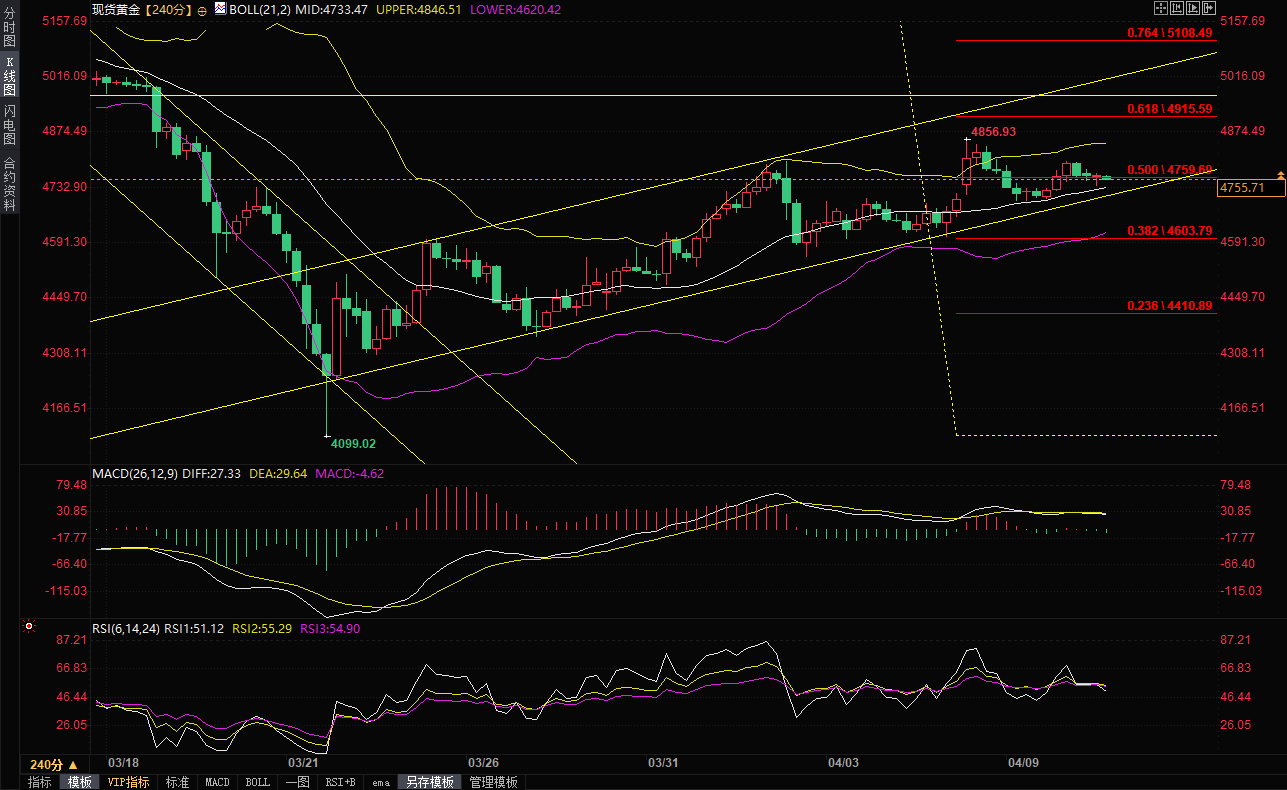
From a technical chart perspective, spot gold presents a neutral-to-bearish overall trend on the 4-hour chart. The price is currently facing significant resistance from the 200-period simple moving average, which coincides with the 61.8% Fibonacci retracement level of the March decline, forming a strong resistance zone roughly between $4890 and $4915. This key resistance level significantly limits the upside potential for gold in the short term.
Meanwhile, the Relative Strength Index (RSI) is currently hovering around 55, indicating a modest recovery in buying demand. However, the Moving Average Convergence Divergence (MACD) indicator has slipped slightly into negative territory, suggesting that upward momentum is gradually weakening. If gold prices can clearly break through the important resistance level of $4,915, the subsequent upside target will first be $5,131.50, and then potentially challenge the high of $5,419. Conversely, on the downside, the initial support level is around $4,750, while the more crucial support lies at $4,732. If this level is breached, gold prices will further test the support areas of $4,595 and $4,401, with deeper structural support near $4,100.
In summary, the current slight decline in gold prices is mainly due to inflation concerns fueled by geopolitical risks in the Strait of Hormuz and the combined pressure from hawkish expectations from the Federal Reserve. The upcoming US CPI data will be a key catalyst in determining short-term price movements. Although bears hold a certain technical advantage, the stability expectations arising from diplomatic negotiations and the lack of sustained selling pressure are jointly limiting the downside potential of gold prices.
Investors need to closely monitor upcoming inflation data and the latest developments in the Middle East to better grasp the next direction of the gold market. Against the backdrop of intertwined global uncertainties, while gold retains its safe-haven asset attributes, it may continue to fluctuate within a range in the short term until clearer macroeconomic or geopolitical signals emerge.
At 14:19 Beijing time, spot gold was trading at $4753.60 per ounce.
Current gold price dynamics: Selling pressure emerges after failed breakout; range-bound trading pattern remains intact.
After failing to hold the $4,800 mark on Thursday, gold (XAU/USD) saw a significant shift in market sentiment, with new selling pressure quickly emerging and pushing prices down to some extent. This movement reflects a weakening of investors' short-term holding intentions for gold in the current uncertain environment.
However, overall, gold prices have not broken out of their previous trading range, indicating that the market remains in a wait-and-see mode and lacks clear directional drivers. Traders generally believe that only after the release of key macroeconomic data will gold see a clearer breakout signal. Current price levels are relatively balanced, exhibiting neither a sharp collapse nor strong upward momentum, displaying an overall cautious and balanced characteristic.
Inflation concerns resurface: US CPI data becomes market focus, Fed rate cut expectations face test.
The upcoming US March Consumer Price Index (CPI) report is highly anticipated. The market widely expects inflation data to rise further this month due to the recent surge in oil prices triggered by the Middle East situation. This potential upward pressure on inflation will directly reduce the likelihood of the Federal Reserve implementing an interest rate cut in the near term.
In fact, the minutes of the March 17-18 Federal Open Market Committee (FOMC) meeting released this Wednesday clearly showed that Federal Reserve officials were cautious in the face of inflation risks from the Middle East energy price shock and did not show any inclination to ease monetary policy. This hawkish signal further strengthened market expectations that the Federal Reserve would maintain a high level of interest rates, thus exerting a certain restraining effect on gold assets that do not generate interest income.
Escalating geopolitical risks in the Middle East: Tensions in the Strait of Hormuz support the US dollar while putting significant pressure on gold prices.
One of the most pressing concerns in global markets right now is the tensions surrounding the Strait of Hormuz. This strategic waterway is a vital route for global oil transportation, and any disruption there can quickly impact energy prices and even overall inflation. Iran has announced a suspension of shipping through the strait following Israel's heavy attacks on Lebanon. Meanwhile, US President Donald Trump has publicly criticized Iran's handling of oil transport through the Strait of Hormuz, stating explicitly that this was not part of a previous agreement. Trump further warned that if the relevant agreements with Iran ultimately collapse, the US will resume military action against them, undoubtedly exacerbating market concerns about an escalation of regional tensions.
The aforementioned geopolitical risks directly provided strong support for crude oil prices, which in turn boosted global inflation expectations and reinforced the Federal Reserve's hawkish stance, ultimately putting downward pressure on gold prices. However, despite the emergence of bearish forces, the lack of sustained follow-up selling has prevented a sharp, one-sided decline in gold prices in the short term, and short-selling traders still need to remain highly cautious.
Diplomatic efforts provide a buffer: Israel-Lebanon negotiations begin; US-Iran dialogue may stabilize the situation, limiting downside potential for gold prices.
It is worth noting that the situation in the Middle East is not only tense. Israeli Prime Minister Benjamin Netanyahu has publicly stated that he has ordered the immediate commencement of direct negotiations with Lebanon to resolve key points of contention in the current fragile US-Iran ceasefire agreement.
According to reliable reports, U.S. State Department officials have confirmed that negotiations between Lebanon and Israel will officially begin next week in Washington, D.C. In addition, key negotiations between the U.S. and Iran are also scheduled to proceed in phases from Friday evening to Saturday.
These positive diplomatic signals have kept the market hopeful that the ceasefire agreement with Iran will effectively stabilize the regional situation. This expectation has limited the further appreciation of the US dollar and provided necessary downside support for gold prices, helping them avoid a more significant decline.
Technical Analysis: Gold bears are currently in control, with key resistance and support levels clearly visible.
From a technical chart perspective, spot gold presents a neutral-to-bearish overall trend on the 4-hour chart. The price is currently facing significant resistance from the 200-period simple moving average, which coincides with the 61.8% Fibonacci retracement level of the March decline, forming a strong resistance zone roughly between $4890 and $4915. This key resistance level significantly limits the upside potential for gold in the short term.
Meanwhile, the Relative Strength Index (RSI) is currently hovering around 55, indicating a modest recovery in buying demand. However, the Moving Average Convergence Divergence (MACD) indicator has slipped slightly into negative territory, suggesting that upward momentum is gradually weakening. If gold prices can clearly break through the important resistance level of $4,915, the subsequent upside target will first be $5,131.50, and then potentially challenge the high of $5,419. Conversely, on the downside, the initial support level is around $4,750, while the more crucial support lies at $4,732. If this level is breached, gold prices will further test the support areas of $4,595 and $4,401, with deeper structural support near $4,100.
Overall Outlook: With geopolitical risks and macroeconomic data intertwined, gold prices are expected to remain cautiously volatile in the short term, requiring a clear catalyst for a breakout.
In summary, the current slight decline in gold prices is mainly due to inflation concerns fueled by geopolitical risks in the Strait of Hormuz and the combined pressure from hawkish expectations from the Federal Reserve. The upcoming US CPI data will be a key catalyst in determining short-term price movements. Although bears hold a certain technical advantage, the stability expectations arising from diplomatic negotiations and the lack of sustained selling pressure are jointly limiting the downside potential of gold prices.
Investors need to closely monitor upcoming inflation data and the latest developments in the Middle East to better grasp the next direction of the gold market. Against the backdrop of intertwined global uncertainties, while gold retains its safe-haven asset attributes, it may continue to fluctuate within a range in the short term until clearer macroeconomic or geopolitical signals emerge.
At 14:19 Beijing time, spot gold was trading at $4753.60 per ounce.
- Risk Warning and Disclaimer
- The market involves risk, and trading may not be suitable for all investors. This article is for reference only and does not constitute personal investment advice, nor does it take into account certain users’ specific investment objectives, financial situation, or other needs. Any investment decisions made based on this information are at your own risk.