The Iran war has triggered a surge in oil prices! US March CPI inflation may hit a near two-year high, and the window for a Fed rate cut is expected to close completely.
2026-04-10 13:57:48
Following the joint US-Israel military action against Iran, tensions in the Middle East escalated dramatically, igniting the global energy market. International crude oil prices, already fluctuating at high levels, surged dramatically within a month, pushing domestic inflationary pressures in the US to new highs. The US March Consumer Price Index (CPI) data, to be released on Friday (April 10), is expected to show a rare jump in inflation, not only exceeding market expectations for the Federal Reserve's monetary policy but also plunging the global foreign exchange market into a state of high uncertainty.

According to widespread market expectations, the upcoming March CPI report from the U.S. Bureau of Labor Statistics will show a month-over-month increase of 0.9%, a significant acceleration from 0.3% in February. This jump is mainly attributed to the sharp fluctuations in energy prices. Meanwhile, the annualized inflation rate is projected to leap from 2.4% in February to 3.3%, reaching its highest level since May 2024 and just shy of a two-year high.
It's worth noting that core CPI, excluding the two major volatile factors of food and energy, is projected to rise by only 0.3% month-on-month, while remaining within a relatively moderate range of 2.7% year-on-year. This indicates that although overall inflation has been significantly pushed up by energy costs, underlying price pressures have not yet spiraled out of control. However, even with relatively stable core data, the impact of energy prices is enough to give the entire CPI a strong "headline inflation" characteristic, triggering deep concerns among investors about the subsequent price transmission path.
The turning point can be traced back to the sudden escalation of the Middle East conflict on February 28. Since then, West Texas Intermediate (WTI) crude oil prices surged nearly 50% in March, climbing rapidly from around $67 per barrel to near $100 by the end of the month. Although the US and Iran announced a two-week ceasefire earlier this week, causing a brief but significant pullback in oil prices, WTI crude is still up about 40% from pre-conflict levels.
The Strait of Hormuz, a crucial chokepoint for global oil transportation, is vital to the stability of the global energy supply chain. Iran's insistence on retaining control of the strait in the peace agreement casts uncertainty on the sustainability of the ceasefire. This escalating geopolitical risk makes it difficult for the market to believe that oil prices will quickly return to pre-war lows. This chain reaction directly translates rising energy costs into the daily expenses of American consumers, driving a significant increase in the Consumer Price Index (CPI).
Several Wall Street institutions reached a consensus before the data release. TD Securities analysts explicitly pointed out that the recent sharp rise in oil prices would be the core driver of the 0.9% month-on-month increase in the March CPI, while the year-on-year inflation rate would jump nearly one percentage point to 3.3%, directly hitting a two-year high. They also emphasized that core inflation is currently able to effectively resist the impact of oil prices, and is expected to rise by only 0.27% month-on-month, while hypercore inflation is likely to remain stable at 0.3%. The tariff transmission effect continues to push up commodity prices, becoming another important supporting force besides energy.
BBH analysts further believe that as long as underlying inflation excluding energy remains within a controllable range, the Federal Reserve still has room to "ignore" the oil price shock and avoid hastily raising interest rates in the current complex labor market environment. However, they also cautioned that if oil prices are transmitted to overall prices through broader channels, the subsequent risks should not be underestimated.
The minutes of the Federal Reserve's March meeting clearly signaled that several policymakers began to postpone potential rate cuts, reflecting their continued concerns about the persistence of inflation. Most officials noted that if rising oil prices spread further, price pressures could remain high for an extended period. This contrasts sharply with current market pricing—according to the CME FedWatch tool, investors now believe there is a 75% probability that the Fed will maintain interest rates at 3.5%-3.75% by the end of the year, a significant increase from 17% on March 9th.
Against this backdrop, even if the March CPI data exceeds expectations, the market may not immediately and significantly adjust its expectations for the Federal Reserve's interest rate path. However, if the conflict in the Middle East escalates again and shipping in the Strait of Hormuz is disrupted for an extended period, investors are likely to reassess the possibility of the Federal Reserve being forced to raise interest rates, thereby increasing the attractiveness of dollar assets.
In the current environment, the impact of the US CPI report on the euro will depend more on the subsequent trend of oil prices than on the data itself. If oil prices continue to decline steadily, regardless of the CPI data, the dollar may continue to be under pressure, allowing the euro to continue its rebound; conversely, if the conflict escalates and oil prices surge again, the dollar is expected to rebound strongly, forcing the euro to turn downwards.
FXStreet's Chief Analyst for the European session, Eren Sengezer, offers a technical perspective: the EUR/USD pair is showing a clear bullish bias in the short term. On the daily chart, the Relative Strength Index (RSI) has climbed above 50 for the first time since the start of the US-Iran conflict, and the pair has successfully broken through a two-month downtrend line. The next key resistance level is at the 50% Fibonacci retracement of the February-April decline at 1.1746, with further upside targets at 1.1825 (61.8% retracement) and 1.1923 (78.6% retracement). On the downside, key support lies at 1.1667 (38.2% retracement); a break below this level could open up downside potential to 1.1569 and even the psychological level of 1.1500.
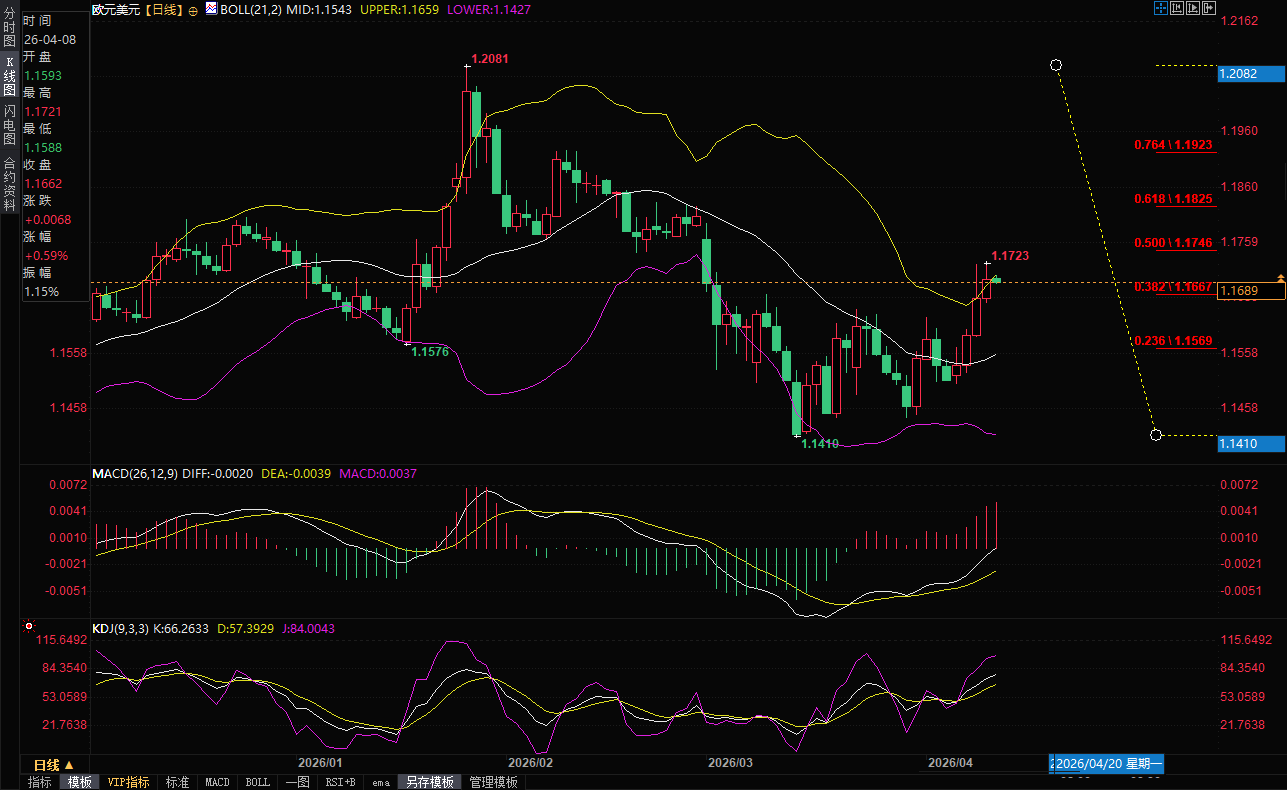
(Euro/USD daily chart, source: FX678)
Although the March CPI data is about to be released, showing the highest inflation rate in nearly two years, the real driving force behind market sentiment will still be the US-Iran crisis and its profound impact on the global energy market. As long as the situation in the Middle East remains unresolved, oil price volatility will continue to dominate inflation expectations, and the Federal Reserve's policy path will fluctuate accordingly. For global investors, this energy crisis triggered by war has far exceeded a simple inflation data release; its subsequent evolution will profoundly shape the direction of global financial markets in 2026.
At 13:56 Beijing time, the euro was trading at 1.1690/91 against the US dollar.
Inflation Data Outlook: Both Month-on-Month and Year-on-Year Inflation Expected to Rise Significantly
According to widespread market expectations, the upcoming March CPI report from the U.S. Bureau of Labor Statistics will show a month-over-month increase of 0.9%, a significant acceleration from 0.3% in February. This jump is mainly attributed to the sharp fluctuations in energy prices. Meanwhile, the annualized inflation rate is projected to leap from 2.4% in February to 3.3%, reaching its highest level since May 2024 and just shy of a two-year high.
It's worth noting that core CPI, excluding the two major volatile factors of food and energy, is projected to rise by only 0.3% month-on-month, while remaining within a relatively moderate range of 2.7% year-on-year. This indicates that although overall inflation has been significantly pushed up by energy costs, underlying price pressures have not yet spiraled out of control. However, even with relatively stable core data, the impact of energy prices is enough to give the entire CPI a strong "headline inflation" characteristic, triggering deep concerns among investors about the subsequent price transmission path.
The root cause of the 50% surge in oil prices: the ongoing escalation of the Middle East conflict.
The turning point can be traced back to the sudden escalation of the Middle East conflict on February 28. Since then, West Texas Intermediate (WTI) crude oil prices surged nearly 50% in March, climbing rapidly from around $67 per barrel to near $100 by the end of the month. Although the US and Iran announced a two-week ceasefire earlier this week, causing a brief but significant pullback in oil prices, WTI crude is still up about 40% from pre-conflict levels.
The Strait of Hormuz, a crucial chokepoint for global oil transportation, is vital to the stability of the global energy supply chain. Iran's insistence on retaining control of the strait in the peace agreement casts uncertainty on the sustainability of the ceasefire. This escalating geopolitical risk makes it difficult for the market to believe that oil prices will quickly return to pre-war lows. This chain reaction directly translates rising energy costs into the daily expenses of American consumers, driving a significant increase in the Consumer Price Index (CPI).
In-depth analysis by analysts: Crude oil shock drives CPI jump
Several Wall Street institutions reached a consensus before the data release. TD Securities analysts explicitly pointed out that the recent sharp rise in oil prices would be the core driver of the 0.9% month-on-month increase in the March CPI, while the year-on-year inflation rate would jump nearly one percentage point to 3.3%, directly hitting a two-year high. They also emphasized that core inflation is currently able to effectively resist the impact of oil prices, and is expected to rise by only 0.27% month-on-month, while hypercore inflation is likely to remain stable at 0.3%. The tariff transmission effect continues to push up commodity prices, becoming another important supporting force besides energy.
BBH analysts further believe that as long as underlying inflation excluding energy remains within a controllable range, the Federal Reserve still has room to "ignore" the oil price shock and avoid hastily raising interest rates in the current complex labor market environment. However, they also cautioned that if oil prices are transmitted to overall prices through broader channels, the subsequent risks should not be underestimated.
Federal Reserve policy shift: Expectations for rate cuts cool significantly.
The minutes of the Federal Reserve's March meeting clearly signaled that several policymakers began to postpone potential rate cuts, reflecting their continued concerns about the persistence of inflation. Most officials noted that if rising oil prices spread further, price pressures could remain high for an extended period. This contrasts sharply with current market pricing—according to the CME FedWatch tool, investors now believe there is a 75% probability that the Fed will maintain interest rates at 3.5%-3.75% by the end of the year, a significant increase from 17% on March 9th.
Against this backdrop, even if the March CPI data exceeds expectations, the market may not immediately and significantly adjust its expectations for the Federal Reserve's interest rate path. However, if the conflict in the Middle East escalates again and shipping in the Strait of Hormuz is disrupted for an extended period, investors are likely to reassess the possibility of the Federal Reserve being forced to raise interest rates, thereby increasing the attractiveness of dollar assets.
UR/USD Exchange Rate Outlook: Technical indicators show bullish signals, but geopolitical risks dominate.
In the current environment, the impact of the US CPI report on the euro will depend more on the subsequent trend of oil prices than on the data itself. If oil prices continue to decline steadily, regardless of the CPI data, the dollar may continue to be under pressure, allowing the euro to continue its rebound; conversely, if the conflict escalates and oil prices surge again, the dollar is expected to rebound strongly, forcing the euro to turn downwards.
FXStreet's Chief Analyst for the European session, Eren Sengezer, offers a technical perspective: the EUR/USD pair is showing a clear bullish bias in the short term. On the daily chart, the Relative Strength Index (RSI) has climbed above 50 for the first time since the start of the US-Iran conflict, and the pair has successfully broken through a two-month downtrend line. The next key resistance level is at the 50% Fibonacci retracement of the February-April decline at 1.1746, with further upside targets at 1.1825 (61.8% retracement) and 1.1923 (78.6% retracement). On the downside, key support lies at 1.1667 (38.2% retracement); a break below this level could open up downside potential to 1.1569 and even the psychological level of 1.1500.
(Euro/USD daily chart, source: FX678)
Conclusion: Geopolitical conflicts are the real protagonists; the March CPI is merely the prelude.
Although the March CPI data is about to be released, showing the highest inflation rate in nearly two years, the real driving force behind market sentiment will still be the US-Iran crisis and its profound impact on the global energy market. As long as the situation in the Middle East remains unresolved, oil price volatility will continue to dominate inflation expectations, and the Federal Reserve's policy path will fluctuate accordingly. For global investors, this energy crisis triggered by war has far exceeded a simple inflation data release; its subsequent evolution will profoundly shape the direction of global financial markets in 2026.
At 13:56 Beijing time, the euro was trading at 1.1690/91 against the US dollar.
- Risk Warning and Disclaimer
- The market involves risk, and trading may not be suitable for all investors. This article is for reference only and does not constitute personal investment advice, nor does it take into account certain users’ specific investment objectives, financial situation, or other needs. Any investment decisions made based on this information are at your own risk.