World Gold Council: Gold bar and coin investments lead the market, with global gold demand growing by 2% in the first quarter; central bank gold purchases remain stable.
2026-04-29 15:05:43
A new report released by the World Gold Council on Wednesday (April 29) shows that the global gold market will maintain a high-level fluctuation pattern in the first quarter of 2026. Driven by the strong rise in gold prices, global gold demand (including over-the-counter transactions) increased by 2% year-on-year to 1,231 tons, while the total demand value jumped by 74% to a record $193 billion. Currently, gold investment demand has significantly exceeded traditional consumer demand.
According to a World Gold Council report, demand for gold bars and coins reached 474 tons in the first quarter, a 42% year-on-year increase, marking the second-highest level on record. The Asian market performed exceptionally well, with demand in major Asian countries surging 67% to 207 tons, a new quarterly record; India saw a 34% increase to 62 tons, with investment demand approaching the scale of jewelry consumption. In a high gold price environment, some jewelry demand shifted to gold bars and coins with lower premiums, driving rapid expansion in the investment sector.
A World Gold Council report shows that global gold ETFs continued net inflows for the seventh consecutive quarter, adding a total of 62 tons, but the increase was significantly lower than the same period in 2025. Large outflows from US funds in March offset some of the previous inflows. Asia became the main supporting force, with the Chinese market seeing significant increases driven by safe-haven demand, stock market volatility, and a weakening currency. Global gold ETF assets under management rose to approximately $607 billion.
A World Gold Council report indicates that gold jewelry production fell 23% year-on-year to approximately 300 tons, a recent low. However, driven by rising gold prices, jewelry consumption increased by 31% year-on-year, reaching $47 billion, a new record high for the first quarter. Demand for gold jewelry in major Asian countries declined by 32%, while the Indian market, despite a decrease in tonnage, still saw record-high consumption. Consumers are shifting towards lighter, lower-purity products, with some demand turning to gold bars and coins.
The World Gold Council report also noted that despite increased gold sales in some countries, global central banks' net gold purchases reached 244 tons in the first quarter, a 3% year-on-year increase. Poland (31 tons) and Uzbekistan (25 tons) were the main buyers, while central banks of major Asian countries increased their holdings by 7 tons. Geopolitical risks and the need for reserve diversification continue to support central bank gold purchases.
The World Gold Council report also showed that gold demand for technology increased by 1% year-on-year to 82 tonnes. Electronics gold demand grew by 3% to 69 tonnes, mainly benefiting from the demand for high-performance chips driven by the expansion of artificial intelligence infrastructure. Other industrial and dental gold demand saw slight declines due to high gold prices.
Global gold supply rose 2% year-on-year to 1,231 tons. Gold mine production increased by 2% to 885 tons, a record high for the first quarter; recycled gold supply increased by 5% to 366 tons, with high gold prices stimulating increased sales of old gold jewelry. Net hedging by producers continued to decline.
A World Gold Council report indicates that Asia remains the core engine of global gold investment.
Demand for gold bars, coins, and ETFs has surged in major Asian countries, with VAT policy adjustments further driving demand from jewelry to investment products. The investment and consumption patterns in the Indian market have undergone a significant shift. While geopolitical factors have impacted some markets in the Middle East, Turkey, and ASEAN, investment demand has remained resilient. Jewelry demand in Europe and the US is under pressure, while investment demand is showing a two-way active trend.
The World Gold Council report suggests that geopolitical risks will remain a key driver of gold demand in 2026. Continued geopolitical tensions, inflation concerns, and strong gold price expectations will continue to boost investment demand and central bank gold purchases. Jewelry demand is expected to be under pressure in terms of tonnage, but spending is expected to remain resilient. Central bank gold purchases are projected to be close to 2025 levels, gold mine production will see moderate growth, and the supply of recycled gold will experience limited growth.
Overall , the global gold market in 2026 will be driven by strong investment demand (especially for gold bars and coins) and robust central bank gold purchases, with the Asian market continuing to play a key role. In a high gold price environment, gold's appeal as a safe-haven and store-of-value asset remains prominent.
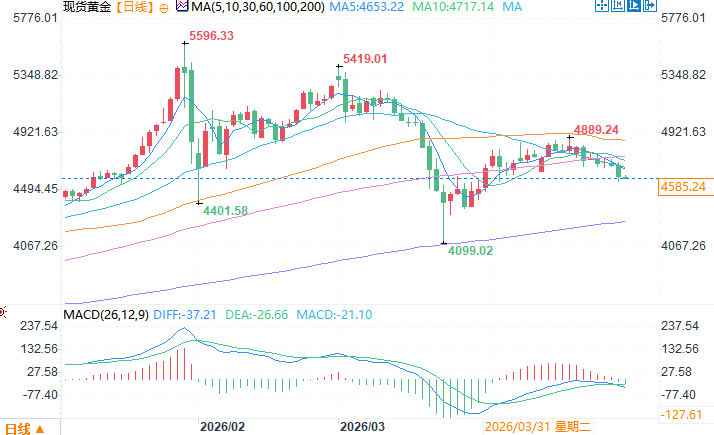
Spot gold daily chart source: EasyForex
At 15:05 Beijing time on April 29, spot gold was trading at $4587.24 per ounce.
Gold bar and gold coin investments are leading the market.
According to a World Gold Council report, demand for gold bars and coins reached 474 tons in the first quarter, a 42% year-on-year increase, marking the second-highest level on record. The Asian market performed exceptionally well, with demand in major Asian countries surging 67% to 207 tons, a new quarterly record; India saw a 34% increase to 62 tons, with investment demand approaching the scale of jewelry consumption. In a high gold price environment, some jewelry demand shifted to gold bars and coins with lower premiums, driving rapid expansion in the investment sector.
Gold ETF inflows slow
A World Gold Council report shows that global gold ETFs continued net inflows for the seventh consecutive quarter, adding a total of 62 tons, but the increase was significantly lower than the same period in 2025. Large outflows from US funds in March offset some of the previous inflows. Asia became the main supporting force, with the Chinese market seeing significant increases driven by safe-haven demand, stock market volatility, and a weakening currency. Global gold ETF assets under management rose to approximately $607 billion.
Demand for gold jewelry decreases while prices rise
A World Gold Council report indicates that gold jewelry production fell 23% year-on-year to approximately 300 tons, a recent low. However, driven by rising gold prices, jewelry consumption increased by 31% year-on-year, reaching $47 billion, a new record high for the first quarter. Demand for gold jewelry in major Asian countries declined by 32%, while the Indian market, despite a decrease in tonnage, still saw record-high consumption. Consumers are shifting towards lighter, lower-purity products, with some demand turning to gold bars and coins.
Central bank gold purchases remain prudent.
The World Gold Council report also noted that despite increased gold sales in some countries, global central banks' net gold purchases reached 244 tons in the first quarter, a 3% year-on-year increase. Poland (31 tons) and Uzbekistan (25 tons) were the main buyers, while central banks of major Asian countries increased their holdings by 7 tons. Geopolitical risks and the need for reserve diversification continue to support central bank gold purchases.
Gold consumption in technology saw a slight increase.
The World Gold Council report also showed that gold demand for technology increased by 1% year-on-year to 82 tonnes. Electronics gold demand grew by 3% to 69 tonnes, mainly benefiting from the demand for high-performance chips driven by the expansion of artificial intelligence infrastructure. Other industrial and dental gold demand saw slight declines due to high gold prices.
Moderate expansion on the supply side
Global gold supply rose 2% year-on-year to 1,231 tons. Gold mine production increased by 2% to 885 tons, a record high for the first quarter; recycled gold supply increased by 5% to 366 tons, with high gold prices stimulating increased sales of old gold jewelry. Net hedging by producers continued to decline.
Regional Performance and Highlights of Major Asian Powers
A World Gold Council report indicates that Asia remains the core engine of global gold investment.
Demand for gold bars, coins, and ETFs has surged in major Asian countries, with VAT policy adjustments further driving demand from jewelry to investment products. The investment and consumption patterns in the Indian market have undergone a significant shift. While geopolitical factors have impacted some markets in the Middle East, Turkey, and ASEAN, investment demand has remained resilient. Jewelry demand in Europe and the US is under pressure, while investment demand is showing a two-way active trend.
Future Outlook
The World Gold Council report suggests that geopolitical risks will remain a key driver of gold demand in 2026. Continued geopolitical tensions, inflation concerns, and strong gold price expectations will continue to boost investment demand and central bank gold purchases. Jewelry demand is expected to be under pressure in terms of tonnage, but spending is expected to remain resilient. Central bank gold purchases are projected to be close to 2025 levels, gold mine production will see moderate growth, and the supply of recycled gold will experience limited growth.
Overall , the global gold market in 2026 will be driven by strong investment demand (especially for gold bars and coins) and robust central bank gold purchases, with the Asian market continuing to play a key role. In a high gold price environment, gold's appeal as a safe-haven and store-of-value asset remains prominent.
Spot gold daily chart source: EasyForex
At 15:05 Beijing time on April 29, spot gold was trading at $4587.24 per ounce.
- Risk Warning and Disclaimer
- The market involves risk, and trading may not be suitable for all investors. This article is for reference only and does not constitute personal investment advice, nor does it take into account certain users’ specific investment objectives, financial situation, or other needs. Any investment decisions made based on this information are at your own risk.